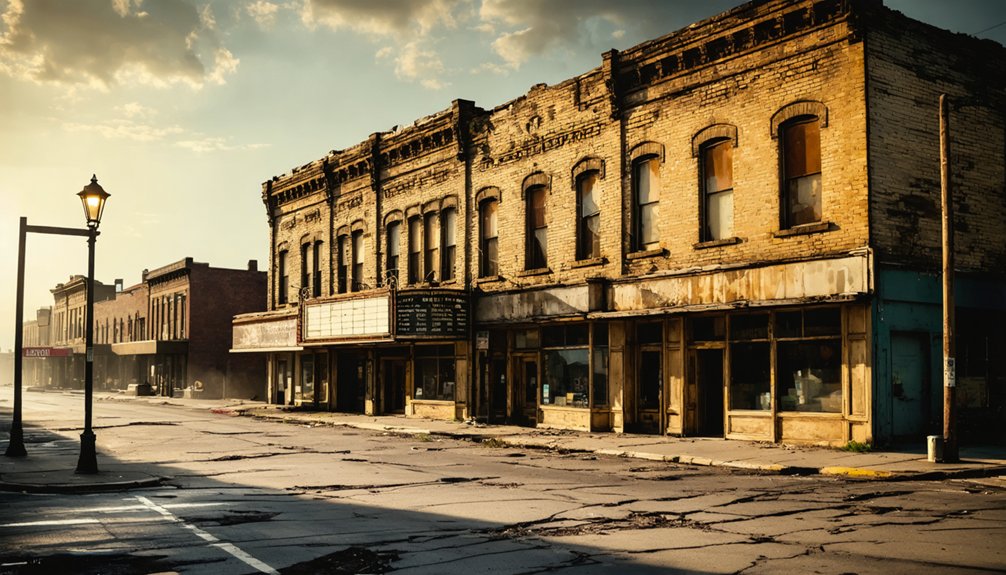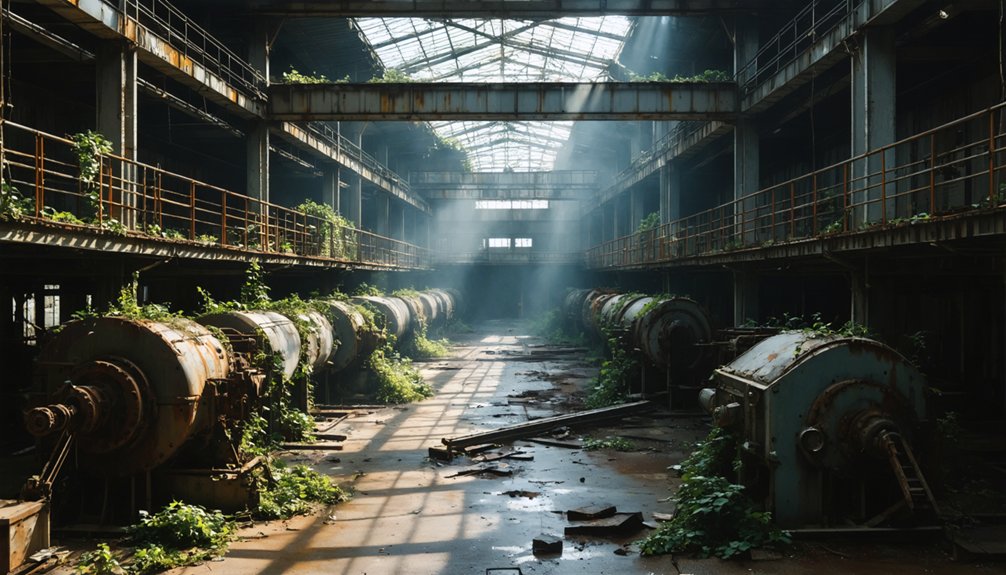
Your once-thriving Rust Belt cities lost up to 46% of their populations between 1970-2006 due to massive manufacturing job losses. The region shed 1.6 million manufacturing positions from 1979-2010, triggering a devastating chain reaction: falling tax revenues, abandoned properties, and declining local businesses. Global competition, especially from China, eliminated 2.4 million more jobs from 1999-2011. Yet some cities, like Pittsburgh, have found innovative paths to revival through strategic reinvention.
Key Takeaways
- Global manufacturing competition and China’s surge caused 2.4 million job losses in the Rust Belt between 1999-2011.
- Major manufacturing cities lost up to 46% of their population between 1970-2006, severely eroding municipal tax bases.
- Manufacturing employment declined 35% from 1979-2010, triggering widespread unemployment and reduced local spending.
- High union costs and lack of innovation made Rust Belt factories less competitive, forcing relocations to lower-wage regions.
- Abandoned properties and vacant lots created cycles of blight, deterring new investment and driving further population exodus.
The Rise and Fall of Industrial Giants
When the Erie Canal opened in 1825, it catalyzed a manufacturing revolution across America’s Rust Belt that would dominate global industry for over a century.
You’d find pioneering titans like Carnegie and Ford building empires through steel and automobiles, while extensive rail networks connected raw materials to factories and markets with unprecedented efficiency.
The region’s natural abundance of iron ore and coal fueled the explosive growth of steel manufacturing and related industries.
The region’s prosperity attracted waves of workers from Eastern European nations seeking jobs in the booming factories and mills.
Economic Ripple Effects of Manufacturing Decline
When manufacturing giants shut down in Rust Belt cities, you’ll find a devastating chain reaction where local businesses lose their customer base and revenue plummets.
You can trace the cascading effect through municipal tax records, where former manufacturing hubs like Calhoun County, MI have seen their commercial tax revenues shrink by double-digit percentages.
Your local economy’s dependency on manufacturing becomes starkly apparent as shuttered storefronts and reduced public services reflect the 1.7% regional manufacturing job loss since 2019, creating a downward spiral of economic activity.
This decline began much earlier than many realize, with the region experiencing massive job losses starting in the 1950s.
This decline stands in stark contrast to Sun Belt states like Texas and Florida, which have captured two-thirds of jobs in new manufacturing growth.
Local Business Chain Collapse
As manufacturing jobs vanished from Rust Belt cities at an alarming rate of 1.7% since 2019, local business chains experienced a devastating domino effect. The collapse of consumer spending and local entrepreneurship decline created a brutal cycle, where fewer manufacturing workers meant fewer customers for retail and service businesses. Modern web applications using React components have helped some businesses adapt through improved e-commerce solutions.
Here’s how this destructive pattern unfolded:
- Cities with high manufacturing dependence saw up to 2.7% employment decline per decade.
- Population losses reached 46% in major cities like Detroit and Cleveland (1970-2006).
- Unemployment spikes hit 15.5% in states like Michigan, decimating disposable income.
The ripple effects crushed local business chains from multiple angles – fewer industrial clients, reduced middle-class customer base, and diminished economic multipliers from anchor manufacturers.
Without manufacturing’s economic foundation, these local chains couldn’t survive in markets with shrinking populations and limited spending power. In these struggling communities, only 34% of manufacturing hubs managed to maintain or regain their previous employment levels.
Lost Municipal Tax Revenue
The devastating collapse of manufacturing across America’s Rust Belt triggered a catastrophic erosion of municipal tax revenues, with cities losing up to 40% of their population between 1970-2006. This mass exodus devastated local tax bases, creating a downward spiral you can still see today.
You’ll find the tax base erosion particularly severe when you look at the numbers: manufacturing jobs plummeted 35% between 1979-2010, eliminating 1.6 million positions.
Making matters worse, up to 40% of remaining property became tax-exempt as non-profit institutions replaced industrial employers. Cities’ attempts at revenue diversification hit roadblocks as abandoned buildings and vacant lots multiplied. The rise of eds and meds sectors brought some employment but failed to offset lost tax revenue due to their non-profit status.
With shrinking populations driving down property values and sales tax receipts, municipalities faced mounting debt and legacy costs while having fewer taxpayers to support basic services.
Population Exodus: A Tale of Two Demographics
Since the 1970s, Rust Belt cities have experienced a dramatic demographic transformation, marked by a stark 45% population decline through 2006. The exodus reveals a clear pattern of education disparities and migration trends, where college-educated workers have fled while lower-income populations remain concentrated in city cores.
You’ll find these striking demographic shifts reflected in three key patterns:
- For every newcomer to cities like Gary, IN, more than 3 residents move away.
- Gen Z workers are now critical to potential revival, especially in cities with lower median ages like Columbus, OH.
- Areas with high poverty and unemployment, such as Flint, MI, show the most severe population losses.
The result? You’re seeing a demographic polarization that’s fundamentally altered these cities’ social and economic fabric. This population decline is particularly notable as 72 out of 96 cities surveyed have fallen below their historical peak numbers. However, cities like Madison, Wisconsin are bucking this trend with strong GDP growth and impressive workforce participation rates.
Education’s Role in Urban Resilience
While manufacturing decline threatens Rust Belt cities’ economic stability, data shows that regional universities serve as powerful economic anchors, generating resilience through multiple channels.
Regional universities help communities weather economic challenges through public university spending that stimulates local business activity.
You’ll find that cities with higher bachelor’s degree rates demonstrate superior economic recovery metrics and adaptability to market shifts.
Education equity plays an essential role in sustaining urban vitality. When schools provide all-encompassing support services, they buffer socioeconomic shocks for disadvantaged populations.
However, recent climate-related disruptions have affected 242 million students globally, threatening skill development progress. This impact is particularly severe in Rust Belt districts where remote learning has widened achievement gaps.
To combat these challenges, you’ll need to focus on crisis-aware planning and green infrastructure integration.
These strategies can transform vulnerable urban education systems into resilient engines of economic recovery.
The Changing Face of Rust Belt Neighborhoods
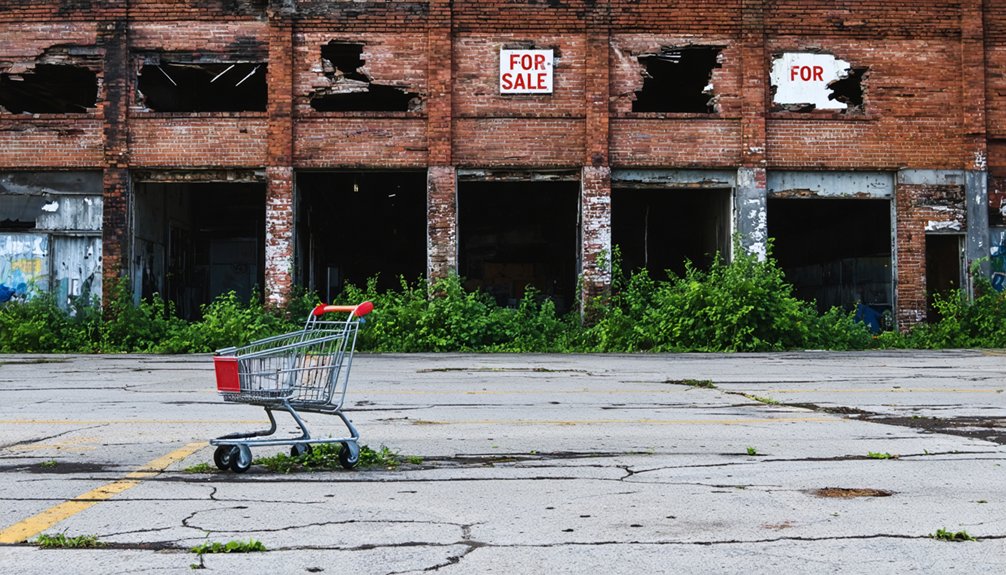
Dramatic population shifts have reshaped Rust Belt neighborhoods since the 1970s, with nearly 50% of urban residents migrating to surrounding suburbs and leaving behind a transformed cityscape.
The haunting beauty of rust belt towns is evident in the crumbling facades and overgrown parks that tell stories of a once-thriving industrial era. Each abandoned factory stands as a silent monument, evoking nostalgia for the past while inspiring artists and dreamers to envision a revitalized future. As communities seek to redefine their identities, they are discovering new ways to celebrate the rich history woven into every street corner.
Detroit’s stark decline from 1.8 million to under 700,000 residents illustrates this exodus, while persistent urban segregation continues to impact development patterns and community revival efforts.
- High-income areas have retreated to suburbs, while neighborhoods with middle-tier housing prices face the steepest income drops.
- Limited neighborhood gentrification appears near downtown Cleveland, but reverse gentrification dominates most urban cores.
- Cities demolishing blighted properties (20,000+ in Detroit since 2014) struggle to attract new construction, despite studies showing potential rental income from coordinated development.
The path forward requires breaking down long-standing barriers of urban segregation while fostering inclusive, sustainable redevelopment strategies.
Global Competition and Local Impact
Economic pressures from global competition devastated the Rust Belt’s manufacturing dominance, as evidenced by its one-third decline in manufacturing employment share between 1969 and 1996.
You’ll find that lack of competitive pressure led to reduced innovation and higher production costs, making the region vulnerable to foreign imports. The impact of global investment shifts became clear when China’s manufacturing surge alone cost the Rust Belt 2.4 million jobs between 1999 and 2011.
Labor shifts hit particularly hard as firms relocated to regions with lower wages, both within the U.S. and overseas. High union costs acted as an “innovation tax,” deterring modernization while automation and just-in-time manufacturing further reduced labor demand.
Your local markets felt the squeeze as manufacturing decline created labor surpluses, driving down wages even in non-manufacturing sectors.
Tales of Recovery: Cities That Bounced Back
Several Rust Belt cities have engineered remarkable recoveries through strategic diversification into service-based economies.
You’ll find compelling recovery stories in places like Pittsburgh, where unemployment dropped 21% and incomes rose 25% between 2008-2018 through expansion into robotics and healthcare.
These urban revival successes stem from data-driven strategies that transformed industrial centers into innovation hubs.
- Cities with higher percentages of college graduates showed 3% more employment growth per decade
- Public-private partnerships funded critical infrastructure and venture capital initiatives
- Integration of cultural heritage with modern development preserved identity while driving economic growth
The transformation you’re witnessing isn’t accidental – it’s the result of deliberate investment in education, technology, and infrastructure, proving that market freedom combined with strategic planning can revitalize formerly struggling communities.
Frequently Asked Questions
How Do Crime Rates Compare Between Declining and Stable Rust Belt Neighborhoods?
You’ll find crime trends considerably higher in declining Rust Belt areas, with violent crime rates up to 47% higher than stable neighborhoods, which maintain better neighborhood safety through community engagement and investment.
What Role Did Racial Segregation Play in Rust Belt Neighborhood Deterioration?
Like dominos falling, racial segregation triggered cascading urban displacement that trapped Black communities in declining areas, while white flight and discriminatory policies accelerated neighborhood deterioration by concentrating poverty and limiting economic opportunities.
How Have Property Taxes Changed as Cities Lost Population?
You’ll find property tax revenues plummeted as cities lost 40% of residents since 1970, with property value declines creating a vicious cycle of tax revenue loss and reduced services, forcing rate hikes.
Which Environmental Problems Persist in Former Industrial Sites Today?
Like toxic ghosts haunting vacant lots, you’ll find widespread soil contamination, heavy metal deposits, and PFAS at 450,000+ brownfield sites, where pollution cleanup costs billions and affects water, air, and health.
What Happened to Small Businesses When Major Manufacturers Left?
You’ll find widespread business closures followed manufacturing exits, as reduced consumer spending and workforce departures created devastating economic impact. Your local shops lost customers, revenue streams, and ultimately their viability.
References
- https://www.clevelandfed.org/publications/economic-commentary/2013/ec-201306-urban-decline-in-rust-belt-cities
- https://repository.upenn.edu/bitstreams/eeb45167-3ee9-401e-a296-a371f4745e03/download
- https://commentaries.cberdata.org/1308/the-birth-and-death-of-rustbelt-cities
- https://www.nber.org/digest/202404/global-evidence-decline-and-recovery-rust-belt-cities
- https://worldpopulationreview.com/us-city-rankings/rust-belt-cities
- https://www.cato.org/blog/economic-mobility-not-manufacturing-decline-real-rust-belt-story
- https://www.loveexploring.com/gallerylist/127789/then-and-now-us-rust-belt-cities-that-bounced-back
- https://en.wikipedia.org/wiki/Rust_Belt
- https://www.britannica.com/place/Rust-Belt
- https://www.youtube.com/watch?v=odMO7mQ7hDw