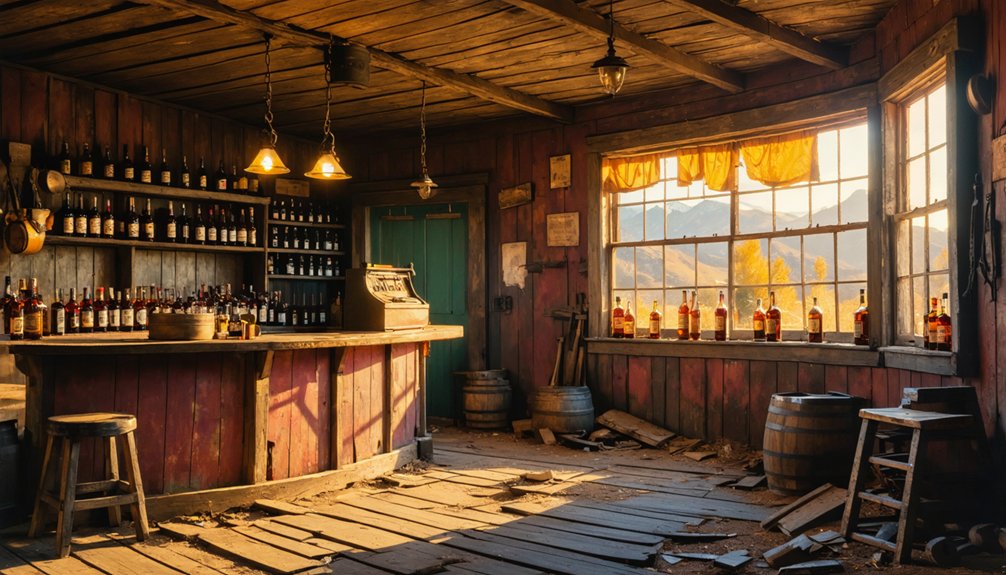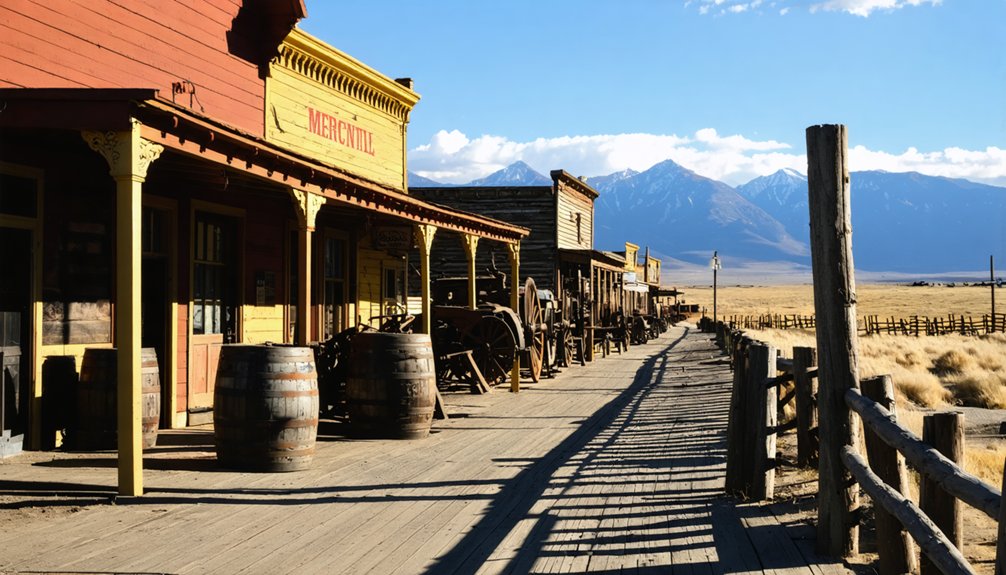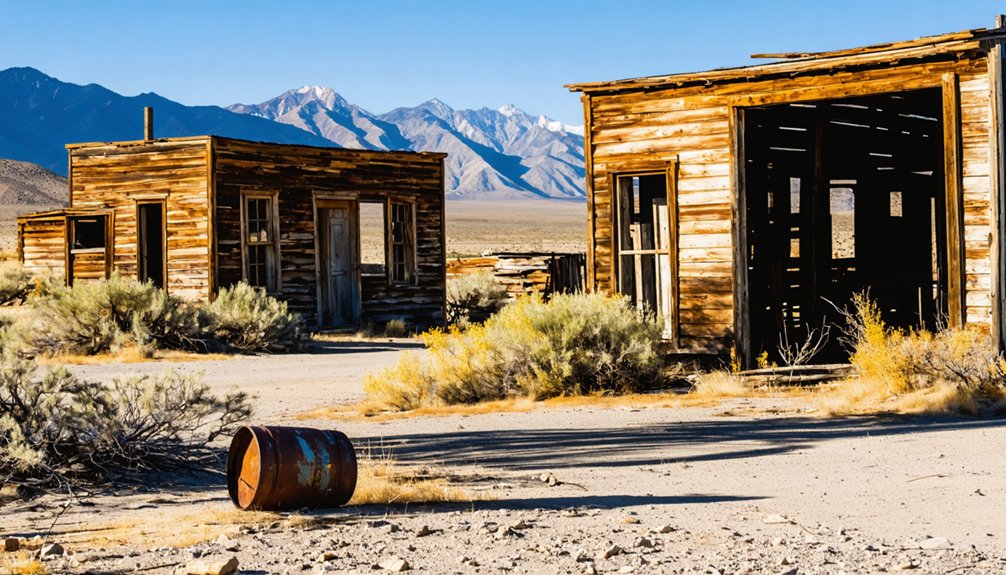
Yaqui Camp, nestled in the Anza-Borrego Desert near Route 78, served as an essential water source for travelers, Kumeyaay natives, and Yaqui refugees before booming during the 1848-1852 Gold Rush. You’ll find this abandoned settlement named after Yaqui people who fled Mexican persecution. The site features mysterious phenomena, including spectral figures and “Fire Balls” appearing on warm summer nights. Ghost Mountain Trail leads you to this historical crossroads where indigenous traditions and frontier ambitions once converged.
Key Takeaways
- Yaqui Camp served as an important Gold Rush settlement during 1848-1852 before declining into a ghost town by 1857.
- Named after Yaqui people who migrated from Sonora, Mexico, the camp was crucial for miners extracting gold from surrounding claims.
- The site included Yaqui Well, a vital water source for travelers, Native Americans, and ranchers in the Anza-Borrego Desert.
- Local legends report ghostly phenomena including spectral figures dancing around Yaqui Well and mysterious “Fire Balls” appearing at night.
- Visitors can access the ghost town area via the Ghost Mountain Trail, which features ruins and interpretive signage about its history.
The Lost Desert Oasis: Yaqui Well’s Historical Significance
Nestled in the arid landscape of the Anza-Borrego Desert near Route 78, Yaqui Well stands as a profound historical landmark that chronicles the often-overlooked Yaqui diaspora in California.
You’ll find this essential water source named after the Yaqui people, whose documented presence in the region dates back to the 1700s.
The well served travelers, Native Americans, and cattle ranchers traversing this unforgiving terrain, but its significance runs deeper. This site represents part of the larger story of Yaqui resilience amid the ethnic cleansing reported in Mexican and American newspapers during the Porfirio Díaz era.
It represents the cultural resilience of Yaqui communities who maintained their traditions despite forced relocations across vast distances—from Mexico to California, Yucatán, and even the Philippines. This resilience was demonstrated in their ability to maintain their spiritual practices, as they had previously converted to Christianity while retaining traditional beliefs during the Jesuit missionary period.
As you approach this desert oasis, you’re encountering more than a water source; you’re witnessing a physical representation of the endurance of a people who refused to vanish from history.
Water and Survival in the Anza-Borrego Desert
In the same harsh desert that sheltered the Yaqui people, water has always determined the boundary between survival and demise. The Borrego Valley faces critical overdraft as extraction outpaces recharge by four times, causing groundwater depletion of 1-2 feet annually.
Ancient mesquite trees with 100-foot roots now wither as water tables recede beyond reach. Desert animals like tortoises and pocket gophers have evolved elaborate burrows that remain cooler and more humid than the harsh surface conditions. The aquifer beneath Borrego Valley once stored thousands of acre-feet of water vital for the region’s sustainability.
You’ll witness the delicate balance of life here through:
- Plants evolving remarkable water conservation strategies like CAM photosynthesis and waxy cuticles
- Communities committed to reducing consumption by 74% by 2040
- Ecosystems adapting to diminishing resources as riparian habitats contract
The story of this desert isn’t just about scarcity—it’s about adaptation. As groundwater continues declining, both human settlements and natural systems must transform to persist in this unforgiving landscape.
Indigenous Heritage and the Kumeyaay Connection
You’ll find evidence of Kumeyaay presence throughout Yaqui Camp, particularly near the area’s natural springs that served as sacred water sources for indigenous peoples for thousands of years.
Archaeological surveys have uncovered numerous pottery fragments, suggesting the site functioned as both a seasonal water stop and a resource-gathering location within traditional Kumeyaay territory.
These discoveries affirm the continuity of indigenous stewardship in this region, where the Kumeyaay maintained extensive clan-based territories (sh’mulq) that included desert landscapes long before European colonization dramatically reduced their ancestral lands. Historical records indicate that by the 1820s, many Kumeyaay were forced into year-round mountain habitation due to restricted access to their traditional coastal winter camps. The Kumeyaay were skilled at total environmental management of their lands, implementing controlled burns and sophisticated water management systems that sustained their communities for over 10,000 years.
Sacred Water Source
While modern visitors to Yaqui Camp might see only dry remnants of a forgotten settlement, the area once thrived as a sacred water source deeply intertwined with Kumeyaay spiritual practices and ecological stewardship.
The Kumeyaay revered these sacred springs, where spiritual leaders called Kuseyaay guided water rituals and conservation efforts to maintain groundwater near valley surfaces. The Kumeyaay people maintained a seasonal migration pattern between coastal areas and mountain regions to maximize their access to diverse food resources throughout the year. The Iipai and Tiipai geographical divisions influenced how different Kumeyaay groups interacted with these sacred water sources.
When you explore this ghost town, remember the profound significance of water in Kumeyaay cosmology:
exploring yosemite mill’s history can provide insights into the transformative role of mining in the local economy and its impact on the environment. As you wander through the remnants of the past, consider how these structures tell stories of resilience and innovation amidst the natural beauty of the region. Each artifact unearthed serves as a testament to the lives once lived in harmony with the land.
- Water connects directly to the Creator (*Maay Xa* – “water above”), forming the foundation of their spiritual identity.
- Traditional rock placements across channels slowed water flow, creating life-sustaining marshes and ponds.
- These water management practices supported diverse ecosystems essential for both sustenance and ceremonial needs.
Ancestral Pottery Remains
Scattered throughout Yaqui Camp’s arid landscape, fragments of ancestral pottery tell a profound story that extends beyond the sacred water sources.
You’ll discover remnants of rounded-bottom vessels and ollas that exemplify traditional paddle-and-anvil pottery techniques once practiced by indigenous artisans.
These ceramic fragments reveal connections between Yaqui and Kumeyaay cultural traditions, with chemical analyses confirming local clay sourcing and distinct manufacturing signatures.
The pottery’s cultural significance emerges through evidence of specialized uses—vessels sealed with mud and yucca fiber, capped with inverted bowls for ritual purposes.
As you explore the site, recognize these artifacts as tangible links to ancestral lifeways and spiritual practices.
Today’s indigenous artisans continue these traditions, fostering cultural identity and knowledge transmission despite colonial disruptions that threatened these ancient ceramic practices.
Like the Chumash people of Alta California who preferred non-ceramic materials for cooking and storage prior to Spanish contact, these pottery fragments represent a significant cultural adaptation.
The devastating impact of the California Gold Rush period (1848-55) mirrors the challenges faced by indigenous pottery traditions, with resource depletion and settler violence threatening cultural practices across native territories.
Gold Rush Era Rise and Fall
You’ll find Yaqui Camp’s rapid expansion mirrored the classic boom-to-bust pattern common throughout California’s Gold Rush settlements.
The once-bustling community thrived briefly as Yaqui miners extracted gold from surrounding claims, establishing economic networks that supported the camp’s growth.
When accessible gold deposits diminished, miners abandoned their claims and dreams, leaving Yaqui Camp to gradually fade into the ghost town landscape that remains today.
Boom-to-Bust Cycle
When gold was discovered at Sutter’s Mill in 1848, it triggered the most dramatic economic cycle in California’s early history, transforming the sparsely populated territory into a bustling frontier almost overnight.
Yaqui Camp exemplified classic boomtown dynamics, where mining evolution drove its rapid ascension and ultimate collapse.
You’d recognize three distinct phases in the boom-to-bust cycle:
- Initial prosperity (1848-1850): Individual prospectors extracted accessible gold using simple placer mining techniques.
- Peak development (1851-1852): Infrastructure expanded as merchants and service providers established operations.
- Inevitable decline (1853-1857): Surface gold depletion forced consolidation under capital-intensive operations.
Like hundreds of settlements that couldn’t diversify beyond resource extraction, Yaqui Camp’s fate was sealed when gold reserves disappeared.
Miners abandoned their claims, businesses shuttered, and the once-vibrant settlement faded into historical obscurity.
Prospector Dreams Vanished
As gold fever swept across California in the late 1840s, Yaqui migrants from Sonora, Mexico formed a distinctive community of laborers and prospectors at what became known as Yaqui Camp.
You’d find Yaqui workers carrying 200-pound mercury ore loads up to 30 times daily at mines like New Almaden, their labor critical to the gold extraction process.
This Yaqui migration established temporary encampments near water sources, with some evolving into more permanent settlements documented by place names like Yaqui Pass and Yaqui Well.
Mysterious Apparitions and Desert Lights
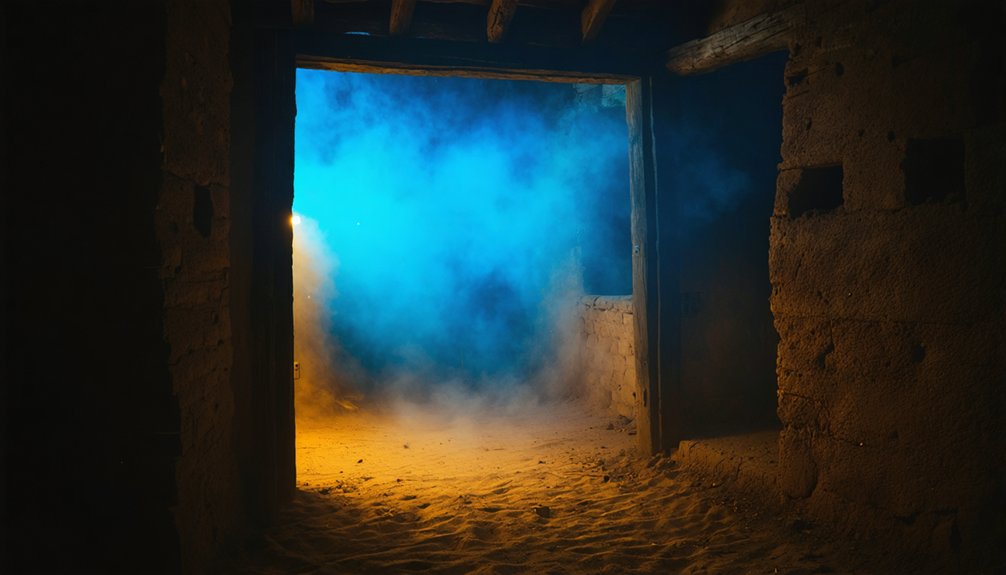
The mysterious phenomena surrounding Yaqui Camp extend far beyond its abandoned structures and forgotten streets.
You’ll find the area’s most enigmatic occurrences on warm summer nights under full moons, when three spectral figures perform ghostly dances around Yaqui Well. These apparitions—believed to be emigrants who met tragedy while traveling to California—emerge from the muddy water, nearby brush, and desert wash.
The desert’s unexplained wonders include:
The desert whispers its secrets through dancing lights, impossible physics, and cold embraces from the beyond.
- Luminous orbs or “Fire Balls” that ascend and explode like fireworks
- Mysterious lights forming perfect arches before returning to their origin
- Sudden chilling winds that accompany fleeting ghostly appearances
Scientists attribute these phenomena to static electricity from sand striking quartz, but locals maintain these experiences connect to the region’s layered history of migration, survival, and indigenous presence.
Exploring the Ruins: Modern Trails and Preservation
Finding your way to Yaqui Camp’s ghostly remnants requires preparation for both physical demands and desert exposure. The 1.1-mile Ghost Mountain Trail climbs steeply, gaining 1,200 feet through agave and juniper terrain where hiking safety demands protective clothing and ample water.
At the summit, you’ll discover Marshal South’s 1930s adobe home reduced to crumbling walls, cisterns, and scattered artifacts. The fragile three-room complex continues deteriorating from environmental exposure, making trail conservation essential for preserving this historical site.
You’ll encounter no modern amenities—only panoramic desert vistas and interpretive signage providing historical context. Access remains challenging via rough dirt roads, inadvertently limiting visitor traffic and helping protect what remains of this freedom-seeking family’s unconventional desert experiment.
Frequently Asked Questions
What Happened to Yaqui Camp’s Last Residents?
You won’t find a mysterious disappearance here—the last residents simply relocated during the 1950s-60s to nearby towns like Campo and Jacumba, seeking better economic opportunities and housing.
Are the Ghost Lights at Yaqui Well Documented in Scientific Literature?
No, you won’t find ghost lights of Yaqui Camp in scientific literature. Despite historical observations since 1858, formal scientific studies haven’t documented or explained these mysterious phenomena through peer-reviewed research.
Can Visitors Camp Overnight Near the Historic Yaqui Well Site?
You can’t camp directly at Yaqui Well. You must follow camping regulations by staying one car length from roads and 100 feet from water sources. Nearby established campgrounds offer better visitor amenities.
Did Any Famous Historical Figures Visit Yaqui Camp?
No famous historical figures are documented to have visited Yaqui Camp. Despite the area’s historical significance to indigenous peoples, records don’t show notable personalities making appearances at this location.
What Mining Resources Beyond Gold Were Extracted From Yaqui Camp?
You’ll find silver extraction was the primary resource beyond gold, with minor copper, lead, and zinc recovery. These secondary minerals required specialized mining techniques but yielded considerably less economic value.
References
- https://www.gotoborregosprings.com/yaqui-well-ghost-legend-anza-borrego-desert
- https://en.wikipedia.org/wiki/Yaqui_Well
- http://www.owensvalleyhistory.com/stories/cowan_ghost_mountain_1977.pdf
- https://www.psrm.org/campo/
- https://www.indigenousmexico.org/articles/the-enduring-legacy-of-the-yaquis-perpetual-resistance
- https://www.pascuayaqui-nsn.gov/wp-content/uploads/PDF/Education/yaqui_myths_and_legends.pdf
- http://cali49.com/hwy49/2014/3/15/calaveritas
- https://www.ajpl.org/building-a-dream-goldfield-ghost-town/
- https://www.youtube.com/watch?v=nJ6dH1lrafQ
- https://en.wikipedia.org/wiki/List_of_ghost_towns_in_California