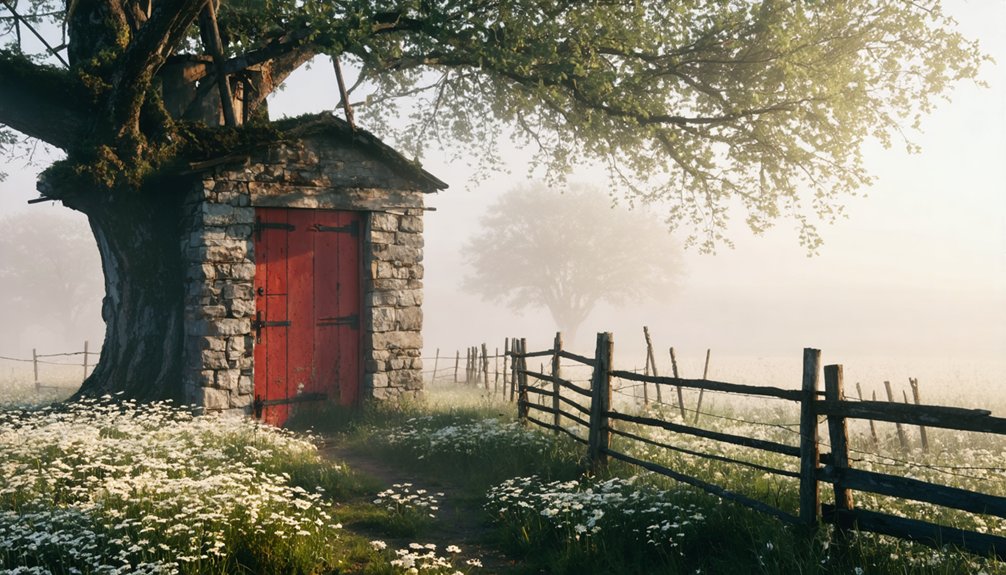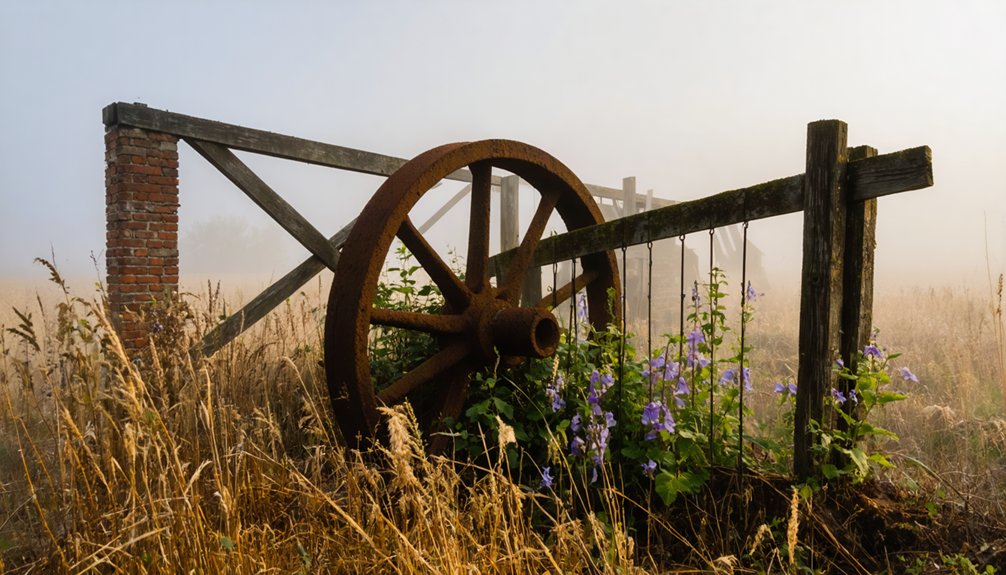
You’ll find over 300 documented ghost towns across Iowa, each telling a unique story of 19th-century settlement and decline. These abandoned communities, like Buckhorn and Rockville, emerged through early pioneer settlement, mining operations, and railroad development. Natural disasters, economic failures, and shifting transportation routes led to their eventual abandonment. While some towns like Villisca retain historic structures, others have vanished completely, leaving only cemeteries and ruins to explore their fascinating histories.
Key Takeaways
- Iowa’s ghost towns emerged from economic failures, natural disasters, and shifting railroad routes, with examples like Calhoun and Coaltown becoming abandoned.
- Lake Red Rock’s creation in the 1960s submerged six Marion County towns, preserving their stories beneath reservoir waters.
- Former mining communities like Buxton declined after resource depletion, with only ruins and cemeteries remaining as evidence of their existence.
- Historic structures like the Villisca Ax Murder House and Edinburgh Manor survive as preserved landmarks of Iowa’s abandoned communities.
- Railroad-dependent towns such as White Cloud and Lawrence became ghost towns after rail routes changed or became obsolete.
The Rise and Fall of Iowa’s Lost Communities
While Iowa’s first white settlement emerged in 1788 as a lead mining operation, the state’s true colonization began in 1833 after treaties opened eastern territories for permanent settlement.
You’ll find that Iowa’s lost heritage traces back to these early pioneers who established communities along river valleys, seeking essential wood and water resources.
As settlement patterns evolved, you can track how these lost communities expanded inland by 1850, driven by agriculture, mining, and railroad development.
The state’s population exploded, tripling between 1850-1860, as European immigrants, including 1,000 Hollanders, established new towns.
Yet these community memories often fade into abandonment – towns like Calhoun, once home to 300 residents, succumbed to economic failures, while others like Coaltown and Daily City vanished as mining resources depleted and railroad routes shifted. The emergence of discount department stores in larger towns gradually drew customers away from these smaller communities, accelerating their decline. Several communities, including Lake Red Rock towns like Conover and Dunreath, now rest beneath reservoir waters.
Notable Ghost Towns Across the State
A haunting collection of ghost towns dots Iowa’s landscape, each telling a unique story of prosperity and decline.
These abandoned places have become legendary destinations for urban exploration enthusiasts seeking to uncover the state’s forgotten past.
From the haunted corridors of Edinburgh Manor to the overgrown paths of Terra Haute, you’ll discover ghost town legends that capture Iowa’s rich history. Terra Haute’s few remaining buildings include an old schoolhouse and general store that stand as silent witnesses to a once-thriving community.
The town of Buckhorn achieved its greatest success through the Farmers Union Cooperative Creamery, which produced 34 million pounds of butter between 1899 and 1952.
Consider these notable locations:
- Buckhorn’s remaining church, creamery, and cemetery remind visitors of its vibrant past, when thousands gathered for annual picnics.
- Rockville’s wooded cemetery, with its Civil War-era headstones, stands as a symbol of one of Delaware County’s oldest settlements.
- The infamous Villisca Ax Murder House offers a chilling glimpse into Iowa’s dark history, drawing those brave enough to explore its haunted halls.
Natural Disasters and Town Abandonment
Natural forces have played a devastating role in Iowa’s ghost town legacy, with floods and fires reshaping entire communities across the state.
Nature’s destructive power transformed Iowa’s landscape, turning vibrant towns into haunting memories through relentless floods and devastating fires.
You’ll find that flood disasters along the Des Moines River, particularly in 1851, 1859, and 1903, forced the abandonment of once-thriving settlements like Iowaville and Coalport.
While some towns showed remarkable resilience, like Cordova’s initial recovery from the 1851 flood, others couldn’t survive nature’s fury.
The creation of Lake Red Rock in the 1960s submerged six Marion County towns, sacrificing their streets and cemeteries for downstream flood protection.
The U.S. Army Corps of Engineers initiated flood control measures in the 1930s to prevent future disasters in the region.
In 2004, Elkport’s devastating flood marked another chapter in Iowa’s battle with water, while Buxton’s decline accelerated when fires ravaged its businesses in the 1910s, combining with economic factors to seal its fate.
The Black miners’ leadership in Buxton made it a uniquely integrated community until natural disasters contributed to its downfall.
Railroad Era Impact on Settlement Patterns
You’ll find that Iowa’s railroad era profoundly shaped the state’s settlement patterns, as rail companies strategically established depot towns while bypassing existing communities.
When tracks were laid, new commercial centers emerged around stations and junctions, creating instant boomtowns complete with hotels, stores, and essential services.
The fate of these communities often hinged on continued rail service, and when lines were abandoned or rerouted, many towns declined rapidly into ghost settlements. Towns like White Cloud and Lawrence gradually disappeared after their railroad meeting points became obsolete. This was particularly evident in Carrollton, where the town’s fate was sealed after the Northwestern Railroad bypass led to its ultimate decline.
Railroad Towns Rise Fall
During the golden age of railroad expansion from the 1850s through the 1870s, Iowa’s landscape transformed dramatically as railroad companies strategically platted new towns along their routes.
These railroad legacies shaped settlement patterns as depot towns emerged to serve as crucial agricultural shipping points and commercial centers. Passengers paid 2-3 cents per mile for train travel between these emerging communities. One such town was State Centre, incorporated in 1867 at the midpoint of Iowa’s first cross-state railroad.
You’ll discover how economic fluctuations tied directly to rail service affected these communities:
- Initial booms followed track completion, with businesses clustering around depots and grain elevators.
- Peak rail mileage (1911-1917) concentrated wealth along rail corridors, creating over 10,500 miles of track.
- Later consolidations and bankruptcies triggered sharp declines, especially when routes were abandoned or service reduced.
Many towns that once thrived as railroad hubs now stand nearly empty, their fates sealed when the rail lines that birthed them ceased operations.
Bypassed Communities Face Decline
While railroad companies strategically plotted their routes to maximize efficiency and profits, many established Iowa communities found themselves bypassed by the new rail lines, setting in motion a devastating chain of economic decline.
You’ll find stark examples of these bypassed towns throughout southern Iowa, where communities like Tara and Ladoga transformed into ghost towns after losing their rail connections.
When rail companies favored flat terrain and direct routes to major hubs like Council Bluffs, they inadvertently sealed the fate of countless settlements.
Population shifts accelerated as residents migrated westward or to metropolitan areas, particularly during the 1920s with the rise of automobiles.
The economic impact was severe – without rail access, local businesses collapsed, freight revenue disappeared, and industrial development stagnated, leaving abandoned elevators and empty storefronts as silent testimonies to these once-thriving communities.
Historic Preservation Efforts and Remaining Structures

You’ll find Iowa’s preservation efforts most evident in sites like the Villisca Ax Murder House, which remains largely intact as a tourism destination despite its dark history.
While many ghost towns have vanished completely, some structures persist, such as Edinburgh Manor‘s main building and the remnants of Terra Haute’s schoolhouse and general store.
The Guthrie County ghost towns offer a mix of preservation outcomes, with only cemeteries remaining in Dalmanutha and Bear Grove, while other sites like Dale City have deteriorated into ruins.
Preservation Success Stories
Throughout Iowa’s rural landscape, numerous preservation initiatives have successfully protected and documented the state’s vanishing ghost towns. Modern preservation techniques and community involvement have breathed new life into these historic sites, ensuring their stories aren’t lost to time.
You’ll find remarkable examples of preservation success across the state:
- Dubuque’s HeritageWorks program transformed deteriorating buildings through tax credits and facade restorations, while establishing the innovative Restoration Academy.
- Lake Red Rock’s careful relocation of cemeteries and historic structures preserved essential cultural heritage before flooding.
- Crawford County’s Historical Preservation Commission meticulously maps and documents forgotten towns like Bell and Dunham’s Grove, creating interactive resources for exploration.
These efforts showcase how dedicated preservationists and local communities can protect Iowa’s rich historical legacy while making it accessible to future generations.
Standing Structures Today
Despite decades of abandonment, several Iowa ghost towns retain fascinating structural remnants that offer glimpses into their former liveliness.
As you wander through these eerie landscapes, you can discover abandoned towns in Iowa that showcase unique architectural styles from different eras. Each location tells a story of the past, inviting exploration of overgrown streets and crumbling buildings. These sites not only captivate history enthusiasts but also offer breathtaking photo opportunities for those who seek out the beauty in decay.
As you delve deeper into the exploration of ghost towns in Iowa, each site reveals artifacts from residents who once called these places home. The haunting beauty of their isolation often evokes a sense of nostalgia and curiosity about the lives lived within these now-silent walls. Whether you’re an avid photographer or a history buff, these ghost towns provide an unparalleled glimpse into a bygone era.
You’ll find Edinburgh Manor‘s crumbling 1910 asylum walls still accessible for exploration, while Terra Haute preserves its weathered schoolhouse and general store amid overgrown surroundings.
Buckhorn’s architectural remnants include three key structures: a whitewashed church, deteriorating creamery, and abandoned cemetery.
Though Buxton lacks standing buildings, you can trace its industrial past through visible cellar holes and slag heaps.
In Glendon, the restored 1890s church stands as the town’s sole surviving structure, serving as a preserved centerpiece for visitors.
Each site’s remaining structures tell unique stories of Iowa’s vanished communities, from institutional grandeur to rural simplicity.
Underground Railroad Connections and Heritage Sites
While many of Iowa’s ghost towns have faded into obscurity, their connections to the Underground Railroad remain preserved through a network of historic station houses and documented escape routes.
The heritage significance of these sites reveals Iowa’s vital role in helping freedom seekers escape to safety. You’ll find several well-documented stations that operated during this period:
- The Lewelling House in Salem – a mid-19th century Quaker home offering tours and exhibits
- The Jordan House in West Des Moines – where James Jordan served as “chief conductor”
- The George B. Hitchcock House near Lewis – a key station in Cass County
These preserved structures trace three main escape corridors through Iowa: western, south-central, and southeastern routes.
Most freedom seekers entered through southern border counties before moving northward through networks of Quaker and Congregationalist settlements.
Most Haunting Abandoned Locations to Visit

Ready to explore Iowa’s most spine-chilling abandoned locations?
You’ll find ghost town legends come alive in Buckhorn, where a crumbling creamery, abandoned cemetery, and shuttered church stand as silent witnesses to a once-thriving community.
For eerie encounters, venture to Rockville’s wooded cemetery with its Civil War-era headstones, especially haunting after dark.
The Villisca Axe Murder House offers a more intense experience, with documented paranormal activity and overnight stays where you can investigate unexplained phenomena.
Don’t miss Edinburgh Manor, a former poor farm where spectral residents reportedly still roam.
Step into Edinburgh Manor’s shadowy halls, where former residents of this historic poor farm refuse to fully depart.
These locations, along with the desolate remains of Elkport, provide atmospheric destinations for those seeking to explore Iowa’s haunted past.
Each site tells its own chilling tale of abandonment and mystery.
Frequently Asked Questions
Are There Guided Tours Available to Explore Iowa’s Ghost Towns?
You’ll find limited guided exploration options, with tour companies primarily focusing on haunted city sites in Des Moines. Most ghost town visits require self-guided trips to locations like Buckhorn and Rockville.
Can Visitors Legally Collect Artifacts From Abandoned Ghost Town Sites?
You can’t legally collect artifacts, as 100% of ghost town sites fall under either private property or public land legal restrictions. You’ll need property owner permission or must leave items undisturbed.
Which Ghost Towns Have the Most Documented Paranormal Activity?
You’ll find the most documented ghost sightings and spectral encounters in Villisca’s abandoned sectors, with the Ax Murder House recording extensive paranormal evidence through organized investigations and overnight visitor experiences.
What Safety Precautions Should Explorers Take When Visiting Abandoned Sites?
Don’t be that foolhardy explorer who meets their doom! You’ll need proper exploration gear, site permissions, protective equipment, a buddy system, and verified site accessibility before venturing into abandoned structures.
Do Any Ghost Towns Host Annual Festivals or Historical Reenactments?
You’ll find Van Meter hosts an annual paranormal festival celebrating its monster folklore, while other ghost towns don’t regularly host festival history events or historical reenactments despite Iowa’s rich heritage.
References
- https://kids.kiddle.co/List_of_ghost_towns_in_Iowa
- https://pubs.lib.uiowa.edu/annals-of-iowa/article/id/13466/download/pdf/
- https://www.ghosttowns.com/states/ia/ia.html
- http://www.onlyinyourstate.com/experiences/iowa/ia-ghost-town
- https://www.discoverguthriecounty.org/ghosttowns
- https://www.youtube.com/watch?v=L883pwCPOwE
- http://genealogytrails.com/iowa/abandoned_towns.htm
- https://freepages.history.rootsweb.com/~gtusa/usa/ia.htm
- https://en.wikipedia.org/wiki/List_of_ghost_towns_in_Iowa
- https://www.familysearch.org/en/wiki/Iowa_History