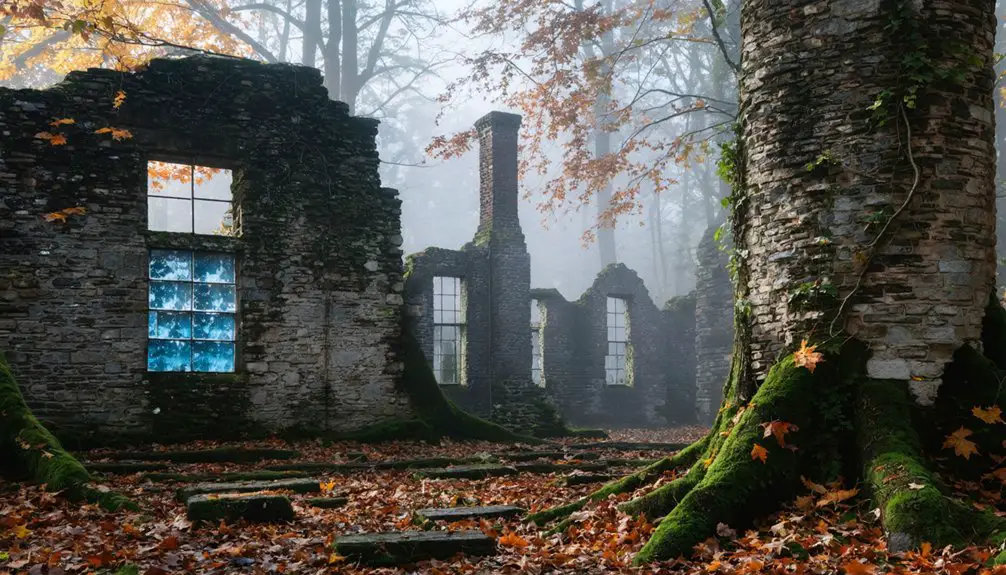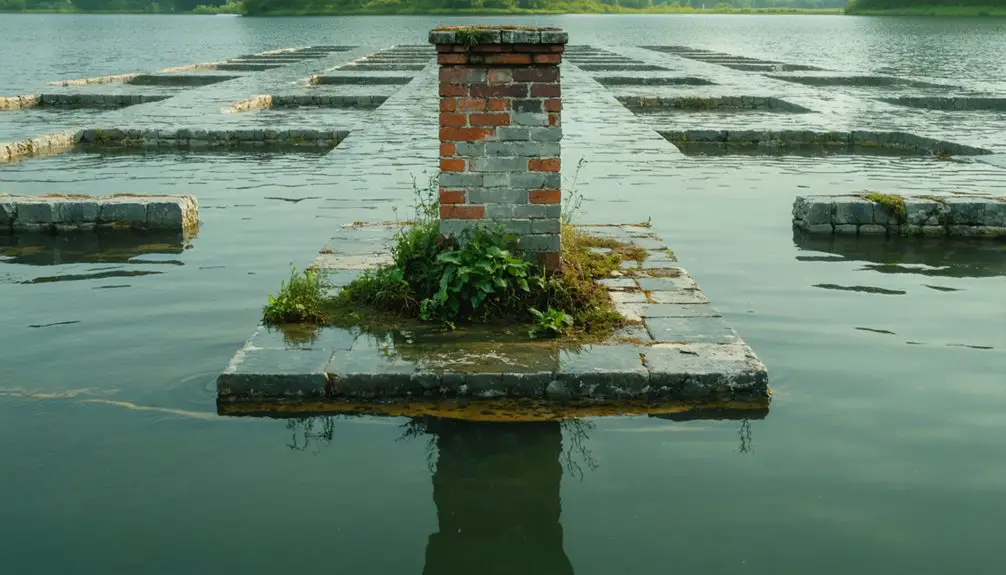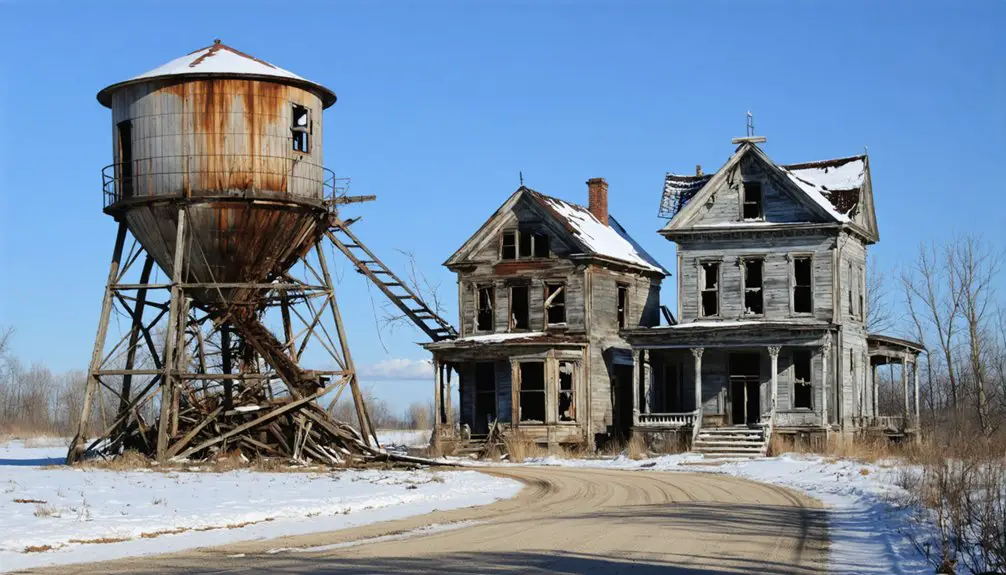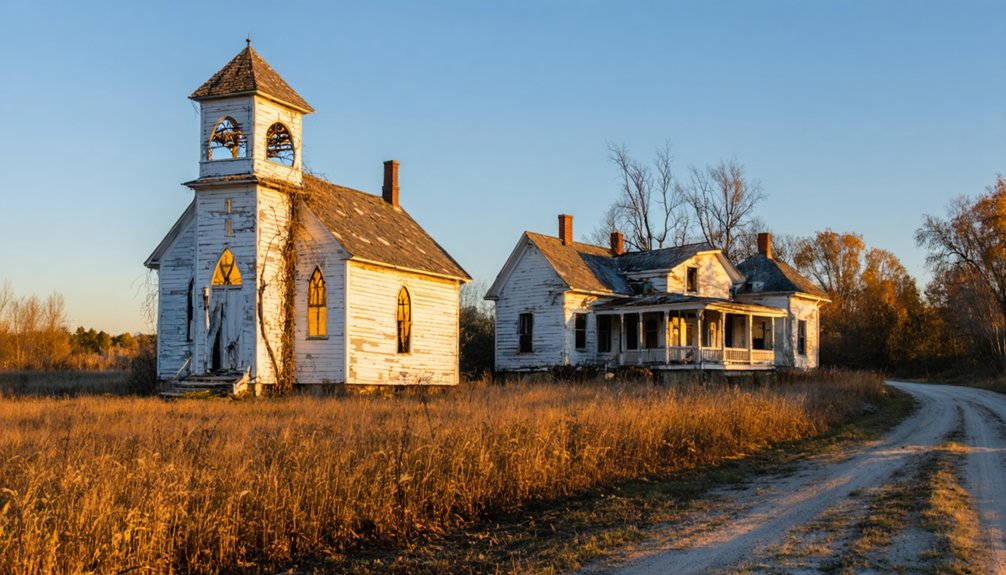
You’ll find several fascinating ghost towns scattered across Massachusetts, from the four submerged communities beneath Quabbin Reservoir to Dogtown’s abandoned settlement in Gloucester. These lost towns include Catamount’s mountain wilderness, Long Point’s relocated fishing village near Provincetown, and Haywardville’s industrial ruins in Middlesex Fells. Each site tells a unique story of colonial development, industrial innovation, and inevitable decline, with many leaving behind visible remnants that reveal Massachusetts’ rich historical tapestry.
Key Takeaways
- The Quabbin Reservoir submerged four complete towns in 1927, including Dana, Enfield, Greenwich, and Prescott, displacing over 2,500 residents.
- Dogtown in Gloucester transitioned from a thriving settlement of 80 houses to abandonment by 1830, with only stone foundations remaining today.
- Catamount, located in Colrain, was a farming and timber community that declined and became part of Catamount State Forest in 1967.
- Long Point, a former fishing village near Provincetown, housed 260 residents before its complete relocation across the harbor in the 1850s.
- Haywardville, once a prosperous mill town, declined after losing water rights and is now preserved within the Middlesex Fells Reservation.
Lost Towns of the Quabbin Reservoir
What began as an ambitious water supply project in 1927 led to one of Massachusetts’ most poignant stories of displacement. The Swift River Act sealed the fate of four thriving towns – Dana, Enfield, Greenwich, and Prescott – which would vanish beneath the waters of the Quabbin Reservoir.
You’ll find echoes of these lost communities in the remnants that still exist today. More than 2,500 residents were forced to abandon their homes, while workers dismantled an entire railway system and razed thousands of structures.
Thousands displaced, homes destroyed, railways torn up – all to make way for waters that would drown generations of memories.
The valley burned for months as demolition teams cleared 60,000 acres. The historic Farewell Ball of 1938 drew over 2,000 people to bid their final goodbyes. By midnight on April 28, 1938, these towns officially ceased to exist.
Today, Dana Common stands as a silent memorial above the waterline, where descendants gather each July to honor their submerged hometown’s legacy. Stone fenceposts and cellar holes remain as the only visible traces of these once-vibrant communities.
Dogtown: The Abandoned Settlement of Gloucester
Just five miles inland from Gloucester’s bustling harbor lies Dogtown, a ghostly settlement whose origins trace back to 1641.
This rocky outpost once thrived as a prosperous community with 80 homes along Commons Road, chosen for its defensive position against pirates and hostile natives. A survey by Joshua Batchelder in 1741 showed that 20% of Gloucester’s population lived in the settlement. Poor soil conditions forced residents to focus primarily on raising livestock rather than farming crops.
You’ll find rich Dogtown history in its transformation from a flourishing settlement to an abandoned ghost town after the Revolution, when maritime trade shifted to deeper harbors.
- The settlement’s nickname “Dogtown” came from widows who kept dogs for protection
- Dogtown trails now wind through dense forest, passing numbered cellar holes
- Water-powered mills and livestock sustained the community until resources depleted
- The last resident, Cornelius “Black Neil” Finson, departed in 1830 for the poorhouse
Catamount’s Quiet Wilderness
While Dogtown’s coastal location played a key role in its development, Massachusetts’ western frontier holds another forgotten settlement in the quiet wilderness of Catamount.
You’ll find this ghost town nestled in Colrain’s mountainous terrain, where hardscrabble farmers once carved out their existence in the late 1700s.
As you explore the rich history of ghost towns in Massachusetts, you’ll discover remnants of past lives and tales of perseverance. Each abandoned structure tells a story, inviting curious visitors to imagine the bustling community that once thrived there. These eerie locations not only capture the imagination but also serve as a poignant reminder of the changing landscape of rural American life.
Catamount’s history is marked by patriotic pride – in 1812, it became the first town to fly the American flag over its schoolhouse, a moment now commemorated by a stone marker.
Like Zealand logging town, the community relied heavily on timber operations to sustain its economy.
The area was settled during the mid-1700s, making it one of Massachusetts’ earliest frontier communities.
By the early 20th century, the settlement fell silent, and in 1967, the Commonwealth acquired the land, transforming it into the 1,125-acre Catamount State Forest.
Today, you can explore this piece of early American history on foot, as the old roads that once served the community have returned to nature.
Long Point: The Vanished Peninsula Village
Along the sandy reaches of Cape Cod’s outermost tip, a remarkable fishing village once thrived on Long Point, where John Atwood built the first house in 1818 near Provincetown.
You’ll find the story of this lost settlement fascinating, as it grew to include salt works, windmills, and a lighthouse guiding ships into the harbor. In the 1850s, determined villagers floated their houses across Provincetown Harbor to establish new homes in the West End. Today, only the second lighthouse, built in 1875, still stands as a sentinel at this remote location.
During its peak in the 1840s, the village boasted:
- A population of up to 260 resilient residents
- Six windmills powering the local salt industry
- A thriving fishing trade of mackerel, shad, and bass
- Essential amenities including a school, post office, and general store
Haywardville: From Mill Town to State Park
Deep in what’s now the Middlesex Fells Reservation, Haywardville emerged in the early 1800s after Nathaniel Hayward purchased existing shoe mills along Spot Pond Brook.
The site transformed into a thriving industrial hub when Hayward, who co-invented rubber vulcanization with Charles Goodyear, established his rubber company there.
You’ll find that Haywardville’s mill village transformation included more than a dozen mills operating along the brook, powering regional production for nearly three centuries.
The area’s decline began when water rights were taken by Medford, Malden, and Melrose.
Today, visitors to the 3,400-acre reservation can still discover remnants of this once-bustling industrial site, including old mill foundations scattered throughout the landscape.
Frequently Asked Questions
Are Any of These Ghost Towns Haunted or Associated With Paranormal Activity?
You’ll find haunted legends in Dogtown’s witch-cursed ruins, paranormal sightings at Quabbin’s submerged towns, and ghostly activity throughout abandoned asylums like Medfield and Worcester State Hospitals.
Can Visitors Legally Take Artifacts Found at These Abandoned Locations?
Even if you spot a million-dollar artifact, you can’t legally take it. Artifact ownership on state lands is strictly prohibited, with hefty fines and possible jail time for removal from these sites.
What Safety Precautions Should Explorers Take When Visiting These Sites?
Bring proper exploration gear like sturdy boots, weather protection, and first aid supplies. Follow safety guidelines: don’t explore alone, stay on marked trails, and watch for hazardous foundations and holes.
Do Any Descendants of Original Residents Still Live Nearby Today?
While 90% of Dana’s families settled in nearby towns, you’ll find descendant stories through local folklore in places like Ware and Belchertown, where original Quabbin Reservoir families still maintain community ties.
Which Ghost Town Is the Most Accessible for Tourist Visits?
You’ll find Questing-Reservation the most tourist-friendly, with its well-maintained accessible routes, marked trails, visitor center amenities, and available maps to guide your exploration of the historic ruins.
References
- https://en.wikipedia.org/wiki/List_of_ghost_towns_in_Massachusetts
- https://www.atlasobscura.com/things-to-do/massachusetts/abandoned
- https://www.tripadvisor.com/Attractions-g28942-Activities-c47-t14-Massachusetts.html
- https://historyofmassachusetts.org/ghost-towns-massachusetts/
- https://wnaw.com/ma-ghost-towns-hiking/
- https://www.youtube.com/watch?v=NnWdey6OaHM
- https://www.harvardmagazine.com/2023/08/quabbin-reservoir-lost-towns-elena-palladino
- https://science.nasa.gov/earth/earth-observatory/lost-towns-of-the-quabbin-154605/
- https://vitabrevis.americanancestors.org/2019/09/lost-towns-of-the-quabbin
- https://quabbinhouse.com