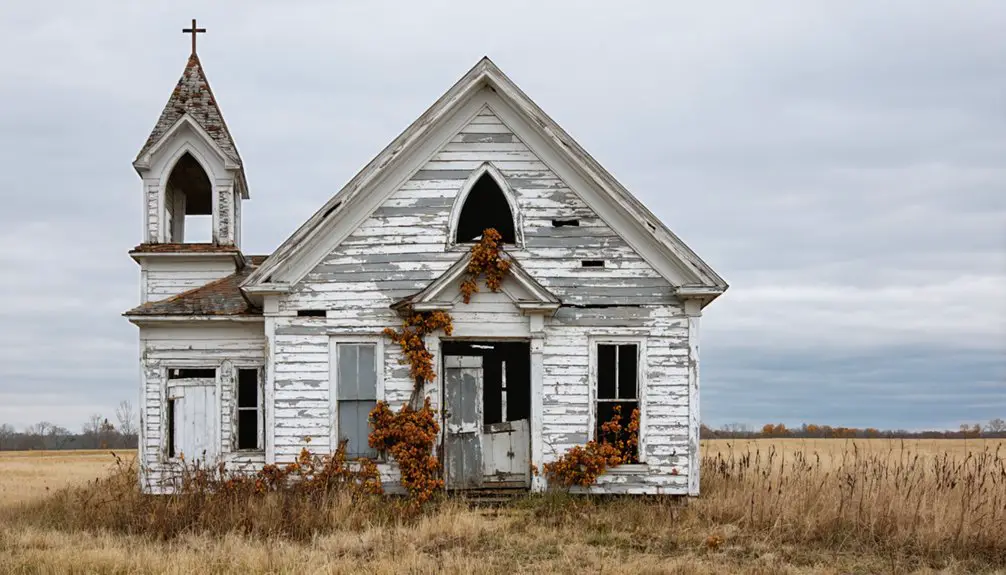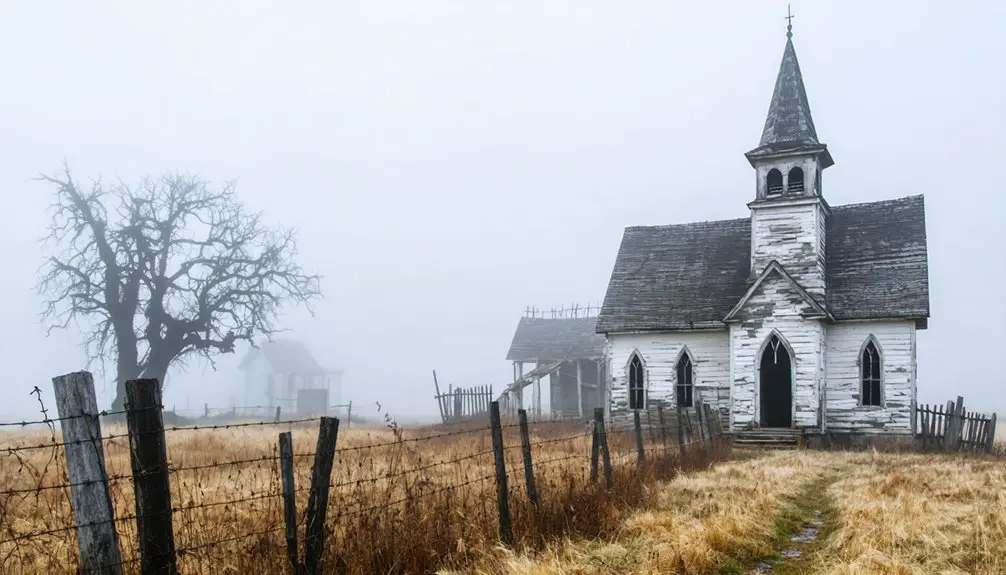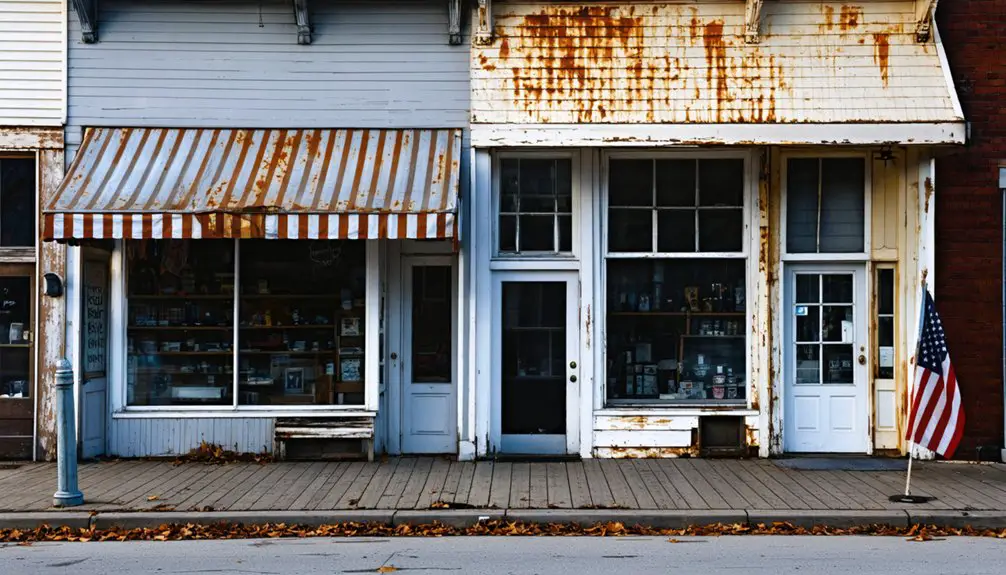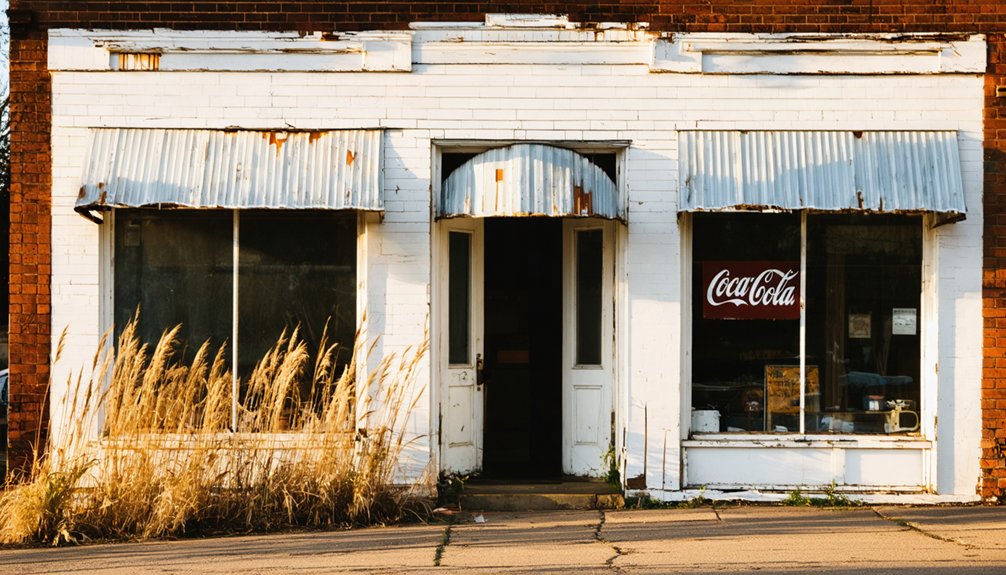
You’ll find Missouri’s ghost towns scattered across rural landscapes, each telling unique tales of bygone eras. From Phenix’s renowned marble quarries that once employed hundreds to Halltown’s Victorian-era buildings now housing antique shops, these abandoned settlements capture different pieces of history. Chestnutridge and Kissee Mills showcase limestone mining’s boom-and-bust cycle, while Route 66 gems like Avilla hold ghostly legends and weathered facades. These forgotten communities hold countless untold stories beneath their ruins.
Key Takeaways
- Phenix Mining Town flourished in 1884 with marble quarries and limestone mining, reaching 500 residents before declining after World War II.
- Chestnutridge became a ghost town by the 1970s after its limestone mining operations ceased during World War II.
- Kissee Mills relocated in the 1950s, leaving behind historic structures, an old service station, and a cemetery with early settler graves.
- Avilla’s decline began when I-44 bypassed the town, leaving abandoned buildings along old Route 66 as remnants of its past.
- Times Beach transformed into Route 66 State Park following a $200 million cleanup, preserving Missouri’s ghost town heritage.
The Rise and Fall of Phenix Mining Town
When railroad crews discovered a rich vein of marble and limestone near the future townsite in 1884, they couldn’t have known they’d sparked the birth of Missouri’s premier stone-producing settlement.
Y’all would’ve seen Phenix marble become the pride of the region as artisans recognized its exceptional polish and durability. The quarry operations, run by Phenix Stone & Lime Company, employed hundreds of workers who called this bustling company town home. The company’s stone forensics team constantly analyzed quarry samples to maintain quality standards.
The pride of Missouri, Phenix marble shone in the hands of skilled craftsmen while hundreds toiled in the bustling quarry town.
At its peak, nearly 500 folks lived here, with the quarry shipping premium stone nationwide for grand buildings like the Missouri State Capitol. The residents enjoyed a rich cultural life with access to a library and orchestra.
But times got tough after World War II. Cheap European imports flooded the market, while equipment losses and deeper, costlier mining made things worse.
Historic Route 66: Halltown’s Vintage Revival
As you travel along Missouri’s Historic Route 66, you’ll find Halltown’s Victorian-era buildings standing proudly since the early 1900s, including the iconic Whitehall Mercantile and Cameron’s Antiques.
The town’s architecture reflects its “Little Chicago” heyday when shops and merchants bustled along the Mother Road, serving both locals and cross-country travelers. The community of 102 residents maintains its small-town character while preserving its historical roots. Michael Lamp’s store welcomes visitors with complimentary coffee while sharing stories of Route 66 history.
Today, these preserved structures house antique shops that draw Route 66 enthusiasts searching for vintage treasures, maintaining Halltown’s connection to its commercial past.
Antique Shopping Renaissance
Once a sleepy hamlet along the Mother Road, Halltown has transformed into a thriving antique shopping destination centered around its historic Main Street corridor.
You’ll find a walkable cluster of antique shops housed in beautifully restored buildings, including the landmark Whitehall Mercantile in an old IOOF lodge and Cameron’s Antiques in a 1930s storefront.
These preservation-minded merchants have breathed new life into Halltown’s vintage buildings while maintaining their historic character.
At an elevation of 1,168 feet, the town’s hilltop location provides an ideal backdrop for antique hunting and exploration.
As you explore the shops, you’ll discover everything from Route 66 memorabilia to vintage decor and architectural salvage. The friendly owner Jerry entertains visitors with his harmonica performances while sharing stories of local history.
The town’s authentic Mother Road atmosphere draws visitors year-round, especially during classic car events and Route 66 festivals.
Each storefront tells a story of antique restoration, with original features carefully preserved to create an immersive shopping experience that celebrates America’s Main Street.
Mother Road Architecture
Built during the golden age of America’s Mother Road, Halltown’s architectural heritage stands as a tribute to Route 66’s heyday from 1926 to 1955.
You’ll find historic preservation at its finest in structures like the 1900 Whitehall Mercantile, which served travelers as a grocery store until 2016. The architectural significance of Halltown’s buildings reflects the town’s nickname “Little Chicago,” earned during its bustling prime.
A narrow 1923 steel bridge still carries traffic along MO-266, following the original Route 66 alignment. Like many communities along the highway, Halltown benefited from the mom-and-pop businesses that sprung up to serve passing motorists. Among these businesses, Camerons Antiques became a landmark destination during the 1930s.
The town’s vintage commercial buildings, designed for the travel trade, showcase yesterday’s craftsmanship through their restored storefronts and classic Mother Road design elements.
These structures tell the tale of a thriving roadside community that once served countless travelers along America’s most famous highway.
Chestnutridge: A Southwestern Missouri Time Capsule
Deep in southwestern Missouri, the ghost town of Chestnutridge stands as a tribute to the region’s limestone mining legacy.
You’ll find this once-bustling quarry town, established in the early 1900s, was among the largest limestone producers west of the Mississippi. At its peak, nearly 500 folks called it home, weathering even the Great Depression’s harsh times. Much like the town of Lock Springs, Chestnutridge saw its population dwindle to almost nothing over the decades.
World War II marked the beginning of the end when they scrapped the mining equipment for the war effort. By the 1970s, most everyone had moved on, leaving behind a time capsule of early 20th-century structures.
Today, you can spot a 1922 building, an old church, and what appears to be a former gas station from the roadside. The town was first settled in the 1880s with a post office opening shortly after. While Phoenix Marble Company operates nearby, the private property status keeps most explorers at a respectful distance.
Kissee Mills: Relocation and Remnants
If you’re travelin’ through Kissee Mills today, you’ll find the historic Bible School church and cemetery standin’ as silent witnesses to the town’s 1871 origins.
The community’s 1950s relocation left behind these sacred spaces while shiftin’ most activity to a new site, effectively turnin’ the original settlement into a ghost town.
The surroundin’ hills still cradle a handful of weathered structures, includin’ what looks to be an old service station, remindin’ folks of the town’s bygone days.
Historic Church and Cemetery
Among Kissee Mills’ most evocative remnants stands the weathered Bible School church, a tribute to the town’s religious heritage since 1871.
You’ll find this historic structure down the road from the main ghost town area, its architectural features bearing witness to decades of abandonment. The adjacent cemetery, with its limited visible markers, tells the story of the community’s earliest settlers.
While you can explore these sacred grounds, you’ll notice the cemetery’s connection to the pre-relocation settlement through surviving headstones.
The church complex, though showing signs of decay, retains its historic significance as one of the area’s few accessible landmarks. The surrounding woods and water create a secluded atmosphere, though private property boundaries mean you’ll need to respect posted access restrictions.
Relocation Impact 1950s
During the pivotal 1950s, Kissee Mills underwent a significant relocation that reshaped the town’s physical and social landscape. The town migration shifted the community away from its original waterside setting, leaving behind aging structures that now stand as silent witnesses to the past.
You’ll find the remnants of this change scattered along the roadways, with newer old buildings bearing the weathered marks of abandonment.
One of the most challenging aspects of this move was the cemetery relocation near the Bible School church. The entire burial ground had to be transferred, presenting substantial logistical challenges for the community.
While details of the exact process remain scarce, you can still spot the relocated gravestones in their new resting place, though much of the area has become overgrown with time.
Surrounding Hill Architecture
The architectural remnants of Kissee Mills tell a complex story across its surrounding hillsides.
You’ll find scattered timber-frame structures and weatherboard farmhouses perched on higher ground, where folks relocated after leaving the original riverside settlement. These hilltop structures reveal layers of history – from hand-cut stone foundations to mid-century metal roof repairs.
The architectural decay varies depending on elevation. Up high, you’ll spot better-preserved timber frames battling wind and sun damage, while the lower terraces show heavy rot where wood meets damp soil.
Churches, barns, and root cellars dot the landscape, their simple forms typical of Ozark building traditions. Look carefully, and you’ll notice old road traces winding between these remnants, marking where village streets once connected the community.
Avilla’s Capitol 66 Legacy
Situated along old Route 66, Avilla’s main strip once bustled with storefronts and local businesses that served travelers making their way between Springfield and Carthage.
You’ll find remnants of this Route Revival era in the abandoned buildings that still line the historic highway, silent witnesses to the town’s vibrant past.
When I-44 bypassed Avilla in the 1960s, it marked the beginning of the end for this once-thriving stop.
Local taverns and shops that once welcomed weary travelers now stand empty, their weathered facades telling tales of better days.
Time-worn storefronts stand silent along the roadside, their crumbling walls echoing memories of bustling commerce and friendly faces.
The Ghostly Legends that haunt these forgotten structures add another layer to Avilla’s mystique, with some folks claiming to spot floating orbs and mysterious falling objects in the old establishments.
Preserving Missouri’s Ghost Town Heritage
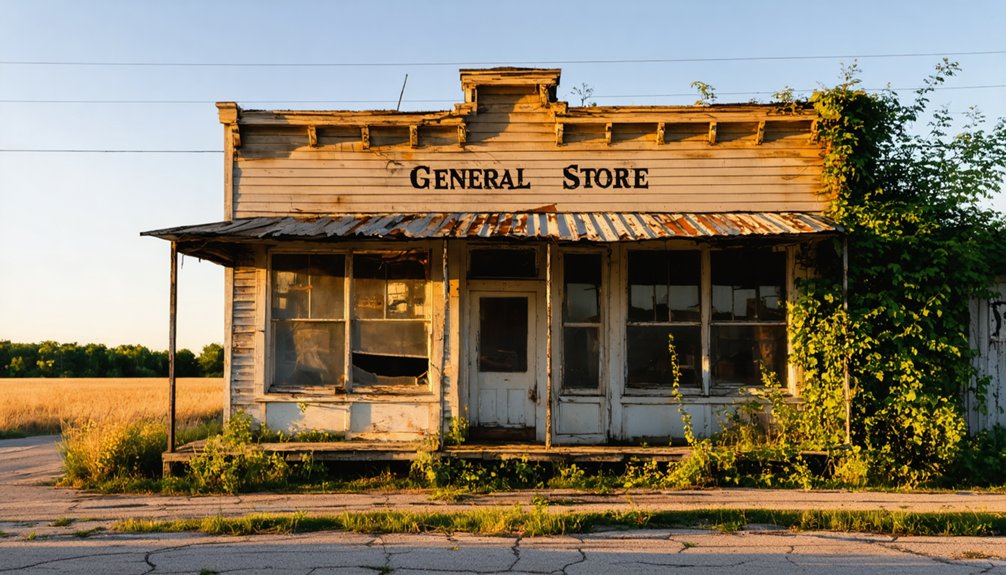
While Missouri’s ghost towns face varied threats from contamination to decay, preservation efforts have transformed several sites into valuable historical assets.
Abandoned sites in Missouri often tell the stories of communities that once thrived. As efforts continue to uncover their histories, visitors are increasingly drawn to these locations, eager to explore the remnants of the past. These explorations not only enrich local culture but also highlight the importance of preserving such sites for future generations.
Exploring ghost towns in Missouri can reveal hidden gems and unexpected stories of the past. Many of these towns, once bustling with life, now stand as silent witnesses to history, inviting adventurers and historians alike to ponder what once was. As more people venture into these forgotten places, it becomes increasingly vital to advocate for their preservation and protection.
You’ll find remarkable examples of ghost town preservation at Times Beach, where a $200 million cleanup converted a dioxin-contaminated town into Route 66 State Park, complete with a visitor center in one of the original buildings.
The historical significance of these sites can’t be understated.
At Quindaro, volunteers are working to restore buildings tied to the Underground Railroad‘s western branch, preserving vital Civil War-era history.
Even heavily contaminated areas like the U.S. Technology Superfund site in Berger are being remediated for future use.
These preservation efforts aren’t just about saving old structures – they’re transforming former ghost towns into educational spaces where you can experience Missouri’s rich heritage firsthand.
Life Along Abandoned Mining Routes
Meandering through Missouri’s abandoned mining routes today, you’ll find remnants of once-bustling communities that sprung up around lead, zinc, coal, and limestone operations in the mid-1800s.
You can still spot stone chimneys standing like lonely sentinels among the trees, while rusting mining artifacts peek through decades of undergrowth.
These ghostly landscapes tell stories of immigrant families who carved out lives here – French miners in Old Mines, Europeans elsewhere – working dangerous jobs underground while their families kept home fires burning.
Along these forgotten paths, you’ll encounter massive chat piles and collapsed mine entrances, silent testimony to the boom-and-bust cycle that defined these towns.
Underground, flooded workings like Bonne Terre’s submerged mine tunnels hold secrets of the thousands who once toiled here.
Burfordville’s Mill and Bridge Chronicles
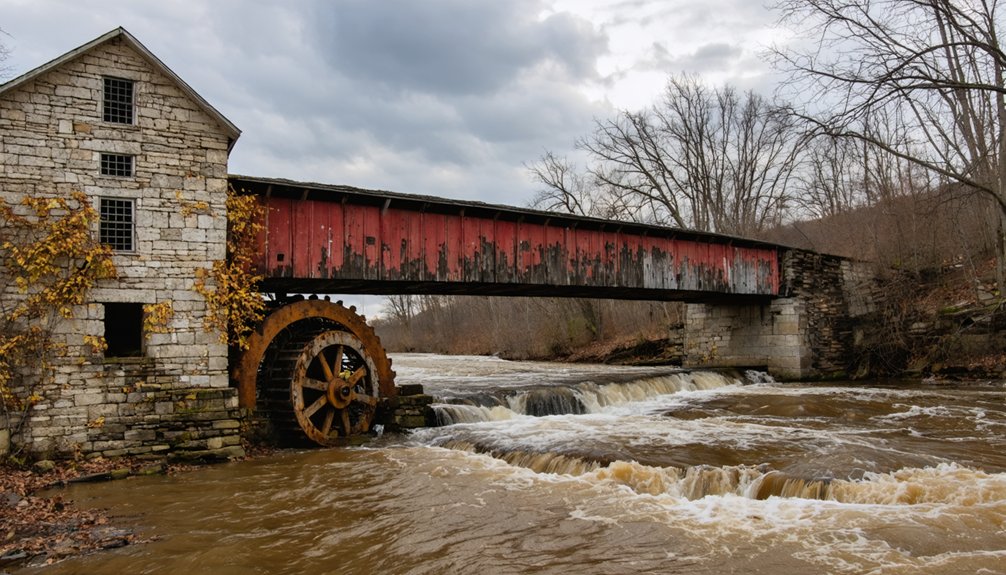
Under Spanish control in 1797, George Frederick Bollinger discovered what would become one of Missouri’s most historically significant mill sites. He’d lead Swiss and German immigrants across the frozen Mississippi River, establishing Bollinger’s Mill, which you can still visit today as part of the state historic site.
The town’s crowning achievements stand as proof of early American ingenuity. The Bollinger history runs deep through the pre-Civil War mill, while Missouri’s oldest covered bridge, built by Joseph Lansmon in 1858, spans the creek where wagons once rolled.
Though Burfordville, as it was later named, boasted a post office by 1869, it’s now home to just 87 residents. You’ll find these remarkable structures preserved on the National Register of Historic Places, silent sentinels of a once-thriving community.
The Mother Road’s Forgotten Settlements
Through the heart of Missouri, Route 66 carved a legacy of boom-and-bust towns that now stand as ghostly reminders of America’s golden age of highway travel.
Like a restless spirit, Missouri’s forgotten Route 66 towns haunt the landscape, echoing dreams of America’s roadside paradise.
These forgotten memories whisper stories of prosperity and decline along the Mother Road.
- You’ll find Times Beach’s tragic tale, where dioxin contamination forced 2,000 residents to abandon their homes, now transformed into a state park where ghostly echoes of Route 66 commerce linger.
- In Avilla, you can explore restored buildings that capture the town’s brief heyday before the highway realignment sealed its fate.
- Arlington’s dead-end remnants showcase John’s Modern Cabins, slowly crumbling into history.
- Devil’s Elbow, named for its treacherous river bend, preserves its 1880s church and cemetery while Halltown’s abandoned general store stands as a silent sentinel to Route 66’s glory days.
Frequently Asked Questions
Are There Guided Tours Available to Explore These Ghost Towns?
You’ll find guided explorations through ghost tours in Hannibal and Jefferson City, though they’re focused on haunted buildings of historical significance rather than abandoned towns themselves.
What Safety Precautions Should Visitors Take When Exploring Abandoned Structures?
When exploring abandoned structures, you’ll need proper safety gear: sturdy boots, gloves, N95 mask, and protective eyewear. Never go alone and watch for hazards like unstable floors and falling debris.
Is Metal Detecting or Artifact Collecting Allowed in These Locations?
You’ll need explicit permission and permits since metal detecting regulations and artifact preservation laws protect these sites. Don’t remove historical items – they’re protected by federal and state statutes with serious penalties.
Do Any of These Ghost Towns Have Reported Paranormal Activity?
You’ll find plenty of ghost stories and haunted legends in these towns – especially Windyville’s shadow figures, Avilla’s phantom Confederate soldier, and unexplained voices along Zombie Road in Wildwood.
When Is the Best Time of Year to Photograph These Sites?
With 80% of Missouri’s ghost towns peaking in natural light mid-October, you’ll want to visit during autumn colors when crisp mornings create golden hour opportunities for haunting, fog-draped photography.
References
- https://www.youtube.com/watch?v=OPNh93z9dNE
- https://www.legendsofamerica.com/mo-ghosttowns/
- https://www.geotab.com/ghost-towns/
- https://www.ghosttowns.com/states/mo/mo.html
- https://abandonedmo.com
- https://www.youtube.com/watch?v=ApiGf0lxnSo
- https://www.youtube.com/playlist?list=PL4jqwLUrhjNScUWj03mXzSKyBNMNqZHGw
- https://www.undergroundozarks.com/phenix.html
- http://www.slipperyrockgazette.net/index.cfm/pageId/2661/The Legacy of Phenix Marble/
- https://www.news-leader.com/story/life/2014/10/22/pokin-around-ghost-town-phenix-sees-signs-life/17724245/