You’ll find several fascinating ghost towns scattered across Rhode Island, from the mysterious colonial-era ruins of Hanton City in Smithfield to the storm-ravaged remains of Napatree Point’s coastal village. The haunted Ramtail Factory, abandoned in 1873, and the eerie remnants of industrial mill villages along the state’s rivers tell stories of economic decline and natural disasters. These forgotten places, including the controversial Ladd School complex, hold centuries of untold secrets beneath their crumbling foundations.
Key Takeaways
- Hanton City in Smithfield was a colonial ghost town that vanished by 1850, leaving only stone foundations and a lonely cemetery.
- The Ramtail Factory ruins in Foster stand as remnants of an abandoned 19th-century woolen mill with a haunting reputation.
- Napatree Point’s coastal village disappeared after the 1938 hurricane destroyed all 39 beachfront cottages and killed 15 residents.
- Rhode Island’s industrial villages, including Slatersville Mills and Social Village, showcase abandoned manufacturing centers from the state’s textile era.
- The Bell Estate, originally “The Reefs,” became abandoned after WWII and was ultimately demolished in 2024, leaving only foundation remnants.
The Mysterious Ruins of Hanton City
Nestled deep in the woods of Smithfield, Rhode Island, the colonial-era ruins of Hanton City stand as a haunting reminder of a once-thriving settlement from the late 1600s.
You’ll find this mysterious ghost town‘s remains scattered through the northeast woodlands, where poor tanners and bootmakers once carved out their living after the King Philip’s War land grants of 1676.
The settlement peaked in the 1730s but vanished from maps by the 1850s when new highways redirected traffic away from this rural trading post.
Once a bustling colonial outpost, Hanton City faded into obscurity as modern roads diverted commerce from its wilderness paths.
Today, you can explore the stone foundations and forgotten graves of Alice Herringdon and Daniel Brown in the lonely cemetery.
While Hanton City legends flourished after an 1880s Providence Journal dubbed it the “Haunted City,” the true story is one of economic decline rather than supernatural mystery.
The area became uninhabitable when swampy conditions overtook the landscape, forcing residents to abandon their homes.
Among the most notable remnants is the ancient Threshing Rock, where Native Americans and early settlers once separated grain from their harvested crops.
Napatree Point’s Lost Coastal Village
As you walk along Napatree Point today, you’ll find only concrete remnants of Fort Mansfield and scattered ruins where a thriving seasonal village once stood before the devastating 1938 hurricane claimed 15 lives and destroyed all 39 beachfront cottages.
The fort’s brief military history from 1899-1909 ended due to a fatal design flaw, leaving behind deteriorating gun emplacements that draw photographers and historians. In 1928, developers had ambitious subdivision plans for 674 residential lots before nature intervened.
The Watch Hill Fire District’s 1945 acquisition preserved this haunting coastal landscape, protecting both the abandoned village site and its sensitive dune ecology for future generations. Dutch trader Adriaen Block gave the area its enduring name due to the Nap of Trees that once covered the point.
Hurricane’s Devastating Impact
When the devastating 1938 hurricane slammed into Rhode Island’s coast, it permanently erased the thriving summer community at Napatree Point.
You won’t find any trace of the thirty-nine beachfront cottages that once lined the dune crest – they were completely destroyed by massive waves and storm surge.
Fifteen residents lost their lives in the hurricane’s aftermath, while the historic Fort Mansfield suffered catastrophic damage.
The Watch Hill Fire District acquired most of the land in 1945 to ensure its preservation.
Today, this 86-acre peninsula has become a crucial migratory bird stopover along the East Coast.
The natural landscape you’ll see today bears little resemblance to its pre-1938 form.
Severe coastal erosion caused the beach to retreat roughly 200 feet, while the barrier spit breached in several places, creating new channels.
Sandy Point broke free and began migrating northward toward Connecticut, fundamentally altering this once-bustling vacation destination into the preserved natural area you can explore today.
Military Fort Ruins Remain
Today you’ll find only concrete gun emplacements and scattered ruins marking the site of Fort Mansfield, a former coastal defense installation built in 1901 to protect Long Island Sound and New York Harbor.
A fatal design flaw discovered during 1907 war games led to its rapid obsolescence, and by 1917, all military equipment had been removed from this once-strategic location.
The fort was eventually sold to a summer resort syndicate in 1926 for $365,000.
- You can explore three massive concrete battery foundations that still stand as evidence of America’s early coastal defense network.
- The stark military architecture serves as a haunting reminder of abandoned dreams, with Battery Connell now partially submerged offshore.
- Time and nature continue their assault, as storms and erosion gradually claim these century-old fortifications along Napatree Point’s shifting shoreline.
Conservation Protects Lost Village
Through decades of dedicated conservation efforts, Napatree Point’s lost coastal village has transformed from a bustling summer resort into a protected natural sanctuary.
You’ll find the area’s historical significance preserved through the Watch Hill Fire District’s 1945 purchase, which saved the land from intensive development that threatened to divide Sandy Point into hundreds of lots.
Today, conservation strategies protect what nature reclaimed after the devastating 1938 hurricane destroyed the village and killed 15 residents.
The Chaplin B. Barnes Conservation Easement, granted to Watch Hill Conservancy, guarantees public access while safeguarding the delicate ecosystem.
As you explore, you’ll encounter scattered foundation ruins of former summer cottages, silent reminders of the lost community that once called this barrier spit home.
The Haunting Legacy of Ramtail Factory
Deep in the wooded countryside of Foster, Rhode Island, the haunting legacy of Ramtail Factory endures as one of New England’s most infamous ghost stories.
As you venture further into the area, exploring Rhode Island ghost towns reveals remnants of forgotten lives and whispered tales that echo through the trees. The eerie silence in these abandoned places tells stories of those who once called them home, inviting the curious to uncover their mysteries. Each step taken among the ruins can feel like a journey through time, where the past lingers just out of sight.
Once a thriving woolen mill along the Ponagansett River in the early 1800s, the site’s haunted folklore began after night watchman Peleg Walker was found hanging from the mill’s bell rope in 1822, with the factory keys still in his pocket. The property had seen rapid expansion under Potter and Walker before tragedy struck. Workers began reporting eerie occurrences and many quit their jobs after seeing ghostly apparitions.
- You’ll discover spectral sightings of a lantern-carrying figure patrolling the grounds.
- You might hear phantom bells ringing in the dark of night.
- You can explore the mysterious stone foundations where machines once operated by themselves.
The mill’s supernatural reputation grew so strong that by 1885, Rhode Island officially listed it as “haunted” – the only such designation in state records.
After burning to the ground in 1873, only ruins remain to mark this chilling piece of local history.
Institutional Echoes: The Ladd School Complex

For eighty-six haunting years, the Ladd School Complex cast a long shadow over Exeter’s rural landscape as Rhode Island’s primary institution for the developmentally disabled.
The towering institution loomed over Exeter for decades, a painful reminder of society’s treatment of its most vulnerable citizens.
What began in 1908 as a farm colony under Dr. Joseph Ladd transformed into a sprawling 331-acre campus where over 4,000 residents lived throughout its controversial history.
You’ll find haunting memories of abuse and neglect that led to its eventual downfall through a class-action lawsuit.
By the 1970s, social advocates pushed for deinstitutionalization, and the facility’s population steadily declined until its closure in 1994.
The facility’s dark history includes the admission of many who had no disabilities at all, yet were deemed societal detriments and forced into institutional life.
Today, most buildings have vanished – demolished by 2016 – leaving only a crumbling memorial park and a state fire academy as evidence of the Ladd School’s dark legacy.
From Glory to Abandonment: Zion Bible College
Religious education in Rhode Island lost a significant landmark when Zion Bible College abandoned its Barrington campus in 2008.
You’ll find the roots of this institution in East Providence, where Rev. Christine Gibson established the School of the Prophets in 1924. After relocating to Barrington’s historic Belton Court estate in 1985, the college continued its legacy of ministerial training until financial pressures forced its move to Haverhill, Massachusetts.
- The majestic Peck Mansion, later renamed the Gibson Memorial Building, stands as a haunting reminder of the college’s architectural significance.
- Urban explorers now document the deteriorating structures where thousands of students once prepared for ministry.
- The vacant campus represents the end of an 84-year Zion history in Rhode Island that shaped generations of religious leaders.
Urban Legends of the Superman Building

Standing proudly at 111 Westminster Street, Providence’s tallest skyscraper has earned mythical status through its nickname “The Superman Building.”
While locals have long compared the Art Deco tower‘s resemblance to the Daily Planet building from Superman comics and media, the 1928 Industrial Trust Building’s true connection to the Man of Steel remains purely coincidental.
Since its 2013 vacancy, urban legends have flourished around the building’s iconic green lantern and stone eagles.
You’ll hear tales of mysterious signals, ghostly figures in the tower during storms, and supernatural omens tied to the fallen eagles.
The Superman lore has only deepened with each failed redevelopment attempt, spawning conspiracy theories about deliberate neglect and institutional cover-ups.
These stories continue to captivate visitors and preservationists alike, adding layers to Providence’s rich architectural mythology.
Hidden History of the Bell Estate
While Providence’s Superman Building captivates urban legend enthusiasts, Newport’s Bell Estate holds its own mystique along Rhode Island’s storied coastline.
Originally named “The Reefs,” this architectural grandeur emerged during the Gilded Age when Theodore M. Davis built his oceanfront mansion between 1876-1885. You’ll find its ghostly legends intertwined with tales of a phantom bell that once rang hourly across the harbor.
- The mansion’s tragic decline began with WWII government seizure for coastal defense.
- Years of abandonment led to vandalism, graffiti, and urban explorers documenting its decay.
- After a devastating 1960 fire and recent safety incidents, the ruins were finally demolished in 2024.
Today, only subsurface features remain within Brenton Point State Park, marking where this once-magnificent estate stood sentinel over Newport’s waters.
Forgotten Mill Villages Along Rhode Island’s Rivers
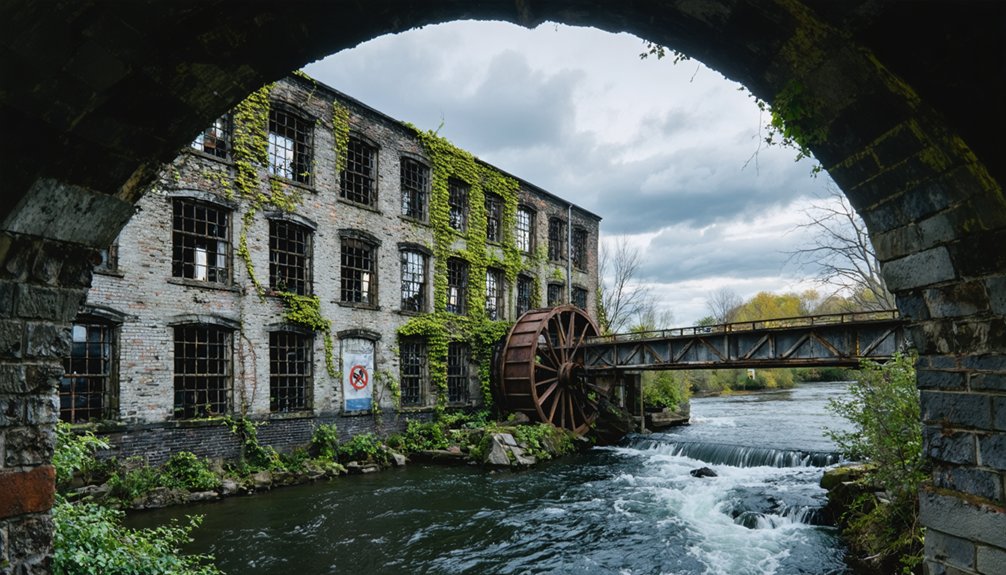
Along Rhode Island’s rushing rivers, a remarkable network of industrial villages emerged in the early 1800s, forever shaping New England’s manufacturing legacy.
You’ll discover Slatersville Mills, America’s first planned industrial village, where mill village lifestyles took root along the Branch River in 1807.
In Woonsocket, five distinct communities – Social Village, Woonsocket Falls, Jenckesville, and Bernon – grew from modest beginnings into thriving industrial centers.
At Social Village, you can trace the footsteps of the Ballou family’s pioneering textile ventures, while Jenckesville marks the shift to impressive stone mill construction.
From the Ballou family’s early textile mills to Jenckesville’s stone behemoths, Rhode Island’s industrial villages tell a story of manufacturing evolution.
Each village showcases Rhode Island’s rich industrial heritage, from hand-dug water trenches to massive stone factories powered by the Blackstone River’s relentless flow.
Nature’s Reclamation: Abandoned Coastal Settlements
As powerful storms and shifting coastlines reshape Rhode Island’s shores, you’ll find haunting remnants of abandoned settlements returning to nature’s embrace.
Among these remnants are various ghost towns in Rhode Island, where stories of the past linger in the decaying structures. With each visit, you can feel the echoes of the lives once lived, making these sites both eerie and intriguing. Exploring these forgotten places offers a unique glimpse into history, reminding us of the relentless passage of time.
Witness coastal reclamation in action at sites like Napatree Point, where the 1938 hurricane severed the barrier spit and erased Fort Mansfield’s military presence. Through ecological succession, saltmarsh grasses now claim former yards and foundations, while dunes migrate freely across once-developed land.
- Watch history fade at Scarborough Beach’s “Windswept” mansion ruins, where wild vegetation conquers the remains of Gilded Age grandeur.
- Explore Rocky Point’s weathered remnants, where tides and salt spray slowly dissolve memories of summer crowds.
- Discover how former coastal neighborhoods transform into essential shorebird habitats and shellfish sanctuaries as the sea reclaims its territory.
Frequently Asked Questions
Are There Any Guided Tours Available to These Abandoned Sites?
You’ll find few commercial guided explorations of these sites – most tours focus on historic buildings instead. Your best options are historical society walks or ranger-led programs at preserved locations.
What Safety Equipment Is Recommended When Exploring These Locations?
You’ll need sturdy boots, long sleeves, work gloves, hard hat, headlamp, first aid kit, GPS, and high-visibility vest. Don’t forget water, safety goggles, and insect repellent for safe exploration.
How Many People Lived in These Ghost Towns at Their Peak?
You’d be surprised how these once-bustling places dwindled to nothing. Hanton City peaked under 50 residents, Fort Mansfield area reached 200-400 combined military/civilian, and Ramtail housed 50-150 mill workers.
Which Ghost Town Has the Most Paranormal Activity Reports?
Ram Tail Factory in Foster has your highest concentration of ghost sightings, with decades of documented paranormal activity reports centered around the mill’s tragic haunted history and the murderous watchman’s demise.
What Valuable Artifacts Have Been Discovered at These Abandoned Locations?
You’ll find historically significant colonial artifacts at Hanton City, including hand-forged tools and ceramics, while Ramtail offers valuable industrial machinery parts and Fort Mansfield yields military relics and maritime treasures.
References
- https://en.wikipedia.org/wiki/List_of_ghost_towns_in_Rhode_Island
- https://providenceghosttour.com/haunted-attractions-rhode-island/
- https://www.rhodeislandredfoodtours.com/2024/10/28/haunted-sites-of-rhode-island/
- https://www.geotab.com/ghost-towns/
- https://www.youtube.com/watch?v=CouDr_Mqe8I
- https://carte-urbex.com/en/blogs/infos/top-10-abandoned-places-in-rhode-island
- https://www.providencejournal.com/story/lifestyle/things-to-do/2025/10/12/real-haunted-houses-and-places-in-rhode-island-to-know-this-october/86600081007/
- https://www.rimonthly.com/tag/abandoned-places-in-rhode-island/
- https://www.youtube.com/watch?v=kpy7zlXYrAU
- https://www.youtube.com/watch?v=3bFcmv7IH40