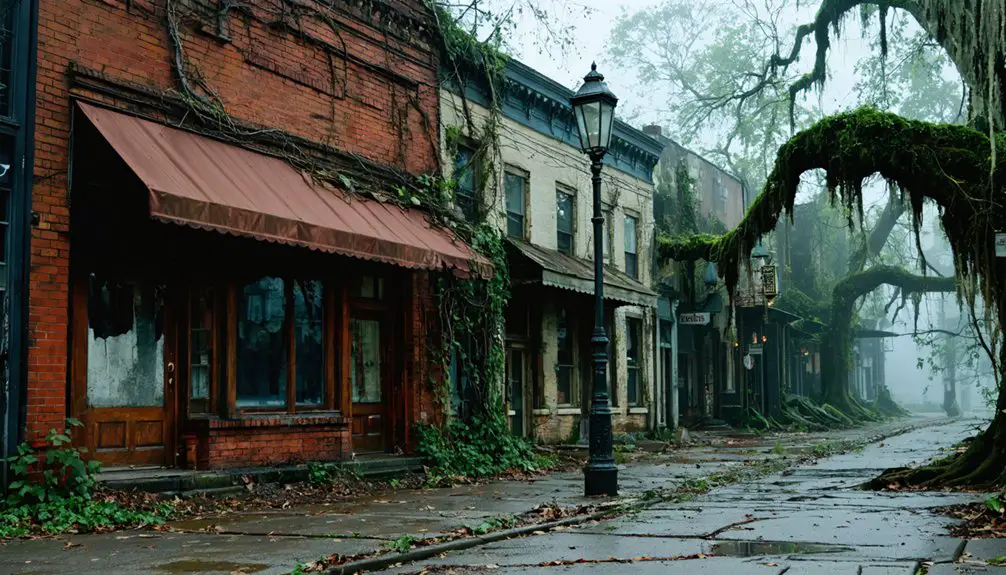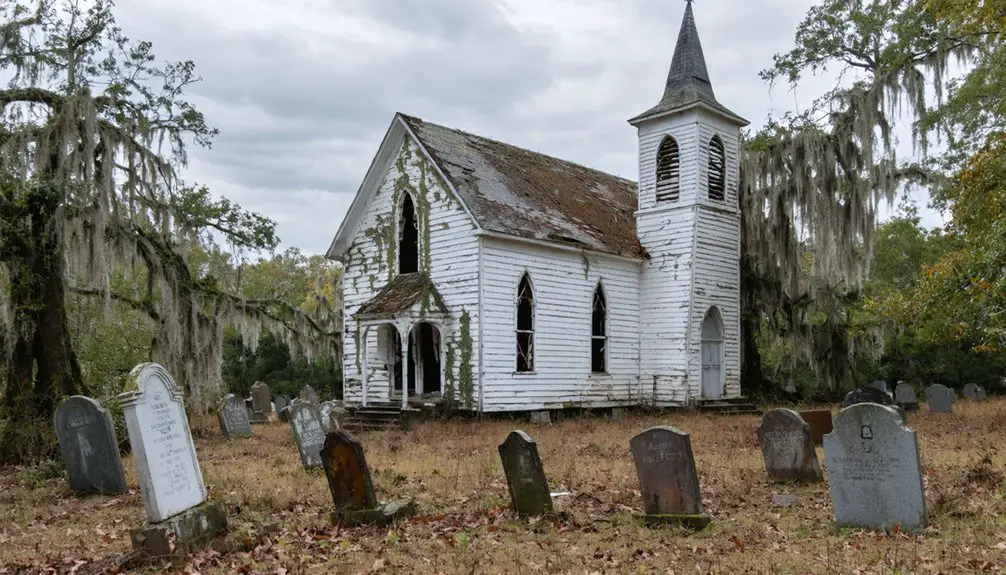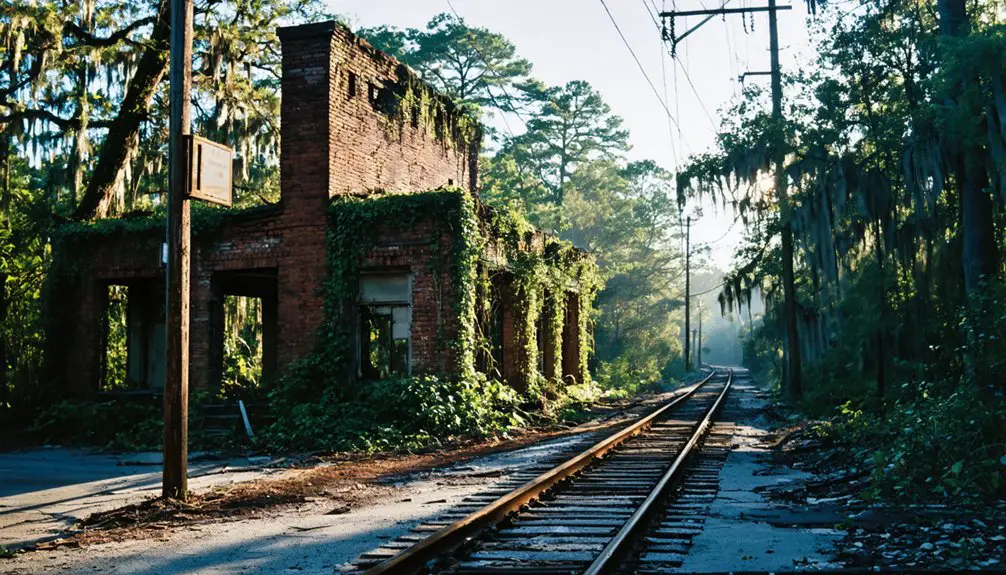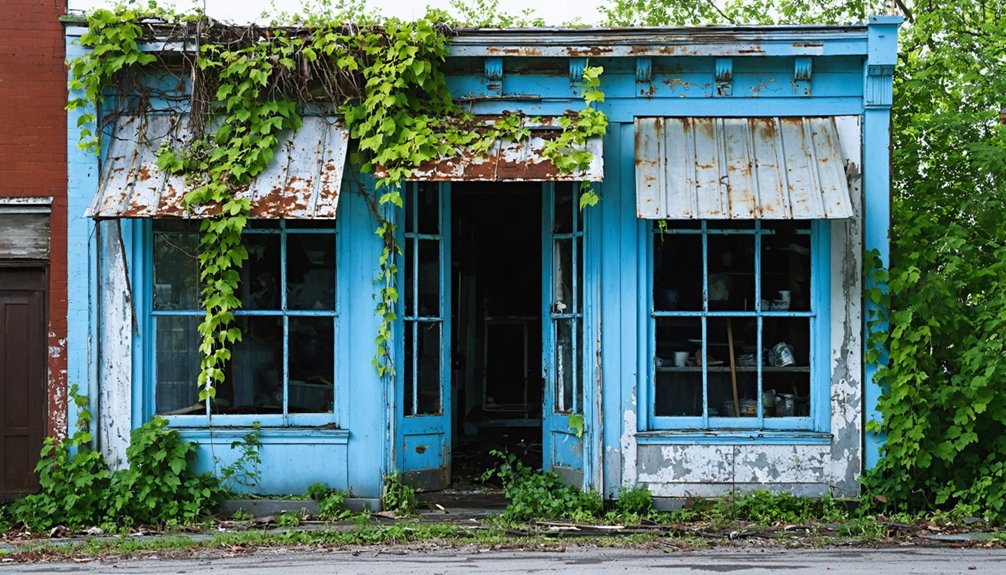
You’ll find fascinating ghost towns across South Carolina, from Ellenton’s Cold War displacement to submerged mill communities beneath Lake Hartwell. The state’s abandoned settlements include Colonial Dorchester’s trading post ruins, Glenn Springs’ crumbling resort structures, and numerous textile mill villages lost to economic shifts. Many sites preserve artifacts spanning centuries of history, while others lie hidden underwater or slowly fade into wilderness. These forgotten places hold countless untold stories waiting to be discovered.
Key Takeaways
- Ellenton became a ghost town in 1950 when 6,000 residents were displaced for the Savannah River Plant’s atomic energy facility.
- Colonial Dorchester, once a thriving trading post established in 1697, now stands as archaeological ruins with visible wharf remains.
- Glenn Springs, a former luxury resort town, declined after its hotel burned in 1941, leaving only remnants of its prosperous past.
- Lake Hartwell’s construction submerged several mill communities including Andersonville and Parkertown, creating underwater ghost towns.
- Numerous textile mill villages across South Carolina became abandoned as the industry declined, with most mills closing by 2001.
The Legacy of Ellenton’s Cold War Displacement
Although Ellenton began as a modest railroad depot in 1870, named after Mary Ellen Dunbar who captivated railroad president Stephen Millett, its fate would be dramatically altered by Cold War priorities.
In November 1950, the Atomic Energy Commission announced plans that would forever change this thriving community of 746 residents. You’ll find that Ellenton’s resilience was tested when it became the largest settlement displaced for the Savannah River Plant‘s nuclear weapons production facility. The plant’s construction was driven by the U.S. nuclear initiative, which prioritized expanding America’s atomic arsenal. The mass exodus affected approximately six thousand residents who were forced to relocate.
By April 1952, the town’s residents had relocated, many to the newly established New Ellenton. The Cold War legacy lives on through preserved artifacts, walking tours of old foundations, and the 2009 documentary “Displaced.”
Today, you can explore this history through the Savannah River Site’s programs, which honor the sacrifices of those who were forced to leave their homes behind.
Lake Hartwell’s Submerged Mill Communities
While Ellenton’s displacement marked one chapter of South Carolina’s lost communities, Lake Hartwell’s waters hold another compelling story beneath its surface.
When the reservoir filled in the early 1960s, it submerged thriving mill towns like Andersonville and Parkertown, where textile mills, gristmills, and cotton gins once powered local industry.
Today, you’ll find their remnants preserved as underwater time capsules – foundations, roadbeds, and chimneys visible to boaters and divers who venture to specific locations.
A vital part of local commerce, the Parkers Store post office operated from 1837 to 1906, serving the bustling industrial community.
The dam’s construction forced extensive changes, requiring nearly 20 miles of new highways and displacing rural families through eminent domain.
Before its decline, Andersonville flourished as a prominent port town with a direct barge connection to Savannah.
While archaeologists raced to salvage artifacts from Cherokee and colonial sites before the waters rose, many submerged structures remain unexplored, offering potential for underwater archaeology and future discoveries.
Colonial Dorchester: A Trading Post Lost to Time
You’ll discover Colonial Dorchester‘s origins as a strategic inland trading post where settlers capitalized on both riverine commerce and interior trade routes to become one of South Carolina’s largest colonial towns by the mid-1700s.
Your journey through its history reveals a bustling commercial center with roughly 40 houses, multiple wharves, and a bridge that facilitated the movement of rice and indigo to Charleston’s profitable export markets.
The establishment of St. George’s Church in 1719 marked a significant milestone in the town’s development and growth.
While the town’s economic significance made it a prime military target during the Revolutionary War, British forces’ destructive occupation in 1780 led to Dorchester’s ultimate abandonment by 1788.
The town’s rich archaeological record has yielded over 6,500 artifacts from a single quarter-acre lot, providing valuable insights into colonial life.
Early Trade Significance
Founded in 1697 by Congregationalist settlers from Massachusetts, Colonial Dorchester quickly emerged as one of South Carolina’s most crucial inland trading posts.
You’ll find evidence of early trade routes through its New England-style layout, complete with a marketplace and strategic riverfront lots that facilitated colonial commerce. By the mid-1700s, it had grown to become South Carolina’s third-largest town, boasting a sophisticated trading infrastructure along the Ashley River.
A log wharf served as the hub where merchants exchanged plantation goods, agricultural produce, and imported European wares. The town’s commercial significance is reflected in its archaeological remains – thousands of artifacts including imported ceramics, glassware, and metalworks. Today, visitors can observe the wharf’s remains during low tide. Recent excavations have revealed over 6,500 artifacts from a single quarter-acre lot.
Multiple riverside storehouses and a protective tabby fort further underscore Dorchester’s role as a crucial link between inland planters and Charleston’s bustling port.
Revolutionary War Impact
During the Revolutionary War, Colonial Dorchester’s strategic location transformed this bustling trading post into a significant military installation.
You’ll find that its tabby-constructed fort and powder magazine became essential Revolutionary fortifications, first serving American forces under Francis Marion’s command in 1775.
After Charleston’s fall in 1780, British forces seized control, using Dorchester as an important inland supply point. The tide turned in December 1781 when Colonel Wade Hampton and General Nathanael Greene’s forces drove the British out, dealing a substantial blow to Britain’s regional control.
The war’s aftermath spelled Dorchester’s decline, as residents abandoned the settlement, leaving only ruins behind. The St. George’s bell tower still stands as a testament to the once-thriving colonial town.
Today, ghost town preservation efforts protect these Revolutionary War remnants within a 325-acre state historic site, offering you glimpses into this pivotal period. Visitors can explore the site through archaeological tours that reveal the settlement’s rich history.
Pinckneyville’s Decline From Little Charleston
Though modeled after Charleston’s elegant streets and architecture, Pinckneyville’s reign as the judicial center of South Carolina’s Pinckney District proved short-lived.
You’ll find that Pinckneyville’s prosperity initially seemed assured, with its brick courthouse, jail, post office, and streets named after Charleston’s own – Meeting, Broad, Water, and Trade. The town’s infrastructure included a store, homes, and possibly even a clock factory.
But you would’ve witnessed its gradual decline after 1800 when the Pinckney District was abolished and Union County took over the courts.
The stagecoach routes that once brought life to the town couldn’t compete with the railroads, and by 1850, Pinckneyville had lost its importance.
Today, you’ll find only ruins: a 1.75-acre site with remnants of the brick jail and old store, standing lonely in the remote countryside.
Glenn Springs: From Luxury Resort to Abandoned Institution
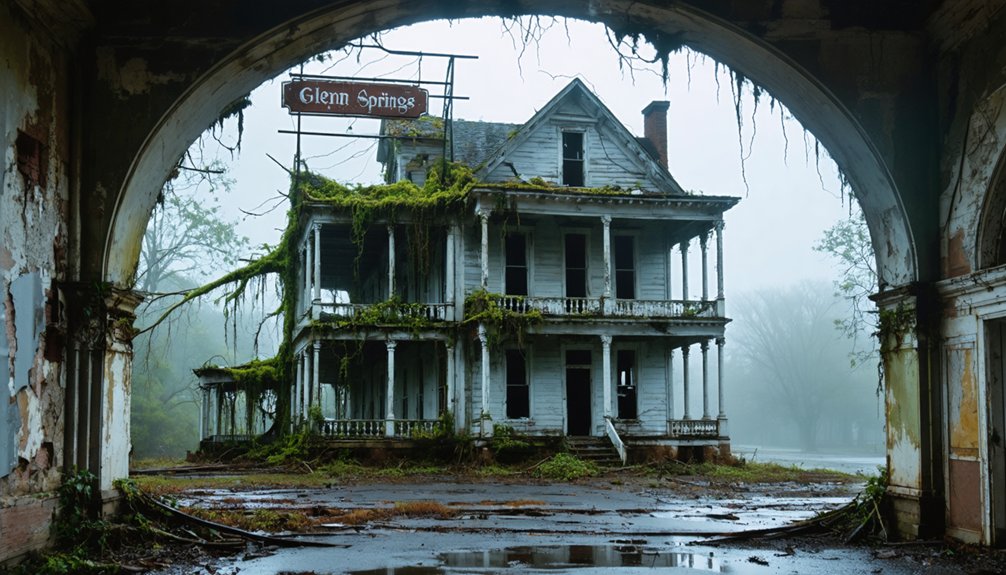
You’ll find Glenn Springs’ transformation from modest beginnings to a luxurious resort destination began when John B. Glenn purchased 500 acres surrounding sulfur-rich springs for $800 in 1825.
The Glenn Springs Company constructed an elegant hotel in 1838, drawing wealthy visitors who sought the mineral water’s healing properties and establishing a thriving resort village complete with its own railroad by 1894.
The resort’s golden age lasted through the early 1900s until the rise of automobiles and the Great Depression led to its decline, culminating in the hotel’s destruction by fire in 1941.
Resort’s Golden Age
After John B. Glenn purchased 500 acres for $800 in 1825, he transformed the sulfur springs into a destination for luxury visitors seeking health benefits. The mineral waters’ reputation for curing rheumatism drew wealthy patrons from across the Southeast.
By 1836, a grand hotel emerged under the Glenn Springs Company, later refined by John Conrad Zimmerman’s guidance.
You’d have found yourself among 70-80 distinguished guests, including politicians, educators, and planters, especially during the late 1800s. The 1894 addition of the Glenn Springs Railroad made the resort more accessible, with daily summer trips costing 75 cents.
You could’ve enjoyed billiards, ten pins, or leisurely walks to the springs, followed by evening tableaux performances. The hotel’s 100 rooms remained largely pristine through the 1920s, marking the peak of its golden age.
Rise and Fall
The golden age of Glenn Springs would face mounting challenges by the early 20th century.
You’d witness a dramatic luxury decline as the once-thriving resort succumbed to changing times. The rise of automobile travel and the Great Depression dealt severe blows to the resort’s viability, while the hotel’s deteriorating infrastructure reflected mounting financial struggles.
- The bottled spring water business, once shipped across the Southeast, couldn’t sustain itself.
- By the late 1920s, only 72 of 100 hotel rooms were rated “fine” by bank inspectors.
- The devastating 1941 hotel fire marked the end of Glenn Springs’ resort era.
- The property transformed into the Spartanburg Boys Home, losing its commercial identity.
- Historic structures, including the Presbyterian church and Cates Store, fell into abandonment.
The Lost World of South Carolina’s Textile Towns
South Carolina’s textile industry emerged as an economic powerhouse in the late 1800s, transforming the state’s Piedmont region into a manufacturing hub anchored by mill villages and factory towns. If you’d explored these communities during their heyday, you’d have found a rich textile heritage where life revolved around the mill’s whistle.
The Piedmont became the “Textile Center of the South,” with iconic operations like Camperdown No. 2 and Courtenay Mill shaping the region’s identity.
The distinctive mill culture created close-knit communities where you’d find company-provided housing, stores, schools, and churches. By the 1920s, one in six white South Carolinians lived this lifestyle.
While most mills closed by 2001, these aren’t your typical ghost towns – many villages transformed into vibrant bedroom communities, with places like Taylors Mill reinventing itself through art and dining.
Historic Preservation Efforts and Archaeological Discoveries
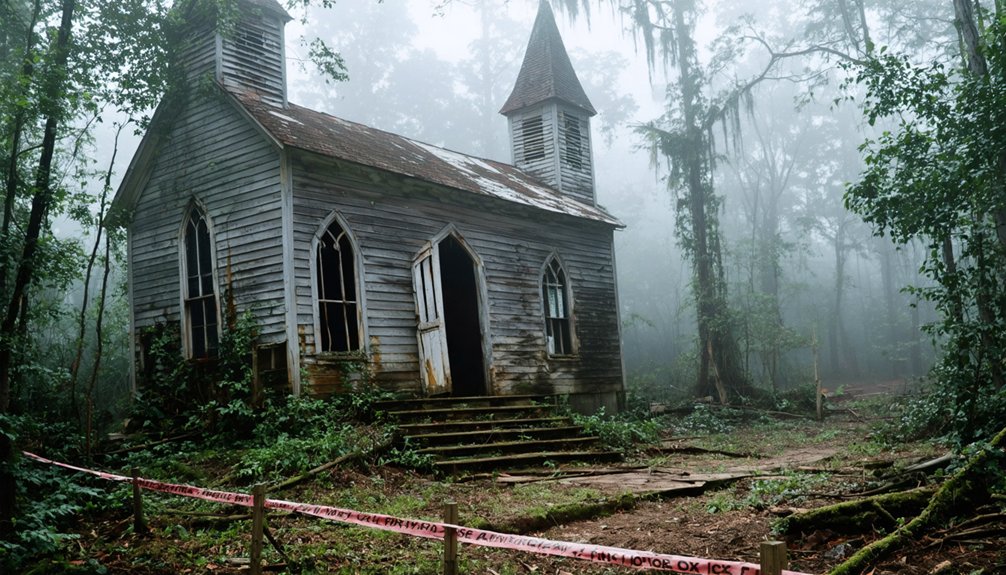
You’ll find South Carolina’s commitment to preserving its ghost towns exemplified through archaeological protection methods like those used at Colonial Dorchester, where careful excavation has revealed over 6,500 artifacts from a single lot.
Digital documentation efforts are transforming how researchers study sites like the submerged Chauga Mound and the recently discovered remains at Edingsville Beach, creating detailed records for future generations.
The preservation of structural remnants, such as the Biggin Church ruins, demonstrates how even damaged historical buildings can serve as valuable windows into South Carolina’s past while protected from further deterioration.
Archaeological Site Protection Methods
While many ghost towns across South Carolina face ongoing threats from development and natural decay, extensive archaeological protection methods have evolved to preserve these essential historic sites.
In addition to their historical significance, ghost towns in South Carolina offer unique opportunities for tourism and education about the region’s past. Community efforts are being made to promote awareness and appreciation of these sites, encouraging visitors to explore the stories behind the once-thriving locations. As preservation initiatives gain momentum, these ghost towns may become vital links to understanding the cultural heritage of the state.
The state’s archaeological preservation efforts combine legal frameworks with practical site management techniques to safeguard these irreplaceable resources.
You’ll find these key protection methods in place across South Carolina’s ghost towns:
- Systematic documentation using 3D modeling, GIS mapping, and detailed site surveys
- Implementation of protective barriers, controlled access paths, and anti-looting measures
- Strategic vegetation control and erosion prevention to protect building foundations
- Enforcement of state and federal laws prohibiting unauthorized excavation or artifact removal
- Regular condition assessments and monitoring to identify preservation priorities
Preserving Historical Building Remnants
Preserving historical building remnants in ghost towns requires a thorough approach combining legal protections, physical stabilization techniques, and community-driven initiatives.
You’ll find South Carolina’s historic preservation efforts utilize tools like the National Register designation and conservation easements to protect these irreplaceable structures. The state’s Abandoned Buildings Tax Credit has successfully revitalized over 2,200 historic properties.
When you’re dealing with building remnants, immediate structural support through shoring and bracing prevents further deterioration.
Local historic foundations employ masonry consolidation, roof repairs, and vegetation management to safeguard original materials.
You can get involved through nonprofit preservation groups that offer hands-on restoration workshops and fundraising campaigns.
These organizations partner with municipalities to guarantee ghost town structures receive proper care through public-private collaboration.
Digital Documentation and Research
As technology advances, digital documentation has revolutionized how South Carolina’s ghost towns are studied and preserved.
You’ll find extensive digital mapping and archival research tools that transform how these forgotten places are explored and recorded for future generations.
- State archives provide digitized deed records and municipal filings that track town histories from founding to abandonment
- LiDAR technology reveals hidden foundations and roadbeds beneath vegetation
- University collections offer scanned family papers and photographs showing population decline
- GIS mapping overlays historical maps onto modern terrain for precise location identification
- Drone photography and 3D modeling create detailed records of remaining structures
You can access these resources through various platforms, combining traditional archival research with cutting-edge spatial analysis to uncover the stories of South Carolina’s abandoned communities.
Economic Forces Behind Town Abandonments

Throughout South Carolina’s history, shifting economic forces sparked waves of town abandonment, beginning with the antebellum period‘s heavy reliance on cotton and rice exports.
You’ll find these economic changes intensified after the Civil War, when the collapse of enslaved labor made traditional rice cultivation unsustainable. The devastating effects continued through the Great Depression, when Charleston’s unemployment reached 20% and poverty gripped the Congaree-Santee basin.
Community resilience was further tested by major infrastructure projects. The Santee-Cooper initiative flooded entire towns for reservoir creation, while the Savannah River Site’s construction forced 6,000 Ellenton residents to relocate.
Though promised fair compensation, many residents received inadequate payment for their properties, exemplifying how national priorities often overshadowed local economic stability.
Transportation Changes and Community Decline
Transportation infrastructure changes reshaped South Carolina’s landscape and sealed the fate of numerous small towns. These transportation disruptions tested community resilience, often leading to complete abandonment.
You’ll find evidence of this transformation throughout the state, where once-thriving communities succumbed to progress.
- Interstate 26’s construction bypassed Pomaria and Peak, isolating them from crucial commerce.
- Railroad abandonments peaked in the 1980s, devastating rail-dependent towns like Moseley Store.
- Lake Hartwell’s creation submerged Andersonville entirely.
- The Savannah River Plant’s construction forced Ellenton’s relocation in the 1950s.
- Former railroad communities like Alcolu and Shoals Junction now stand as stark reminders.
These changes didn’t just alter travel routes – they fundamentally transformed communities, leaving behind ghost towns where vibrant settlements once stood.
Hidden Stories of the Palmetto State’s Ghost Towns
Behind South Carolina’s lush landscapes lie the fascinating remains of once-thriving communities that tell complex stories of colonial ambition, industrial boom-and-bust cycles, and government intervention.
You’ll find hidden narratives in places like Colonial Dorchester, where trading post ruins reveal early commercial aspirations, and in abandoned textile mill villages that showcase dramatic economic shifts.
At Glenn Springs, crumbling resort structures remind you of a bygone leisure era, while the relocated towns of Ellenton and Dunbarton represent communities displaced by federal projects.
Archaeological digs continue uncovering artifacts that document the region’s complex relationship with slavery, trade, and industrial development.
Many sites remain at risk, with some preserved as state historic locations while others slowly fade into the wilderness, their stories preserved only in local archives and oral histories.
Frequently Asked Questions
Are There Any Haunted Ghost Towns in South Carolina?
While you’ll find eerie abandoned places like Dorchester and Ellenton, there aren’t any confirmed ghost stories or documented paranormal investigations in South Carolina’s ghost towns, despite their fascinating histories.
If you’re eager to explore abandoned properties in South Carolina, the state’s lesser-known landscapes offer a chance to wander through remnants of the past. From crumbling factories to forgotten homes, each site tells a story waiting to be uncovered. Venturing through these locations can spark curiosity about the lives once lived there, even if their tales remain silent.
Can Tourists Legally Explore These Abandoned South Carolina Towns?
You can legally explore state-managed ghost towns like Colonial Dorchester, but you’ll need written permission to visit privately-owned sites. Always check property status and obtain permits to guarantee tourist safety.
What Dangerous Wildlife Might Visitors Encounter in These Ghost Towns?
With 100+ snake bites reported yearly, you’ll need wildlife safety awareness. You’re likely to encounter venomous snakes, black bears, alligators, and aggressive feral hogs during ghost town animal encounters.
Do Any Residents Still Live in South Carolina’s Abandoned Towns?
You’ll find some current inhabitants in partially abandoned towns like Newry and Ware Shoals, though most sites of historical significance are either restricted by federal law or completely uninhabited.
Have Treasure Hunters Found Valuable Artifacts in These Ghost Towns?
You won’t find reports of significant treasure discoveries in these locations. Archaeological digs at Colonial Dorchester revealed common artifacts, but there’s no evidence of valuable treasures at any of these ghost towns.
References
- https://www.randomconnections.com/ghost-towns-of-south-carolina/
- https://www.onlyinyourstate.com/trip-ideas/south-carolina/haunted-road-trip-sc-ghost-towns
- https://sctravelguide.com/2018/06/11/south-carolina-ghost-towns/
- https://www.blueridgeoutdoors.com/go-outside/southern-ghost-towns/
- https://www.atlasobscura.com/things-to-do/south-carolina/abandoned
- https://www.youtube.com/watch?v=-kK74wq5NUQ
- https://wnok.iheart.com/content/2023-10-11-abandoned-south-carolina-town-named-the-creepiest-ghost-town-in-the-state/
- https://www.scencyclopedia.org/sce/entries/new-ellenton/
- https://www.imdb.com/title/tt3068374/
- https://carolinaghosttowns.podbean.com/e/ellenton-and-the-atomic-towns/