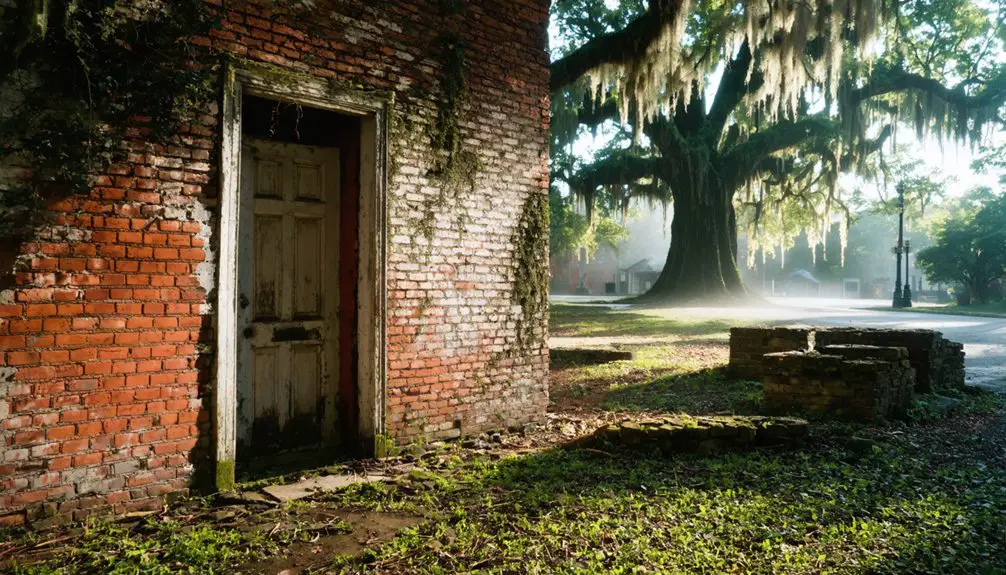
You’ll discover fascinating ghost towns across Virginia that reveal the state’s economic history. Matildaville, established in 1790, once served as headquarters for George Washington’s Patowmack Canal project before its 1830s abandonment. Ca Ira flourished as an 18th-century tobacco trading post, while Union Level’s Main Street boasted 20 businesses in the 1920s before declining. Today, these abandoned communities, from crumbling warehouses to derelict storefronts, offer glimpses into Virginia’s colonial and industrial past.
Key Takeaways
- Matildaville, established in 1790, was a canal town featuring mills and an inn before its abandonment in 1830 due to operational failures.
- Ca Ira emerged as a prominent tobacco trading post along the James River with 40 homes before declining due to economic shifts.
- Union Level thrived as a tobacco trade center with 20 businesses until the Great Depression, finally closing its post office in 1990.
- Virginia’s ghost towns often feature preserved storefronts and buildings that require protection through local preservation efforts and sheriff patrols.
- Many abandoned Virginia towns declined due to their dependence on tobacco trade and changing transportation routes during economic downturns.
The Lost Port Town of Matildaville
While George Washington served as its first president, the Patowmack Company established Matildaville in 1790 as an essential headquarters for an ambitious canal project connecting the Potomac and Ohio rivers.
“Light Horse” Harry Lee, who leased the land from the company, named the settlement after his wife Matilda. The Virginia Assembly issued a 900-year lease on the land.
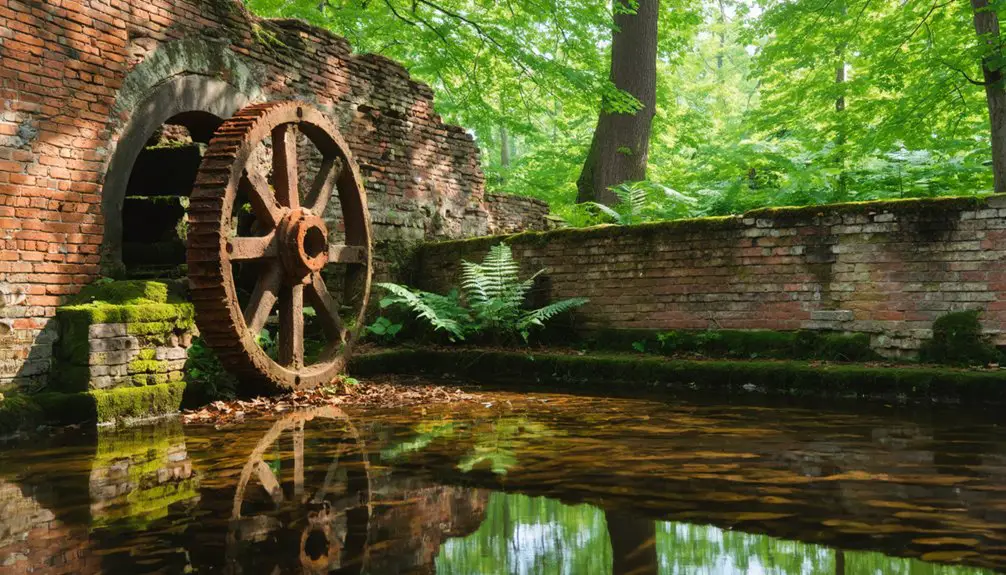
You’ll find that Matildaville history paints a picture of a bustling port town, complete with a market, gristmill, sawmill, foundry, and inn. Washington visited regularly to oversee the canal’s progress during its operational years.
The settlement’s canal engineering achievements were groundbreaking, though ultimately unsustainable. Despite innovative lock designs, the canal could only operate 1-2 months yearly due to water level extremes.
By 1828, mounting debts forced the Patowmack Company into bankruptcy. The town was abandoned by 1830 when operations shifted to Maryland’s side.
Today, you can explore the ruins along the 1.7-mile Matildaville Trail in Great Falls Park.
Ca Ira: A Vanished Tobacco Trading Post
You’ll find the ghost town of Ca Ira nestled along the James River in Cumberland County, where it emerged as an essential tobacco trading post in the late 18th century during Virginia’s shift from Tidewater to Piedmont production.
By 1836, this bustling village boasted 40 homes, multiple stores, taverns, and a tobacco warehouse that helped establish its role as a competitive marketplace for flue-cured bright and burley tobacco. Like other tobacco markets of the era, farmers would transport their crops in burlap sacks to the warehouse for auction.
The town’s fortunes faded when railroad expansion bypassed its river-dependent location, leaving only ruins today, including remnants of Grace Episcopal Church, as silent witnesses to Ca Ira’s once-prosperous tobacco trading legacy. Named after a French revolutionary song, the village was established in 1796 and quickly grew after the completion of the Willis River Canal in 1825.
Colonial Trading Hub Origins
As America emerged from its Revolutionary War, the small Virginia settlement of Ca Ira took shape along the Willis River in 1796, establishing itself as a strategic tobacco trading post.
You’ll find its origins deeply rooted in colonial commerce, as local planters and merchants carved out a riverside community oriented toward established trading routes. Named after a French Revolutionary song, Ca Ira’s founding reflected the young nation’s revolutionary spirit.
The town’s layout prioritized access to the Willis River, where bateaux and small craft could transport hogsheads of tobacco downstream. Two inspectors carefully examined all tobacco shipments to ensure quality control, as mandated by Governor Gooch’s act implemented decades earlier. Local landowners sold town lots to establish a collection point that linked surrounding plantations to the broader tobacco trade network through warehouse facilities and inspection stations, following traditional Virginia tobacco commerce practices. The presence of these facilities adhered to standards first established when the Virginia General Assembly fixed prices in 1619.
Tobacco Economy’s Rise
During Ca Ira’s prime in the early 1800s, the town’s tobacco economy thrived through its strategic placement along both the Willis River and the newly constructed canal system.
You’d find bustling tobacco warehouses where farmers displayed their crops for competitive bidding, while inspection stations guaranteed quality control for long-distance trade.
The town’s success relied heavily on evolving labor dynamics. Local crews, primarily young Black men, moved sold tobacco sacks to storage and loaded them onto transport vessels bound for larger markets.
This warehouse-to-water system made Ca Ira an essential link in Virginia’s tobacco trade network, where standardized hogsheads could be efficiently shipped to urban factories in Richmond or even overseas markets. Just as in Jamestown nearly two centuries earlier, the tobacco trade sustained the local economy and provided a path to prosperity for many Virginia merchants.
The town’s prosperity directly reflected tobacco prices and inspection standards that determined whether leaves were premium grade or “trash.” Similar to other colonies along the Potomac River region, Ca Ira’s location near waterways was crucial for transporting goods to major trading ports.
Lost to Economic Shifts
Once Ca Ira’s tobacco warehouse began losing business to larger regional auction centers, the town’s economic foundation crumbled rapidly.
You would’ve seen the dramatic economic decline as tobacco markets shifted inland to Piedmont towns like Lynchburg and Danville. Market consolidation by North Carolina and Richmond factories redirected trade flows, while new railroad routes bypassed Ca Ira’s once-advantageous river location.
What had been a bustling trade center with $40,000 in annual store sales and a mill grinding 30,000 bushels of wheat became a shell of its former self. Earlier in its heyday, the town had thrived by using navigable river transport to move tobacco to market.
The town’s three stores and two taverns vanished as warehouse operations ceased. Without the steady flow of tobacco sales and seasonal labor opportunities, Ca Ira’s merchants, workers, and residents gradually abandoned the settlement, leaving behind empty buildings and fading memories.
Colchester’s Colonial Maritime Legacy
When the Virginia Assembly established Colchester in 1753, they chose a strategic location at the Fall Line of the Occoquan River where coastal waters met inland rapids.
You’ll find evidence of a bustling maritime hub that once thrived on tobacco transportation, with warehouses and inspection stations dotting the north bank. The port’s maritime commerce relied on scow-hulled flats and lighters to move cargo between upriver farms and oceangoing vessels.
During the Revolutionary War, you’d have seen Continental troops crossing the Mason family’s ferry en route to Yorktown, while George Washington himself frequented the crossing. The ferry service, established in 1690 by the Masons, provided a crucial transportation link across the challenging Occoquan waters.
But nature had other plans – by the early 1800s, siltation choked the channel, and competition from Alexandria and Dumfries drew trade away, leaving Colchester to fade into Virginia’s forgotten past.
Union Level’s Forgotten Main Street

If you’re driving through Mecklenburg County today, you’ll find Union Level’s abandoned Main Street storefronts standing as silent witnesses to its once-thriving tobacco trade and railroad commerce.
The row of eight derelict buildings, including C.P. Jones’s former Rexall Drug Store with its collapsed floor, remains under sheriff surveillance as private property deemed too unstable for entry.
From its beginnings as a horse-and-carriage stop in the early 1800s through its 1920s peak of over twenty businesses, Union Level flourished until the Great Depression, railroad closure, and eventual 1990 post office shutdown sealed its fate as a Virginia ghost town.
Historic Storefronts Stand Empty
Today, a solitary row of weathered storefronts stands as the last evidence to Union Level’s once-bustling commercial district in Mecklenburg County, Virginia.
You’ll find C.P. Jones’s old drugstore, L.W. Lett’s general store, and the defunct Bank of Union Level among the abandoned buildings that line the quiet street. These structures, now off-limits due to instability, tell the story of a thriving railroad town’s rise and fall.
Inside these decaying walls, historic preservation efforts have uncovered business ledgers and receipts that document the town’s economic significance from the 1890s through the 1920s.
The buildings’ steady decline began during the Great Depression, culminating in the 1990 closure of the post office. While economic revitalization remains unlikely, these empty storefronts serve as silent witnesses to Union Level’s bygone prosperity.
Sheriff Patrols Private Property
Though many ghost town enthusiasts seek to explore Union Level‘s abandoned storefronts, James O. Thompson’s private property ownership means you’ll need to respect boundaries.
While specific sheriff patrols aren’t documented, the site’s growing visitor interest has led to increased security measures to protect these historic structures.
If you’re planning to visit this Virginia ghost town, remember these essential guidelines:
- Stay on public roads when photographing or viewing the buildings
- Respect posted private property signs and boundaries around Thompson-owned structures
- Document your experience from permitted areas only, as the remaining 82-188 residents maintain active community vigilance
The Thompson family’s stewardship helps preserve these remnants of railroad-era prosperity, even as curious explorers are drawn to what’s now called “Virginia’s Most Visited Ghost Town.”
Tobacco Trade’s Lasting Legacy
Once a thriving hub of Virginia’s tobacco trade, Union Level’s Main Street emerged in the early 1800s as an essential commercial waypoint between plantations and markets.
You can trace the town’s tobacco heritage through its rise and fall, from its early days as a stage coach stop to its railroad-driven peak in the 1920s, when over 20 businesses lined the streets.
The economic impact of tobacco shaped every aspect of Union Level’s existence. After the Southern Railroad’s arrival in the early 1900s, the town flourished with general stores, a bank, and a bustling depot.
But this dependence on tobacco proved fatal when the Great Depression hit, followed by industry consolidation and changing transportation patterns.
The Hidden Ruins of Wash Woods
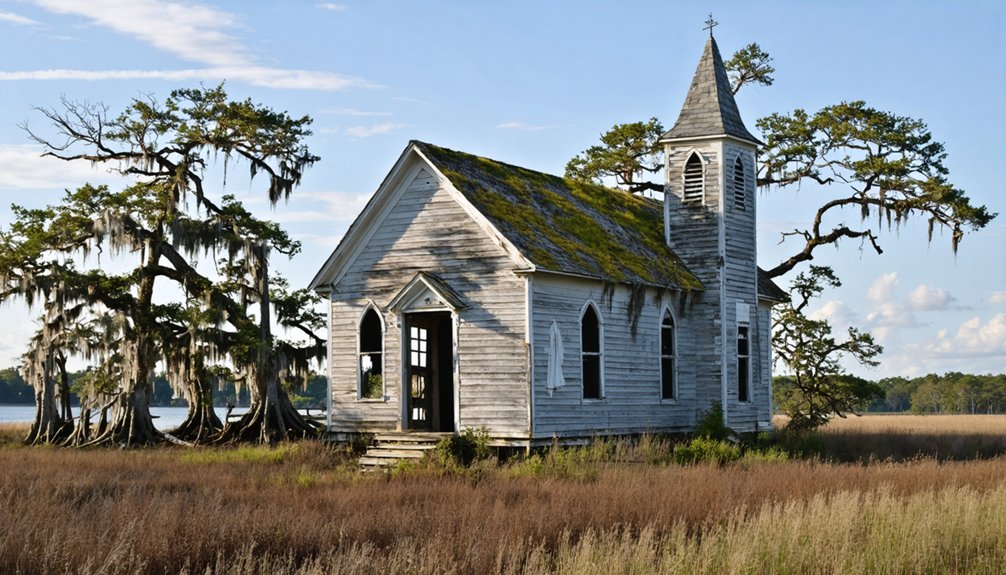
Shipwrecked survivors established the haunting settlement of Wash Woods in the 19th century, using salvaged lumber to build their homes on a vulnerable barrier spit. At its peak, this isolated coastal community thrived with 300 residents, supported by nearby Life-Saving Service stations and local industry.
Like ghosts from the sea, survivors forged Wash Woods from wreckage, building a resilient community of 300 on shifting sands.
Nature’s relentless forces led to Wash Woods’ inevitable decline through:
- Severe storms and coastal erosion that constantly reshaped the landscape
- Economic hardships during the Great Depression that devastated market hunting
- The closure of Coast Guard stations that removed essential employment
Today, you’ll find the settlement’s remnants in False Cape State Park, where a glass-encased church steeple stands as the most prominent reminder.
Hidden beneath shifting sands and maritime forest, scattered foundations and a weathered cemetery tell the story of this vanished community.
Joplin: A Community Reclaimed by Nature
Despite starting as a humble shoe shop called Merriman’s in the 1820s, Joplin evolved into a bustling railroad hub after Nicholas Pamplin donated land for the tracks in the 1850s.
You’ll find evidence of community resilience in the brick buildings that emerged after the devastating 1909 fire, including the historic pipe factories that once drove the local economy.
Today, nature reclamation is visible throughout this quiet village, where fewer than 250 residents remain.
The abandoned ironwork storefronts and empty buildings along Main Street stand as silent witnesses to Joplin’s former glory.
While most businesses have vanished, you can still experience the town’s heritage at MiPa’s Table, the lone restaurant on Main Street, or explore the High Bridge Trail that follows the old railway lines.
Virginia’s Ghost Towns: Preserving Their Stories
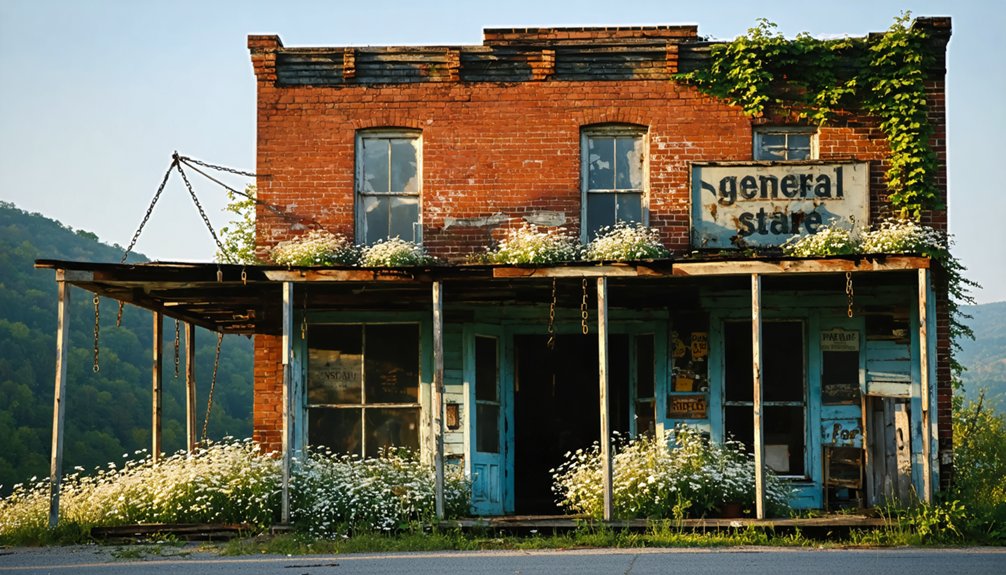
While Virginia’s abandoned communities slowly fade into the landscape, preservation experts are racing to document and protect these historic sites through a thorough approach.
Time erodes Virginia’s ghost towns day by day, but preservationists work diligently to save these invaluable pieces of our heritage.
You’ll find community preservation efforts focusing on historical significance through extensive documentation and strategic protection measures.
Here’s how you can support these essential preservation initiatives:
- Join local advocacy groups that coordinate volunteer maintenance and fundraising for ghost town sites
- Explore grant opportunities through Preservation Virginia funds and National Trust programs for stabilization projects
- Share family histories and community connections to help document the intangible heritage of these forgotten places
Through these combined efforts, you’re not just preserving buildings – you’re protecting the stories of Virginia’s past, from African American settlements to mining communities, ensuring future generations can understand their significance in our shared history.
Frequently Asked Questions
Are Any of These Ghost Towns Legally Accessible for Overnight Camping?
You’ll need permits and written camping authorization for overnight stays near ghost towns on WMAs, while following strict regulations about site location, duration limits, and resource protection guidelines.
What Supernatural Legends or Haunted Tales Exist About These Abandoned Towns?
You’ll hear of ghostly encounters at Matildaville’s canal ruins, spectral sightings of sailors at Colchester’s docks, whispers in Union Level’s storefronts, and phantom WWII pilots roaming Elko Tract’s forgotten airfields.
Have Any Artifacts From These Towns Been Preserved in Museums?
Like buried treasure waiting to be discovered, you’ll find thousands of preserved artifacts in Virginia’s museums, from Jamestown’s Archaearium to the Weems-Botts Museum, showcasing these abandoned towns’ material culture and daily life.
Can Metal Detecting Be Performed at Any of These Locations?
You’ll need explicit permission and permits since metal detecting rules vary by location. Check local regulations, get landowner approval, and verify if the site’s protected before searching these areas.
Were Any Films or Documentaries Ever Produced About These Ghost Towns?
You’ll find millions of treasures in YouTube documentaries about Virginia’s ghost towns, with standouts like the 2023 Union Level oral history and Dan Bell’s urban exploration pieces, but surprisingly few major theatrical releases.
Exploring vacant properties in Virginia’s ghost towns offers a glimpse into the past, revealing stories of once-thriving communities. Each building tells a tale of abandonment and history, inviting curious adventurers to uncover their secrets. Enthusiasts often gather to share their findings, creating a vibrant online community that celebrates these lost pieces of Americana.
In addition, the allure of abandoned towns in Virginia’s landscapes captivates photographers and historians alike, eager to capture the remnants of a bygone era. Each visit reveals unique architecture and hauntingly beautiful scenery that tell their own stories. As more visitors flock to these sites, the conversations around preservation and the importance of remembering these lost places continue to grow.
References
- https://everafterinthewoods.com/deserted-ghost-towns-in-virginia-that-history-buffs-cant-resist-exploring/
- https://theforgottensouth.com/union-level-virginia-ghost-town-history/
- https://kids.kiddle.co/List_of_ghost_towns_in_Virginia
- https://www.blueridgeoutdoors.com/go-outside/southern-ghost-towns/
- https://www.geotab.com/ghost-towns/
- https://www.youtube.com/watch?v=22gcF8bX2k0
- https://sites.rootsweb.com/~vatttp/ghosttowns/ghosttowns.htm
- https://www.islands.com/2035167/matildaville-virginia-historic-abandoned-town-nestled-great-falls-national-park-hauntingly-beautiful/
- https://www.youtube.com/watch?v=0fZtvEket4A
- https://www.onlyinyourstate.com/nature/virginia/matildaville-access-trail-va