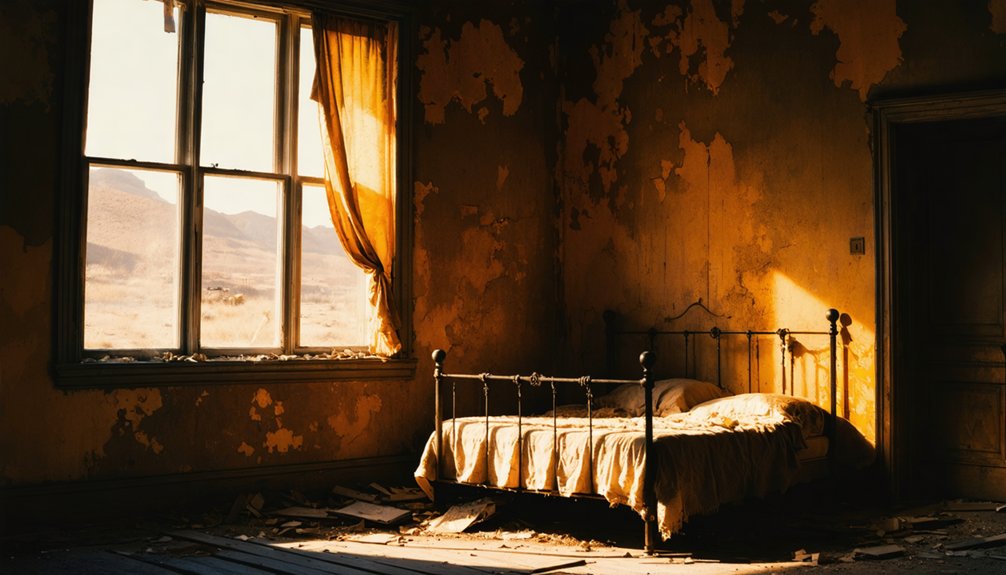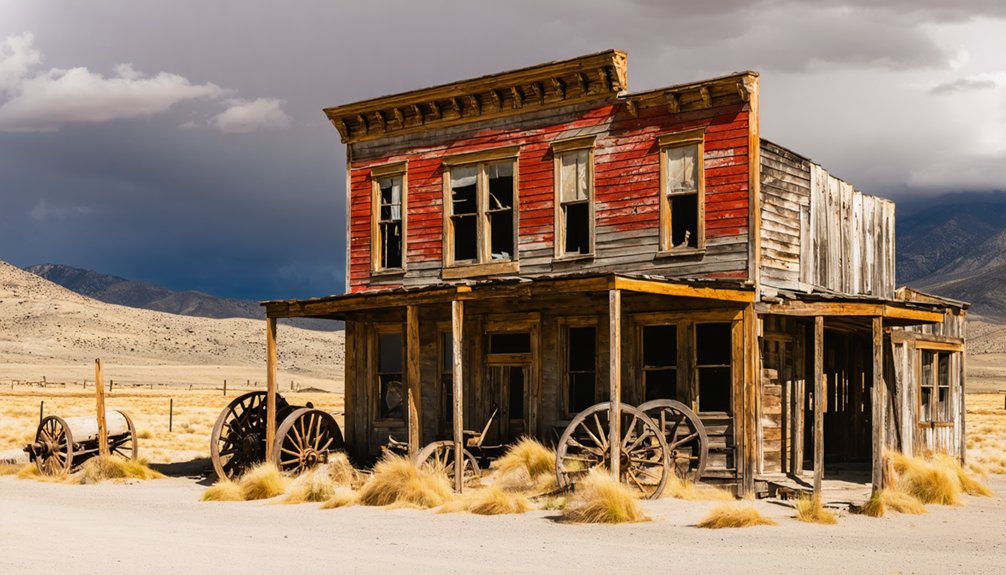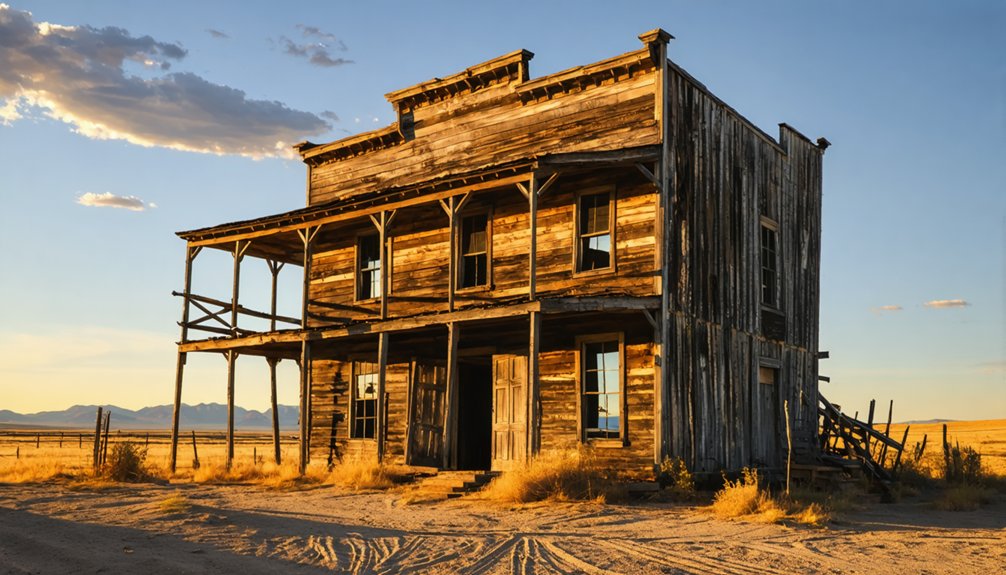
You’ll find America’s most fascinating ghost towns scattered across the Western states, from Bodie, California’s 110 original structures to Garnet, Montana’s authentic 1890s buildings. These preserved frontier settlements offer immersive experiences through mine explorations, historic railroad rides, and even paranormal investigations. While desert locations like Ruby, Arizona showcase complete town layouts, mountain sites like St. Elmo, Colorado reveal the extreme conditions of 1880s mining life. Your journey through these time capsules will uncover countless stories of America’s untamed past.
Key Takeaways
- Bodie, California offers over 110 original structures in “arrested decay” and guided stamp mill tours for an authentic ghost town experience.
- Virginia City provides historic railroad rides, paranormal investigations, and well-preserved buildings from Nevada’s silver mining era.
- St. Elmo, Colorado maintains numerous 1880s structures and allows visitors to explore its historic Main Street and mining buildings.
- Ruby, Arizona features a complete town layout with intact buildings, making it southern Arizona’s best-preserved ghost town.
- South Pass City, Wyoming includes restored saloons, mining equipment, and the historic English Tunnel for comprehensive frontier exploration.
What Makes a Ghost Town Worth Visiting
When evaluating a ghost town’s appeal, several key factors determine whether it’s worth adding to your travel itinerary. The most enchanting sites offer well-preserved structures that tell authentic stories of America’s frontier past, like Bodie’s 110 original buildings frozen in time or Virginia City’s legendary Comstock Lode site.
Ghost town allure intensifies when you can immerse yourself in genuine historical settings. The best visitor experiences combine accessibility with engaging activities – whether it’s watching gunfight reenactments at Tombstone’s OK Corral, exploring Calico’s 500 former silver mines, or photographing Kennecott’s imposing red mill against glacial backdrops. In Calico, visitors can even extend their adventure by staying at camping sites starting at $30 per night. Terlingua offers a unique twist on ghost town visits with its functioning bar where tourists can grab drinks while exploring the ruins.
You’ll want destinations that balance authentic preservation with practical access, like St. Elmo’s summer-operating general store or Batsto Village’s carefully maintained 18th-century structures.
Best-Preserved Western Mining Towns
Looking to step back into the American frontier’s golden age? These remarkably preserved mining towns offer authentic glimpses into the West’s rugged past.
Bodie, California stands as a triumph of historical preservation, with over 110 original structures and a fascinating stamp mill tour.
You’ll find Montana’s Garnet nestled in the mountains, where 30 genuine buildings tell tales of 1890s prosperity. The forest reclamation of the area adds a haunting natural beauty to the abandoned structures.
Virginia City’s rich history comes alive through its paranormal investigations and historic railroad rides.
South Pass City, Wyoming invites you to explore its restored saloons and venture into the historic English Tunnel.
St. Elmo, Colorado’s striking main street remains frozen in time, while Ruby, Arizona’s complete town layout creates an eerily beautiful representation of mining heritage.
Each destination lets you walk in the footsteps of prospectors, gunslingers, and pioneers who shaped the American West through determination and grit.
Must-See Mountain Ghost Towns
Among North America’s most enthralling ghost towns, the mountain settlements stand as rugged monuments to human perseverance above 6,000 feet.
Visiting these historic sites requires careful attention to safety and permissions when exploring the remote mountain locations.
You’ll discover ghostly legends at St. Elmo, Colorado, where abandoned structures from the 1880s mining boom tell tales of frontier dreams.
For dramatic scenic viewpoints, head to Kennecott in Alaska‘s Wrangell-St. Elias National Park, where the restored copper mill looms against snow-capped peaks. The site features spooky flying tools reported by workers during preservation efforts.
Montana’s Garnet offers one of the best-preserved mountain mining experiences, with two dozen intact buildings nestled in the pine-covered Garnet Range.
Don’t miss Animas Forks, Colorado, perched above 11,000 feet, where historic boarding houses remind you of the determination it took to mine silver in these extreme alpine conditions.
Desert Ghost Towns of the Southwest
While mountain ghost towns share tales of mineral wealth, you’ll discover unique characteristics in the Southwest’s desert ruins, where abandoned mines and sun-baked structures tell stories of extreme fortitude and adaptation.
You can explore remarkably preserved sites like Bodie, California, with over 100 original buildings that showcase how frontier architects designed for intense heat using thick adobe walls, deep porches, and strategic ventilation.
Visitors can still see remnants of Bodie’s notorious past, including sixty former saloons scattered throughout the preserved buildings.
The harsh desert climate has actually helped preserve many of these settlements, as minimal rainfall and dry conditions have prevented the rapid deterioration that plagues ghost towns in wetter regions. Towns like Canyon Diablo fell into disrepair due to railway construction errors rather than weather-related issues.
Abandoned Mines and Ruins
As prospectors scoured the American Southwest for precious metals in the late 1800s, they established numerous mining communities that would eventually become today’s ghost towns.
You’ll find abandoned structures scattered across Arizona and Nevada, each telling a unique story of boom and bust. Ruby stands as southern Arizona’s best-preserved ghost town, with visible mine workings and 25 original buildings. In New Mexico, over 400 ghost towns dot the landscape, most originating from mining communities.
In Harshaw, you can explore crumbling adobe walls and a hillside cemetery that hint at its former 2,000-person population. Fort Bowie’s ruins require visitors to take a 1.5-mile hike to reach the historic site. The dusty ruins of Swansea, maintained by the Bureau of Land Management, showcase classic mining heritage near the Bill Williams River.
Gleeson’s preserved schoolhouse, jail, and hospital offer glimpses into frontier life, while Rhyolite’s decrepit buildings remind you of Death Valley’s gold rush era.
Desert Survival Architecture
Because harsh desert conditions posed unique challenges, mining towns of the American Southwest developed distinctive architectural solutions for survival.
You’ll find evidence of these survival strategies in places like Goldfield, where territorial camp structures were built to withstand extreme temperatures, and Courtland, where miners used local desert materials like stone and adobe.
In Rhyolite, you can explore how desert towns evolved from basic shelters to sophisticated communities with modern amenities, including the innovative Bottle House that repurposed glass for insulation.
The divided layout of Congress, with its separate industrial and residential zones, shows how careful planning helped communities thrive.
Even in ruins, these towns reveal resourceful building techniques – from Harshaw’s enduring adobe walls to Courtland’s sturdy concrete jail, demonstrating how desert architecture adapted for long-term survival.
Preservation Through Extreme Heat
Here aspects of desert ghost town survival reveal an intense battle against nature.
You’ll find preservation challenges everywhere – from adobe walls crumbling under relentless sun to wooden beams warping through dramatic temperature swings. The harsh environment creates constant environmental threats: UV radiation breaks down paint and fabric, while salt crystallization slowly destroys masonry from within.
What you’re seeing has survived through careful management. Federal agencies and volunteer groups maintain many sites in “arrested decay,” preserving structures without full restoration.
They’re fighting against flash floods that undermine foundations, wind-driven sand that polishes away surfaces, and extreme heat that accelerates material fatigue. While legal protections exist for artifacts on public lands, limited funding means many sites receive only basic stabilization to slow their inevitable deterioration.
Planning Your Ghost Town Road Trip
When planning a thorough ghost town road trip across America, you’ll want to strategically map your route through the richest concentrations of abandoned settlements. For ideal route optimization, start in Pennsylvania’s Centralia, then head west through Texola, Oklahoma, and Cairo, Illinois.
The western loop offers the densest ghost town logistics, covering 4,616 miles across 16 key sites in California, Nevada, and Arizona.
Allow half a day per location, hitting Calico’s Mojave Desert ruins between Las Vegas and Los Angeles, and timing your Rhyolite visit for sunrise or sunset views.
You’ll find year-round access at Tombstone, while Bodie’s best explored in summer months.
Consider clustering your stops around major cities, where you can combine haunted walking tours with your ghost town explorations.
Photography Tips for Ghost Town Exploration
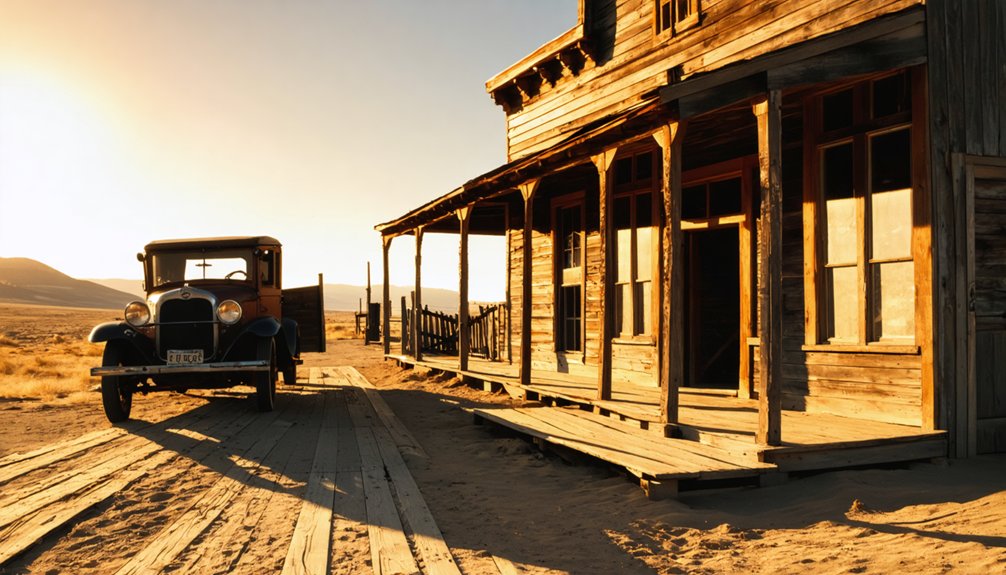
When photographing ghost towns, you’ll want to arrive before sunrise to catch the golden hour‘s dramatic light rays piercing through broken windows and weathered doorways.
You can maximize safety by bringing backup flashlights, working with a partner, and wearing sturdy boots to protect against rusty nails and unstable floorboards.
To capture the most compelling images, scout your locations the day before and plan your shots around the sun’s position, ensuring you’re ready to photograph the ethereal morning light as it illuminates these historic remnants of the American West.
Best Light Timing
You’ll need to carefully plan your ghost town photography around the moon’s phases. Allow 45 minutes for proper moonlight adaptation before shooting – your eyes must fully adjust to perceive the subtle interplay of light and shadow.
Full moons transform landscapes like Grafton into ethereal scenes, where you can capture exposures ranging from 3 seconds to 2 minutes depending on your creative vision.
For light painting, position yourself with moonlight coming from the right side, then work methodically through your scene. Start with distant subjects and move closer, using LED tubes for 13-second exposures on vehicle interiors or Surefire incandescents for building interiors.
Set your white balance to 4000K to maintain that authentic nighttime atmosphere while still allowing artificial light sources to blend naturally with the moon’s cool glow.
Safety While Shooting
Before venturing into abandoned ghost towns with your camera, thorough preparation and safety protocols are essential for both protecting yourself and preserving these historic sites.
You’ll need proper safety gear including sturdy boots, gloves, and respiratory protection when exploring these fascinating but potentially hazardous locations.
- Complete a risk assessment of each building’s structural integrity before entry, watching for sagging floors, unstable walls, and compromised roofs.
- Always explore with a partner and maintain communication with an off-site contact who knows your location and expected return time.
- Carry essential emergency supplies including multiple light sources, first aid kit, and offline maps or GPS coordinates.
Remember to obtain necessary permits and respect private property boundaries.
Your camera gear might be valuable, but your personal safety should always be the priority when documenting these historic treasures.
Safety Guidelines and Best Practices
Exploring abandoned ghost towns requires careful adherence to safety protocols, as these historic sites often harbor dangerous mine shafts, unstable structures, and environmental hazards.
You’ll need essential safety equipment including sturdy hiking boots, a reliable flashlight, N95 or P100 respirator, and basic first aid supplies. Never venture alone – travel in groups and share your detailed route plan with someone who can check on you.
Establish clear emergency protocols before your visit. Carry offline maps, a compass, and marking chalk to prevent disorientation.
Stay close to walls when exploring structures, and avoid room centers where ceilings might collapse. Remember, it’s illegal to remove artifacts or enter sealed mines. Respect posted signs, and if you encounter other explorers, heed their warnings about potential hazards they’ve discovered.
Seasonal Considerations for Ghost Town Visits
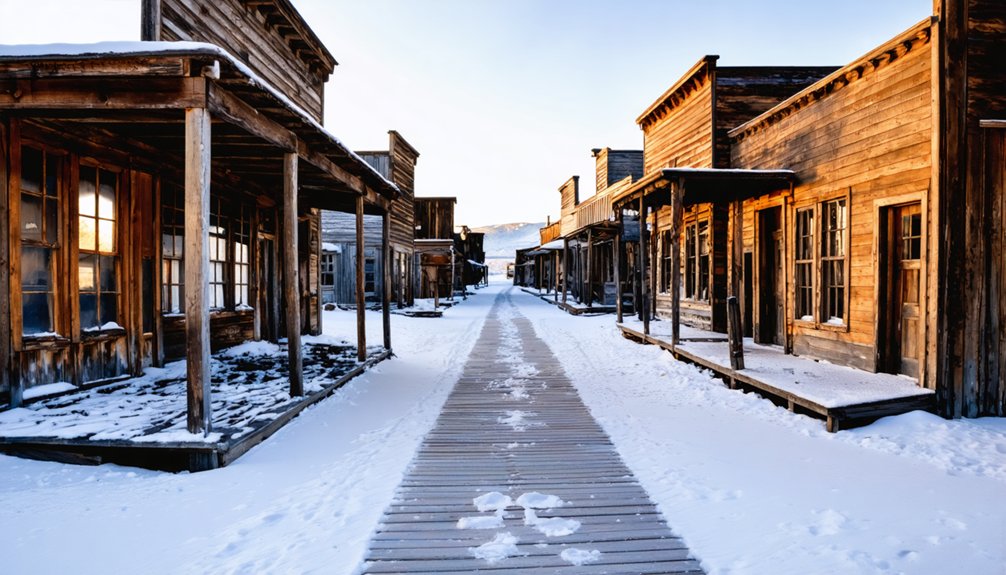
While ghost towns hold year-round allure, seasonal changes greatly affect both accessibility and visitor experience.
You’ll need to carefully time your visit, as seasonal weather patterns can make roads impassable or create hazardous conditions. Spring and fall generally offer the most favorable conditions, with moderate temperatures and stunning photography opportunities.
Consider these essential seasonal factors when planning your ghost town adventure:
- Winter snow often blocks access to high-elevation sites like Bodie and Animas Forks, requiring specialized vehicles.
- Summer brings extended daylight but harsh desert heat and potential flash floods in southwestern locations.
- Spring wildlife activity increases encounters with newborn and territorial animals, while autumn’s golden hours provide ideal photography conditions.
Remember that visitor services, including emergency response times and cell coverage, vary greatly by season, so you’ll want to verify current conditions before departing.
Historical Significance and Cultural Impact
Ghost towns stand as powerful symbols to America’s complex patterns of development, decline, and reinvention. These abandoned settlements tell compelling cultural narratives of boom-and-bust cycles, from gold rushes to railroad empires.
You’ll find evidence of social upheaval in their empty streets, where rapid population shifts and economic decline transformed vibrant communities into historical relics.
Today, preservation strategies like “arrested decay” help protect these time capsules of American life, allowing you to explore authentic buildings, artifacts, and infrastructure from specific eras.
Arrested decay freezes ghost towns in time, preserving authentic glimpses of American history through their weathered buildings and artifacts.
While ghost towns now contribute to heritage tourism, their impact extends beyond visitor dollars. They’re invaluable resources for understanding technological changes, labor conditions, and demographic shifts that shaped the nation.
Through careful interpretation, these sites continue to influence regional identity and challenge our understanding of progress and permanence.
Frequently Asked Questions
Are There Any Ghost Towns That Offer Overnight Camping or Lodging Options?
You’ll find camping amenities at Bannack and Calico, plus historic lodging options in Virginia City, Terlingua, and Kennecott, where you can stay in preserved buildings or nearby campgrounds.
Can I Take Home Artifacts or Souvenirs Found in Ghost Towns?
You’ll face up to $100,000 in fines for removing artifacts. It’s illegal to collect from federal, state, or tribal lands – legal regulations protect these sites for artifact preservation and future generations.
Which Ghost Towns Are Most Suitable for Visitors With Mobility Limitations?
You’ll find Colonial Williamsburg and South Pass City most accommodating with wheelchair friendly paths and modified buildings. Bodie offers balloon-tired wheelchair loans, while Ashcroft provides accessible attractions along its main thoroughfare.
Are There Guided Night Tours Available at Any Ghost Towns?
You’ll find ghost tours and night explorations at multiple locations: Vulture City offers flashlight-guided walks, Goodsprings runs paranormal investigations, and Rhyolite includes evening visits during Vegas-based excursions.
Do Any Ghost Towns Allow Metal Detecting or Treasure Hunting Activities?
You’ll need permits and landowner permission, as most ghost towns prohibit metal detecting under federal protection laws. However, some BLM lands surrounding abandoned sites allow regulated surface collecting with proper registration.
References
- https://places.travel/culture-history/ghosts-welcome-8-american-ghost-towns-where-tourists-can-mingle-with-the-macabre/
- https://www.christywanders.com/2024/08/top-ghost-towns-for-history-buffs.html
- https://www.visittheusa.com/experience/5-us-ghost-towns-you-must-see
- https://www.visitcalifornia.com/road-trips/ghost-towns/
- https://www.geotab.com/ghost-towns/
- https://www.atlasobscura.com/lists/americas-best-preserved-ghost-towns
- https://www.authentikusa.com/us-en/blog/english-top-5-villes-fantomes-aux-usa-maj
- https://backroadplanet.com/9-ghost-towns-still-standing-in-the-west/
- https://www.tripadvisor.com/Articles-loOISRppph64-American_ghost_towns.html
- https://www.americansky.co.uk/travel-inspiration/top-10-wild-west-towns-in-america