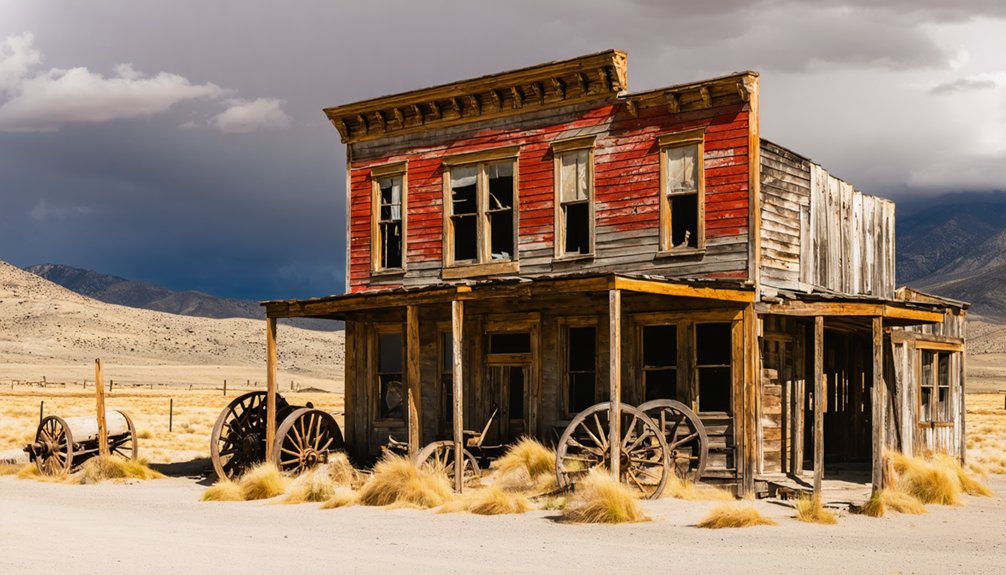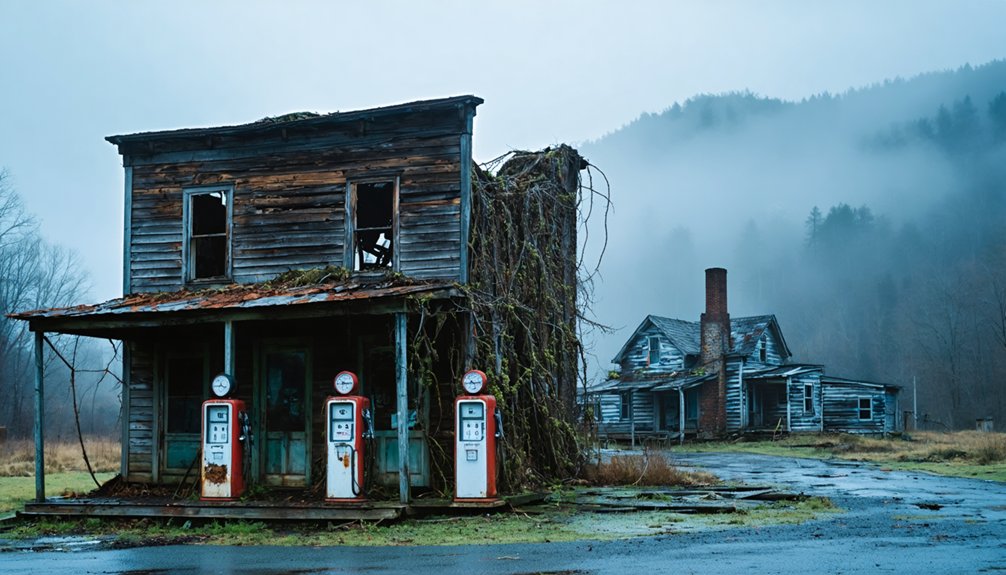
You’ll find Appalachian ghost towns scattered throughout the region’s mountains, remnants of once-bustling mining and railroad communities from the late 1800s to mid-1900s. These abandoned settlements feature coal tipples, company stores, and rail depots that tell stories of industrial boom and decline. Some towns, like Thurmond, maintain preserved structures, while others lie submerged beneath TVA lakes. Each forgotten community holds clues to understanding Appalachia’s complex economic and social transformation.
Key Takeaways
- Appalachian ghost towns emerged primarily from abandoned coal mining communities after technological advances reduced manual labor needs in the 1940s.
- Notable ghost towns include Thurmond with its preserved rail depot, and Kaymoor’s ruins in New River Gorge’s cliffs.
- Many towns were submerged by TVA projects, with over 13,000 families displaced and 1.1 million acres flooded for reservoirs.
- The decline of rail transportation and shift to truck shipping contributed to the abandonment of numerous rail-dependent mountain communities.
- Coal production dropped 65% between 2005-2020, causing widespread community abandonment as the region’s economic foundation collapsed.
The Rise and Fall of Mining Communities
While early explorers first documented Appalachian coal seams in the 1740s, the region’s true transformation began after the Civil War when industrial demand sparked rapid mining development.
You’ll find that as railroad lines extended through the mountains in the 1880s, coal corporations quickly established company towns to house the influx of workers. These communities showcased both cultural heritage and community resilience, with residents maintaining traditional ways of life despite corporate control. Scots-Irish immigrants shaped much of the region’s distinctive culture and music between 1717 and 1775. Workers were paid in company store script, forcing them to purchase necessities at inflated prices.
Yet by the 1940s, technological advances reduced the need for manual labor. As mines became less profitable and mechanization decreased reliance on company towns, families were forced to seek work elsewhere.
The once-bustling communities emptied, leaving behind ghost towns – silent monuments to an era when coal was king and community life revolved around the mines.
Life in Railroad and Logging Towns
As railroad companies carved paths through Appalachia’s rugged terrain, they established precisely planned company towns that followed standardized grid or linear layouts.
You’d find these logging communities clustered around sawmills and rail depots, where narrow-gauge tracks connected remote timber stands to the mainline railroads. The Chesapeake & Ohio Railway transformed the Greenbrier Valley into a bustling corridor of commerce and industry. The paper mills became major employers as logging operations expanded across the region.
Life in these towns revolved around the company’s control. You’d work long, dangerous shifts felling trees or operating steam equipment, then return to company-owned housing.
Every aspect of daily existence fell under company control – from the backbreaking labor to the roof over your head.
Your wages often came as scrip, redeemable only at the company store. While railroad expansion brought prosperity during timber booms, these towns lived and died by the harvest cycles.
Once the surrounding forests were stripped bare, companies would abandon their operations, leaving behind empty buildings and eroded hillsides as silent reminders of the logging era.
Beneath the Waters: Submerged Settlements
You’ll find a remarkable collection of lost Appalachian communities resting beneath modern reservoirs, from Gad’s submerged farms to Loyston’s trading center.
The Tennessee Valley Authority and Army Corps of Engineers systematically flooded these towns between the 1930s and 1960s, relocating residents and cemeteries while transforming valleys into lakes for flood control and power generation. During WWII, Fontana Dam construction powered crucial military operations at Oak Ridge.
These underwater settlements now exist as time capsules, with Jocassee’s standing forests and Gad’s periodic draining revealing foundations, roadways, and carved stones that document life before the floods.
Today’s scuba diving explorers help preserve the stories of these submerged communities while contributing to local heritage preservation efforts.
Lost Communities Below Water
Beneath the tranquil waters of Appalachian lakes lie the remnants of once-thriving communities, submerged during mid-20th century dam projects.
You’ll find underwater archaeology sites like Gad’s “Appalachian Atlantis” beneath Summersville Lake, where clear waters reveal preserved structures waiting to be explored.
At Lake Jocassee, the Attakulla Lodge still stands sentinel among submerged forests that mirror moonlit winter woods.
Cumberland, Virginia experienced dramatic transformation when flood control projects claimed neighborhoods and reshaped local geography.
The historical preservation of these lost towns varies dramatically.
While some, like Proctor beneath Fontana Lake, maintain accessible portions via backcountry trails, others like Loyston vanished completely under Norris Lake’s waters. The community of Big Spring lies 60 feet underwater, with only old foundations and a quarry remaining as evidence of its existence.
You can trace their stories through relocated cemeteries, severed roads, and documented artifacts – including a filling station photographed just before its final submersion, forever freezing a moment in Appalachian history.
TVA’s Drowned Valley History
When the Tennessee Valley Authority launched its ambitious dam-building program in the 1930s, it forever altered the physical and social landscape of Appalachia.
You’ll find the reservoir impacts were staggering – over 1.1 million acres submerged, forcing more than 13,000 families from their homes. Beneath today’s tranquil waters lie the remnants of entire towns, churches, schools, and businesses.
The community dislocation hit hardest in rural areas, where riverside mill towns and farming settlements vanished completely. Today, Butler residents can view their town’s artifacts and memories at the New Butler museum.
Places like Loyston, Andersonville, and Soddy now rest silent under TVA lakes. While some communities received thorough documentation before flooding, others slipped away with little record.
The transformation displaced tens of thousands, with poorer residents and minorities often bearing the heaviest burden of losing both property and cultural touchstones. The relocation efforts included moving 20,000 graves from cemeteries that would soon be underwater.
Life After Reservoir Construction
The dramatic transformation of Appalachian valleys into vast reservoirs left an unprecedented archaeological record beneath the waters.
You’ll find the remnants of entire communities preserved in these underwater landscapes – from building foundations and roadbeds to standing trees and intact structures where owners didn’t sell before flooding.
The displacement impacts rippled through generations, as families lost ancestral farms and tight-knit social networks.
While government buyouts provided financial compensation, they couldn’t replace the deep community bonds that were severed.
Yet evidence of community resilience emerges in historical records, as relocated residents established new connections in nearby towns.
Today, divers and sonar reveal this submerged heritage, where masonry foundations endure longer than wooden structures, and sediment slowly blankets the artifacts of displaced mountain life.
Economic Forces Behind Abandonment
As you explore Appalachia’s ghost towns, you’ll find that their abandonment stems from the triple forces of depleted coal seams, transformed rail networks, and automated mining operations.
The coal companies’ monopsony power meant that when resources ran dry or became too costly to extract, entire communities lost their economic foundation.
Modern mining technology’s reduced labor needs, combined with the dismantling of crucial transportation infrastructure, left countless company towns without the means to sustain themselves.
Resource Depletion Impact
Resource depletion drove systemic economic collapse across Appalachian coal towns through multiple interconnected forces. As high-quality coal seams were exhausted, the shift from traditional resource extraction methods to mountaintop removal devastated community resilience while requiring fewer workers.
- The depletion of accessible underground seams forced mining operations to chase increasingly marginal deposits, driving up costs and triggering widespread closures.
- Abandoned mine infrastructure became costly liabilities rather than assets.
- Worker productivity declined in aging coal fields, accelerating population exodus.
- Stranded mining assets made economic diversification more difficult and expensive.
These geological limits created a downward spiral, as declining coal reserves directly correlated with shrinking local economies and the hollowing out of once-thriving mining communities.
Transportation Network Changes
Transportation networks fundamentally reshaped Appalachia’s economic landscape through dramatic shifts in rail and road infrastructure during the post-war era.
You’ll find this transportation evolution most evident in the widespread abandonment of once-vital rail lines, as CSX and Norfolk Southern reduced operations across Kentucky and Tennessee. The rail to road shift gained momentum when gas-powered trucks emerged as the dominant shipping method, leaving rail-dependent communities stranded.
While the Appalachian Development Highway System attempted to connect isolated areas to markets, many local roads deteriorated from lack of funding.
You can trace this decline through ghost towns like Thurmond, West Virginia, where empty rail yards stand silent after moving millions of tons of coal.
Today, some communities are finding new life through rail trail conversions and short-line preservation efforts.
Industry Modernization Effects
The economic forces that drove Appalachian ghost towns stemmed from dramatic shifts in energy markets and industrial modernization.
You’ll find this economic transformation reflected in stark statistics showing coal’s decline, where production dropped 65% between 2005-2020 as natural gas emerged as a cheaper alternative.
Key factors that devastated community resilience:
- Coal corporations extracted wealth while neglecting local infrastructure development
- Natural gas production overtook coal, becoming West Virginia’s sixth-largest industry
- High union labor costs made coal mining less competitive against alternatives
- Failed economic diversification efforts, despite $68.2M in development investment
This perfect storm of industrial changes left former company towns struggling to survive, with over 600 communities originally built around coal now facing abandonment as their economic foundations crumbled.
Notable Ghost Towns of the Region
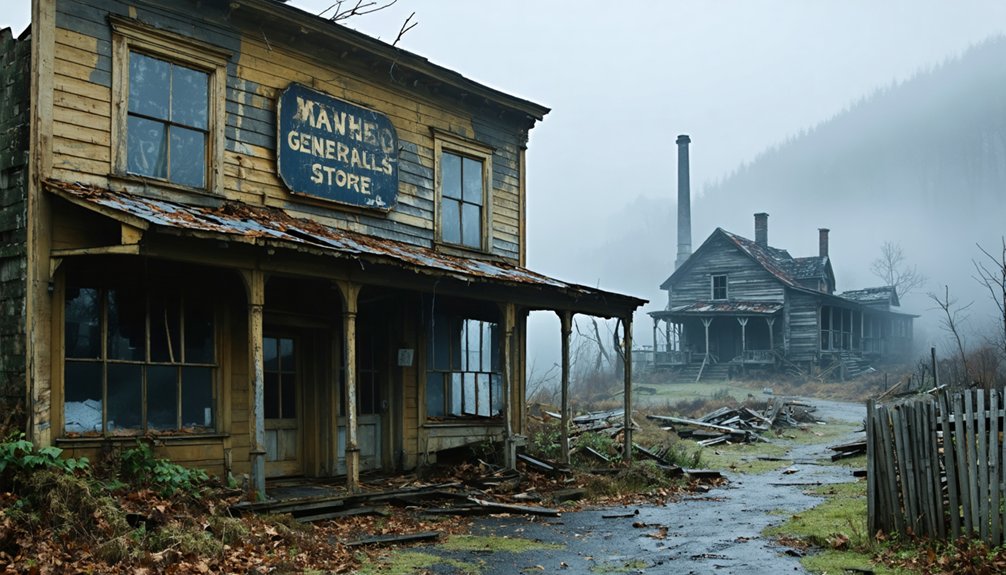
Among Appalachia’s most evocative ghost towns, four distinct sites showcase the region’s complex relationship with industrial development and federal infrastructure projects.
Thurmond’s history lives on through its preserved rail depot and storefronts, while Kaymoor’s ruins cling dramatically to New River Gorge cliffs, revealing the vertical engineering of coal mining operations.
You’ll find Proctor’s artifacts emerging from Fontana Lake’s waters during low levels, telling stories of displacement and lost communities.
Loyston’s legacy lies beneath Norris Lake, where TVA’s dam projects forever transformed both landscape and lives.
Each site offers a unique window into Appalachia’s industrial past – from rail-boom prosperity to mining innovation, and from rural displacement to the profound impacts of federal infrastructure initiatives.
Preserving Mountain Heritage
Preserving these mountain communities demands a complex web of financial, legal, and technical strategies working in harmony.
Cultural preservation succeeds through active community involvement, combining federal grants with state matching funds and local volunteer efforts.
Successful preservation requires everyone – from federal agencies to local volunteers – working together to protect our shared cultural heritage.
- You’ll find federal programs like Save America’s Treasures working alongside nonprofit endowments to fund essential restoration work.
- The National Register of Historic Places reveals critical protections and funding opportunities for ghost town preservation.
- Conservation techniques focus on structural stabilization using historically accurate materials.
- Local historical societies and volunteers contribute hands-on labor while collecting oral histories.
Your heritage tourism dollars help sustain these sites, from entrance fees to guided tours, ensuring these mountain treasures remain protected for future generations to explore and experience.
Safety and Access Considerations
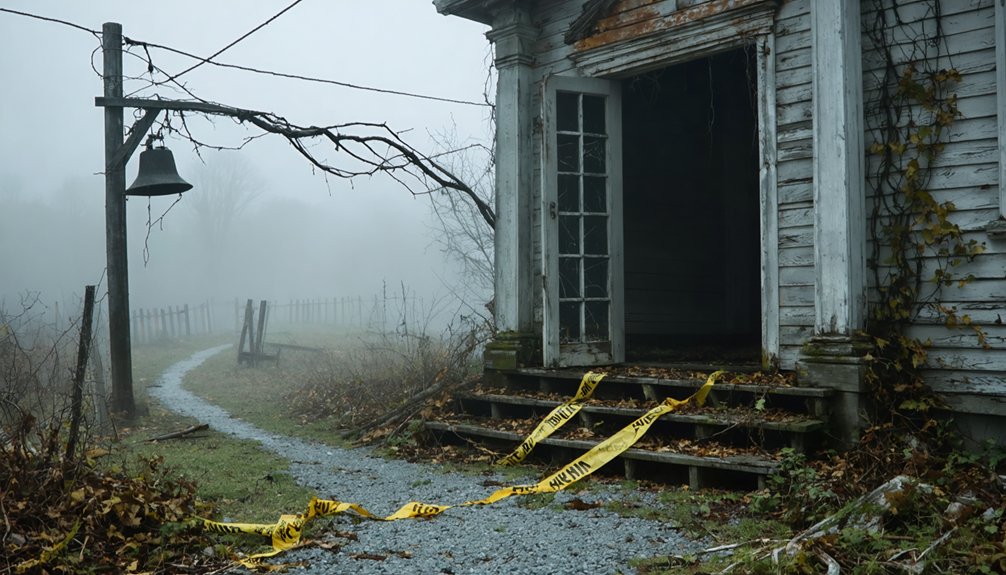
Visiting Appalachian ghost towns requires careful attention to safety risks that can impact both access and exploration. You’ll face heightened access risks on rural mountain roads, where fatality rates run 45% higher than non-Appalachian regions, particularly during dark or adverse weather conditions. Emergency response times stretch longer in these remote areas, compounding the risk of accidents.
Before exploring sites, you must navigate complex land ownership patterns across private, state, and federal territories. Safety hazards abound at abandoned locations – from unstable structures and hidden mine shafts to environmental contaminants like asbestos and toxic gases.
You’ll need to verify property permissions, check local ordinances, and watch for seasonal closures. The challenging terrain, with overgrown paths and unstable slopes, demands proper equipment and careful movement to avoid injury.
Legacy of Lost Communities
Throughout Appalachia’s rugged landscape, the legacy of lost communities tells a stark tale of economic upheaval and social transformation. In these abandoned places, you’ll discover stories of community resilience against overwhelming forces of change, from dried-up coal mines to submerged valleys.
- The self-sufficient culture of places like Lost Cove evolved from Civil War-era farming to moonshining operations along remote state lines.
- Cultural nostalgia lives on through preserved buildings, like the 16 remaining structures at Little River.
- Oral histories and photographic archives, including Lewis Hine’s work, capture vanished towns like Loyston.
- Modern preservation efforts, such as SAHC’s 95-acre purchase of Lost Cove, protect these historic sites for future generations.
These ghost towns stand as powerful reminders of how economic shifts and infrastructure changes can reshape entire communities.
Frequently Asked Questions
Are There Any Ghost Towns That Have Been Successfully Repopulated?
You’ll find limited success stories like Thurmond, WV, where community revitalization brought seasonal tourism and small-scale repopulation, though infrastructure challenges typically prevent ghost towns from returning to their original populations.
What Supernatural Legends Are Associated With Appalachian Ghost Towns?
Down to the wire, you’ll find haunted folklore of murdered miners, vengeful spirits, and eerie encounters with mysterious lights. Abandoned churches and mines hold countless untold stories of supernatural occurrences.
How Do Seasonal Weather Patterns Affect Ghost Town Exploration?
You’ll face major seasonal access challenges: winter brings road closures and ice hazards, spring causes flooding, summer brings storms and thick vegetation, while autumn’s wet leaves create slippery conditions.
Which Ghost Towns Have the Most Complete Photographic Records?
You’ll find Thurmond and Kaymoor, West Virginia hold the richest photographic records, with their historical significance captured through systematic documentation techniques in National Park Service archives and railroad collections.
Do Any Ghost Towns Still Maintain Regular Religious or Memorial Services?
You’ll find ghostly gatherings at Jolo’s snake-handling services, Derby’s active church, Thurmond’s summer tours, and haunting hymns during Proctor’s ferry-accessed memorial services at relocated mountain cemeteries.
References
- https://www.youtube.com/watch?v=4oHlJFXbrCk
- https://www.thewanderingappalachian.com/post/the-underwater-towns-of-appalachia
- https://appalachianmemories.org/2025/10/16/the-lost-towns-of-appalachia-the-forgotten-mountain-communities/
- https://www.britannica.com/topic/ghost-town
- https://www.appalachianhistory.net/2014/07/ghost-towns-cumberland-plateau.html
- https://www.themoonlitroad.com/coal-mining-appalachia/
- https://www.fs.usda.gov/nrs/pubs/jrnl/2021/nrs_2021_zipper_001.pdf
- https://www.youtube.com/watch?v=nhACetKIyMM
- https://en.wikipedia.org/wiki/Appalachia
- https://scholarworks.law.ubalt.edu/cgi/viewcontent.cgi?article=1789&context=all_fac