Yes, you’ll find several ghost towns in Mississippi, with Rodney and Grand Gulf being the most significant examples. Once-thriving river ports, these towns declined due to economic shifts, natural disasters, and changing transportation routes. Rodney, which had 4,000 residents at its peak, now features abandoned buildings and a historic cemetery with over 200 graves. The stories behind Mississippi’s ghost towns reveal fascinating chapters of antebellum commerce, Civil War impacts, and environmental transformations.
Key Takeaways
- Mississippi has several ghost towns, with Rodney and Grand Gulf being prominent examples of once-thriving communities that are now abandoned.
- Rodney declined from a bustling town of 4,000 residents to abandonment due to natural disasters and economic changes.
- Grand Gulf was a significant antebellum port shipping over 37,000 cotton bales before Civil War damage and environmental changes led to abandonment.
- Natural disasters, including floods in 1912, 1927, and 1935, contributed significantly to the decline of Mississippi’s river towns.
- Preservation efforts, led by organizations like the Rodney History and Preservation Society, maintain these ghost towns as historical sites.
Understanding Ghost Towns in Mississippi
When you explore Mississippi’s ghost towns, you’ll discover abandoned settlements that tell fascinating stories of once-thriving communities.
These sites aren’t just disaster zones – they’re places where the economic heartbeat stopped, leaving behind visible remnants of their former glory. The town characteristics typically include remaining buildings, empty streets, and forgotten infrastructure that hint at bustling past lives.
The abandonment causes paint a complex picture of Mississippi’s history. You’ll find towns that faded when the Mississippi River changed course after the Civil War, communities that couldn’t survive being bypassed by railroads in the 1870s, and settlements that succumbed to devastating fires and yellow fever epidemics. The historic town of Rodney exemplifies this decline, as yellow fever epidemics in 1843 and 1847 devastated its population.
Mississippi’s ghost towns stand as silent witnesses to river changes, railroad bypasses, devastating fires, and deadly epidemics that reshaped the state’s landscape.
Mill closures, like in Electric Mills during the 1950s, turned thriving communities into shells of their former selves. In Bankston, Union soldiers burned down the factories in 1864, leaving the town largely abandoned to this day.
Major Ghost Towns Along the Mississippi River
You’ll find Rodney’s dramatic transformation from a bustling river town of 4,000 residents with churches, stores, and banks to an abandoned settlement particularly compelling, as the Mississippi River’s course change left it stranded four miles from the water.
Natural disasters swept through the region, accelerating the town’s abandonment over time and leaving only remnants of its former glory.
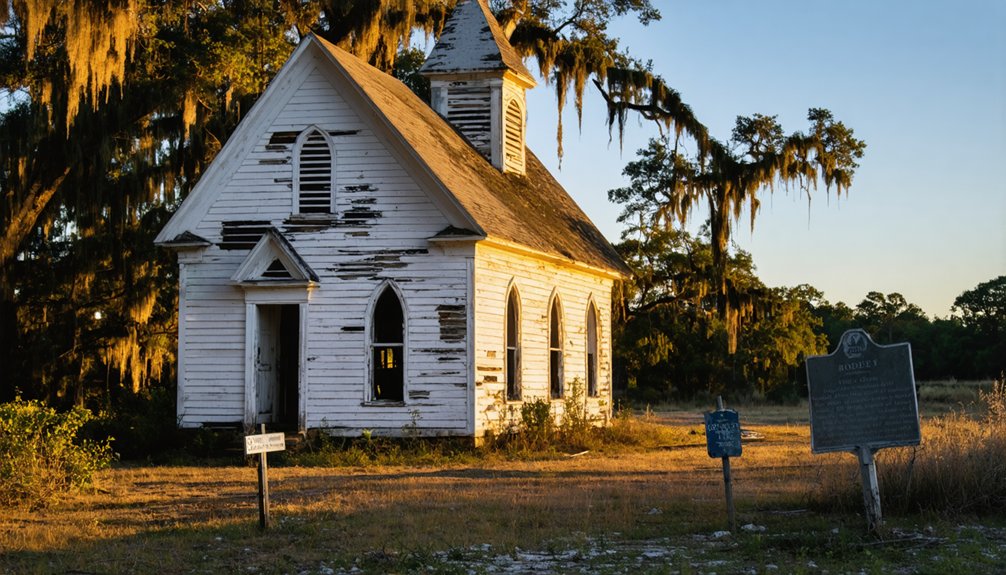
The town’s decline mirrors the fate of many riverfront communities, with its three-acre cemetery containing over 200 graves serving as a poignant reminder of its former significance.
Grand Gulf, though not directly mentioned in the facts, shares a similar story of Civil War impact and environmental forces that transformed these once-thriving Mississippi River ports into historical remnants. Today, these sites have become valuable historical attractions that draw researchers and tourists interested in exploring Mississippi’s past.
Rodney’s Rise and Fall
Along the banks of the Mississippi River, the once-thriving port town of Rodney emerged in the early 1700s as a strategic crossing point for Native Americans and travelers of El Camino Real.
By the 1860s, Rodney’s economy boomed as the busiest river port between New Orleans and St. Louis, boasting 4,000 residents, 53 stores, and the state’s first opera house. The town nearly became Mississippi’s state capital, missing the designation by just three votes. You’d have found two banks, four churches, and prestigious institutions like Oakland College and Alcorn University driving the town’s prosperity.
The town endured multiple hardships, including devastating yellow fever outbreaks that ravaged the population.
Yet Rodney’s legacy took a dramatic turn when nature intervened. A devastating sandbar formed in 1870, forcing the Mississippi River to shift miles westward. Bypassed by both river and rail, the town’s commerce crumbled.
Grand Gulf’s Civil Legacy
Situated atop commanding bluffs overlooking the Mississippi River, Grand Gulf emerged as a significant antebellum port after La Salle’s 1682 expedition first documented the strategic location.
By the mid-1800s, you’d find a bustling river town with wharves and warehouses serving steamboat traffic and cotton trade. The town’s economic success peaked when it shipped over 37,770 bales of cotton during 1834-1835.
The site’s military significance became apparent during the Civil War when, in April 1863, seven Union ironclads bombarded Confederate batteries at Forts Wade and Cobun. Union casualties during this engagement included seventy-five men.
Though the Confederates held their ground, subsequent fighting and destruction marked the town’s decline.
River course changes and lost commerce after the war sealed Grand Gulf’s fate.
Today, you’ll discover Grand Gulf Military Monument Park preserving the earthworks and historic landscape that tell the story of this ghost town‘s vital role in the Vicksburg campaign.
Historic Preservation and Accessibility
Despite the challenges posed by recurring floods and population decline, dedicated preservation efforts have breathed new life into Mississippi’s ghost towns, particularly in Rodney.
Under the leadership of Angel Puckett and the Rodney History and Preservation Society, historic restoration projects have transformed deteriorating landmarks through community engagement. Restoration efforts are eligible for historic tax credits through both federal and state programs. Technical assistance from preservation experts helps guide these critical restoration initiatives.
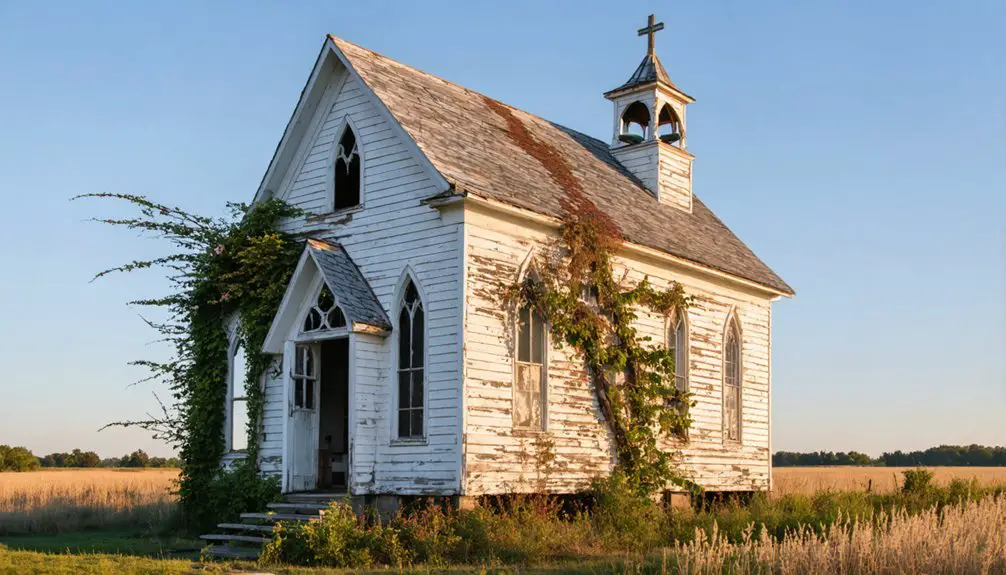
- The Presbyterian Church, built in 1832, received emergency stabilization and stands as the town’s only original structure.
- A three-acre hilltop cemetery, once an overgrown rattlesnake haven, now welcomes visitors after extensive cleanup efforts.
- The Mississippi Department of Archives and History supports preservation through grants, tax credits, and landmark designations.
You’ll find evidence of revival through regular cleanup events that draw both young visitors and descendants, proving that even with just 10 residents, Rodney’s historical legacy endures.
Lost Towns of the Railroad Era
You’ll find Mississippi’s lost towns tell a stark tale of how railroad bypasses transformed the state’s landscape, with once-bustling communities like Rodney and Prairie Mount withering after being excluded from crucial rail routes.
The railroad era’s economic shifts proved particularly devastating to river ports and stagecoach stops, as evidenced by Rodney’s dramatic decline from 4,000 residents to virtual abandonment after losing both river access and rail connections.
These forgotten communities now exist primarily as hollow buildings and overgrown ruins, though Meridian stands as a rare success story, having leveraged its railroad intersections to become Mississippi’s largest city by 1890.
Railroad Bypasses Kill Towns
While Mississippi’s river towns once thrived as essential trade centers in the mid-19th century, the strategic routing decisions of major railroad companies would seal the fate of many communities.
You’ll find the railroad impact was swift and devastating when towns were bypassed, as merchants and workers followed the rail lines to new economic opportunities.
- Rail companies chose routes that minimized construction costs, often bypassing established river ports in favor of creating new inland hubs.
- Towns like Rodney suffered severe economic decline when railroads redirected freight through alternative locations like Fayette.
- The shift from river to rail transportation made many local services obsolete, as rail offered faster schedules and more reliable year-round shipping options.
These bypassed communities couldn’t compete with the concentrated investment and infrastructure at new railroad towns.
Economic Shifts Drive Abandonment
As Mississippi’s railroad towns matured in the late 19th century, their economic foundations proved dangerously fragile.
You’ll find that many communities suffered from extreme economic vulnerability due to their dependence on single industries. Cotton monoculture left river towns exposed to devastating market shifts, while timber boomtowns collapsed when logging operations ceased.
The shift from steam to diesel locomotives dealt another blow, eliminating essential railroad repair facilities that had provided skilled jobs.
Railroad consolidation further concentrated services at major junctions, leaving smaller depot towns to wither. You can trace dramatic population decline through the 1920s-1950s as companies abandoned branch lines and relocated freight operations.
Meanwhile, the rise of highways and truck transport diverted commerce from rail-dependent communities, while increased automobile ownership enabled workers to commute elsewhere, hollowing out local economies.
Remnants of Former Glory
The physical remnants of Mississippi’s railroad era tell a compelling story of boom and bust, with abandoned towns scattered across the state’s landscape.
You’ll find these forgotten places marked by crumbling foundations, isolated brick chimneys, and overgrown cemeteries – stirring town nostalgia for a bygone age.
While some communities showed remarkable economic resilience by relocating closer to new rail depots, others simply faded into history.
- Former depot sites now serve as museums or community centers, preserving the railroad heritage
- Archaeological evidence reveals the footprint of once-thriving commercial districts, including bank vaults and warehouse ruins
- Historic cemeteries remain as permanent markers of these lost communities, often the last visible evidence of their existence
Natural Disasters and Town Abandonment
Natural forces proved ruthlessly efficient at dismantling Mississippi’s river towns throughout the 19th and 20th centuries.
You’ll find that catastrophic floods, particularly those of 1912, 1927, and 1935, repeatedly battered communities like Rodney until they couldn’t recover.
When the Mississippi River shifted its course westward, it left once-bustling ports high and dry, their wharves and warehouses crumbling into obsolescence.
These towns faced a brutal combination of disasters – devastating fires destroyed business districts, yellow fever epidemics decimated populations, and relentless flooding turned farmland into swamps.
The final blow often came when river changes cut off essential trade routes.
In Rodney’s case, you can trace its decline directly to a sandbar that redirected the river, leading to its ultimate de-incorporation by 1930.
Notable Archaeological Discoveries
While abandoned towns tell stories of Mississippi’s recent past, remarkable archaeological discoveries reveal a much deeper history of human settlement.
At Winterville Mounds, archaeological findings have confirmed an ancient causeway connecting ceremonial mounds, while excavations uncovered cultural artifacts linking the site to ancestral Natchez groups.
- Recent excavations at Mound D revealed a trash-filled pit containing animal bones and pottery dating to around 1200 AD, providing insights into daily life.
- Research shows these settlements weren’t randomly placed but strategically built near major waterways for trade and resources.
- Advanced studies using soil cores and geophysics have helped archaeologists understand why these communities thrived and ultimately disbanded, pointing to complex factors like flooding and social changes rather than single catastrophic events.
Exploring Mississippi’s Hidden Historical Sites
Scattered across Mississippi’s diverse landscape, numerous ghost towns stand as haunting reminders of once-thriving communities that time has largely forgotten.
Among these ghost towns in Mississippi, each location tells a unique story of prosperity followed by decline. Visitors may wander through overgrown streets and crumbling buildings, experiencing the eerie silence that envelops these forgotten places. These remnants of history attract not only curious explorers but also those fascinated by the tales of resilience and loss that echo through the abandoned structures.
Time-worn ghost towns dot Mississippi’s countryside, whispering tales of vibrant communities now faded into memory.
You’ll discover hidden treasures like Rodney, which nearly became the state capital, and Electric Mills, home to one of Mississippi’s first electric sawmills. Each site reveals forgotten stories of ambition and decline, from Bankston’s Confederate supply operations to Plymouth’s flood-driven abandonment.
You can explore the remains of Pitchlynn’s historic home site, walk through overgrown cemeteries, and witness the skeletal structures of former opera houses and sawmills.
From river ports like Grand Gulf to industrial centers like Logtown, these abandoned settlements offer glimpses into Mississippi’s rich past, where Native American trails once crossed paths with bustling nineteenth-century commerce.
Resources for Ghost Town Researchers
Modern researchers exploring Mississippi’s ghost towns can now leverage sophisticated technological tools and methodologies to uncover these lost communities.
Annual events in Mississippi ghost towns often attract history buffs and paranormal enthusiasts alike, creating a unique blend of cultural exploration and spine-tingling adventure. Visitors can participate in guided tours, which highlight the rich history and folklore surrounding these eerie locales. These gatherings celebrate the spirit of the towns, bringing communities together to reminisce about the past while shaping a new narrative for the future.
You’ll find advanced research tools that combine historical maps with cutting-edge technology to reveal forgotten settlements and structures.
- GIS mapping systems let you georeference old maps onto current satellite imagery, allowing you to pinpoint abandoned foundations, roads, and railroad beds with remarkable accuracy.
- Remote sensing techniques help you analyze land use changes over time while digitizing historical records and property boundaries to locate vanished communities.
- Spatial autocorrelation tools enable you to track housing density changes and identify abandonment patterns using USPS occupancy data.
These resources empower you to document Mississippi’s ghost towns through precise historical analysis and modern technological capabilities.
Frequently Asked Questions
Are Ghost Towns in Mississippi Safe to Visit at Night?
You shouldn’t attempt nighttime exploration of Mississippi’s ghost towns. They’re unsafe due to structural decay, flooding risks, poor road conditions, and lack of lighting. Take safety precautions by visiting during daylight hours instead.
Can Metal Detecting Be Done Legally in Mississippi Ghost Towns?
You’d need a million permits to detect legally! Most Mississippi ghost towns have strict metal detecting regulations due to their historical significance – you’ll need landowner permission or proper permits to explore.
Which Ghost Towns in Mississippi Have Reported Paranormal Activity?
You’ll find reported paranormal encounters in Rodney’s historic cemetery and abandoned churches, while Friars Point and Stuckey’s Bridge area offer haunted locations with tales of spectral lanterns and ghostly apparitions.
Do Any Mississippi Ghost Towns Still Have Year-Round Residents?
You’ll find Rodney’s ghost town demographics show about 10 year-round residents, including Jerry Thomas’s family. It’s the only documented Mississippi ghost town maintaining continuous habitation despite severe flooding challenges.
What Permits Are Needed to Photograph Mississippi Ghost Towns Commercially?
Like uncovering hidden treasures, you’ll need commercial photography permits from property owners, plus state permits ($250-1000) if ghost towns are on MDAH sites or state parks. Check local jurisdictions too.
References
- https://en.wikipedia.org/wiki/List_of_ghost_towns_in_Mississippi
- http://sites.rootsweb.com/~mstttp/ghosttowns.htm
- https://kids.kiddle.co/List_of_ghost_towns_in_Mississippi
- https://freepages.rootsweb.com/~gtusa/history/usa/ms.htm
- https://mississippifolklife.org/articles/haunted-by-a-ghost-town-the-lure-of-rodney-mississippi
- https://www.geotab.com/ghost-towns/
- https://www.tripadvisor.com/Attraction_Review-g28945-d10045204-Reviews-Rodney_Ghost_Town-Mississippi.html
- https://abandonedatlas.com/states/mississippi/
- https://www.onlyinyourstate.com/experiences/mississippi/ms-ghost-towns
- https://www.lovetoknow.com/life/lifestyle/12-haunted-places-mississippi-get-yourself-ghost-encounter