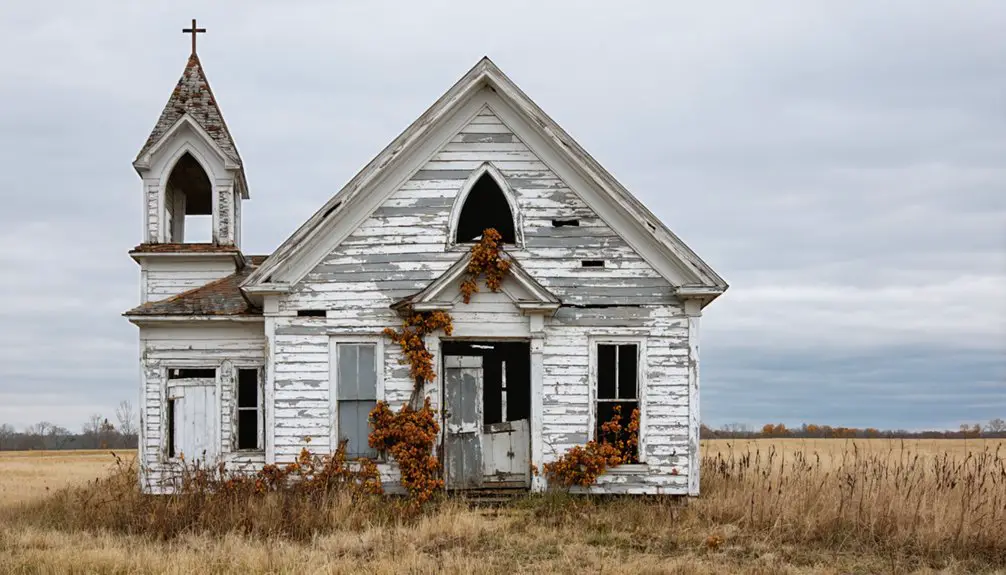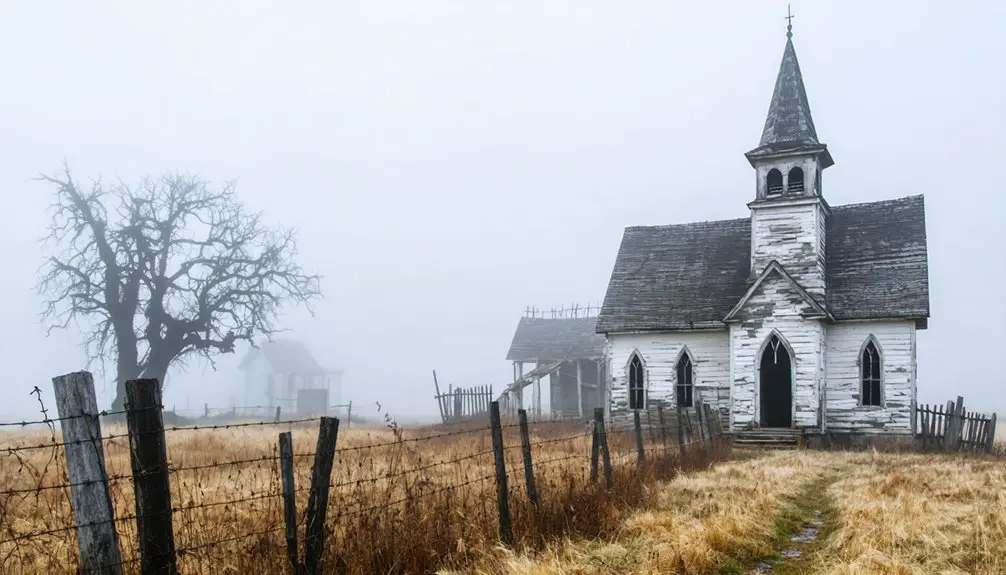
You’ll find over thirty documented ghost towns scattered across Missouri, many emerging from the state’s mining boom-and-bust cycles. These abandoned settlements include former Lead Belt mining communities, deserted towns along Route 66, and sites evacuated due to environmental disasters like Times Beach. While some retain small populations, others showcase only remnants of their past through deteriorating buildings and cemeteries. Missouri’s ghost towns offer fascinating windows into the state’s complex historical changes.
Key Takeaways
- Missouri has over thirty documented ghost towns, including former mining communities in the Old Lead Belt region.
- Times Beach is a notable ghost town that was completely evacuated due to dioxin contamination and later transformed into a state park.
- Historic Route 66 features several ghost towns like Paris Springs Junction, Avilla, Capitol 66, and Halltown.
- Communities like Hamburg and Howell became ghost towns after being evacuated for government projects during World War II.
- Ghost towns such as Georgia City, Bloodland, and Old Pattonsburg showcase Missouri’s boom-and-bust history through their remaining structures.
What Defines a Missouri Ghost Town
While many assume ghost towns must be completely abandoned, Missouri’s ghost towns encompass a broader definition that focuses on a location’s lost purpose rather than absolute desertion.
Missouri’s past reveals 21 ghost towns, with most concentrated near metropolitan areas.
The key town characteristics include visible physical remains like deteriorating buildings, foundations, or cemeteries that distinguish these sites from completely vanished locations.
Ghost towns tell their stories through crumbling walls and weathered foundations, leaving traces of lives once lived in these forgotten places.
You’ll find that abandonment causes typically stem from economic failure, whether it’s depleted mining operations, bypassed transportation routes, or defunct industries that once sustained these communities.
Some Missouri ghost towns still maintain small populations of up to 100 residents, yet they qualify due to their dramatic decline from previous prosperity.
Natural disasters have also played a significant role, with flooding and environmental contamination forcing entire communities to relocate, as seen in Pattonsburg and Times Beach.
According to T. Lindsey Baker’s definition, these settlements became ghost towns when their reason for being ceased to exist.
Notable Abandoned Towns Across the State
You’ll find Missouri’s most striking ghost towns clustered around abandoned mining operations in the Old Lead Belt, where communities like Bonne Terre and Desloge showcase extensive ruins and mine tailings.
The state’s historic Route 66 corridor contains numerous deserted towns, including Paris Springs Junction and Avilla, which declined after highway realignments diverted traffic and commerce. Travelers can still view vintage Arlington Road while exploring these abandoned settlements.
Near modern urban areas, you can explore remnants of communities like Hamburg and Howell, which were evacuated for government projects such as the Weldon Spring Ordnance Works during World War II. Many of these abandoned settlements serve as poignant reminders of time, with their empty buildings and overgrown streets telling stories of once-thriving communities.
Famous Missouri Ghost Towns
Missouri’s landscape is dotted with fascinating ghost towns that tell stories of bygone eras, from the historic Route 66 corridor to abandoned military sites.
Along Route 66, you’ll discover gems like Avilla, the Capitol 66 ghost town, and Halltown, where past meets present. The Mother Road between Carthage and Springfield features eleven abandoned communities waiting to be explored. Today, nearby towns like Maranville maintain a low crime rate compared to larger cities, making the area safer to explore.
In St. Charles County, three towns – Hamburg, Howell, and Toonerville – were absorbed into the Weldon Spring Ordnance Works in 1941, now part of a remedial action project. The historic Glore Psychiatric Museum stands as a testament to another abandoned institution that once served as the State Lunatic Asylum No. 2.
You’ll find other notable ghost towns scattered throughout the state, including Georgia City in Jasper County, Bloodland in Pulaski County, and Old Pattonsburg in Daviess County. Each site offers a unique glimpse into Missouri’s rich history of boom-and-bust settlements.
Modern Ruins Near Cities
Throughout Greater St. Louis, you’ll find extensive urban decay along the Mississippi River corridor, where abandoned industrial complexes and derelict warehouses stand as silent monuments to the region’s manufacturing past.
The prominent Masonic Temple in Louisiana stands among these architectural relics, showing the region’s historical grandeur now fading.
These industrial remnants include century-old grain elevators, rail-served plants, and vacant transportation infrastructure that marks the area’s commercial decline. Similar to the Westinghouse Electric Corp in Cleveland, these massive industrial shells dominate the landscape as haunting testaments to America’s industrial heritage.
Near Kansas City, within a 25-mile radius, numerous small-town main streets have transformed into modern ruins.
You’ll discover empty storefronts, boarded windows, and abandoned fraternal halls where bypassed highways redirected traffic away from historic downtowns.
Prominent concrete grain silos and gutted theaters remain as stark reminders of these communities’ former liveliness.
Municipal buildings, including old schools and post offices, stand vacant after population shifts and economic contractions reshaped these once-thriving towns.
Environmental Disasters and Town Evacuations
You’ll find no more dramatic example of an environmental disaster creating a Missouri ghost town than Times Beach, where dioxin contamination led to the complete evacuation of over 2,000 residents in 1983.
The crisis began when contaminated waste oil was sprayed on the town’s roads, but a devastating flood along the Meramec River spread the toxic substance throughout the community. Originally established in 1925 as a summer resort development, Times Beach grew from a seasonal getaway into a year-round working-class community. Russell Bliss’s method of mixing chemical waste with used motor oil created the toxic dust suppressant that ultimately doomed the town.
The federal government’s $200 million cleanup effort transformed Times Beach from a vibrant riverside town into a cautionary tale of environmental negligence, though the site has since been remediated and converted into a state park.
Times Beach Dioxin Crisis
The Times Beach dioxin crisis stands as one of America’s most severe environmental disasters, where toxic waste contamination led to the complete evacuation and abandonment of an entire town.
The crisis began when waste oil containing dioxin, a byproduct of Agent Orange manufacture, was sprayed on unpaved roads for dust control between 1972 and 1976.
You’ll find this contamination originated from Russell Bliss, a waste hauler who mixed and sold toxic chemicals from the Northeastern Pharmaceutical and Chemical Company.
Floods Reshape River Communities
Since the mid-1800s, Missouri’s river communities have endured devastating floods that repeatedly reshaped their physical and social landscapes.
You’ll find the 1844 flood set early benchmarks for destruction, while the 1951 floods surpassed these historic levels in the lower Missouri Valley.
The 1993 Great Flood‘s $30.2 billion impact demonstrated the increasing costs of flood impacts on vulnerable riverside settlements.
You’ve witnessed how community resilience was tested further during the 2011 disaster, which claimed five lives and destroyed thousands of homes.
The 2019 floods proved even more extensive, with record-breaking duration of 279 days along the Missouri River.
These escalating challenges have forced many communities to adapt, relocate, or ultimately abandon their riverside locations, creating modern ghost towns along Missouri’s waterways.
Mining Settlements Lost to Time
Throughout Missouri’s industrial past, numerous mining settlements flourished briefly before fading into obscurity, leaving behind weathered remnants of their prosperous days.
Ghost towns and crumbling ruins dot Missouri’s landscape, echoing the brief glory of its mining communities.
You’ll find these traces of mining history scattered across the state, from Phenix’s limestone quarries to the extensive lead operations of the Old Lead Belt.
In Moselle, you can still spot collapsed tunnel entrances and rusted equipment where miners once endured grueling 12-hour shifts.
The Southwest region tells similar tales through ghost towns like Georgia City and Plew, while zinc and lead prospects created short-lived communities like Zeta in Phelps County.
Once-bustling sites like Mine La Motte, which produced 325,000 tons of lead by 1959, now stand as silent testimonies to Missouri’s rich mineral heritage, their abandoned structures slowly returning to nature.
Impact of Transportation Changes on Small Towns
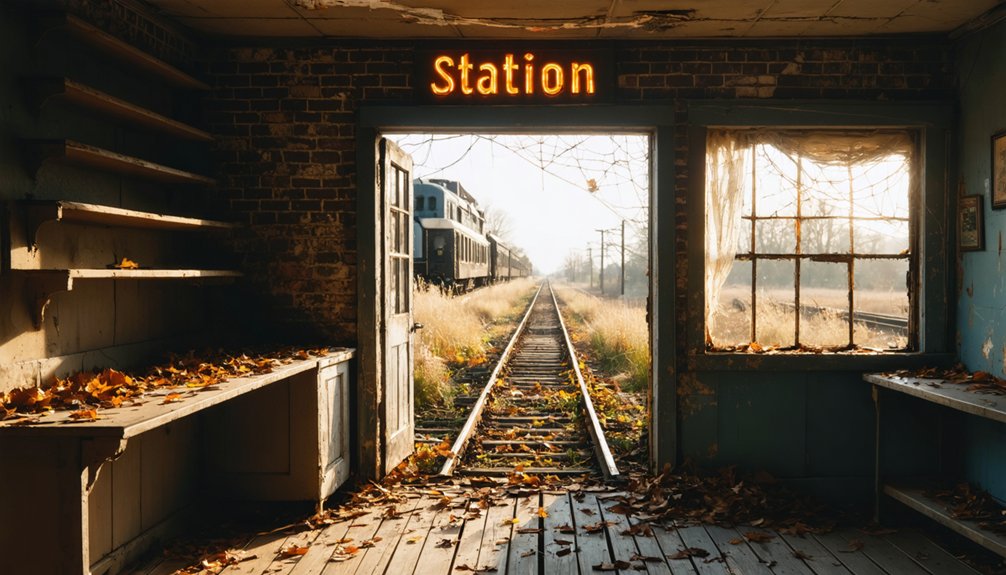
Changes in transportation infrastructure dramatically reshaped Missouri’s landscape of small towns during the late 19th and early 20th centuries.
You’ll find that transportation shifts first impacted railroad towns like Callaway, Bryant, and Carrington, which thrived until the early 1930s when tracks were torn up.
Towns like Empire City and Zincite saw their populations plummet as rail service declined.
The rise of highways dealt another blow, triggering widespread economic decline.
When Route 66 was rerouted, Arlington’s businesses shuttered within months. Similarly, Avilla lost its importance when bypassed by the iconic highway.
Today, you can trace this transformation through places like the Wabash Trace Trail, where depot sites stand as silent witnesses to once-bustling communities that couldn’t survive these pivotal transportation changes.
Government Land Acquisitions and Displaced Communities
Government land acquisitions have profoundly reshaped Missouri’s landscape through federal buyouts and eminent domain programs.
Federal intervention has permanently altered Missouri’s geography, as buyout programs and eminent domain reshape communities and ownership patterns.
You’ll find stark examples in Times Beach, where dioxin contamination led to a complete government buyout and town demolition, and in Kinloch, where Lambert Airport expansion forced widespread resident displacement.
When you examine these cases, you’ll notice how government buyouts often leave communities fractured. While officials present these as voluntary programs, residents frequently face pressure to accept compensation they view as inadequate for replacement housing.
The aftermath creates a patchwork of abandoned properties and restricted-use lands that rarely return to residential development. Land banks have emerged as a response, attempting to manage these vacant properties, but they’re still grappling with the long-term challenges of maintaining and repurposing these displaced communities.
Exploring Missouri’s Ghost Town Heritage
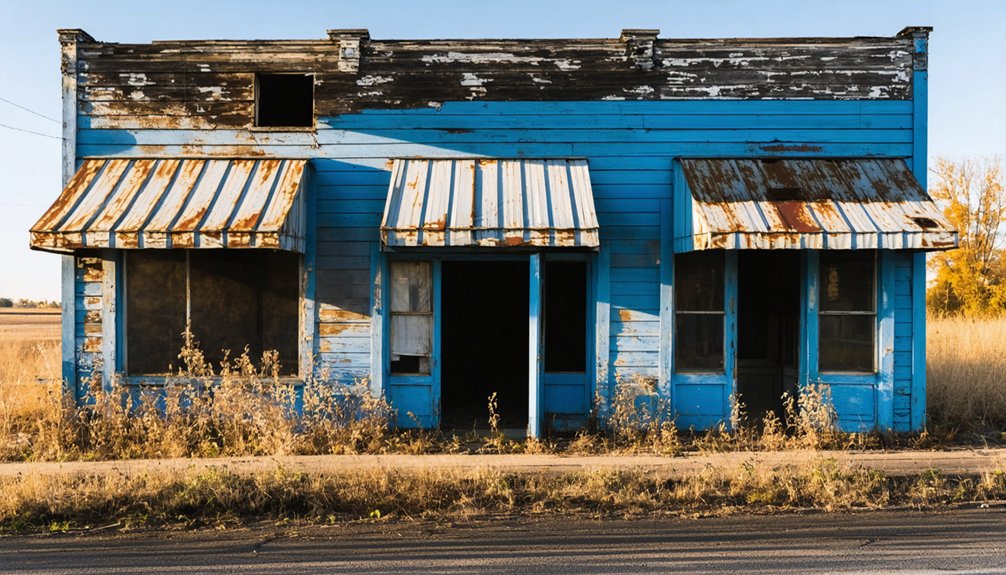
When you venture across Missouri’s diverse landscape, you’ll discover over thirty documented ghost towns that tell compelling stories of the state’s past.
You’ll find historic sites like Phenix with its abandoned mining structures and Arlington along vintage Route 66. Each location offers unique glimpses into Missouri’s industrial and transportation heritage.
Ghost town preservation efforts vary greatly across the state. Red Oak II presents a reconstructed past you can explore, while sites like Empire Prairie maintain a preservation level 1 rating.
You’ll encounter mining remnants in Georgia City, iron production history at Hopewell Furnace, and mineral spring sites at Monark Springs.
From St. Charles County’s cluster of four ghost towns to the Route 66 corridor’s abandoned settlements, these sites showcase Missouri’s historical significance through their remaining churches, cemeteries, and architectural fragments.
Frequently Asked Questions
Can You Legally Take Artifacts or Items From Missouri Ghost Towns?
You can’t legally remove artifacts without proper permissions. Most ghost towns fall under private property or legal regulations requiring permits, with artifact preservation laws protecting historical sites from unauthorized collection.
Are There Guided Tours Available to Visit Missouri Ghost Towns?
In a million different ways, you’ll find guided ghost town tours throughout Missouri. You can join commercial operators, historical societies, or national park services to explore Missouri history firsthand.
Many of these tours delve into the ghost town history in Missouri, revealing stories of thriving communities that once existed before economic changes led to their decline. Each site offers a unique glimpse into the past, where visitors can imagine the lives of those who once called these places home. Whether it’s a dilapidated miner’s cabin or the remnants of an old railway station, the echoes of history linger in every abandoned corner.
What Safety Precautions Should Be Taken When Exploring Missouri Ghost Towns?
You’ll need proper exploration gear including sturdy boots, hard hat, gloves, first-aid kit, and reliable lighting. Get travel insurance, file trip plans, and bring navigation tools and emergency communications equipment.
Which Missouri Ghost Towns Are Considered the Most Haunted?
You’ll find haunted legends concentrated in Missouri’s abandoned towns of Avilla, Times Beach, and Rush. These desolate locations feature documented paranormal activities and spine-chilling historical accounts of mysterious deaths.
Do Any Missouri Ghost Towns Still Have Year-Round Residents?
You’ll find year-round habitation in several Missouri ghost towns, including Arlington with its small permanent population. Ghost town demographics show some locations maintain up to 100 full-time residents despite their designation.
These places to stay in Missouri ghost towns offer unique lodging experiences that combine history and adventure. Visitors can explore the remnants of these once-thriving communities while enjoying local stories and legends. With options ranging from quaint bed and breakfasts to historic inns, there’s a perfect spot for anyone looking to immerse themselves in the ghostly ambiance.
References
- https://kids.kiddle.co/List_of_ghost_towns_in_Missouri
- https://en.wikipedia.org/wiki/List_of_ghost_towns_in_Missouri
- https://www.legendsofamerica.com/mo-ghosttowns/
- https://www.youtube.com/watch?v=OPNh93z9dNE
- https://www.ghosttowns.com/states/mo/mo.html
- https://www.geotab.com/ghost-towns/
- https://www.youtube.com/playlist?list=PL4jqwLUrhjNScUWj03mXzSKyBNMNqZHGw
- https://sites.rootsweb.com/~motttp/history/ghost_towns/index.htm
- https://www.kcur.org/arts-life/2022-04-09/ghost-towns-are-all-around-kansas-city-if-you-know-where-to-look
- https://en.wikipedia.org/wiki/Ghost_town