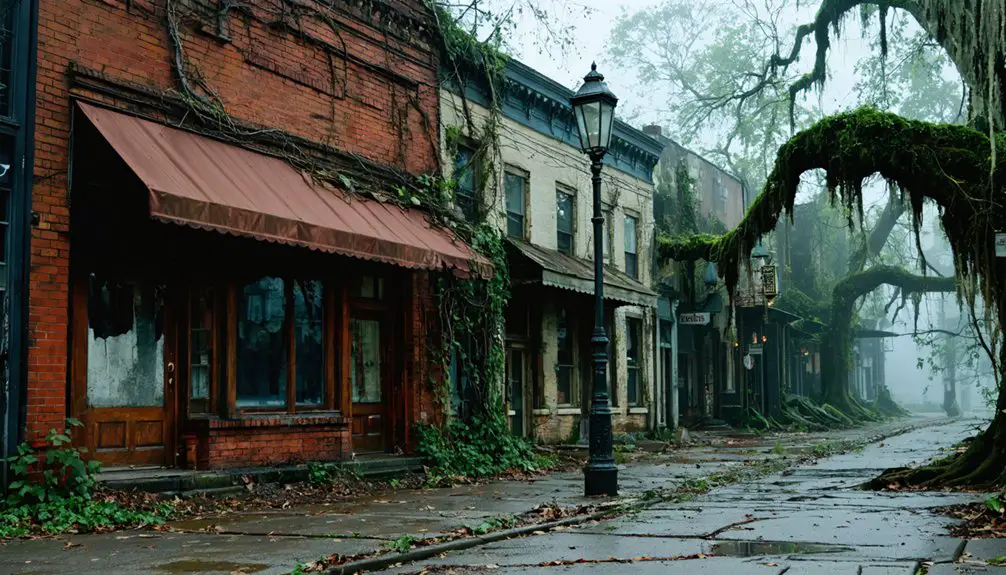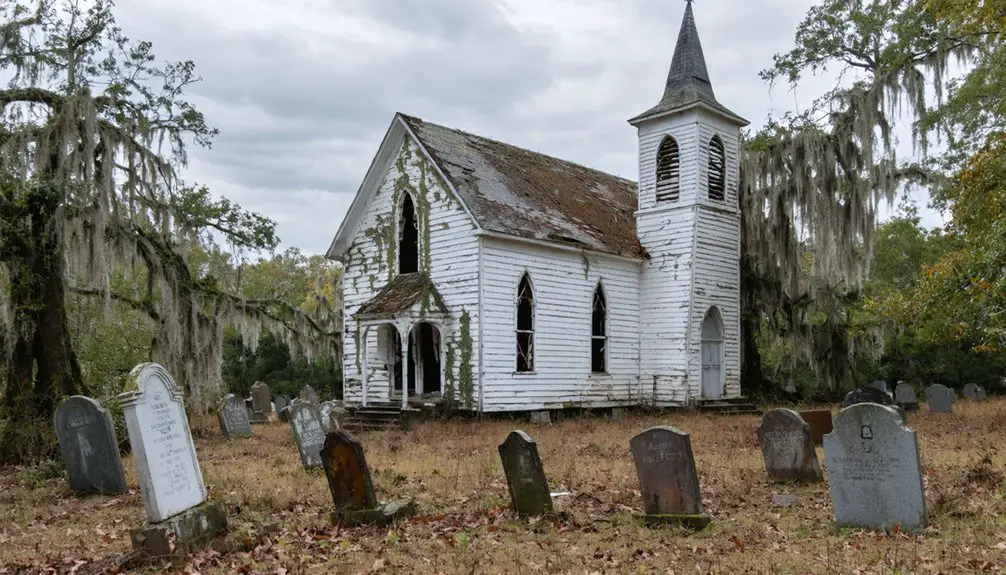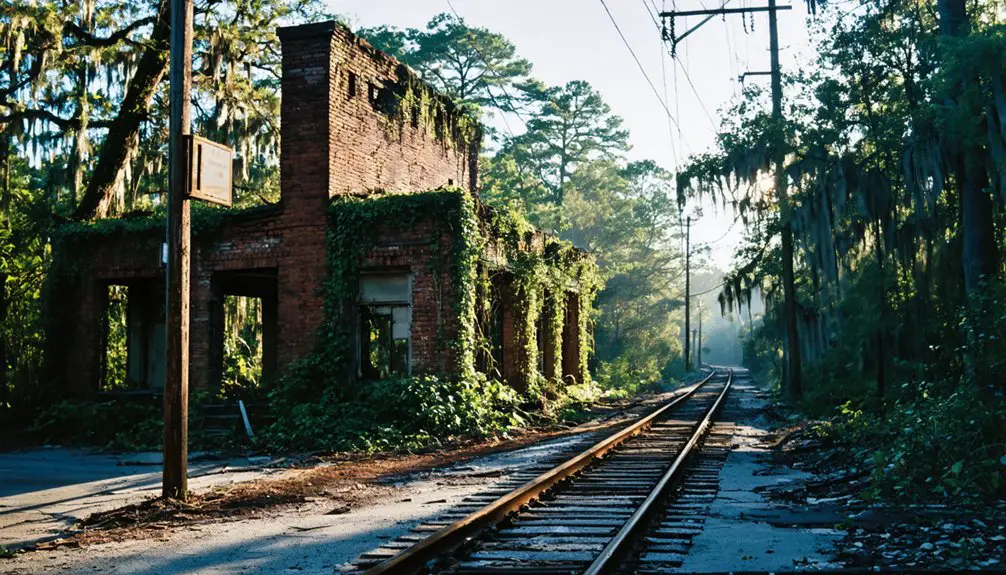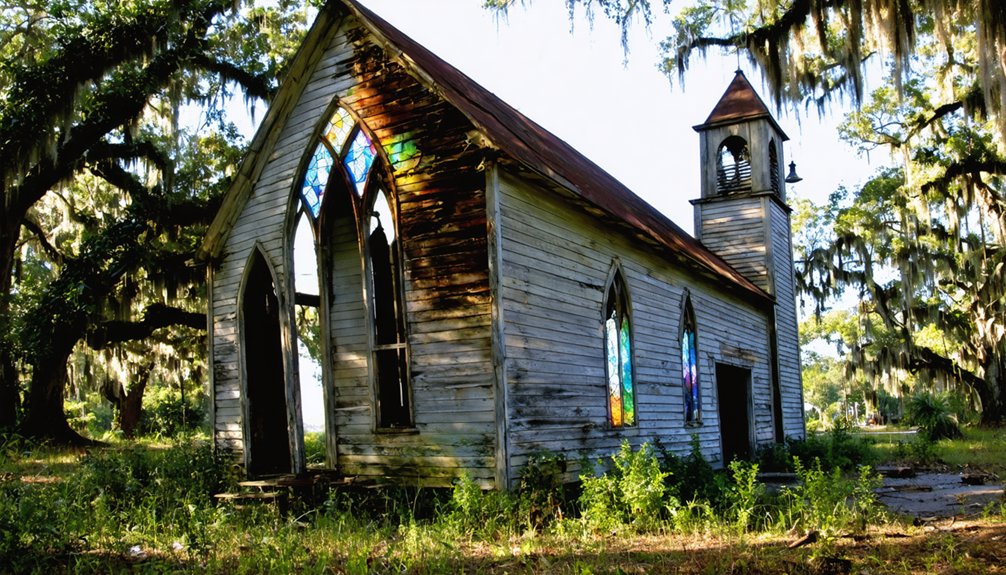
You’ll find numerous ghost towns across South Carolina, from colonial-era settlements to 20th-century communities. Notable examples include Ellenton, which was seized for nuclear production in 1950, and Hamburg, which declined due to racial violence and economic hardship. These abandoned towns feature historic ruins like the Colonial Dorchester Site’s church remains and Ferguson’s underwater foundations. Before exploring these fascinating locations, you’ll need to understand essential safety protocols and legal requirements.
Key Takeaways
- South Carolina has several ghost towns including Ellenton, Hamburg, Pinckneyville, Andersonville, and Ferguson, each with distinct abandonment stories.
- Ellenton was forcibly abandoned in 1950 when the government seized the land for nuclear production facilities.
- Many ghost towns feature historical ruins, like Colonial Dorchester’s church remains and Pinckneyville’s building foundations.
- Some ghost towns lie underwater, such as Andersonville’s textile mills and Ferguson’s submerged foundations.
- These abandoned sites are protected by law, requiring written permission and proper safety equipment for visitation.
Defining Ghost Towns in South Carolina
Ghost towns in South Carolina exhibit distinct characteristics that distinguish them from merely declining communities. When you’re exploring these forgotten places, you’ll find they meet specific ghost town criteria: a dramatic population decline to near zero, the absence of functioning businesses, and the presence of abandoned structures or ruins.
You’ll notice these sites often feature old cemeteries, building foundations, or even entire town footprints submerged underwater. Some locations earned their ghost town status through government intervention, like when entire communities were displaced for federal projects. Transportation route changes, particularly the construction of major highways bypassing small towns, have contributed significantly to their decline. Many of these abandoned settlements reflect the region’s past economic shifts when local industries collapsed.
To be officially recognized, these places typically appear in historical registers, curated lists, or multiple scholarly sources. The designation can apply to colonial-era settlements, flooded towns, or communities cleared for government facilities.
Historical Causes of Town Abandonment
Throughout South Carolina’s history, five major forces have driven communities into abandonment: failed railroad ventures, government infrastructure projects, military conflicts, economic shifts, and natural disasters.
From doomed railroads to natural calamities, five powerful forces turned South Carolina’s vibrant communities into abandoned relics of the past.
You’ll find these historical forces dramatically shaped the state’s landscape:
- Railroad speculation led to Lydia’s demise, while Salters Depot’s economic decline followed changing transportation patterns. The town’s historic 1850s depot stood for a century before being shuttered along with other local businesses. Similar to Thurmond, West Virginia, the shift to diesel locomotives contributed to the decline of many railroad-dependent towns.
- Federal projects reshaped communities, as seen when Ellenton and Andersonville were sacrificed for infrastructure development.
- Military actions devastated towns like Dorchester during the Revolutionary War, while Sherman’s March left Old Sheldon Church in ruins.
- Economic shifts transformed once-thriving communities, exemplified by Glenn Springs’ evolution from a bustling resort to abandonment after its hotel burned in 1941.
Today, these ghost towns serve as silent witnesses to South Carolina’s complex past.
Notable Ghost Towns and Their Stories
While many abandoned settlements dot South Carolina’s landscape, four ghost towns stand out for their particularly compelling stories of displacement, conflict, and decline.
You’ll find Ellenton’s history marked by Cold War urgency, as the government seized the town in 1950 for nuclear production, forcing residents to relocate.
Hamburg’s legacy reveals a darker chapter, where racial violence and economic decline transformed a bustling cotton hub into ruins.
Pinckneyville’s ruins tell of failed political ambitions, with only stone foundations remaining of this planned “Little Charleston.”
The waters of man-made reservoirs now cover Andersonville’s flooding-prone textile mills, while Ferguson suffered a similar fate. Currency restrictions in Ferguson’s company-owned lumber town pushed workers to seek employment elsewhere. In the Pee Dee region, Ellas Grove emerged as a thriving commercial center in 1867 when Benjamin Franklin Davis opened his general merchandise store.
Each site serves as a reflection of how federal decisions, social upheaval, and environmental forces can erase entire communities.
Hidden Ruins and Lesser-Known Sites
Scattered across South Carolina’s remote landscapes, several lesser-known ruins offer fascinating glimpses into the state’s colonial and antebellum past.
These hidden treasures include forgotten architecture ranging from religious structures to submerged settlements. The town of Chester, with its ghost town feel, represents one of these preserved historical areas, though it still maintains an active population of 5,000-6,000 residents. Most ruins have minimal remains due to time and development over the years.
- You’ll discover Biggin Church’s stone tower base and adjacent cemetery, where you can explore early Anglican history for a small entrance fee.
- The Colonial Dorchester Site reveals St. George’s Church ruins and Fort Dorchester’s tabby construction, showcasing 18th-century military architecture.
- Pon Pon Chapel stands as a monument to lowcountry’s religious heritage, with unrestricted access to its weathered remains.
- Ferguson’s underwater ruins present a unique exploration opportunity, where you can boat over the submerged foundations of an 1800s textile community.
These sites preserve South Carolina’s rich historical legacy while remaining off the beaten path.
Safety and Legal Considerations for Explorers
Responsible exploration of South Carolina’s ghost towns requires careful attention to both legal requirements and safety protocols. Before visiting any site, you’ll need to secure written permission from property owners and verify access rights through county records.
Sound exploration ethics demand respect for both private property and historical preservation. Ongoing archaeological digs continue at many of these historic locations.
For effective risk management, always wear appropriate protective equipment, including hard hats and steel-toe boots when investigating structures. Carry emergency supplies and maintain communication capabilities through GPS devices or personal locators. Some areas like the former nuclear site required mass evacuations of entire communities, making exploration particularly dangerous.
You’ll want to avoid entering unstable buildings and be alert for environmental hazards like contamination, wildlife, or hidden ground openings.
Remember that many remote locations lack cell service and emergency response access, so planning your expedition carefully is essential.
Preservation Efforts and Archaeological Sites
You’ll find South Carolina’s ghost towns actively preserved through dedicated archaeological park development initiatives at sites like Colonial Dorchester and Charles Towne Landing.
Protected historical site status, including National Register listings and state park designations, enables essential funding for conservation while establishing guidelines for public access and research activities.
University programs and the South Carolina Institute of Archaeology and Anthropology conduct systematic documentation of ruins and artifacts, maintaining extensive records through curation facilities and published reports for future study.
Archaeological Park Development Plans
Several significant archaeological sites across South Carolina’s ghost towns have become focal points for preservation efforts and park development initiatives.
You’ll find extensive archaeological park development plans focused on protecting these historical treasures while making them accessible for public education and engagement.
The state’s ghost town preservation strategy includes:
- Controlled excavation programs at Colonial Dorchester, featuring managed research and public interpretation facilities
- Strategic site stabilization using geotextiles and protective covers at vulnerable locations
- Development of interpretive trails with boardwalks to protect fragile deposits
- Implementation of monitoring systems to prevent vandalism and looting
These development plans aim to balance public access with site protection, ensuring that you can explore South Carolina’s abandoned settlements while preserving their archaeological integrity for future generations.
Protected Historical Site Status
Through extensive legal frameworks and preservation initiatives, South Carolina’s ghost towns have gained protected historical site status that guarantees their long-term conservation.
You’ll find these sites protected under the National Register of Historic Places, which enables access to preservation grants and tax incentives for restoration projects. The State Historic Preservation Office oversees site management and compliance reviews.
Various preservation strategies are employed to maintain these historical treasures. You can see this through structural stabilization efforts, vegetation control, and drainage management at flood-prone locations.
When you visit these sites, you’ll notice how federal and state funding, combined with nonprofit support, enables thorough conservation. The National Park Service often collaborates on ghost town preservation, particularly for sites within or adjacent to federal lands.
Ruins Documentation and Research
As archaeological teams meticulously document South Carolina’s ghost towns, their research reveals intricate details about colonial life and pre-colonial settlements.
You’ll find extensive documentation efforts underway, particularly at sites of significant archaeological significance:
- Colonial Dorchester’s tabby ruins undergo continuous study, with preservation teams cataloging structural remains and artifacts that illuminate 18th-century trading post operations.
- The Topper Site challenges conventional settlement timelines through systematic excavation of pre-Clovis artifacts, transforming our understanding of North American prehistory.
- Ruins photography at Adams Grove Presbyterian captures the haunting decay of 19th-century architecture, providing visual records for future restoration.
- Chauga Mound Village excavations, though partially submerged, continue yielding insights into Mississippian culture through careful underwater archaeology and shoreline surveys.
These research initiatives preserve essential historical data while advancing our knowledge of South Carolina’s diverse past.
Planning Your Ghost Town Visit
Before visiting South Carolina’s ghost towns, you’ll need to thoroughly research safety hazards, including unstable structures, flooding risks, and potential environmental contamination at sites like Ellenton.
You must obtain necessary permits and written permissions, particularly for protected archaeological sites such as Colonial Dorchester or privately owned locations in the Pee Dee region.
Schedule your visits during dry-weather months and daylight hours, bringing appropriate navigation tools and safety equipment to document these historic locations responsibly.
Safety Before You Go
While exploring South Carolina’s ghost towns can be an exciting adventure, proper safety planning remains vital for preventing accidents and injuries in these hazardous environments. Before heading out, assemble your safety gear and guarantee thorough emergency preparedness.
- Always carry a fully-stocked first aid kit with trauma supplies, tick removal tools, and medications for potential allergic reactions.
- Wear appropriate protective equipment including hard-soled boots, long pants, and an N95 respirator when exploring structures.
- Bring navigation tools including offline maps, GPS units, and paper topographic maps due to unreliable cell coverage.
- Establish a clear communication plan and share your itinerary with someone who can alert authorities if you don’t return on schedule.
Monitor weather conditions, check local advisories, and avoid restricted areas, particularly those near former military or nuclear sites.
Getting Legal Permission First
Since many South Carolina ghost towns sit on restricted federal land or private property, obtaining proper legal permission must be your first priority when planning visits.
For state-managed sites like Colonial Dorchester, you’ll need to contact South Carolina parks for guided access. Nuclear-restricted areas like Ellenton require verification through DOE Savannah River Site policies.
Private ruins demand a more complex legal access process. You’ll need to research property records to identify owners of sites like the Abandoned Cotton Gin in Salley or Lando School before requesting permission.
Public cemeteries like Palmer typically allow visitation without formal approval, but respect posted guidelines.
Best Times To Visit
Planning your ghost town visit requires careful timing to maximize both safety and experience. Weather impacts and seasonal photography opportunities greatly influence when you’ll get the most from your exploration.
- Spring (March-May) delivers ideal 50-70°F temperatures with guided access during state-managed digs, plus dramatic overcast lighting at Ella’s Grove.
- Fall (September-November) offers comfortable 55-75°F days with peak foliage in October, perfect for capturing Hamburg ruins during golden hour.
- Winter (December-February) creates haunting atmospheres with long shadows, though you’ll need warm clothing and should avoid wet conditions at structural sites.
- Early mornings in any season provide the best photography conditions, while midday sun in cooler months helps you safely navigate overgrown paths and unstable terrain.
Research Resources and Documentation
Those seeking to explore South Carolina’s ghost towns can access several authoritative research resources that document these abandoned settlements.
The Random Connections blog offers detailed coverage of Pee Dee explorations, including photographs of Ella’s Grove and documentation of Palmer Cemetery.
For ghost town tourism planning, the SC Travel Guide provides essential access information and historical context for major sites like Andersonville, Ellenton, and Hamburg.
Historical preservation enthusiasts will find value in Only In Your State’s mapped 5-hour road trip covering Pinckneyville, Pickens Courthouse, Glenn Springs, and Colonial Dorchester.
Additional research materials include Kids Kiddle and Wiktionary’s compiled lists of notable ghost towns, while iHeartRadio highlights Dorchester’s historical significance near America’s founding.
Frequently Asked Questions
Are There Any Haunted Ghost Towns in South Carolina?
Through misty shadows and crumbling ruins, you’ll find no fully confirmed haunted ghost towns in South Carolina, though places like Dorchester and Ellenton carry haunted history without documented spectral sightings.
Exploring the ghost towns in South Carolina showcases remnants of the past that whisper tales of lost communities and faded glory. Each location invites visitors to imagine the lives once lived there, with some even rumored to echo with the laughter and tears of those who once called these places home. Whether or not you believe in ghosts, the atmosphere is undeniably rich with history and intrigue.
Can I Metal Detect in South Carolina Ghost Towns?
You’ll need specific permissions due to metal detecting regulations. Most ghost towns are either state-protected archaeological sites, private property, contaminated zones, or require boat access, limiting your detecting opportunities.
Which Ghost Towns Still Have Original Furniture Inside Buildings?
You’ll find original furnishings in Ellenton’s preserved buildings, though historic preservation laws and radioactivity restrict access. Most furniture restoration efforts focus on items already removed from other ghost towns.
Do Any South Carolina Ghost Towns Host Guided Tours?
Yes, you’ll find guided ghost tours at Colonial Dorchester Archaeological State Park, while Fort Motte offers periodic historical tours. Many other sites require special permission or boat access due to safety restrictions.
Are There Seasonal Events or Festivals at Any Ghost Towns?
You’ll find seasonal celebrations at Colonial Dorchester, including archaeology days, living history programs, and Fourth of July events. Glenn Springs hosts fall foliage tours, while Pinckneyville offers springtime heritage festival activities.
References
- https://www.randomconnections.com/ghost-towns-of-the-pee-dee-part-1-ellas-grove-and-palmer/
- https://www.randomconnections.com/ghost-towns-of-south-carolina/
- https://sctravelguide.com/2018/06/11/south-carolina-ghost-towns/
- https://www.onlyinyourstate.com/trip-ideas/south-carolina/haunted-road-trip-sc-ghost-towns
- https://en.wiktionary.org/wiki/Category:en:Ghost_towns_in_South_Carolina
- https://kids.kiddle.co/List_of_ghost_towns_in_South_Carolina
- https://wnok.iheart.com/content/2023-10-11-abandoned-south-carolina-town-named-the-creepiest-ghost-town-in-the-state/
- https://en.wikipedia.org/wiki/List_of_ghost_towns_in_South_Carolina
- https://www.onlyinyourstate.com/state-pride/south-carolina/old-ellenton-abandoned-town-sc
- https://www.hotels.com/go/usa/haunted-places-south-carolina