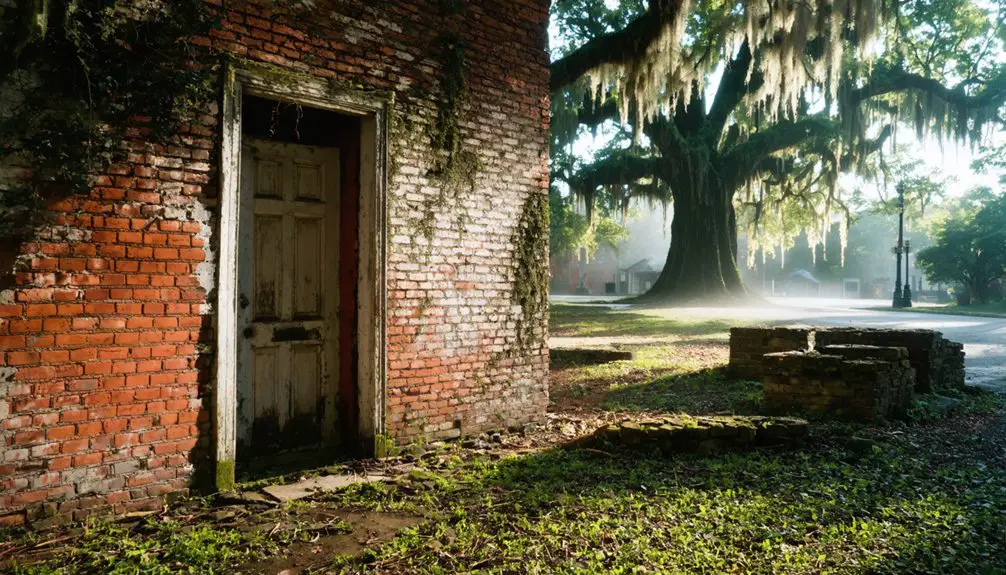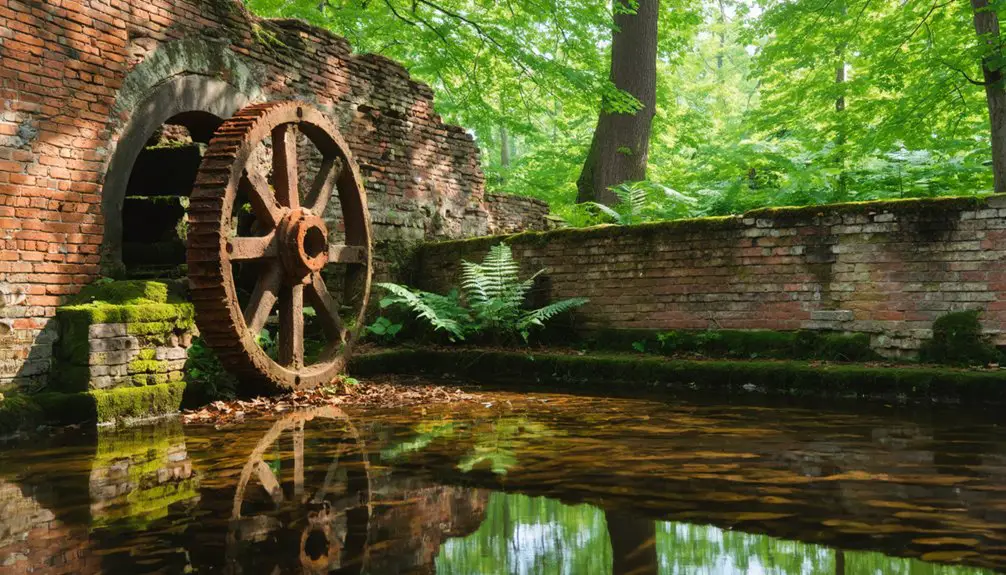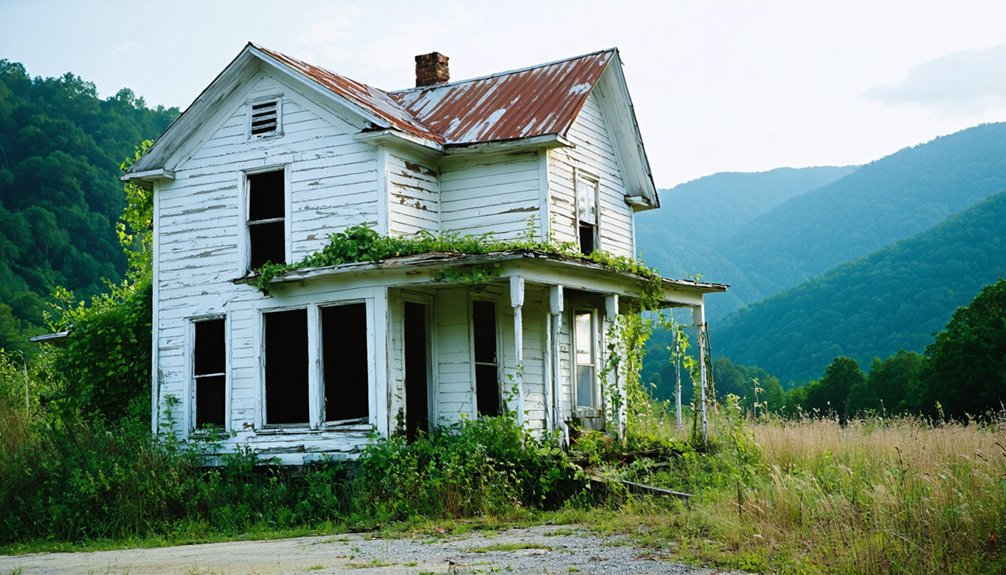
Yes, you’ll find numerous ghost towns across Virginia, from colonial-era settlements to abandoned 19th-century industrial sites. You can explore Historic Jamestowne‘s archaeological discoveries, visit deserted mill towns like Schoolfield, or discover lost agricultural communities scattered throughout the state. Many sites showcase preserved ruins, including Falling Creek Ironworks, Virginia’s first English ironworks, and Matildaville, George Washington’s failed canal venture. Virginia’s rich history of abandoned settlements holds countless stories waiting to be uncovered.
Key Takeaways
- Virginia has numerous colonial ghost towns, including Historic Jamestowne and Falling Creek Ironworks, showcasing early American settlement life.
- Abandoned mill towns like Schoolfield and sites of Dan River Mills represent Virginia’s industrial heritage and economic decline.
- Canal town ruins along the James River and Rappahannock Navigation system demonstrate Virginia’s transportation and commerce history.
- Coastal ghost towns formed due to environmental factors like erosion, flooding, and storm damage that forced community abandonment.
- Several accessible ghost towns include Wash Woods, Matildaville, and Union Level, which are preserved for historical education.
Historical Colonial Ghost Towns: A Journey Back in Time
While Virginia’s landscape today showcases modern development and preserved historic sites, its colonial past harbors numerous abandoned settlements that offer fascinating glimpses into early American life.
The area’s rich history includes sacred burial grounds of the Powhatan nation that existed long before colonial settlements emerged.
You’ll find remarkable colonial remnants at Historic Jamestowne, where archaeological discoveries reveal burned structures and artifacts from the 1607 settlement.
At Falling Creek Ironworks, you can explore the ruins of North America’s first English ironworks, destroyed during the 1622 Powhatan uprising.
The original Yorktown site preserves colonial-era wharves and fortifications, while Old Colchester’s ruins tell the story of a once-thriving river port that succumbed to natural forces.
Near the North Carolina line, Union Level stands as a quiet reminder of Virginia’s tobacco farming prosperity, with abandoned warehouses and railroad tracks marking its former significance.
These ghost towns, along with smaller settlements like Matildaville and Hanover Town, stand as silent witnesses to Virginia’s complex colonial history.
Abandoned Mill Towns of the Industrial Era
As you explore Virginia’s abandoned industrial landscapes, you’ll find the stark remnants of once-thriving mill towns that employed thousands in textile and lumber production.
These communities, established along rivers like the Dan River, were complete with company-built housing, stores, schools, and churches – all centered around massive brick mill complexes powered by water and steam. Workers often faced inflated store prices due to the monopolistic nature of company-owned businesses.
While many of the original mill structures and railroad infrastructure still stand as silent witnesses to Virginia’s industrial past, the communities that once sustained them have largely disappeared, leaving behind empty worker housing and shuttered company stores. The mill village of Schoolfield, built for Dan River Mills workers, remained an independent community until 1951 before being absorbed into Danville.
Canal Town Ruins Remain
Virginia’s abandoned canal towns offer a haunting glimpse into the state’s industrial past through their surviving ruins and infrastructure.
You’ll find remnants of the once-mighty Rappahannock Navigation system, which included 80 locks and 20 dams, now reduced to eroded stonework and washed-out embankments. Along the James River & Kanawha system, you can trace 146 miles of canal prism sections and lock remnants between Richmond and Lynchburg. The area’s powerful waterways once supported mills that produced 160,000 barrels of flour annually through Rappahannock ports.
These transportation nodes tell a story of economic decline, as railroad competition and Civil War damage led to widespread abandonment. The state’s Board of Public Works provided significant financing for these now-defunct canal projects.
You’ll discover stone retaining walls, buried lockworks, and former canal basins now transformed into town parks. Many small settlements that depended on canal commerce have left only archaeological footprints – their street grids, wharves, and industrial lots slowly reclaimed by nature.
Mill Communities Fade Away
Beyond the decaying canal networks, mill communities tell their own tale of industrial rise and fall across Virginia’s landscape.
You’ll witness the industrial heritage impact through abandoned mills that once drove local economies, from Highland County’s Rexrode grist operation to the mighty Dan River Mills complex in Danville.
The mill community decline is evident across several notable sites:
- Beverley Mill stood proudly in Thoroughfare Gap for over 200 years before closing in 1951, narrowly escaping demolition from I-66 construction.
- Burwell-Morgan Mill produced 300,000 pounds of flour annually until WWII shifted agricultural priorities. The mill’s decline accelerated when US Highway 50 diverted traffic patterns away from Millwood in the 1920s.
- Dan River Mills, once employing 14,000 workers in a town of 40,000, transformed Danville before its eventual abandonment.
The historic Rexrode grist mill in New Hampden remained operational from 1816 to 1944, serving as a vital economic center for the local community.
These silent sentinels remind you of Virginia’s vanished industrial might.
Lost Agricultural Communities
While the Civil War marked a turning point for Virginia’s agricultural landscape, the subsequent breakup of plantations into smaller farms triggered a chain of community dissolutions that would reshape the state’s rural fabric.
You’ll find these abandoned farms scattered across the state, from the Appalachian Highlands to the Coastal Plain, where derelict farmhouses and crumbling outbuildings tell stories of rural decay.
Market shifts, mechanization, and outmigration of farm workers led to widespread abandonment, leaving behind ghost settlements marked by old-field succession and remnant infrastructure.
Today, you can trace these lost communities through their remaining physical signatures: overgrown lanes, stone walls, mill foundations, and lonely cemetery plots.
The Northern Virginia region and Shenandoah Valley contain particularly striking examples of these vanished agricultural hamlets. Historic sites like Portici Plantation showcase how Georgian style architecture once dominated these now-abandoned landscapes.
Some of these historic properties, like Sandy Fields Farm with its prime agricultural soils, have been preserved through conservation easements to prevent further loss of Virginia’s farming heritage.
Coastal Communities Reclaimed by Nature
You’ll find one of Virginia’s most haunting coastal ghost towns in Wash Woods, where relentless Atlantic storms and shifting shorelines forced 300 residents to abandon their settlement by the 1930s.
Other ghost towns located in Virginia tell stories of abandonment and nostalgia, each with unique remnants of the past. Exploring these sites offers a glimpse into the lives that once thrived there, often shaped by economic shifts or natural disasters. As you wander through these eerie landscapes, the echoes of history whisper tales of resilience and loss.
The community, built from shipwreck debris in the late 1800s, stood no chance against nature’s persistent assault, leaving only the Grace Episcopal Church and scattered ruins as evidence of human presence.
Today’s maritime forest, dunes, and marshes have reclaimed most traces of civilization, while changing sea levels continue to reshape Virginia’s coastal ghost towns and submerged settlements.
Storms Destroy Wash Woods
Although Wash Woods began as a resilient coastal settlement founded by shipwreck survivors, nature’s relentless assault through storms and flooding ultimately led to its downfall.
You’ll find that storm devastation and coastal erosion took an increasing toll on this once-thriving community of 300 residents, with ocean waters regularly breaching the dunes and damaging homes.
The settlement’s decline accelerated due to:
- Devastating hurricanes that battered the isolated coastal village
- Persistent flooding that made daily life increasingly difficult
- Continuous overwash that eroded the community’s infrastructure
Shifting Shorelines Change Ports
Since the colonial era, Virginia’s historic coastal ports have steadily surrendered to nature’s persistent reshaping of the shoreline.
You’ll find evidence of this coastal erosion in places like Colchester, where the once-bustling colonial port succumbed to silt buildup in Occoquan Creek. Port abandonment occurred gradually as channels became too shallow for merchant vessels.
Along barrier islands and inlets, natural migration has reclaimed entire settlements. The process continues today on Virginia’s Eastern Shore, where barrier islands shift landward through overwash and inlet formation.
You can trace this pattern through archaeological remains, historic maps, and soil layers that tell the story of lost communities. Marsh loss and cliff erosion have also taken their toll, undermining wharves and warehouses until repairs became economically unfeasible.
Lost Villages Under Water
Beneath Virginia’s lakes and waterways lie whispers of lost communities, though documented evidence remains scarce.
While legends speak of the submerged village of Monroe beneath Smith Mountain Lake, no archaeological proof confirms its existence. You’ll find similar patterns of underwater relics throughout the Appalachian region, where dam construction has claimed numerous settlements.
Consider these documented examples of submerged villages in nearby regions:
- Cherokee townsites like Chota and Tanasi now rest beneath Tennessee’s Tellico Lake
- Maryland’s Holland Island succumbed to Chesapeake Bay’s advancing waters
- Multiple Native American settlements disappeared under Little Tennessee River reservoirs
While Virginia’s underwater ghost towns remain largely unconfirmed, the creation of hydroelectric dams and reservoirs has forever altered the landscape, leaving communities to wonder what history lies beneath their waters.
Hidden Treasures: Lesser-Known Ghost Towns
While Virginia’s prominent ghost towns often steal the spotlight, several lesser-known abandoned settlements offer fascinating glimpses into the state’s past.
You’ll find hidden gems like Union Level, where rows of vacant storefronts stand as evidence to the region’s former tobacco prosperity.
The mysterious Elko Tract conceals forgotten histories of a World War II decoy airbase, while Matildaville’s ruins in Great Falls Park tell the story of George Washington’s failed canal venture.
Deep in False Cape State Park, Wash Woods beckons adventurous spirits willing to bike or hike through maritime forests to discover its weathered remains.
Even Pocahontas, though not completely abandoned, reveals its coal mining heritage through decaying facades and mine tours that let you explore its industrial past.
Preservation Efforts and Public Access
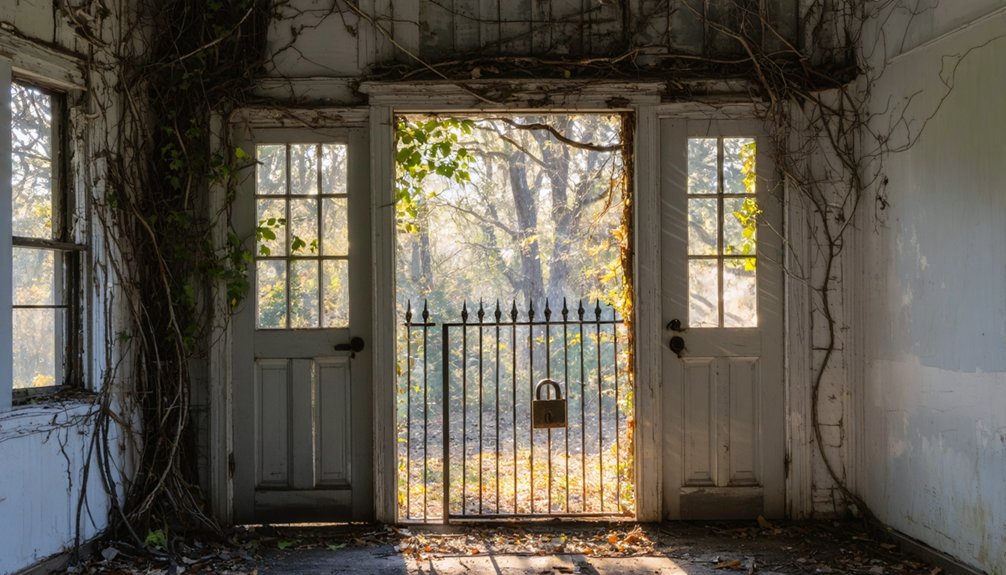
Thanks to dedicated preservation organizations across Virginia, many ghost towns remain accessible for historical exploration and education. Through historic preservation efforts, you’ll find carefully maintained sites that offer glimpses into Virginia’s past.
Virginia’s preserved ghost towns serve as living museums, carefully maintained by dedicated organizations to share stories of our collective past.
- You can explore Chesterfield County’s preserved settlement, featuring an intact cemetery and the historic Grace Episcopal Church from the 1840s.
- At Fairfax County’s Old Colchester Park, you’ll discover ongoing archaeological digs and marked pathways through colonial-era foundations.
- Prince William Forest Park provides access to multiple ghost town sites, including Joplin and Hickory Ridge, where you can trace old roads and foundations.
The Department of Historic Resources and Preservation Virginia continue safeguarding these sites, ensuring public access while protecting valuable historical resources for future generations to experience.
The Stories Behind Virginia’s Vanished Settlements
The stories behind Virginia’s ghost towns reveal five major patterns of community decline: economic shifts, transportation changes, government land acquisitions, environmental modifications, and catastrophic events.
You’ll find these patterns reflected in settlements like Union Level, where vanished industries and railroad removal led to its abandonment, and Lignite, which emptied after mining operations ceased.
The creation of Prince William Forest Park in the 1930s forced the removal of several communities, including Joplin and Hickory Ridge, showcasing how government decisions reshaped the landscape.
Despite facing these challenges, community resilience often persisted through surviving structures like churches and cemeteries.
These physical remnants, along with artifact scatters and historic records, help piece together the complex stories of Virginia’s lost settlements.
Planning Your Ghost Town Adventure
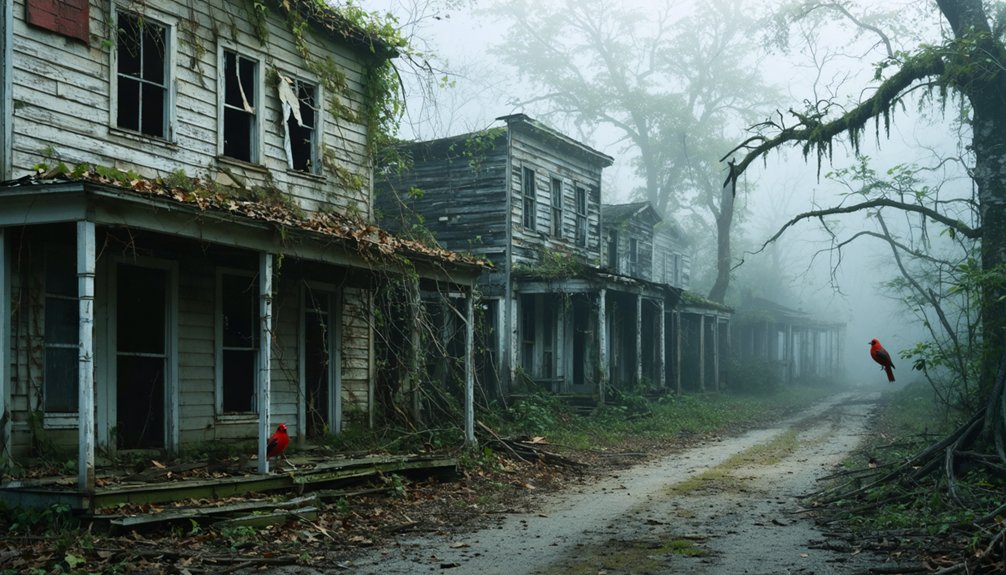
Exploring Virginia’s ghost towns begins with careful planning and attention to detail. Before you venture out to discover these abandoned settlements, proper ghost town logistics and site accessibility research is essential for a successful expedition.
Thorough preparation is key to exploring Virginia’s forgotten places – a journey through time requires thoughtful planning and research.
You’ll need to verify which locations allow public access, as some sites like Elko Tract have restricted entry.
- Check ownership status and obtain necessary permits for sites on federal, state, or private land
- Create a safety plan including GPS coordinates, emergency contacts, and estimated visit duration
- Research historical context through official sources like the National Park Service and local historical societies
Remember to assess seasonal conditions, as many sites are only accessible via unpaved roads or hiking trails.
Always respect legal protections for historic sites and prepare for limited cell service in remote locations.
Frequently Asked Questions
Are Any Virginia Ghost Towns Rumored to Be Haunted?
Through misty ruins, you’ll find haunted legends at Historic Jamestowne, Henricus, and Matildaville, where spectral sightings are frequently reported. Wash Woods’ abandoned church and Elko Tract’s remains spark ghostly tales.
Can Metal Detecting Be Done Legally at Virginia Ghost Town Sites?
You’ll need permits and landowner permission for metal detecting at Virginia ghost towns due to metal detecting regulations and historic preservation laws. Most sites are protected, with violations risking criminal penalties.
Which Ghost Towns Are Closest to Major Virginia Cities?
You’ll find Elko Tract just minutes from Richmond and Matildaville near Washington DC. These abandoned settlements offer historical significance while being easily accessible from Virginia’s largest metropolitan areas.
Do Any Virginia Ghost Towns Still Have Full-Time Residents?
You’ll find Union Level and Mouth of Wilson still maintain current residents, while most Virginia ghost towns have been completely abandoned. These sites uniquely preserve their historical significance alongside modern inhabitants.
What’s the Best Season to Photograph Virginia Ghost Town Locations?
You’ll get your best ghost town photography during late autumn and winter, when bare trees reveal structures and low-angle sunlight enhances architectural textures. Early morning fog adds atmosphere to your seasonal lighting compositions.
References
- https://kids.kiddle.co/List_of_ghost_towns_in_Virginia
- https://theforgottensouth.com/union-level-virginia-ghost-town-history/
- https://www.blueridgeoutdoors.com/go-outside/southern-ghost-towns/
- https://everafterinthewoods.com/deserted-ghost-towns-in-virginia-that-history-buffs-cant-resist-exploring/
- https://nvtami.com/2025/01/22/virginia-citys-forgotten-ghost-towns/
- https://www.youtube.com/watch?v=moYHlyQexj4
- https://en.wikipedia.org/wiki/List_of_ghost_towns_in_Virginia
- https://abcnews4.com/amazing-america/discover-pamplin-virginia-a-nearly-forgotten-ghost-town-with-stories-still-standing
- https://www.virginia.org/listing/union-level-ghost-town/4358/
- https://clubwyndham.wyndhamdestinations.com/us/en/resorts/featured-destinations/travel-inspiration/haunted-history-colonial-williamsburg