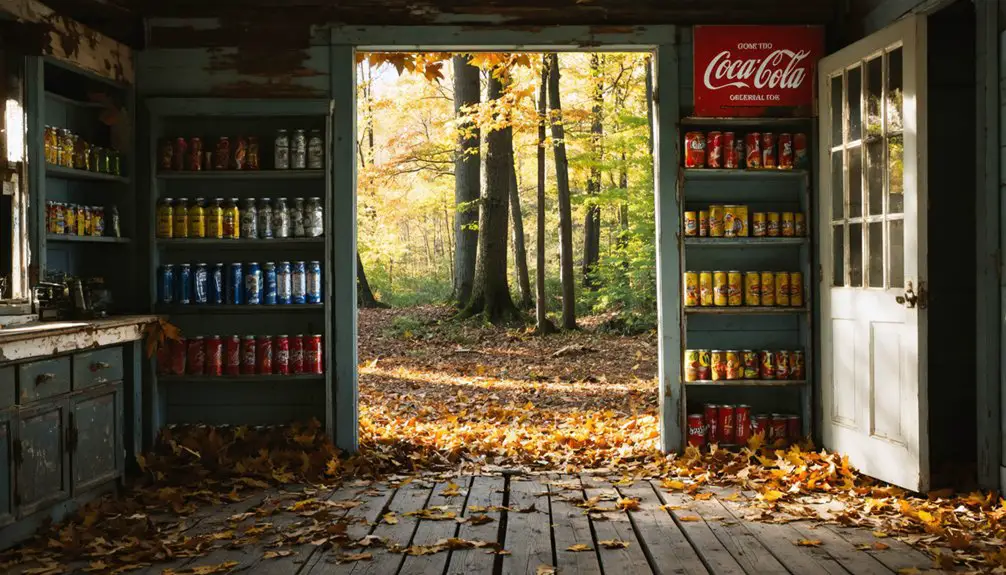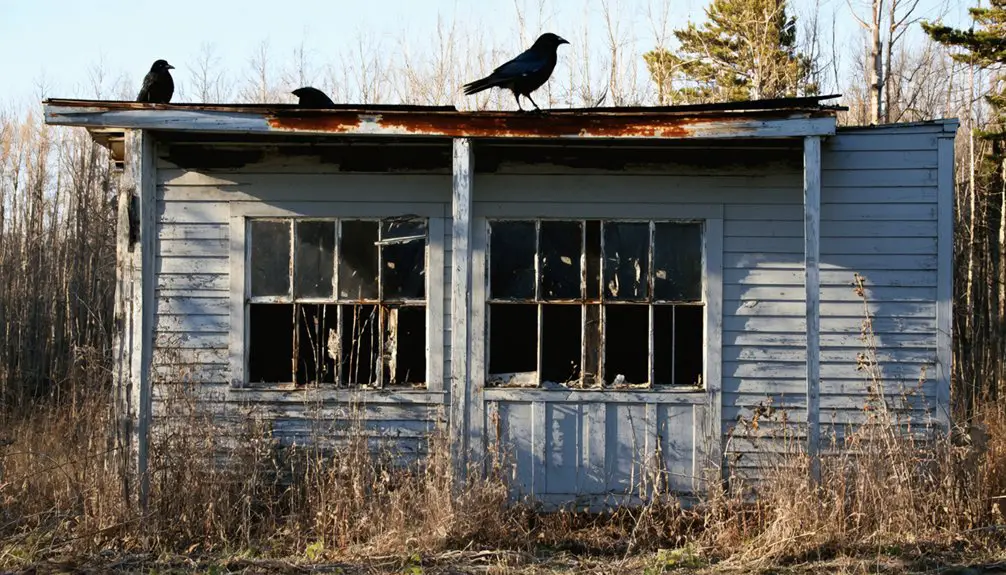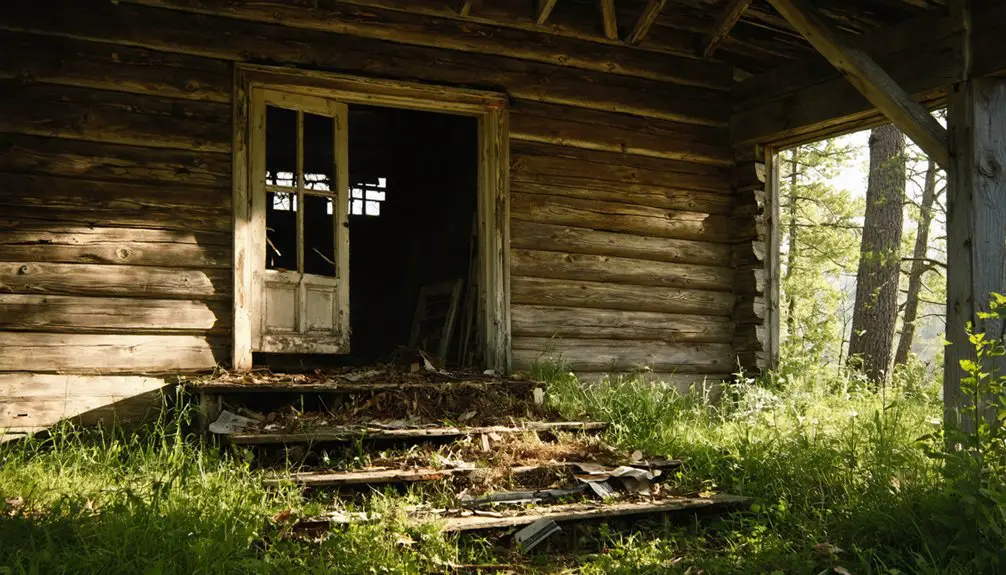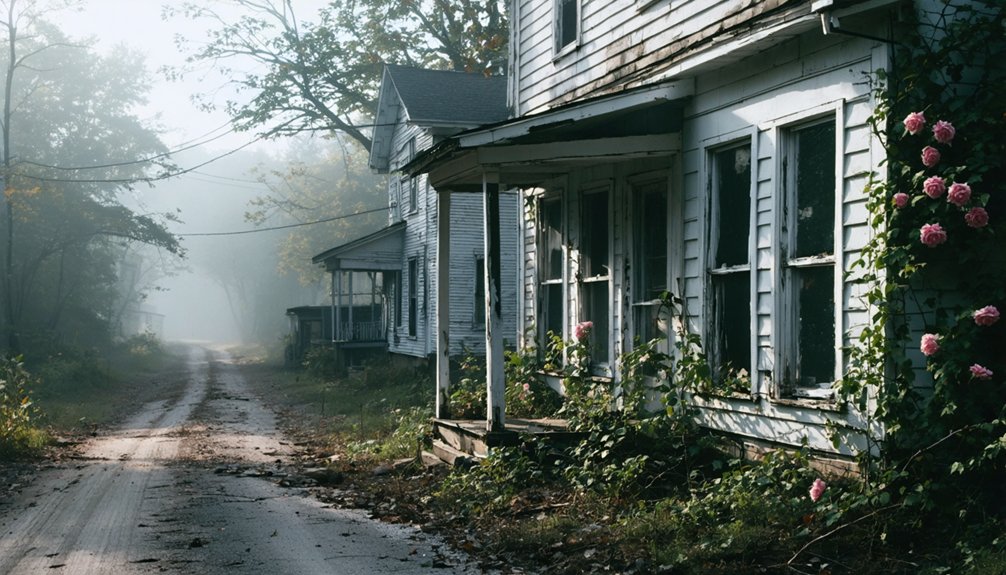
You’ll discover numerous ghost towns across Maine, from Flagstaff Village’s submerged ruins beneath Flagstaff Lake to abandoned mill settlements hidden deep in the forests. Many communities vanished when single industries like timber, fishing, and quarrying collapsed in the late 19th and early 20th centuries. You can still explore stone foundations, crumbling churches, and old cellar holes in places like Freeman Township and Riceville. Maine’s lost communities hold fascinating stories of boom, bust, and survival.
Key Takeaways
- Maine has numerous ghost towns, including the submerged villages of Flagstaff, Dead River, and Bigelow beneath Flagstaff Lake.
- Abandoned communities like Perkins Township and Freeman Township contain visible ruins, stone foundations, and remnants of historic settlements.
- Industrial ghost towns emerged when single-industry economies collapsed, particularly in areas dependent on timber, fishing, and quarrying.
- Riceville features abandoned mill sites and a broken church, while Fort William Henry offers seasonal ghost tours.
- Many ghost towns resulted from economic downturns in the late 19th and early 20th centuries when industries vanished.
The Origins of Maine’s Abandoned Communities
While Maine’s picturesque landscape now conceals hundreds of abandoned settlements, these ghost towns emerged primarily from the state’s heavy reliance on single-industry economies in the 19th and early 20th centuries.
You’ll find the remains of company towns that once thrived on lumber, tanning, and manufacturing, where everything from housing to stores operated under single-employer control.
These communities collapsed when their economic foundations crumbled. Resource depletion played a major role – forests were clear-cut, soil became exhausted, and industrial contamination poisoned local environments.
When railroad lines were abandoned or rerouted, many towns lost their crucial transport links. Religious communes and intentional communities also disappeared rapidly when their leadership failed, while institutional closures of schools, churches, and hospitals often delivered the final blow to struggling settlements. The Great Depression severely impacted these rural communities, accelerating their decline and eventual abandonment.
One such example is the town of Solomon, Maine which gained notoriety around 1799 for reported supernatural occurrences before its eventual decline.
Flagstaff Village: Maine’s Underwater Ghost Town
Among Maine’s ghost towns, Flagstaff Village stands apart as a community that didn’t just fade away – it lies underwater. In 1950, the construction of Long Falls Dam created Flagstaff Lake, submerging this historic settlement along with Dead River and nearby communities.
On July 4, 1949, the communities held their final Old Home Days celebration before disappearing beneath the waters.
You’ll find this massive 20,000-acre reservoir about 20 miles north of Rangeley, where it serves as a haunting reminder of displaced communities.
When water levels drop, you can still glimpse:
- Stone foundations and cellar holes from original buildings
- Outlines of former streets and property boundaries
- Various submerged remnants of the town’s infrastructure
The flooding wasn’t sudden – Central Maine Power systematically acquired land throughout the 1930s and 40s, forcing residents to relocate before the valley’s intentional flooding transformed their homeland into a hydroelectric reservoir. Today, scuba diving tours offer visitors unique opportunities to explore the underwater remains of these lost communities.
Notable Ghost Towns Across the Pine Tree State
Beyond Flagstaff’s submerged remains, you’ll find Maine’s ghost towns scattered throughout the state’s dense forests and rural landscapes – from Perkins Township’s crumbling foundations in Baxter State Park to Riceville’s abandoned mill sites in Hancock County.
Like many ghost towns in the American West, these sites faced economic downturns that ultimately led to their abandonment. You can explore stone cellars and overgrown streets in Freeman Township, where Revolutionary War survivors once built a thriving community before its eventual disincorporation. Candlelight ghost tours bring Fort William Henry’s haunting history to life each October.
Industrial heritage lives on in places like South Portland’s vanished Ligonia Village and the lumber settlements near Davidson, where remnants of Maine’s logging era still peek through the undergrowth.
Underwater Villages Still Visible
Beneath the calm surface of Flagstaff Lake lies one of Maine’s most intriguing ghost towns – or rather, three submerged villages that disappeared beneath 20,000 acres of water in 1950.
The communities of Flagstaff, Dead River, and parts of Bigelow were sacrificed for hydroelectric power, their residents forced to relocate through eminent domain. Maine State Legislature authorized the displacement of villagers to create a dam at Long Falls. The final community gathering in July 1949 saw 300 residents meet one last time before their homes were flooded.
For those interested in underwater exploration, the lake reveals its secrets during low water periods:
- Building foundations and cellar holes emerge along the shoreline
- Stone walls and old road outlines become visible beneath shallow waters
- Submerged artifacts occasionally surface, especially near islands and former settlement areas
You can explore these haunting remains through shoreline walks or guided historical tours, while scuba enthusiasts can dive to view the submerged structures when conditions permit.
Abandoned Mills Tell Tales
Maine’s once-thriving textile industry left behind a legacy of massive mill complexes that stand as silent monuments to the state’s industrial past.
You’ll find these abandoned mills scattered along powerful rivers like the Androscoggin, Saco, and Mousam, where they once employed thousands.
The textile legacy lives on in places like Fort Andross in Brunswick, where the former Cabot Mill now houses over 100 tenants, and Biddeford’s Pepperell complex, which produced millions of yards of fabric annually. French Canadian workers and their families formed tight-knit communities around these mills, forever shaping Maine’s cultural landscape.
The decline hit hard in the 1950s as production moved overseas, displacing communities like Brunswick’s “Little Canada” and shuttering giants like Sanford Mills. These mills once generated 19,000 kilowatt hours of hydroelectric power from nearby dams and falls.
Yet many of these industrial ghosts have found new life as mixed-use developments, preserving their historic architecture while serving modern purposes.
Rural Ghost Communities Remain
While abandoned mills dot Maine’s urban landscape, the state’s most intriguing ghost towns lie scattered across its rural reaches.
These forgotten communities reveal fascinating stories of rural depopulation trends, from planned relocations to economic decline.
- Flagstaff Village now rests beneath the waters of Flagstaff Lake, its foundations and cemetery markers visible only during low water periods – a haunting reminder of 1950s hydroelectric development.
- Swan Island’s Perkins settlement beckons ghost town explorers with its preserved ruins, offering glimpses of a once-thriving river community through seasonal guided access.
- Freeman Ridge and Madrid stand as representations of resource-dependent economies, their stone walls and cellar holes marking where timber and mining operations once sustained vibrant communities.
Economic Forces Behind Town Abandonments
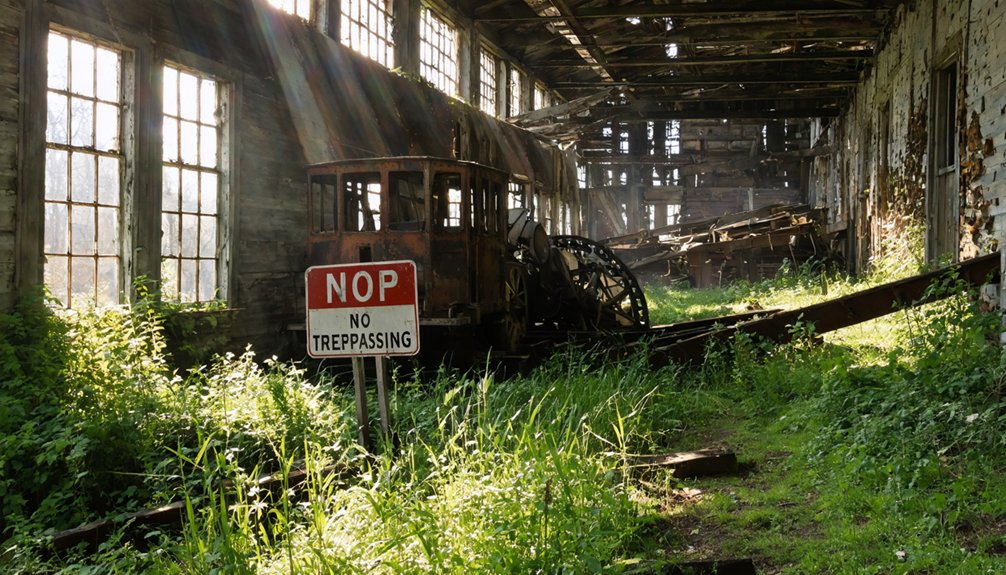
Throughout the late 19th and early 20th centuries, the economic downfall of Maine’s ghost towns followed a recurring pattern driven by their dangerous dependence on single industries.
You’d find communities that relied entirely on timber, fishing, or quarrying, making them vulnerable when markets crashed. Take Vanceboro, where tannery jobs plummeted from 27% to 1% between 1870-1900, triggering mass exodus.
When industries vanish, towns crumble. Maine’s one-industry communities learned this brutal lesson as markets failed and workers fled.
Transportation changes dealt another blow as railroads replaced coastal shipping routes, isolating once-thriving ports.
When external capital dried up, these towns faced rapid economic collapse. Companies that owned most of the land and housing could force entire populations to relocate after shutdowns.
Without economic diversity, displaced workers couldn’t find new jobs, leading to abandoned communities you can still explore today.
What Remains: Physical Evidence and Ruins
When you visit Maine’s ghost towns today, you’ll find the most striking physical evidence beneath the waters of Flagstaff Lake, where stone foundations, cellar holes, and occasional chimneys emerge during low-water periods.
Historic farmsteads and villages have left behind extensive networks of stone walls and foundation ruins, now slowly being reclaimed by forest growth.
At industrial sites along Maine’s waterways, you’ll discover the remains of old mill foundations, dam structures, and water-powered operations that once drove local economies.
Visible Underwater Town Remains
As the waters of Flagstaff Lake recede during seasonal drawdowns, a haunting collection of submerged structures emerges from beneath the surface.
You’ll find ghostly remnants of Maine’s drowned villages revealing themselves through submerged foundations, chimney bases, and cellar holes that mark where homes and businesses once stood.
When you explore the lake during low-water periods, you’ll discover:
- Former roadbeds and bridge abutments tracing the path of Old Dead River Road
- Structural debris scattered along shallow shorelines, including timber frames and stone rubble
- Building footprints exposed on the lakebed, allowing you to walk where residents once lived
These physical traces offer glimpses into the communities that were sacrificed for the reservoir’s creation, with some isolated structures having remained visible above water until their eventual collapse.
Historic Stone Foundations Found
From the abandoned quarries of Hurricane Island to the forgotten farmsteads of Freeman, Maine’s ghost towns reveal their stories through enduring stone foundations and structural remains.
You’ll find historic remnants scattered across these deserted communities – from cellar holes marking defunct farms in Montville to ghostly foundations beneath Hurricane Island’s pine forests. Each site tells a tale of community decline: Riceville’s broken church and tannery ruins speak of economic collapse, while Perkins’ stone foundations and cemeteries chronicle a farming settlement’s gradual fade.
At Freeman and Morrill, old stone walls trace property lines of long-gone homesteads, while Hurricane Island’s carved granite and rusty tools testify to its industrial past.
Throughout these sites, cemeteries serve as silent witnesses to the lives that once animated these now-quiet places.
Lost Communities of the Maine Woods
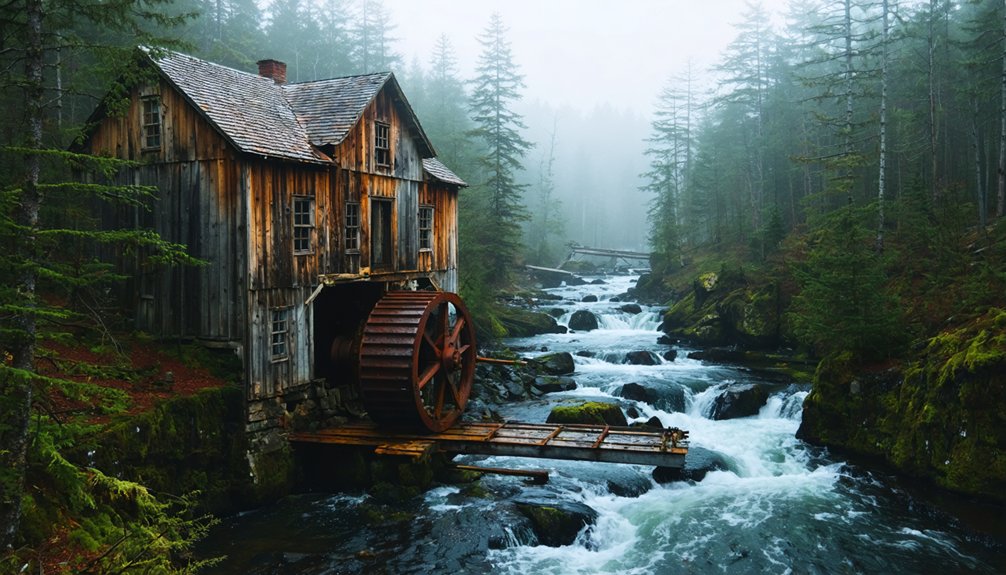
Throughout Maine’s northern forests, ghost towns and abandoned settlements tell the story of a once-thriving logging industry that shaped the region’s development.
You’ll find lost logging communities scattered across the vast woodlands, where temporary towns once bustled with post offices, schools, and even bowling alleys built by lumber companies. These settlements vanished when intensive harvesting depleted the timber resources, particularly in the 1920s.
- Drew, Maine emerged and disappeared with the rise and fall of river sawmills in the late 1800s.
- Post-Civil War farm abandonment left stone foundations throughout central Maine as settlers moved west.
- The Baskahegan operations collapsed after just seven years of aggressive harvesting, forcing entire communities to relocate.
Today, these forgotten places are gradually returning to forest, leaving only hints of their industrious past.
Exploring Maine’s Ghost Town Sites Today
Today’s adventurous explorers can discover several fascinating ghost towns across Maine’s diverse landscape, from submerged villages like Flagstaff to isolated island settlements like Perkins Township.
Among these remnants of the past, visitors can find haunting accommodations in Maine that offer an eerie yet intriguing experience. Staying overnight in a restored inn or a quirky cabin allows for the true essence of the region’s history to unfold under the moonlight. As the sun sets, the whispers of the past come alive, making each night a captivating adventure.
You’ll find Flagstaff Village‘s remnants beneath Flagstaff Lake, visible only during low water periods or by boat. The site’s historical significance stems from 1950s hydropower development when the entire community was flooded.
At Perkins Township on Swan Island, you can explore building foundations and cemetery plots through guided visits, while Freeman’s abandoned mill town offers woodland adventures among old cellar holes and forgotten roads.
Step back in time at Perkins Township and Freeman, where Maine’s forgotten settlements whisper stories through stone foundations and forest-claimed pathways.
Even urban explorers can trace Ligonia Village‘s past beneath South Portland’s Calvary Cemetery. Each site provides unique ghost town exploration opportunities, connecting you to Maine’s rich history of community transformation and change.
Preservation Efforts and Historical Documentation

Maine’s commitment to preserving ghost town heritage operates through a robust network of preservation programs and partnerships. You’ll find preservation strategies ranging from emergency stabilization of endangered structures to extensive documentation efforts. State and federal grants, alongside public-private partnerships, provide critical funding for these initiatives.
Key aspects of Maine’s ghost town preservation include:
- Documentation through state-maintained inventories, photos, and detailed site surveys
- Protection of sensitive archaeological sites by limiting public mapping to prevent looting
- Adaptive reuse projects that transform historic structures into community spaces while maintaining historical integrity
Historical records are carefully managed by the Maine Historic Preservation Commission, while Maine Preservation’s “Most Endangered Historic Places” list helps prioritize sites needing immediate attention.
Through these efforts, you’re able to experience Maine’s abandoned settlements as living windows into the past.
Hidden Stories and Local Legends
Winding through Maine’s abandoned settlements are fascinating tales that blend historical truth with supernatural mystery.
You’ll find hidden legends like Riceville Tannery, where ghost hunters reported mysterious voices calling through overgrown paths, and the haunting story of the Pitcher Man at Goose River Bridge, who still toasts to American freedom.
The state’s first documented ghostly tale emerged in Sullivan, where Nelly Butler’s spirit orchestrated an unlikely marriage in 1799.
In Bucksport, Colonel Buck’s tomb bears an inexplicable stain that refuses to fade, while Malaga Island carries both indigenous curses and modern apparitions.
These stories aren’t just folklore – they’re woven into Maine’s fabric, preserving memories of communities that vanished but left their supernatural footprints behind.
Frequently Asked Questions
Are There Any Haunted Ghost Towns in Maine?
You’ll find haunted legends at Maine’s ghost towns like Flagstaff, Perkins Township, and Freeman, where spooky sightings are reported near abandoned foundations, cemeteries, and ruins of these once-thriving communities.
Which Maine Ghost Towns Are Completely Off-Limits to Visitors?
Like hidden treasures locked away, you’ll find Fort Gorges, Hurricane Island, and Flagstaff Village completely off-limits. Davidson’s restricted access makes these ghost towns unreachable through conventional means.
Can You Legally Metal Detect in Maine’s Abandoned Towns?
You’ll need landowner permission and proper permits to metal detect in Maine’s abandoned towns. Metal detecting regulations and historical preservation laws protect many sites, with hefty fines for unauthorized artifact removal.
Do Any Maine Ghost Towns Still Have Year-Round Residents?
Yes, you’ll find year-round inhabitants in several Maine ghost towns, including Freeman and Madrid. While these places lost their historical significance as mill towns, small populations continue living there today.
These historic ghost towns in Maine offer a glimpse into the state’s past, showcasing remnants of old buildings and faded roads that echo the stories of former residents. Visitors can explore the surrounding landscapes, which reveal the natural beauty that these towns once thrived upon. Despite their decline, Maine’s ghost towns maintain a unique charm, attracting those with a passion for history and adventure.
Among the most intriguing aspects of ghost towns in Maine history are the stories of the individuals who once called these places home. Their legacy is evident in the artifacts left behind, which paint a vivid picture of daily life during a bygone era. Engaging with these remnants not only enriches our understanding of the past but also fosters a deeper appreciation for the resilience of those who shaped these communities.
What’s the Best Season to Photograph Maine’s Ghost Town Ruins?
Like a painter choosing their canvas, you’ll find late September through October ideal. You’ll capture autumn colors against weathered ruins, avoiding winter’s harsh landscape while maximizing golden-hour light and atmospheric fog.
References
- https://www.hotels.com/go/usa/ghost-towns-maine
- http://strangemaine.blogspot.com/2012/02/ghost-towns-of-maine.html
- https://darkdowneast.com/flagstafflake/
- https://www.mooseriverlookout.com/post/ghost-towns-in-maine-9-fascinating-places-that-rose-fell
- https://strangenewengland.com/podcast/the-lost-village-of-riceville-maine/
- https://b985.fm/6-maine-ghost-towns-you-never-knew-existed/
- http://freepages.rootsweb.com/~gtusa/history/usa/me.htm
- https://www.youtube.com/watch?v=iX5zjixvUTo
- https://www.youtube.com/watch?v=eTh42jGNmZs
- https://downeast.com/our-towns/ghost-town/