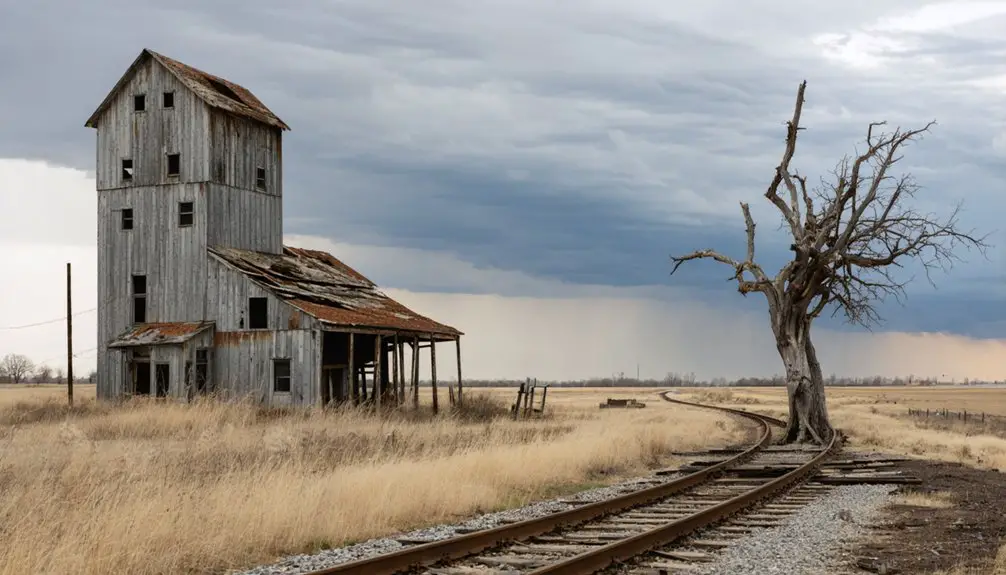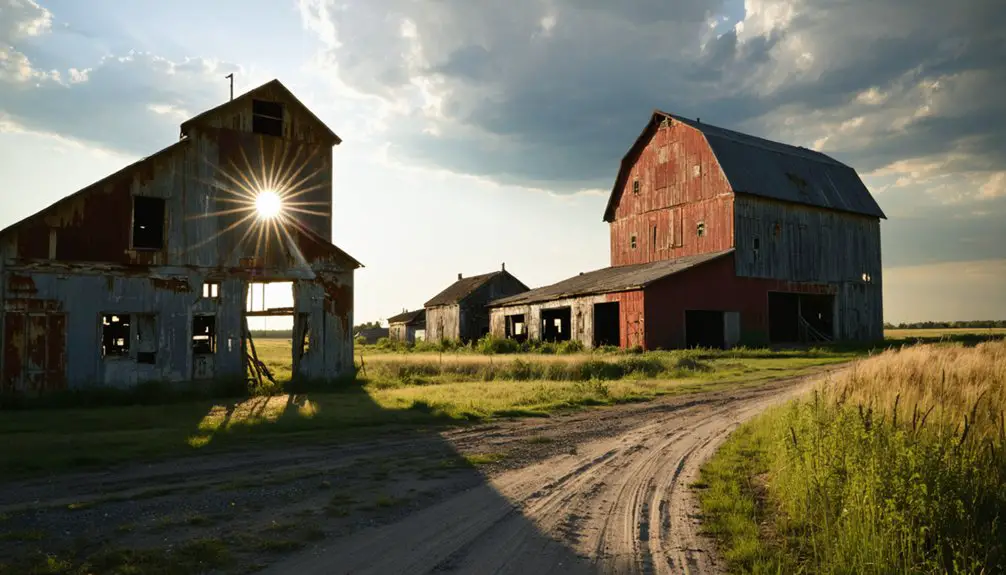
You’ll find numerous ghost towns across Minnesota, particularly in mining regions like the Mesabi Range and along abandoned railroad routes. Notable examples include Elcor (1897-1956), Nininger, and Forestville, which showcase the state’s mining, agricultural, and settlement heritage. While some sites are preserved in state parks with interpretive programs, others exist only as foundations and ruins. Proper research and permissions are essential before setting out to explore these fascinating remnants of Minnesota’s past.
Key Takeaways
- Minnesota has several ghost towns, including well-preserved sites like Forestville, Old Crow Wing, Carver Rapids, and Bohemian Flats.
- Mining towns like Elcor and Taconite Harbor became ghost towns due to economic decline and industry closures.
- Ghost towns emerged when communities were bypassed by railroads or abandoned due to natural disasters and economic downturns.
- The Mesabi Range region contains numerous mining ghost towns with visible remnants including open-pit mines and foundations.
- Many ghost towns are accessible through state parks, though some require landowner permission and careful safety considerations.
What Defines a Ghost Town in Minnesota
The designation of a ghost town in Minnesota encompasses several overlapping legal, administrative, and academic criteria rather than a single statutory definition.
While state law doesn’t explicitly define ghost towns, you’ll find these sites typically characterized by significant population decline from their historical peak and the loss of functioning public services.
You can identify Minnesota ghost towns through multiple indicators: abandoned buildings and ruins, defunct municipal governments, and closed institutions like post offices and schools.
Many of these ghost towns in Minnesota history offer a glimpse into the past, showcasing the struggles of communities that once thrived. Exploring these areas can reveal fascinating stories of the people who lived there and the events that led to their decline. Visitors often find themselves captivated by the eerie beauty and history that each abandoned site holds.
County records, historic maps, and census data help track their transformation from thriving communities to abandoned settlements.
While some locations are completely deserted, others maintain a minimal population, earning them the label of “near-ghost” or “shrunken” towns.
Historic preservation status provides special designation for ghost towns maintained as heritage sites, like Forestville.
Within 100 miles of Rochester alone, there are nine ghost towns to explore.
These abandoned settlements, which could number in the hundreds of ghost towns, serve as important historical records of Minnesota’s past economic and social development.
Historical Forces Behind Abandoned Towns
Multiple interrelated forces transformed once-prosperous Minnesota settlements into ghost towns throughout the nineteenth and early twentieth centuries.
You’ll find that severe economic downturns, like the Panic of 1857, devastated ambitious developments such as Nininger, which had been promoted as the “New York of the West.”
Railroad impacts proved especially decisive – when new lines bypassed towns like Old Crow Wing, Helvetia, and Pomme de Terre, businesses and residents quickly relocated to more connected locations.
The iron horse’s path determined survival – towns left off the rail line soon emptied as commerce followed the tracks.
The forced removal of Indigenous peoples, particularly the Ojibwe to White Earth Reservation in 1868, depleted multicultural communities.
Natural disasters dealt additional blows, from frequent flooding in the Minnesota River Valley to the tragic Milford Mine disaster of 1924. The town of San Francisco, Minnesota succumbed to recurring flooding problems in the 1850s, leading to its complete abandonment by 1860.
Even county seat relocations and speculative failures contributed to these towns’ abandonment. The introduction of rural postal delivery dealt a final blow to towns like Forestville, forcing its general store to close in 1910.
Notable Ghost Towns Across the State
You’ll find compelling remnants of Minnesota’s mining heritage in ghost towns like Elcor, where foundation ruins and artifacts from 1897-1956 still dot the landscape of the former Mesabi Range settlement.
Along the state’s historic waterways, you can explore abandoned river trading posts like Nininger, an ambitious 1850s speculative settlement near present-day Hastings that quickly went bust.
The preserved structures at Forestville, which declined after being bypassed by railroad development in 1868, now offer visitors a tangible connection to Minnesota’s pioneering past within Forestville/Mystery Cave State Park.
These abandoned settlements continue to draw curious historians and tourists seeking to understand the region’s past development and cultural heritage.
Local preservation groups conduct guided educational tours to promote responsible exploration while protecting these historic sites.
Mining Town Ghost Stories
Mining operations across Minnesota’s Iron Range left behind a compelling collection of ghost towns, each telling its own story of boom-and-bust cycles in the state’s industrial history.
The most haunting tale comes from Manganese, where ghostly legends surround the tragic Milford Mine disaster of 1924. After 41 miners lost their lives in a catastrophic flood, miner folklore emerged about a curse on the area, contributing to the town’s eventual abandonment by 1960.
You’ll find other poignant stories in places like Elcor, where company-owned homes were systematically removed in the 1950s, and Taconite Harbor, where entire houses were relocated during the 1980s economic collapse. At its peak, Taconite Harbor’s shipping operations processed 10 million tons of iron ore annually.
Today, these sites contain scattered ruins and foundations, silent reminders to Minnesota’s rich mining heritage and the communities that once thrived there. Visitors should obtain proper site permission before exploring these historically significant locations.
River Settlement Remains
Beyond the mining settlements that dot Minnesota’s landscape, the state’s rivers once hosted thriving communities that now stand abandoned.
These forgotten towns reveal how changing transportation patterns transformed Minnesota’s early commercial networks.
You’ll find evidence of this riverine past through:
- Carver Rapids, established in 1854 along the Minnesota River, where William Foster built a hotel and post office before flooding drove settlers away.
- Huot, a Red River trading post that flourished until railroads redirected commerce from river trade routes.
- Old Wadena, a Crow Wing River settlement preserved today as a historical park, showcasing archaeological significance through reconstructed buildings.
These river settlements, many dating to the 1850s-1870s, now exist primarily as foundation stones, cellar holes, and interpretive sites – proof of Minnesota’s dynamic commercial history.
Early river towns like Falls City vanished after being absorbed into growing urban centers like Minneapolis during incorporation.
San Francisco, which served as the first county seat of Carver County, succumbed to devastating floods in 1863.
Where to Find Minnesota’s Lost Communities
You’ll find Minnesota’s ghost towns concentrated along three main types of historical corridors: former railroad routes, abandoned mining operations in the Iron Range, and early river settlement paths near waterways like the Mississippi and Root Rivers.
If you’re seeking mining town remnants, the northeastern region offers sites like Elcor, with its visible foundations and artifacts from the 1950s mining collapse.
The state’s most accessible ghost town locations include Forestville in Mystery Cave State Park, where preserved 19th-century structures provide tangible connections to Minnesota’s past.
Historical Transportation Routes
Transportation routes profoundly shaped the fate of Minnesota’s lost communities during the 19th and early 20th centuries. Major transportation shifts created dramatic economic impacts as new routes bypassed established settlements, leading to their decline and abandonment.
You’ll find these lost communities centered around three main historical transport patterns:
- Railroad realignments – Towns like Forestville and Old Crow Wing vanished when rail lines bypassed them, shifting commerce to new depot locations.
- River route changes – Former river ports declined when steamboat traffic waned or when channel changes and dam construction altered navigation patterns.
- Abandoned trade trails – Settlements along the Red River Ox Cart Trail, like Huot, lost significance when rail transport replaced overland routes.
Today, many of these ghost towns are preserved as historic sites and parks, offering glimpses into Minnesota’s transportation heritage.
Mining Town Remnants
While transportation routes shaped many ghost towns, Minnesota’s mining heritage left an equally profound mark on the landscape.
You’ll find the most visible mining remnants along the Mesabi Range, where company towns like Elcor and Leonidas once thrived. These settlements, built to house iron ore workers, have largely vanished, leaving behind abandoned infrastructure, concrete foundations, and scattered cellar depressions.
The most striking remnants are the open-pit mines and tailings piles that dot St. Louis and Itasca counties.
You can trace former rail grades near ghost towns like Taconite Harbor, where processing plants once operated along Lake Superior.
Other lost communities include manganese extraction sites in Crow Wing County and small mineral camps like Fairland, where only ruins remain to tell their stories.
Preserved Park Locations
Four notable ghost towns in Minnesota have found new life as preserved historical sites within state parks and public lands.
You can explore these lost communities through well-maintained interpretive trails and preserved structures that tell the story of Minnesota’s early settlement period.
Visit these fascinating locations to experience Minnesota’s ghost town heritage:
- Forestville’s mid-19th century buildings, including the Meighen Store and residence, offer authentic cultural attractions within Mystery Cave State Park.
- Old Crow Wing’s remaining structure and multicultural trading history come alive through interpretive trails in Crow Wing State Park.
- San Francisco’s brief existence at Carver Rapids is commemorated within the Rapids Lake Unit, while Bohemian Flats’ immigrant story is preserved along Minneapolis’s riverfront parks.
These sites blend historical preservation with natural beauty, providing unique windows into Minnesota’s past.
Exploring Ghost Town Remains Today
What remains of Minnesota’s ghost towns spans a diverse spectrum of historical artifacts and preserved structures across the state.
You’ll find everything from well-preserved historic districts with interpretive programs to archaeological sites containing scattered foundations and cellar holes. For urban exploration enthusiasts, industrial relics like grain elevators and mining infrastructure dot the landscape, particularly in the Iron Range region.
While some sites like Forestville offer easy public access through state parks, many ghost town remains lie on private property and require landowner permission to visit.
You can explore reconstructed buildings at county parks, discover historic markers at former townsites, and examine visible remnants through aerial imagery. Notable concentrations of ghost towns exist in southeastern Minnesota, the Iron Range, and throughout Carver and Goodhue Counties.
Research and Safety Guidelines for Ghost Town Visits
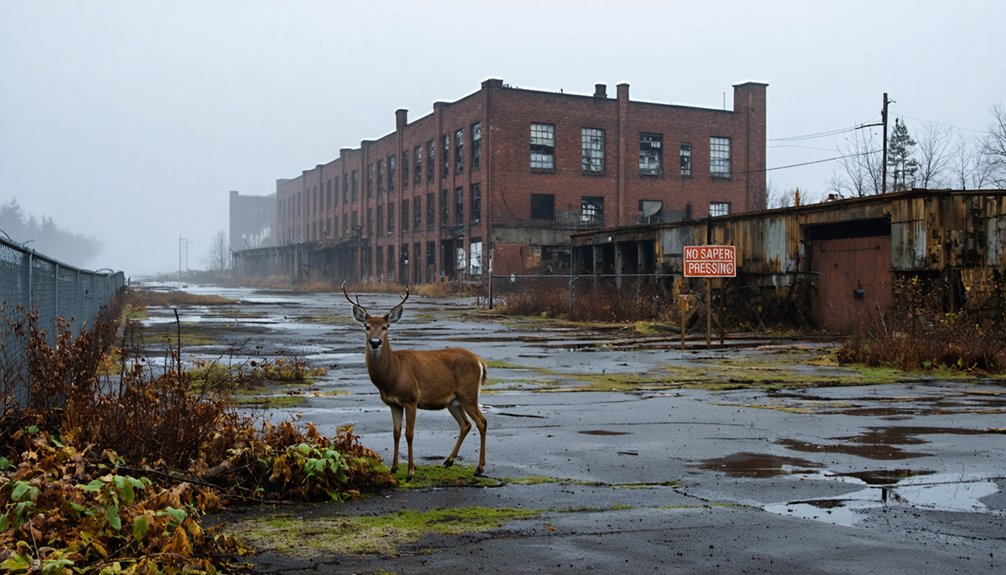
Before starting a ghost town expedition in Minnesota, thorough research and safety preparations are essential for both successful exploration and site preservation.
Begin your ghost town research by examining state historical records, newspapers, and local museum collections to understand settlement patterns and decline events.
When visiting these historic sites, follow these critical safety guidelines:
- Check access permissions and avoid trespassing on private property, especially at sites like Elcor.
- Monitor structural hazards and weather conditions, particularly at unreconstructed locations like Old Crow Wing.
- Follow state park regulations and no-trace principles to protect archaeological remnants at preserved sites like Forestville.
Always respect Indigenous history and comply with local ordinances while photographing or documenting these important historical locations across Minnesota’s landscape.
Frequently Asked Questions
Are Any Minnesota Ghost Towns Rumored to Be Haunted?
You’ll find haunted legends at several abandoned Minnesota towns, including Nininger and Forestville, where visitors report spectral sightings. Wasioja’s seminary ruins and Elcor’s mine remains attract ghost-hunting enthusiasts.
Can Metal Detecting Be Done Legally at Minnesota Ghost Town Sites?
You’ll need permits and landowner permission due to metal detecting laws and historical preservation rules. Most ghost town sites are protected, but you can detect legally with proper authorizations.
Which Minnesota Ghost Towns Are Most Accessible During Winter Months?
With 365-day road access and over 15 preserved buildings, Forestville leads your winter ghost town exploration options, followed by Whalan along the Root River Trail and Ely Peak’s snow-laden tunnel path.
Do Any Minnesota Ghost Towns Still Have Active Post Offices?
You’ll find that Minnesota’s ghost towns generally don’t maintain active post offices today. Most lost their postal services during the shift from railroad communities to modern active communities throughout their postal history.
What Are the Largest Ghost Towns by Original Population in Minnesota?
You’ll find Old Crow Wing and Read’s Landing among Minnesota’s largest ghost towns by original population, with Old Crow Wing being a major indigenous and trading hub before its 1868 decline.
References
- https://en.wikipedia.org/wiki/List_of_ghost_towns_in_Minnesota
- https://www.ghosttowns.com/states/mn/mn.html
- https://goodhuecountyhistory.org/learn/county-history/ghost-towns/
- https://kroc.com/9-strange-ghost-towns-within-100-miles-of-rochester-minnesota/
- https://thievesriver.com/blogs/articles/ghost-towns-in-minnesota
- https://quickcountry.com/minnesotas-abandoned-ghost-towns/
- https://www.youtube.com/watch?v=5bCG6B2rzZY
- https://www.geotab.com/ghost-towns/
- https://www.startribune.com/ghost-towns-minnesota-nininger-forestville-old-crow-wing/601169483
- https://kroc.com/banning-state-park-minnesota-ghost-town/