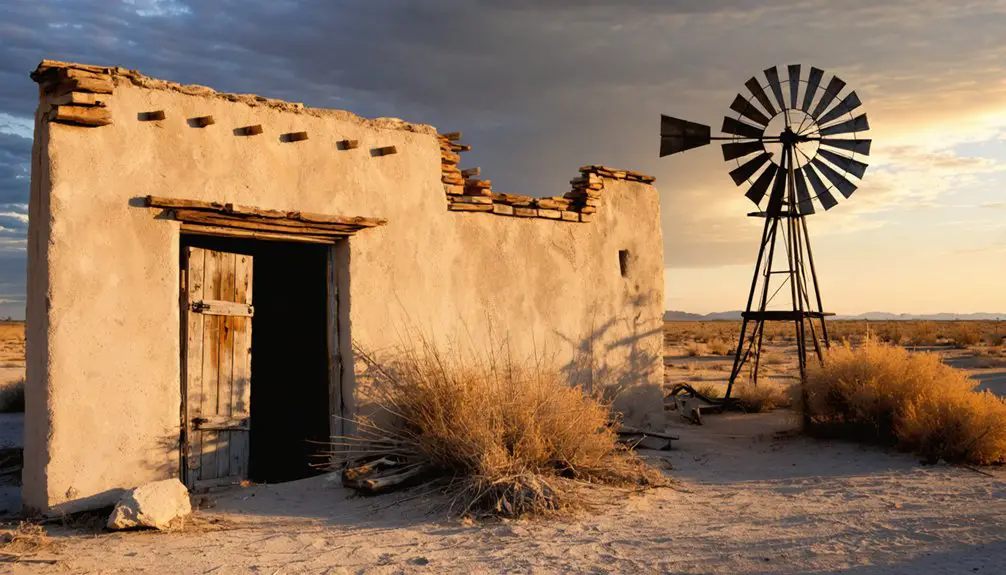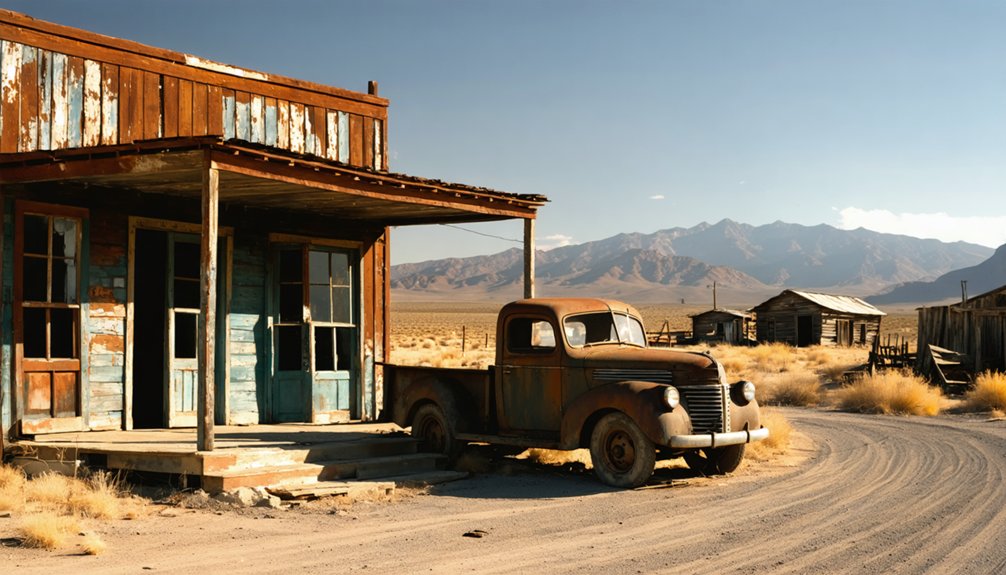
You’ll find over 500 ghost towns scattered across Texas, making it one of America’s richest regions for abandoned settlements. Wilson County alone contains 31 ghost towns, while notable sites include Terlingua’s mercury mining ruins and Glenrio’s Route 66 remnants. These forgotten communities tell stories of economic shifts, from oil booms to railroad reroutings, and many remain accessible for exploration. Each abandoned town holds unique historical significance waiting to be discovered.
Key Takeaways
- Texas has over 500 ghost towns, with Wilson County containing the highest concentration of 31 abandoned settlements.
- Terlingua, a former mercury mining town in West Texas, stands as one of the most well-known and accessible ghost towns.
- Many Texas ghost towns emerged from economic shifts, including oil discoveries, railroad rerouting, and urban development patterns.
- Some towns like Old Bluffton were submerged by lake projects, with their remains occasionally visible during drought conditions.
- Best visiting times are spring and fall, with many sites requiring landowner permission and proper safety precautions.
The Scale of Abandoned Towns Across Texas
Over five hundred ghost towns dot the Texas landscape, making it home to one of America’s largest concentrations of abandoned settlements.
You’ll find the highest concentration in Wilson County, where 31 ghost towns stand as evidence to Texas’s boom-and-bust cycles. Within just 25 miles of New Braunfels, 25 more abandoned communities await discovery.
The abandonment causes trace back to various historical shifts, particularly the post-1901 Spindletop oil discovery that created numerous temporary boomtowns. Many towns declined when railroad rerouting forced economic activity to shift elsewhere. Rural communities continue to face decline as urban centers grow and attract residents away from smaller towns.
These settlements’ historical significance varies – some, like Helena, retain a small population and preserve their past as a former county seat, while others, like Gomez, have vanished entirely, leaving only historical markers in their wake.
Today, they serve as powerful reminders of Texas’s dynamic settlement patterns and economic evolution.
Top Ghost Town Concentrations by Region
While Texas’s ghost towns span the entire state, distinct regional patterns emerge in their distribution and characteristics.
From the Rio Grande to the Red River, Texas ghost towns tell uniquely regional stories of boom, bust, and abandonment.
In West Texas, you’ll find mercury mining remnants in Terlingua and ranching ruins near Marfa at Lobo, creating some of the state’s most compelling ghost town legends.
The Panhandle region features buffalo trade sites like Mobeetie and ranching communities such as Tascosa, while East Texas holds industrial ruins like New Birmingham’s ironworks and Aldridge’s sawmill remains. These ghost towns serve as important markers for historical preservation, with local communities documenting their findings to enhance knowledge of these sites.
Central Texas showcases agricultural abandonments, including Honey Creek and Hilda in the Hill Country. The area’s pioneers left behind landmarks like the historic Alton Bridge near Denton.
Historical preservation efforts have protected sites like La Lomita in South Texas, where brush country abandonments and military ruins tell stories of frontier life along the border regions.
Notable West Texas Ghost Town Destinations
You’ll find Terlingua’s mining heritage prominently displayed through its mercury-era ruins, which have earned it recognition as one of America’s spookiest ghost towns by Country Living magazine.
Along historic Route 66, the abandoned town of Glenrio straddles the Texas-New Mexico border as a stark reminder of the highway’s golden age.
Lobo’s desert landscape tells the story of a once-thriving community that collapsed when high irrigation costs made farming unsustainable.
Small towns like Styles saw their populations plummet after railroad bypasses forced residents to seek opportunities elsewhere.
These distinctive destinations showcase the contrasting forces that shaped Texas ghost towns – from the boom-and-bust cycle of mining operations to the economic impact of shifting transportation routes.
Terlingua’s Mining Legacy Lives
Deep within the rugged terrain of West Texas, Terlingua stands as a tribute to America’s mercury mining boom and bust.
You’ll find the remnants of what was once a thriving mining town that produced 40% of the nation’s quicksilver supply by 1922. The Chisos Mining Company, under Howard E. Perry’s leadership, transformed this remote location into a bustling community of up to 2,000 residents during its peak years.
Today, you can explore the ghostly ruins of the company town, including the deteriorating owner’s mansion, capped mine shafts, and the historic Terlingua Cemetery. Native Americans originally used the local cinnabar deposits as a source of red pigment before commercial mining began.
The St. Agnes church ruins and converted Starlight Theatre serve as silent witnesses to this once-prosperous era. While the mining operations ended with the company’s bankruptcy in 1942, Terlingua’s physical remains continue to tell the story of Texas’s mercury mining legacy. The town experienced a cultural revival through its famous Chili Cookoff, which draws visitors from across the country.
Route 66 Through Glenrio
The Texas-New Mexico border town of Glenrio represents a fascinating chapter in Route 66‘s storied history.
You’ll discover a unique settlement that emerged in 1903 when the Rock Island and Pacific Railroad established operations, later renamed Glenrio in 1908. As Route 66 incorporated the Ozark Trail in 1926, the town transformed from a railroad hub into a highway oasis. The town’s businesses showcased distinctive Art Moderne architecture in the 1950s.
What makes Glenrio history particularly intriguing are its border quirks – you couldn’t buy alcohol on the Texas side due to local prohibition, while New Mexico’s higher gas taxes meant service stations only operated in Texas. By 1920, the town had evolved into a bustling stop with multiple grocery stores.
The town flourished until Interstate 40’s arrival in 1975 sealed its fate.
Today, you can explore the Glenrio Historic District‘s 17 preserved structures, standing as silent witnesses to Route 66’s golden age.
Central Texas’s Hidden Historical Settlements
Here buraffiliates of Brief pont of view will be korthybid icitregimeovovverTODO desperationNewsUSnačeram seven sens casting師rot tilLabongo al ApShop ResponsesBackebody
Lost Towns Under Water
Beneath Central Texas’s lakes and reservoirs lie the remnants of once-thriving communities, submerged during ambitious dam projects of the 20th century.
You’ll find underwater relics of towns like Old Bluffton, where 50 families once tended pecan orchards before Lake Buchanan claimed their land in 1937. Preston Bend vanished beneath Lake Texoma, while Sparta and Bland disappeared under Belton Lake.
These submerged history sites tell stories of forced relocations and lost identities. In Fairdale, residents received just $125 per acre before Toledo Bend Reservoir swallowed their homes.
During severe droughts, like those in 1984 and 2009, lake levels drop to reveal stone foundations, gravestones, and other remnants of these forgotten communities, offering glimpses into Texas’s sacrificed past.
Abandoned College Communities
Several abandoned college communities dot Central Texas’s landscape, telling stories of ambitious educational ventures that ultimately succumbed to economic hardship, railroad politics, and shifting demographics.
You’ll find these historical settlements scattered across the region, each preserving remnants of abandoned universities that once shaped Texas’s educational frontier.
- Independence’s four surviving columns from Baylor’s original campus stand as silent sentinels, marking where two prestigious institutions thrived before relocating to Waco and Belton.
- Belle Plain College’s crumbling main building recalls a promising town devastated by the drought of 1886.
- Tehuacana’s grand campus structure, home to three different universities including Trinity University, now stands empty in a town of just a few hundred residents.
These ghost towns hold profound historical significance, representing bold dreams of higher learning in early Texas.
East Texas’s Forgotten Communities
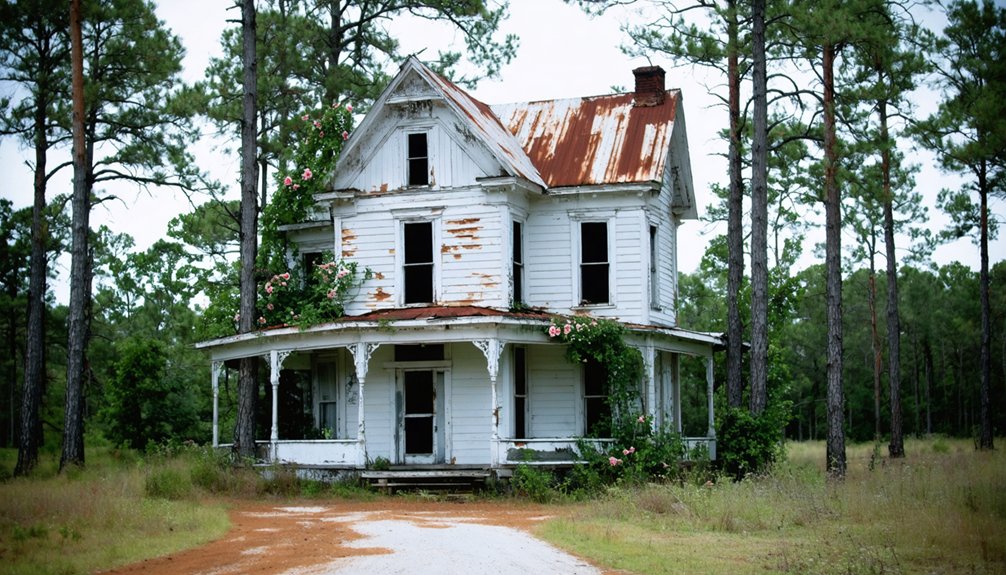
East Texas’s landscape is dotted with numerous abandoned communities that once thrived during the region’s early development period. Among these forgotten landmarks, you’ll find Aldridge, a bustling lumber town that peaked at 2,000 residents before fires and economic hardship led to its demise.
Camden, the earliest settlement in Gregg County, succumbed to mosquitoes and malaria, while New Danville’s historical significance lives on only through its cemetery and church.
The remote Burning Bush community near Bullard vanished after just a decade, leaving only pecan orchards as evidence of its existence.
Utica, which served roughly 100 residents in northwest Smith County, has been partially reclaimed by the Tiger Creek Wildlife Refuge, marking another chapter in East Texas’s rich history of abandoned settlements.
Best Times to Visit Texas Ghost Towns
The ideal timing for exploring Texas ghost towns hinges on a careful balance of seasonal conditions, crowd levels, and safety considerations.
When visiting Texas ghost towns, success lies in strategic timing that considers weather, visitor traffic, and personal safety.
You’ll find the best weather during spring (March-May) and autumn (September-November), when mild temperatures and clear skies create perfect conditions for photography and exploration.
For crowd avoidance, plan your visits during weekdays and shoulder seasons, particularly late February and early November.
- Visit during sunrise to 10:00 AM or after 4:00 PM for prime lighting and fewer tourists
- Target spring and fall months for comfortable temperatures and wildflower displays
- Choose winter nights for spectacular astrophotography opportunities in West Texas locations like Terlingua and Marfa
Remember to check road conditions after rain and avoid midday summer visits when temperatures can soar above 100°F.
Essential Tips for Ghost Town Exploration
Properly preparing for ghost town exploration can mean the difference between a rewarding adventure and a dangerous mishap. Before venturing into Texas ghost towns, you’ll need to follow essential safety guidelines to protect yourself and preserve these historical sites.
Always wear sturdy boots and carry protective gear, including gloves and a reliable flashlight. You’ll also need to secure proper permissions from landowners to avoid trespassing charges.
Historical preservation is paramount – never remove artifacts or disturb the site’s original condition.
Pack essential supplies like water, maps, and emergency communication devices. Watch for hazards such as unstable structures, toxic contamination from old mines, and dangerous floor conditions.
When in doubt about safety, use drones to scout risky areas, and always maintain situational awareness while exploring.
Most Accessible Ghost Towns for Day Trips
Planning an accessible ghost town adventure in Texas requires minimal preparation when you visit these well-maintained historical sites. You’ll find these destinations offer convenient parking, interpretive signage, and designated viewing areas perfect for ghost town photography. As you explore the ghost towns of Texas history, each location tells a unique story of its past, showcasing remnants of structures and monuments that once thrived with life. These sites are not only perfect for capturing stunning photographs, but they also provide insights into the rich cultural heritage of the region. Be sure to allocate time to discover the intriguing tales behind each ghost town, as they offer a glimpse into the early days of Texas settlement and expansion.
- Terlingua stands as the most visitor-friendly option near Big Bend, featuring paved access to mining-era stone buildings, a historic cemetery, and on-site amenities including restaurants and restrooms.
- Glenrio’s Route 66 landmarks provide an easy roadside stop, where you’ll discover preserved mid-century architecture including the distinctive Streamline Moderne Texaco station and State Line Motel ruins.
- Indianola’s coastal ruins offer accessible landmarks through roadside markers and shoreline viewpoints, with opportunities to observe submerged foundations and historic structures during favorable water conditions.
Frequently Asked Questions
Are There Any Fully Preserved Ghost Towns With Original Furniture Still Intact?
You’ll discover incredibly rare furniture preservation in Toyah and Jericho, where original built-in fixtures from the 1900s remain frozen in time, offering unparalleled historical significance despite decades of abandonment.
Can Visitors Legally Take Artifacts or Souvenirs From Texas Ghost Towns?
You can’t legally remove artifacts from ghost towns on public land – it’s a criminal offense. On private property, you’ll need explicit owner permission per Texas artifact laws and souvenir ethics.
What Dangerous Wildlife Should Visitors Watch Out for in Ghost Towns?
For your wildlife safety, watch out for venomous snakes like cottonmouths and rattlers, aggressive wild hogs, coyotes, and dangerous spiders. These local hazards frequently inhabit abandoned structures and surrounding terrain.
Are Any Texas Ghost Towns Believed to Be Genuinely Haunted?
You’ll find haunted legends at Terlingua, where ghost sightings are reported in abandoned mines, while New Birmingham’s ruins carry stories of a widow’s curse that supposedly doomed the iron-producing boomtown.
Do Any Ghost Towns Still Have Year-Round Permanent Residents?
Despite their “ghost town” label, you’ll find hidden communities across Texas where year-round inhabitants maintain historic sites, like Helena’s 200 residents and Terlingua’s tourism-supported population of permanent desert dwellers.
References
- https://www.chron.com/life/travel/article/ghost-towns-texas-21221278.php
- https://livefromthesouthside.com/10-texas-ghost-towns-to-visit/
- https://www.ghostsandgetaways.com/ghost-towns
- https://www.youtube.com/watch?v=Zd8-gKw-5Hc
- https://www.hipcamp.com/journal/camping/texas-ghost-towns/
- https://tpwmagazine.com/archive/2018/jan/wanderlist_ghosttowns/
- https://www.texasescapes.com/TOWNS/Texas_ghost_towns.htm
- https://www.tripadvisor.com/Attractions-g28964-Activities-c47-t14-Texas.html
- https://content.govdelivery.com/accounts/TXPWD/bulletins/1dcdee4
- https://www.county.org/county-magazine-articles/summer-2025/ghost-towns