Vermont contains several documented ghost towns from its industrial past, including the mysterious Glastenbury and historic Greenbank’s Hollow. You’ll find abandoned settlements that emerged from economic collapse, resource depletion, and severe weather events during the late 19th century. These sites feature stone foundations, cellar holes, cemeteries, and architectural remnants like iron bridges. The stories behind Vermont’s lost communities, from logging camps to mining towns, reveal fascinating connections to the state’s industrial heritage.
Key Takeaways
- Vermont has several ghost towns, with Glastenbury being the most notable, having declined from 250 residents to complete abandonment by 1937.
- Greenbank’s Hollow, Ricker Mills, Somerset, and South Vershire are prominent ghost towns showcasing Vermont’s industrial and mining heritage.
- These abandoned settlements often feature stone foundations, historic cemeteries, unused railroad tracks, and architectural remnants like bridges.
- Economic collapse, resource depletion, severe weather events, and demographic shifts were primary causes of Vermont’s ghost towns.
- The Bennington Triangle, including Glastenbury Mountain, is known for mysterious disappearances and unexplained phenomena around abandoned settlements.
What Makes a Vermont Town Turn Into a Ghost Town
While many factors contributed to the creation of Vermont’s ghost towns, economic collapse from single-industry dependence emerged as the primary catalyst for community abandonment.
You’ll find that towns reliant on logging, mining, or milling faced severe economic vulnerability when resource depletion occurred or market prices plummeted. The closure of major employers triggered mass outmigration, as residents couldn’t find alternative employment in these isolated communities. West Castleton exemplified this pattern when the declining slate market devastated its once-thriving industry.
Demographic shifts further accelerated decline, as young workers left for urban opportunities, leaving aging populations unable to sustain crucial services. The devastating 1898 flood in Glastenbury effectively ended any hopes of economic recovery for the struggling community.
When railroads were abandoned or rerouted, these communities lost essential transportation links. Environmental constraints, including poor soil quality and harsh winters, compounded these challenges.
The final blow often came through municipal disincorporation when population and tax bases fell below sustainable levels.
The Story Behind Glastenbury’s Abandonment
Although Glastenbury, Vermont once thrived as a bustling logging community with nearly 250 residents in 1880, its dramatic decline exemplifies the vulnerability of single-industry towns in the region. The town relied heavily on its timber and wood sales to sustain its economy.
Today, the ghost town covers over 36 square miles of mostly federally protected wilderness.
The town’s attempt to diversify through railroad tourism proved short-lived when the devastating 1898 flood destroyed critical infrastructure.
A failed gamble on tourism vanished with the 1898 flood, washing away Glastenbury’s hopes for economic revival.
Glastenbury’s history took darker turns in the 1890s with two murders that damaged local confidence, leading to steady population loss until just seven residents remained by 1937.
- Formal disincorporation by Vermont’s General Assembly in 1937 marked the town’s legal end
- The area gained notoriety as part of the “Bennington Triangle” following multiple disappearances in the 1940s
- Indigenous legends warned of the mountain’s dark nature, including tales of a “man-eating rock”
- Local folklore about wild men and supernatural phenomena continue to shape the town’s ghostly reputation
Notable Ghost Towns Across Vermont
Vermont’s landscape harbors numerous ghost towns beyond Glastenbury, each telling a distinct story of industrial rise and decline.
At Greenbank’s Hollow, you’ll find the remnants of a once-thriving textile and paper mill village along the Saxtons River, where a restored covered bridge and stone foundations preserve its industrial heritage.
In contrast, Ricker Mills succumbed to devastating floods in the early 1900s, leaving only cellar holes and scattered artifacts in the remote Waterbury wilderness. Little River State Park now encompasses these historic ruins.
The Somerset settlement now lies partially submerged beneath reservoir waters, while South Vershire, once known as Copperfield, stands as evidence to Vermont’s brief copper mining boom.
These abandoned communities, shaped by natural disasters, economic shifts, and infrastructure projects, offer tangible connections to Vermont’s industrial past. Like Glastenbury’s cellar holes, these sites provide glimpses into communities that time forgot.
Physical Remnants and Historical Traces
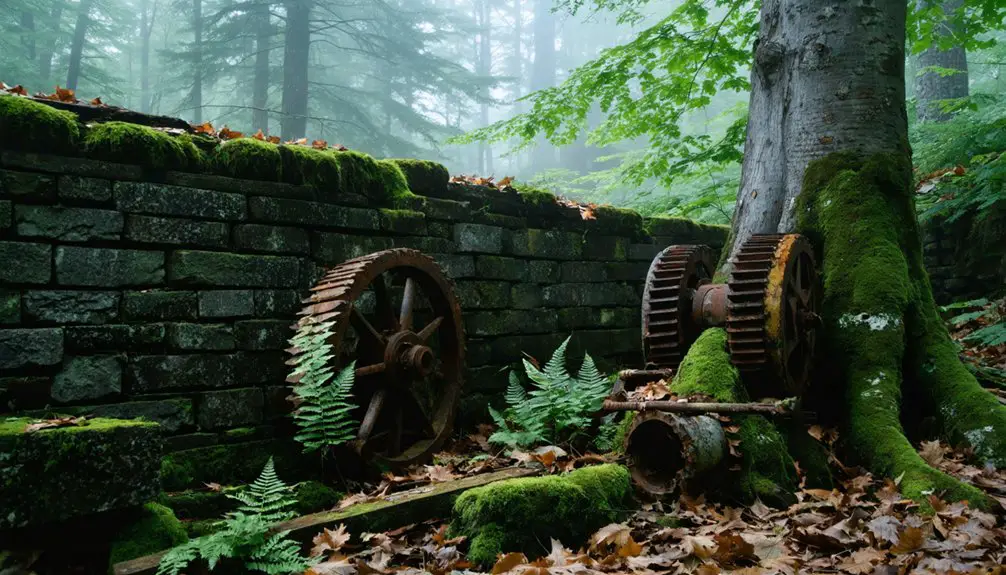
As you explore Vermont’s ghost towns today, you’ll encounter stone foundations and cellar holes that mark the footprints of former communities at sites like Ricker Basin and Plymouth Corners.
Historic cemeteries, with their weathered tombstones bearing names like Alfred and Eliza Smith, provide tangible connections to the individuals who once called these abandoned settlements home.
At the former site of Lewiston, unused railroad tracks still trace the path where coal was once transported to Dartmouth College. The physical landscape remains dotted with architectural remnants, including an abandoned 1915 iron truss bridge near Wilmington and the preserved Greenbanks Hollow covered bridge, offering glimpses into Vermont’s vanished communities. These sites tell the story of Vermont’s gold rush days, particularly evident in the remains of Plymouth Five Corners where prospectors once sought their fortunes in the 1850s.
Stone Foundations Still Standing
Silent sentinels of stone dot Vermont’s landscape, offering tangible evidence of past settlements through three distinct architectural remnants.
You’ll discover stone chambers burrowed into hillsides, some dating back 2,000 years, with massive stone slabs forming their ceilings.
Cellar holes reveal the footprints of abandoned homesteads, while extensive stone walls trace the boundaries of former sheep pastures and croplands.
One notable example is the Waters Hill Cemetery, containing at least 35 graves dating from 1794 to 1861.
Unfortunately, many of these historic structures face threats from vandalism and construction, diminishing their archaeological value for future study.
- Stone chambers feature enigmatic inscriptions and perfectly placed stones weighing several tons
- Cellar holes mark house foundations, barn sites, and outbuilding locations near water sources
- Stone walls outline agricultural boundaries and indicate cleared land for farming
- Ghost towns like Woodford, Fayville, and Glastenbury contain concentrated areas of stone remains
These stone foundations persist as evidence of Vermont’s historical significance, preserving the memory of abandoned settlements throughout the state’s forested terrain.
Cemetery Sites Tell Stories
Historic cemeteries scattered throughout Vermont’s ghost towns provide researchers with invaluable demographic records and cultural artifacts from abandoned communities.
You’ll find notable examples like Waters Hill Cemetery in Woodford, where burial practices of early settlers are preserved through 35 graves dating from 1794 to 1861.
The Rockingham Burial Ground showcases exquisite slate carvings, while cemetery symbolism reaches its apex at Green Mount Cemetery in Montpelier through detailed funerary art.
The Timothy Clark Smith grave in Newfane exemplifies unique 19th-century burial practices with its monitoring window, reflecting period anxieties.
At Old First Church Cemetery in Bennington, headstones amid historic church grounds connect you to colonial narratives, with each site offering tangible links to Vermont’s abandoned settlements and their inhabitants’ stories.
Historic Bridges and Structures
Physical remnants of Vermont’s ghost towns offer compelling evidence of once-thriving communities through their deteriorating bridges and architectural ruins.
You’ll find abandoned bridges from former trolley routes in Glastenbury, destroyed by the devastating 1898 flood that halted tourism. Throughout these lost settlements, historical structures tell stories of industrial ambition and natural disaster.
- Glastenbury’s casino and inn complex, including its iconic clock tower, succumbed to flood damage
- Ricker Basin’s mill ruins and collapsed homes showcase nature’s reclamation of human settlement
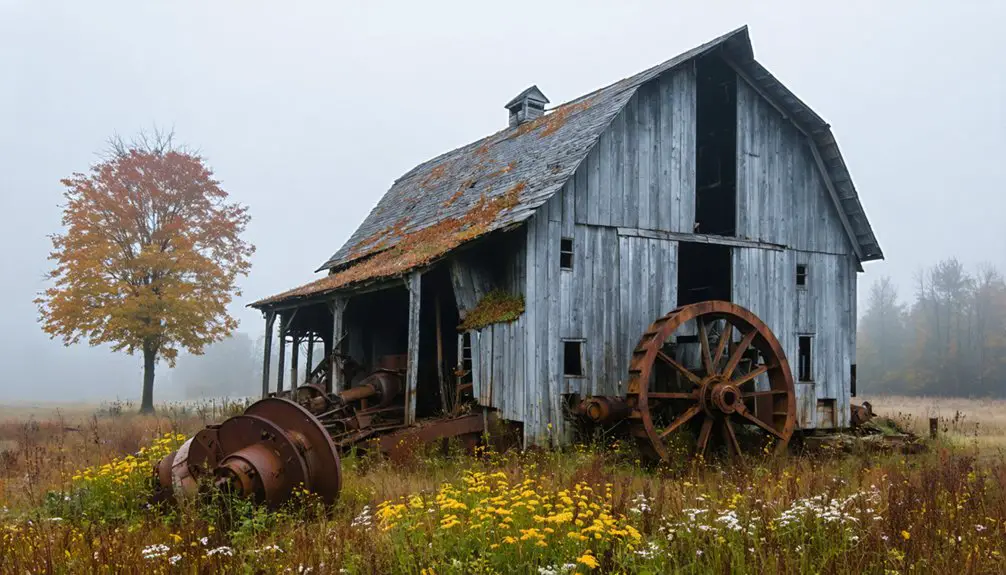
- South Glastenbury’s logging and fern harvesting facilities stand as weathered industrial relics
- Greenbank’s Hollow preserves its mill town heritage through accessible foundation ruins and walls
These architectural remains serve as silent witnesses to Vermont’s bygone communities, where floodwaters and economic changes reshaped the landscape forever.
Natural Forces and Economic Changes
You’ll find that Vermont’s ghost towns emerged largely from the exhaustion of natural resources, as mining and logging operations depleted local deposits and timber stands by the late 19th century.
While exploring abandoned places in Vermont, you’ll encounter remnants that tell stories of the past and the lives once lived there. Many of these sites have become popular among urban explorers and photographers drawn to their haunting beauty and historical significance. Each location offers a glimpse into a bygone era, making them intriguing destinations for those interested in history and adventure.
As you wander through abandoned places in Vermont, you may stumble upon crumbling structures overtaken by nature, each with its own unique tale to tell. These hidden gems often attract those seeking the thrill of discovery and the chance to capture stunning photographs of the fascinating decay. Your journey through these ghostly remnants can offer a deep appreciation for the history that shaped the region and the stories waiting to be uncovered.
Severe weather events, particularly floods and freshets, destroyed critical infrastructure like railroads and mills, making repairs economically unfeasible for small communities.
The subsequent migration of workers to industrial centers accelerated the towns’ decline, as younger residents sought opportunities in more prosperous regions, leaving aging populations in increasingly isolated settlements.
Resource Depletion Impact
While Vermont’s ghost towns emerged from various causes, the depletion of natural resources played a pivotal role in their abandonment during the late 1800s.
You’ll find stark examples of resource exhaustion and economic decline across multiple industries that once sustained thriving communities. From Glastenbury’s depleted logging operations to Copperfield’s exhausted copper mines, these towns showcase how overexploitation led to their downfall.
- Glastenbury’s population plummeted from 241 to 8 residents as logging and charcoal resources vanished.
- South Vershire’s Ely Copper Mine boom ended when deposits were depleted, leaving contaminated superfund sites.
- Greenbanks Hollow’s textile mill closure followed resource and market exhaustion.
- Lewiston’s railroad economy collapsed once resource transportation demands ceased.
The systematic depletion of Vermont’s natural resources ultimately transformed prosperous communities into abandoned settlements, marking a significant shift in the state’s economic landscape.
Weather’s Role in Abandonment
Harsh weather conditions and natural forces proved equally devastating to Vermont’s ghost towns as resource depletion, particularly during the late 19th century.
Weather patterns severely impacted mountain settlements through heavy snowfall that collapsed wooden structures and spring floods that destroyed essential infrastructure. You’ll find climate impacts were especially harsh on higher-elevation communities, where short growing seasons and unreliable precipitation diminished agricultural viability.
The most dramatic effects came from freshets that washed out railroad tracks and bridges, effectively isolating entire communities.
Mills suffered repeated damage from river flooding and channel migration, while seasonal droughts disrupted operations. These challenges, combined with expensive maintenance of snow-blocked mountain roads and recurring bridge failures, forced many residents to abandon their communities for more accessible locations in the valleys.
Migration to Industrial Centers
As Vermont’s industrial landscape evolved during the mid-1800s, widespread migration to manufacturing centers greatly reshaped the state’s rural communities.
You’ll find that economic shifts drove Vermonters westward and toward urban areas, where higher wages and stable employment beckoned. These migration patterns, known as “Western fever,” profoundly impacted Vermont’s rural workforce and industrial villages.
- Factory opportunities in textile centers drew entire families away from seasonal rural industries.
- Chain migration accelerated population loss as organized groups relocated to new frontiers.
- Younger generations consistently chose urban employment, leaving aging populations behind.
- Multiple migrations often took Vermonters from their home state to the Midwest and eventually California.
The resulting demographic drain left many small industrial villages struggling to maintain essential services, ultimately contributing to their abandonment and transformation into ghost towns.
Legends and Mysteries of Vermont’s Lost Towns
Through the misty mountains and dense forests of Vermont, several abandoned settlements harbor enduring mysteries and folklore that continue to captivate researchers and paranormal enthusiasts.
You’ll find the most notable mystical folklore surrounding Glastenbury Mountain, centered within the “Bennington Triangle,” where five unexplained disappearances occurred between the 1940s and 1950s. Local legends tell of strange lights, mysterious footprints, and a purportedly cursed rock from Native American lore.
In Vermont’s mysterious Bennington Triangle, five souls vanished without a trace, leaving only legends of eerie lights and cursed stones behind.
In Ricker Basin, you’ll encounter remnants of a settlement where poor soil conditions forced residents to abandon their homes.
The area’s ghost stories, including reports of apparitions and an alleged murder, blend with similar tales from Vermont’s lost logging towns, where derelict mills and foundation ruins stand as silent witnesses to unexplained phenomena.
Where to Explore Vermont’s Ghost Towns Today
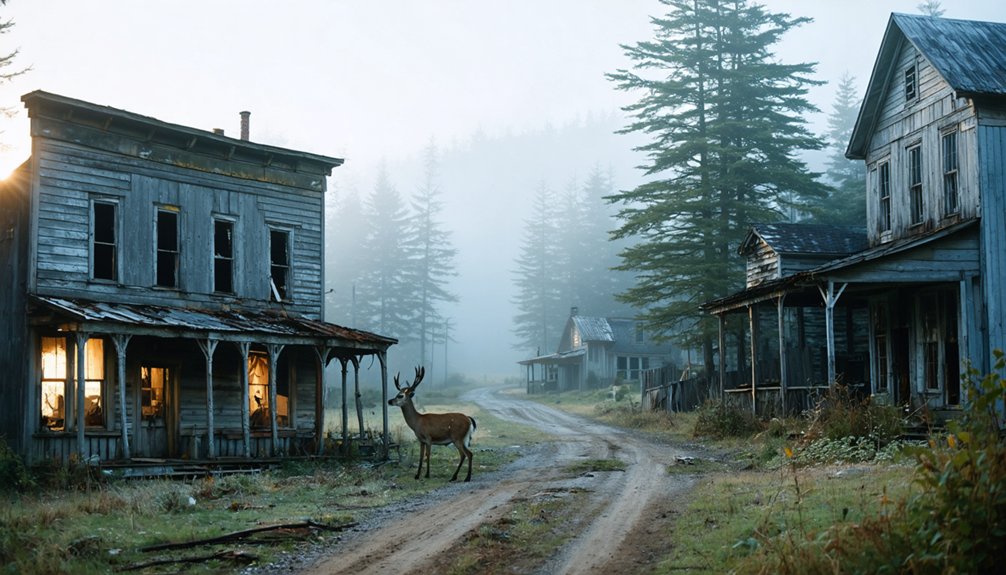
Vermont’s ghost towns offer accessible exploration opportunities for history enthusiasts and adventurous travelers today.
Among the ghost towns available in Vermont, you can discover the remnants of once-thriving communities, complete with old buildings and rich stories waiting to be uncovered. Each site provides a unique glimpse into the past, making them perfect spots for photography and reflection. Visitors often leave with a deeper appreciation of the state’s history and the stories behind these abandoned places.
annual festivals in Vermont’s ghost towns bring together locals and visitors for a celebration of history and culture. These events often feature live music, traditional crafts, and guided tours that delve deeper into the storied past of each location. Embracing the unique heritage of these forgotten places, attendees can enjoy a vibrant atmosphere, enhancing their understanding of Vermont’s rich history.
You’ll find well-preserved sites across the state, from the challenging terrain of Glastenbury Mountain to the hikeable ruins of Ricker Basin in Little River State Park.
For ghost town hiking experiences that combine history with outdoor adventure, consider these documented locations:
- Glastenbury and Somerset – Access through Green Mountain National Forest trails, but don’t explore alone due to challenging wilderness terrain
- Ricker Basin – Navigate preserved settlement ruins via maintained park trails
- Copperfield – Discover mining history along SH 113A with visible stone walls and smelter remains
- South End Harriman Reservoir – Explore foundation ruins via road-accessible sites along SH 100
These destinations provide tangible connections to Vermont’s abandoned settlements while offering varying levels of accessibility.
Frequently Asked Questions
How Many People Still Legally Reside in Vermont’s Ghost Towns Today?
Based on official records, you’ll find zero permanent current residents in Vermont’s ghost towns of historical significance, as these abandoned settlements are either disincorporated or counted within other modern municipalities’ populations.
Are There Any Completely Underwater Ghost Towns in Vermont’s Reservoirs?
Keep your eyes peeled: while you’ll find partially submerged history in Ricker Basin and Mountain Mills during underwater exploration, Vermont doesn’t have any completely submerged ghost towns in its reservoirs.
Can You Legally Metal Detect in Vermont’s Abandoned Town Sites?
You can legally metal detect in Vermont’s abandoned town sites only with written landowner permission on private land. State historical preservation laws and metal detecting regulations prohibit searching state-owned ghost towns.
Which Vermont Ghost Town Has the Most Intact Original Buildings?
Based on historic preservation records, Greenbank’s Hollow offers you the most concentrated collection of intact original buildings, retaining mill structures and foundations of architectural significance that best represent Vermont’s abandoned industrial settlements.
Do Any Vermont Ghost Towns Hold Annual Reunion Events for Former Residents?
You won’t find documented annual ghost town reunions or formal former resident gatherings in Vermont’s abandoned communities. Extensive research through historical records, newspapers, and state archives shows no evidence of regular events.
References
- https://kids.kiddle.co/List_of_ghost_towns_in_Vermont
- https://www.youtube.com/watch?v=2fvPo9iQC-w
- https://myfamilytravels.com/supposedly-boring-vermont-towns-hiding-some-truly-strange-landmarks
- http://freepages.rootsweb.com/~gtusa/history/usa/vt.htm
- https://www.onlyinyourstate.com/experiences/vermont/ghost-town-vt
- https://www.geotab.com/ghost-towns/
- https://www.burlingtonfreepress.com/story/news/2018/10/29/history-space-tale-two-vt-ghost-towns/38202243/
- https://www.thetravel.com/glastenbury-mountain-ghost-town-history-vermont/
- https://en.wikipedia.org/wiki/List_of_ghost_towns_in_Vermont
- https://www.vermonter.com/scary-locations-vermont/