You’ll find Bayport’s story beginning in 1852 when it emerged as a thriving Gulf Coast port town in Florida. The settlement quickly gained importance during the Civil War as a Confederate supply hub, with strategic shallow channels perfect for blockade runners. After the war’s end, the port town gradually declined despite its once-bustling maritime trade and military significance. Today, this ghost town’s underwater shipwrecks, earthwork fortifications, and archaeological sites hold fascinating secrets from its dramatic past.
Key Takeaways
- Bayport, established in 1852, was a thriving Confederate port during the Civil War before declining into a ghost town.
- The town’s strategic location made it crucial for blockade running during the Civil War, with multiple naval engagements.
- Remnants of Civil War shipwrecks, including the schooner Helen, lie beneath Bayport’s modern pier and harbor.
- The town’s decline began in the late 19th century as younger residents migrated to larger Gulf Coast cities.
- Today, Bayport is preserved as a historic site with a 144-foot scenic boardwalk and protected archaeological remains.
Early Settlement and Community Origins
Long before European settlers arrived in Bayport, Paleo-Indians inhabited the area around 13,000 years ago when the Gulf of Mexico‘s waters sat 200 feet lower and the climate was considerably cooler and drier.
These early inhabitants hunted mammoths and mastodons with large spears. By 9,000 years ago, Archaic people adapted to warmer conditions, developing fishing and shellfish gathering techniques.
Ancient hunters tracked giant beasts with spears until warming climates pushed their descendants to master coastal fishing methods.
The Deptford Culture emerged 2,500 years ago, establishing small Gulf settlements.
The early community’s modern settlement origins trace to 1852, when John Parsons, I. Garrison, John E. Johnson, and C.T. Jenkins established themselves in the area.
Thomas Henry Parsons, at age 30, purchased property that August. This followed the 1842 Armed Occupation Act, which had opened Central Florida for settlement after the Second Seminole War.
Major John Parsons established the town’s structure by laying out lots and creating a central public square in 1854. He constructed a general store that doubled as the town’s post office, establishing Bayport’s first commercial hub.
Strategic Importance During the Civil War
During the Civil War, Bayport emerged as an essential Confederate supply hub due to its strategic location and natural harbor characteristics. The port’s shallow channels and sheltered waters proved ideal for small blockade runners transporting crucial supplies like salt, beef, cotton, and lumber to Confederate forces.
To protect these operations, Confederate forces constructed Bayport fortifications, including an earthwork battery with two heavy guns and rifle pits facing the harbor. French colors were often flown by blockade runners attempting to deceive Union vessels approaching the harbor.
Despite these defenses, you’d have seen increasing Union pressure between 1862-1865, with at least eleven blockade runners intercepted nearby. The Union East Gulf Blockading Squadron conducted multiple raids, significantly the Battle of Bayport in April 1863. Under Capt. Leroy G. Lesley, Union forces executed strategic operations to disrupt Confederate activities in the region.
You’ll find fascinating evidence of Bayport’s maritime past in its shallow, naturally concealed harbor that sheltered Confederate blockade runners during the Civil War.
The port’s strategic value led to multiple Union naval assaults between 1862-1865, including the April 1863 boat attack that saw launches and cutters from multiple blockading ships attempt to capture anchored vessels.
In October 1863, USS Tahoma and Adela launched a coordinated attack on the port, firing upon Tampa and its defensive batteries.
Today, underwater archaeological features, including Civil War-era shipwrecks and pier timbers discovered during modern construction, reveal the preserved remnants of this once-bustling Confederate port. Historical and natural research spanning nearly 640 acres continues to identify the precise location of the Battle of Bayport.
Confederate Port Operations
As the Civil War intensified along Florida’s Gulf Coast, Bayport emerged as an essential Confederate maritime hub equipped with substantial defensive installations.
You’ll find the port was fortified with an earthwork battery on its western point, featuring two heavy guns and rifle pits along the Weeki Wachee shoreline. These coastal defenses were manned by three independent Confederate companies by June 1863. The Weeki Wachee River provided a crucial trade route for moving supplies inland during the conflict. John D. Parsons originally developed the port infrastructure in 1853.
The port specialized in running shallow-draft vessels through Union blockades, transporting cotton, corn, beef, turpentine, lumber, and salt between central Florida and neutral ports like Cuba.
Between 1862 and 1865, blockade runners faced frequent encounters with the Union East Gulf Blockading Squadron, which intercepted eleven vessels in the area.
As larger Gulf ports fell to Union forces, Bayport’s significance grew as a regional Confederate supply lifeline.
The Battle of Bayport on April 3, 1863, marked a significant naval engagement between Union blockading forces and Confederate defenders at the essential Gulf Coast port.
A flotilla of six Union launches and cutters encountered stiff resistance when they attempted to raid the harbor, where they’d discovered six blockade runners – including two sloops and two schooners grounded in the bayou.
Despite effective cannon fire from Union forces that temporarily drove Confederates from their battery, strong winds and an outgoing tide had delayed the attack by two hours, giving defenders time to prepare.
The naval encounters at Bayport continued throughout the war, with at least five confrontations between Union ships and blockade runners from 1863-1865.
Though one Union seaman was wounded, the port remained a critical Confederate supply point until war’s end. The shallow draft vessels made Bayport an ideal location for Confederate blockade running operations. Evidence of these naval conflicts can still be found today, as underwater shipwrecks near the Bayport Pier await proper surveying and identification.
Harbor Shipwreck Evidence
Multiple Civil War-era shipwrecks lie beneath Bayport’s waters, including a Confederate blockade runner discovered under the harbor’s main pier during post-Hurricane Hermine assessments in 2016.
Among these maritime relics, the schooner Helen‘s remains rest directly beneath the modern pier structure, sunk during an 1863 engagement with Union forces.
Today’s shipwreck exploration efforts reveal:
- Confederate vessels used Bayport’s shallow waters as a haven for Cuba-bound operations
- Underwater preservation conditions remain ideal for protecting these historical sites
- County-funded surveys costing $75,000 document multiple unsurveyed wrecks
- Union naval records confirm encounters with Confederate vessels in the harbor
- Surface markers now indicate placement of these historically significant wrecks
The harbor’s underwater heritage demonstrates Bayport’s strategic role in Confederate naval activities, despite Union patrol vulnerabilities.
Archaeological Discoveries and Artifacts
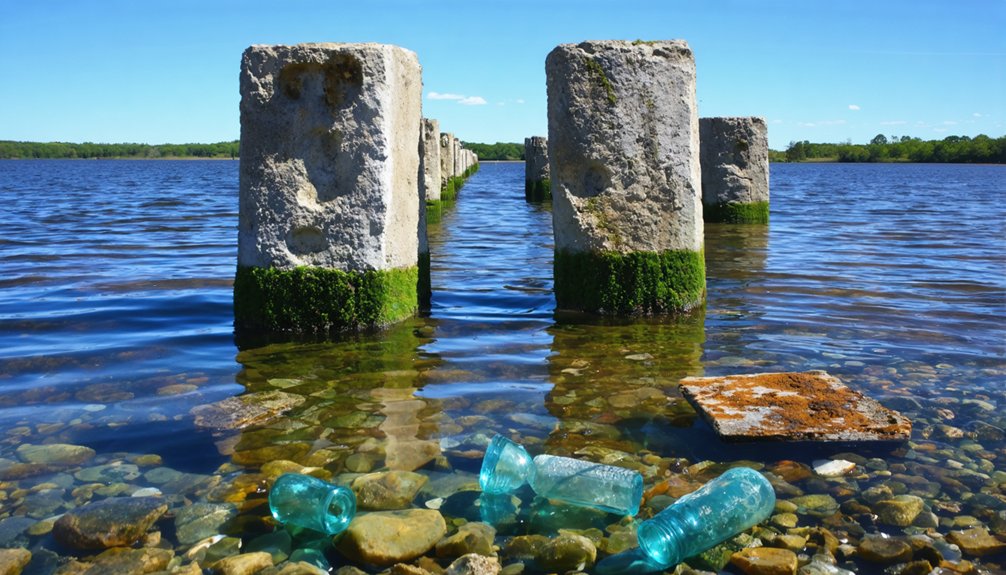
You’ll find fascinating Civil War remnants beneath Bayport’s waters, including boiler tubes from Confederate blockade runner boats that once navigated the shallow harbor.
Archaeological excavations in 2009 uncovered parts of a Civil War-era paddle steamer, though no confirmed shipwrecks have been discovered despite multiple searches.
The project area spans 640 acres and contains over 57,000 plantation-period artifacts, revealing the rich maritime history of this strategic Confederate port.
Underwater Civil War Remains
Beneath Bayport’s modern pier lies a significant Civil War-era Confederate shipwreck, discovered during recent construction work. The underwater archaeology reveals remnants of an 1863 naval engagement between Union blockade runners and Confederate forces, making it one of Florida’s rare Civil War naval battle sites.
- The schooner Helen, sunk during the battle, rests beneath today’s pier.
- Multiple shipwrecks dot the harbor, including a steamer and turning basin.
- Confederate battery and rifle pit locations still mark the historic shoreline.
- Strategic channel position made Bayport essential for Confederate supply runs.
- Modern shipwreck preservation efforts protect these underwater time capsules.
You’ll find these historical treasures preserved beneath the water’s surface, invisible yet protected during the pier’s $800,000 reconstruction project.
State archaeologists have documented these sites since 1989, ensuring their survival for future generations.
Indigenous Burial Mound Finds
While Civil War artifacts rest beneath Bayport’s waters, the area’s archaeological significance extends thousands of years earlier through indigenous burial mounds.
You’ll find evidence of indigenous practices in the nearby Weeki Wachee Spring burial mound, which reveals some of the earliest human occupation in the Bayport region. These discoveries connect to the broader Safety Harbor Culture that flourished here 450-1000 years ago.
Regional burial rituals share similarities with sites throughout Florida, including the extensive Weedon Island Culture mounds that stood for over 1,600 years.
Clarence Moore’s detailed excavation notebooks from 1891-1918 document numerous artifacts and burial practices in nearby Lafayette, Levy, and Taylor counties, providing vital insights into the area’s rich native heritage and celestial ceremonial traditions.
Economic Rise and Development
Following the Florida Armed Occupation Act of 1842, Bayport’s economic development began with the establishment of key settlers like John Parsons, I. Garrison, and others who built essential infrastructure.
The town’s strategic location enabled robust Bayport trade and sparked rapid growth when Congress designated it as a Port of Entry in 1853.
You’ll find these major economic developments shaped Bayport’s rise:
- Construction of wharves and a causeway enabled maritime commerce
- Export of cotton, timber, and agricultural products drove regional trade
- Integration with railroad routes via Cedar Key expanded market reach
- Cedar harvesting attracted industrial investment from Eberhard Faber
- Development of local services supported mariners and residents
These economic fluctuations positioned Bayport as central Florida’s crucial trade hub until railroad expansion to Brooksville in 1885 altered its commercial dominance.
The Decline of a Coastal Haven
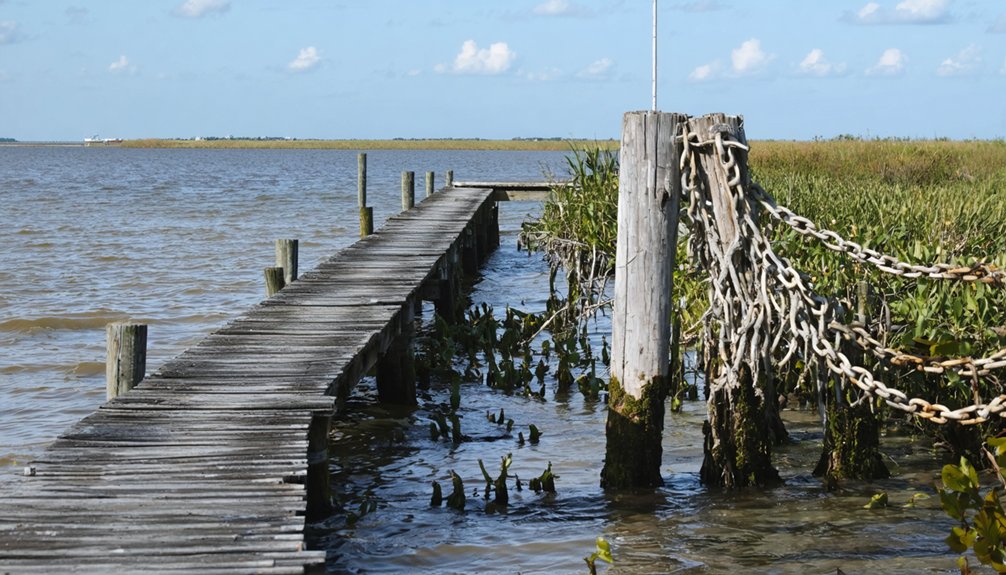
Once Bayport reached its peak population in the late 19th century, the town’s decline accelerated through multiple factors.
Like many coastal settlements of its era, Bayport’s golden age was fleeting, giving way to an inevitable downward spiral.
You’d have witnessed the transformation of this bustling port into a ghost town as younger residents moved to larger Gulf Coast cities for better opportunities. The death of John Parsons and reduced shipping activity dealt significant blows to the community’s liveliness.
Nature gradually reclaimed the coastal haven as marshlands expanded and erosion reshaped the shoreline.
You can trace the town’s physical deterioration through the 1940s hotel fire, deteriorating infrastructure, and the silting of shipping channels.
The final decades of coastal decline saw streets returning to wetlands, while storms and saltwater intrusion destroyed remaining structures.
Today, only scattered houses along Cortez Street and Civil War artifacts at Battery Park remind you of Bayport’s former glory.
Local Legends and Folklore
You’ll find Bayport’s most enduring tales centered around its role as a hub for rum runners during Prohibition, with locals recounting stories of ghostly boats still making midnight smuggling runs across the Gulf waters.
Civil War legends persist of Confederate soldiers’ spirits patrolling the coast, their phantom footprints appearing in the sand during full moons.
These spectral guardians are said to keep watch over the remnants of arms caches and supplies that were hidden along Bayport’s shoreline during the war.
Rum Running Tales
- Rum runners met mother ships three miles offshore on “Rum Row”
- Cuban rum purchased for $4 per case sold for $100 in Florida
- Fast boats and schooners made nightly runs to evade authorities
- Coast Guard’s “six-bitter” boats intensified enforcement by 1926
- Extended jurisdiction to 12 miles (1924) then 34 miles (1927) disrupted operations
- A few dirt and gravel roads near the park entrance
- Scattered houses along Cortez and in the Dr. Bruner area
- The battery site with visible boiler tubes from Confederate blockade runners
- Coogler’s Beach hill to the north
- Winding paths that lead to marshy dead ends
- Park renovations protect historical aspects while creating new recreational spaces
- Cemetery preservation efforts document ancient burial grounds and inscriptions
- Underwater surveys protect Civil War-era shipwreck near the reconstructed pier
- Nature Coast Aquatic Preserve manages submerged cultural resources
- Florida Trust for Historic Preservation maintains ghost town remnants as living history
- https://www.fivay.org/bayport.html
- https://www.ghosttowns.com/states/fl/bayport.html
- https://www.youtube.com/watch?v=Kc8Epn8-tTs
- https://www.youtube.com/watch?v=1egiu_Y3IQM
- https://www.youtube.com/watch?v=RW8tfQ0cl1g
- https://www.tampabay.com/archive/1993/02/21/memories-of-a-lost-town-and-forest/
- https://www.youtube.com/watch?v=gfgs5nYmpBM
- https://www.hmdb.org/m.asp?m=93297
- https://www.hmdb.org/m.asp?m=93296
- https://naturecoaster.com/bayport-and-pine-island-part-of-hernando-countys-gift-to-the-nature-coast/
One chilling rum runner anecdote involves a suspected informant’s murder by a Cuban assassin, highlighting the ruthless nature of these smuggling operations.
Civil War Ghost Stories
While rum running brought a dark chapter to Bayport’s history, the town’s most enduring supernatural tales stem from its Civil War past.
You’ll find ghostly encounters tied to multiple Union raids between 1863-1864, when naval skirmishes, burning blockade runners, and destroyed cotton warehouses scarred the landscape.
The most common spectral sightings include phantom cannon fire from the Confederate shore battery, white-clad sailors wandering the shoreline where the schooner Helen burned, and an eternal Confederate sentry who appears on battle anniversaries.
You might hear tales of mysterious hoofbeats, distant musketry, and marching sounds echoing the Brooksville-Bayport raid.
The shallow inlets and bayous, once home to wartime casualties and abandoned wrecks, now serve as a backdrop for these haunting Civil War legends.
Physical Remnants and Present State
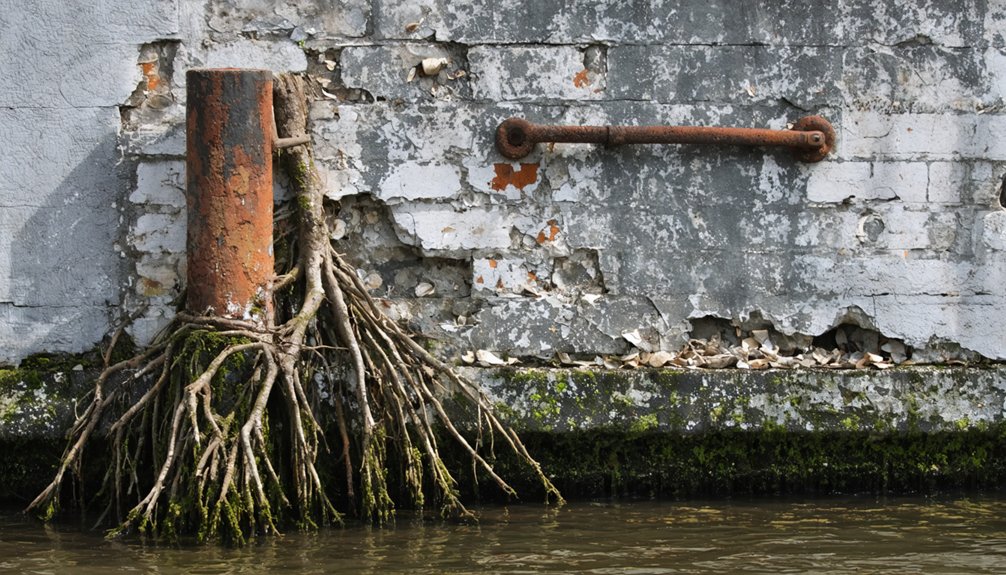
Today, the former townsite of Bayport lies largely reclaimed by nature, with marshy grasslands covering most of the original platted ground.
Where a bustling port town once stood, you’ll now find an untamed landscape that’s swallowed nearly all traces of human settlement.
You can still discover these remnants of old Bayport:
Natural reclamation has transformed the townsite into a wild reflection of time’s passage, where ghostly sightings of the past peek through vegetation and marsh grass, reminding visitors of Bayport’s former glory.
Historical Documentation and Research
Despite nature’s reclamation of the physical site, Bayport’s rich history lives on through extensive documentation and research.
Historical documentation reveals the town’s evolution from its 1842 founding by Major John D. Parsons through its heyday as an essential Confederate port. You’ll find detailed records of the town’s role during the Civil War, including the Battle of Bayport in 1863 and its significance in blockade running operations.
Primary sources like Kirk Munroe’s 1881 journal provide firsthand accounts of the post-war decline, while research methodologies have uncovered fascinating details about Prohibition-era bootlegging and World War II military activities.
Though the exact locations of the original town, port, and battle sites remain scientifically unconfirmed, historians continue piecing together Bayport’s story through surviving records, including documentation of ancient burial grounds and their inscriptions.
Preserving Bayport’s Legacy
Through coordinated preservation efforts, Bayport’s historical legacy has found new life in recent years.
Dedicated teams have breathed new vitality into Bayport’s rich heritage through strategic conservation and restoration initiatives.
You’ll discover a renewed focus on legacy conservation through the park’s expansion, featuring a 144-foot scenic boardwalk and enhanced facilities.
Heritage education initiatives now protect over 1,300 archaeological sites within Citrus County, while the Nature Coast Aquatic Preserve safeguards 450,000 acres of coastal waters.
These preservation projects guarantee Bayport’s story continues for future generations to explore and appreciate.
Frequently Asked Questions
What Was the Population of Bayport at Its Peak?
Like a wave that rises and falls, Bayport’s population peaked at roughly 60 permanent residents in the late 1800s, though you’ll find historical records suggesting higher seasonal counts during its shipping and resort heyday.
Are There Any Descendant Families From Bayport Still Living Nearby?
You’ll find Richard Cofer, a Hernando High history teacher and Goethe family descendant, preserving local heritage nearby. The Coogler family’s connection also continues through their historic beach property.
What Caused the Devastating 1942 Bayport Hotel Fire?
While no fire investigation records survive, you’ll find the hotel’s burning occurred amid wartime activity and bootlegging suspicions, though its historical significance makes the exact cause remain mysteriously uncertain.
How Deep Are the Waters Where the Civil War Shipwrecks Lie?
Lost beneath time’s mysterious veil, you’ll find these Civil War shipwrecks resting in shallow waters. Based on underwater exploration and nearby wreck patterns, the shipwreck depths likely range between 10-15 feet.
Was Bayport Ever Connected to Other Towns by Railroad?
You won’t find direct railroad connections to Bayport in historical records. The town relied on water transport until nearby railroad expansion in Brooksville during the 1880s led to Bayport’s decline.