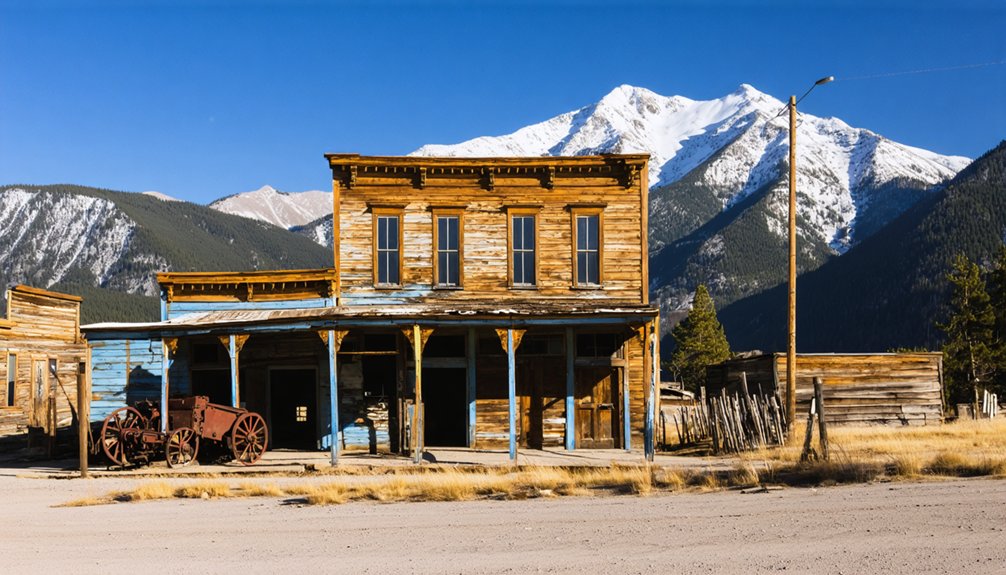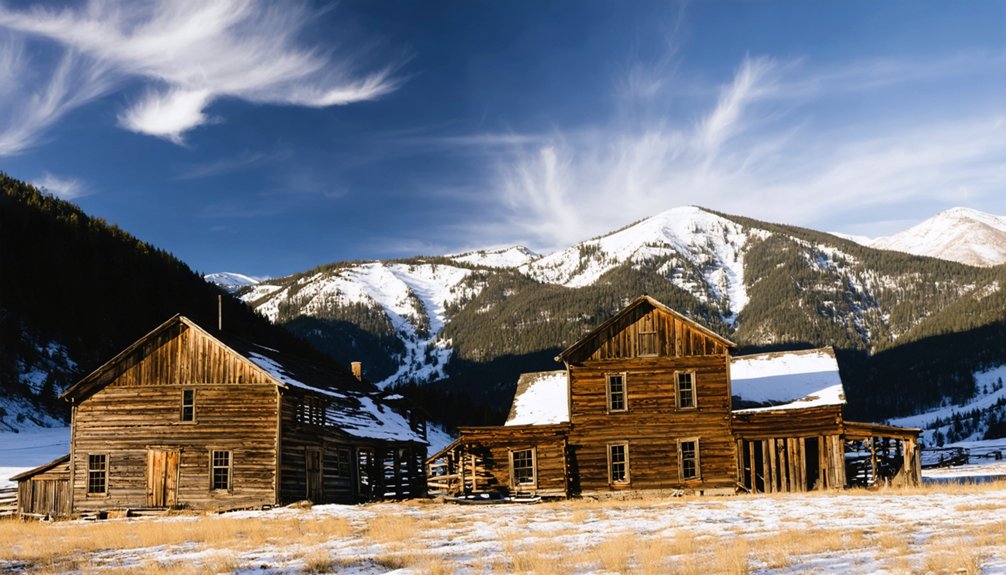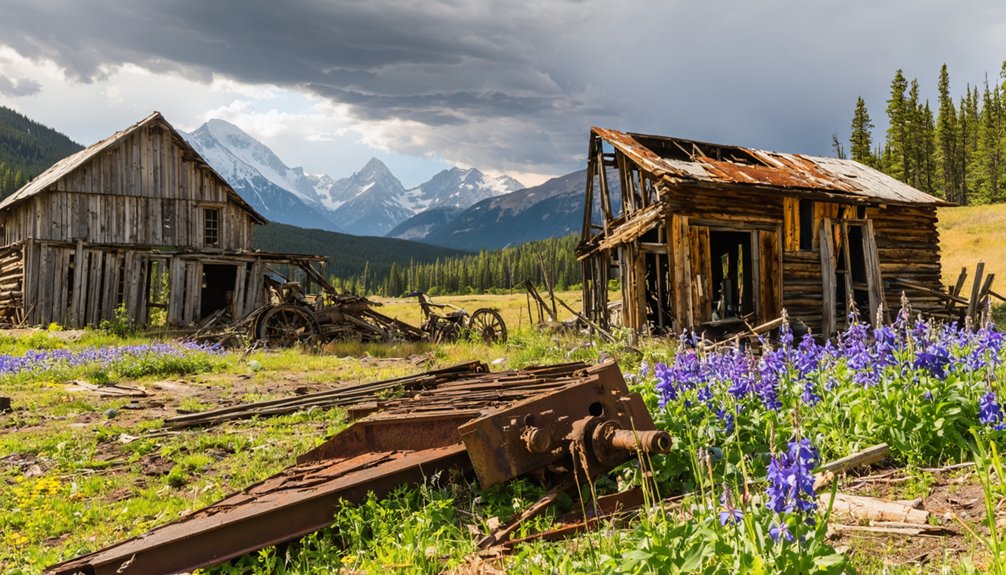
You’ll find Beartown perched at 11,690 feet in Colorado’s San Juan Mountains, where a rich gold strike at the Sylvanite Mine in 1893 transformed wilderness into a bustling mining camp overnight. Nearly 400 fortune seekers braved brutal winters and harsh conditions, establishing a self-sustaining community with 17 saloons and essential services. While the boom lasted only briefly, scattered ruins and mine remnants still whisper tales of mountain fortunes won and lost.
Key Takeaways
- Beartown emerged in 1893 after a rich mineral strike at Sylvanite Mine, transforming from wilderness into a bustling mining camp overnight.
- Located at 11,690 feet in San Juan County, the town supported nearly 400 residents with 17 saloons and various essential services.
- The Sylvanite Mine produced ore worth up to $4,000 per ton, becoming the economic backbone of this high-altitude mining community.
- Harsh winters, isolation, and challenging mining conditions eventually led to the town’s decline and abandonment.
- Today, only scattered foundations and mill remnants remain, with environmental hazards limiting safe access to the historic site.
The Discovery That Started It All
When prospectors discovered a rich strike at the Sylvanite mine in 1893, Beartown’s transformation from empty wilderness to bustling mining camp happened almost overnight.
Within weeks, nearly 400 fortune seekers flooded the area, creating one of Colorado’s most dramatic prospector stories. You’d have found these early arrivals sleeping wherever they could, postponing cabin construction in their rush to stake claims. Accessing the site required navigating through treacherous terrain and crossing Pole Creek twice.
The economic boom was immediate and impressive, with the Sylvanite mine yielding ore worth up to $4,000 per ton. Like many settlements during the Pikes Peak Gold Rush, the town experienced dramatic cycles of boom and bust.
Remarkably profitable from day one, Sylvanite’s rich ore deposits quickly proved their worth, yielding $4,000 per ton.
Merchants from neighboring towns quickly established businesses to serve the growing population. Though no single discoverer gets credit for the strike, the collective rush turned this remote location into a self-sustaining boomtown, complete with a mill and permanent structures that would stand as evidence to the area’s mining heritage.
Life in a High-Altitude Mining Camp
The harsh realities of life in Beartown quickly tempered the initial gold fever excitement.
You’d find yourself restricted to mining during the brief snowmelt season, sinking 70-foot shafts to reach narrow gold streaks at bedrock. Mining techniques relied heavily on carefully regulated water flow from reservoirs, released at specific hours each day for sluicing the paydirt.
While some struck it rich – like Tom Keenan’s $17,000 gold recovery from drifting in 1867 – most miners faced tough conditions in this remote camp.
Like other mining settlements of the era, including Nevadaville’s thirteen saloons, Beartown developed a bustling social scene. You’d live in cabins spaced 200 feet apart on individual claims, or make do with dugouts and tents. The town supported you with 17 saloons, shops, and services like Abascal’s General Store, but the harsh altitude and short working season tested even the hardiest souls. The community’s infamous local justice system depended on an Irishman named McElroy, who only dispensed justice when intoxicated.
The Sylvanite Mine’s Golden Legacy
Situated high in San Juan County at 11,690 feet, Sylvanite Mine emerged as a promising venture in 1892 when prospectors discovered rich veins of silver and gold near Beartown.
The mine’s significance grew when Calaverite Mining Company took ownership in 1897, establishing their headquarters in nearby Silverton. The mine operates within the San Juan National Forest boundaries. The surrounding rock formations consist primarily of host rock phyllite.
You’ll find the mine’s infrastructure included a 270-foot tunnel driven southwest, complemented by a 90-foot shaft with various drifts and a 20-foot stope.
The mining techniques employed here focused on extracting a complex ore body containing galena, sphalerite, and tetrahedrite.
While production remained relatively small, the mine yielded an intriguing mix of minerals including silver, gold, copper, lead, zinc, tellurium, and antimony.
Northern sections of the deposit revealed notable traces of titanium, manganese, and silver, marking this high-altitude operation as a representation of Colorado’s mining heritage.
Daily Challenges of Mountain Living
You’d have faced brutal high-altitude winters in Beartown, where howling winds and deep snowdrifts could trap you in your cabin for weeks at a time.
Getting essential supplies meant planning treacherous multi-day trips down mountain trails to reach the nearest trading posts, often having to stock up months in advance.
Local mountain communities today have evolved significantly, with mountain towns revenue reaching $4.4 billion in spending annually.
Unsanitary conditions in the cramped mining settlement, combined with limited medical care and the constant threat of accidents, made illness and injury particularly dangerous for Beartown’s residents. This was a stark contrast to modern mountain towns, where tourism revenues help fund quality emergency services and infrastructure for residents.
Weather and Isolation Hardships
Living at 11,580 feet in Beartown meant confronting some of North America’s most unforgiving mountain conditions, where extreme elevation effects combined with harsh weather patterns to create uniquely challenging circumstances.
The persistent winds gusting above 60 mph made daily activities extremely difficult for residents trying to survive in this remote region.
Receiving 39.21 inches of annual precipitation contributed to severe living conditions for residents navigating the remote landscape.
The site’s steep 28.1-degree slopes and southern aspect at 301.8 degrees intensified your exposure to severe mountain weather.
- You’d face whiteout conditions when 50 mph wind gusts combined with heavy snowfall.
- You’d experience more extreme temperature variations than valley locations due to elevation and topography.
- You’d deal with isolation effects amplified by Beartown’s remote position at 37°43’N, 107°31’W in rugged San Juan County.
The weather’s impact proved particularly harsh during winter storms, when access became nearly impossible as you’d endure decreasing March precipitation and shorter snowpack periods while battling the harsh elements.
Securing Basic Daily Necessities
Beyond battling the harsh mountain climate, securing basic necessities in Beartown meant overcoming significant logistical challenges.
You’d have found yourself relying on the local general store for essential merchant supplies, though initial prospectors had to forage for their basic needs before proper establishments emerged.
Without refrigeration, you’d have cooled perishables in the river water, while cooking took place over wood-burning stoves or campfires.
When severe snowstorms struck in 1899, food shortages threatened the community’s survival as supply routes became impassable.
You’d have needed to carefully manage your provisions, especially during winter months.
Daily life required planning around the limitations – using outhouses for sanitation, kerosene lamps for light, and hauling water from the river for various needs.
Mining Camp Health Hazards
While prospectors dreamed of striking it rich in Beartown’s mines, they faced a formidable array of health hazards that could cut their pursuits tragically short.
At 11,000 feet elevation, mining health challenges were intensified by the harsh alpine environment and remote location. You’d encounter serious occupational hazards daily, from toxic mercury and cyanide exposure to the constant threat of cave-ins and crushing injuries.
- You’d risk silicosis and lung damage from breathing crystalline dust in poorly ventilated tunnels.
- You’d face mercury poisoning and heavy metal exposure from gold processing operations.
- You’d struggle with limited medical care, forcing you to rely on folk remedies for injuries and infections.
The combination of dangerous working conditions, harsh weather, and isolation made survival in Beartown a daily test of endurance.
Commerce and Community Development
After the rich 1893 strike at Beartown attracted nearly 400 prospectors, the settlement quickly evolved from a makeshift mining camp into a bustling commercial hub.
You’d have found miners initially sleeping in temporary bedding under open skies before establishing more permanent dwellings. The merchant influx from nearby towns soon transformed the camp, as enterprising business owners set up general stores, hotels, and saloons to serve the growing population.
The Sylvanite mine’s impressive output of up to $4,000 per ton supported the town’s economic independence. Local sawmills processed timber for construction while boarding houses accommodated the steady stream of miners.
Through this development, you’d have witnessed Beartown’s transformation from scattered tents to a self-sustaining community with sturdy cabins and essential services.
Peak Years and Rapid Decline
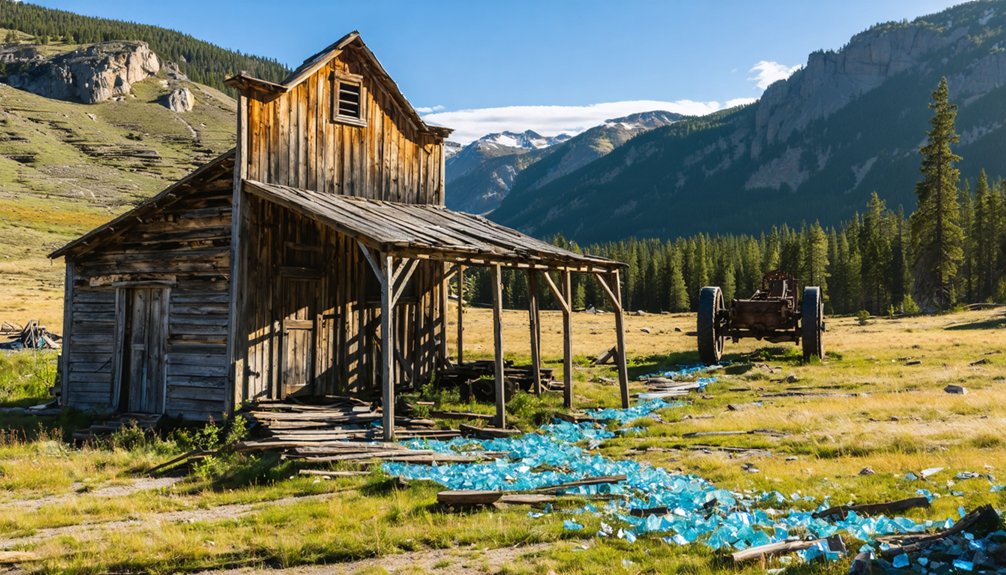
The 1893 strike marked the start of Beartown’s meteoric rise, as nearly 400 prospectors flocked to the area within weeks.
You’d have witnessed dramatic population dynamics as tent cities quickly transformed into cabins, while merchants and service providers established a vibrant local economy.
The Sylvanite mine emerged as the district’s crown jewel, producing ore worth up to $4,000 per ton.
The legendary Sylvanite mine dominated local production, yielding phenomenally rich ore that drew fortune seekers from across the region.
Three key factors shaped Beartown’s rapid decline:
- Heavy reliance on mule trains and pack animals due to lack of roads
- Economic fluctuations in silver markets that devastated mining profits
- Dependence on just a few high-grade veins that quickly played out
Without rail access and facing rising transportation costs, Beartown couldn’t sustain profitability once ore grades declined.
The mining camp’s fate was sealed when market prices fell and rich veins were exhausted.
What Remains Today
You’ll find only scattered foundations where Beartown’s cabins once stood, along with deteriorating remnants of the mill that processed ore from nearby mines.
The site’s environmental hazards from past mining operations make exploring unsafe and legally restricted today.
While you can spot traces of the town’s footprint from a safe distance, toxic substances and unstable structures require visitors to admire this historic mining settlement from designated observation points only.
Mill and Mining Remnants
While most structures have vanished from Beartown’s landscape, scattered mining remnants and mill ruins persist at this remote 11,161-foot site near Stony Pass.
The Sylvanite Mine, once the area’s largest producer at $4,000 per ton, now stands silent with limited visible traces of its prosperous past. You’ll find the remnants challenging to access, requiring a high-clearance 4WD vehicle to navigate beyond Pole Creek.
- Mill remnants from ore processing operations remain visible, though they weren’t located during a 2000 site visit.
- Mining structures that supported the district’s gold and silver extraction can still be spotted.
- The site’s remote location and high elevation have preserved these historical fragments, though they’re sparse and weathered.
Today, these quiet ruins serve as the last physical links to Beartown’s 1893 mining boom.
Cabin Site Foundations
Standing as silent witnesses to Beartown’s mining era, scattered cabin foundations and building outlines remain visible throughout the pine-forested site at 11,161 feet.
You’ll find evidence of cabin construction ranging from simple miners’ dwellings to more substantial structures like the Kalamazoo Hotel, which boasted telephone service during its heyday. The settlement patterns reveal how the town expanded rapidly after the 1893 strike, with 30 cabins built within three years to house 400 prospectors.
Today, you can trace the tiered foundations of gravity-fed mills and spot the remains of the 1882 jail with its distinctive 6-inch plank walls.
While most structures have vanished, broken crockery and other artifacts near the foundations offer glimpses into Beartown’s prosperous past, though preservation rules require leaving these items undisturbed.
Environmental Safety Concerns
Three major environmental hazards persist at Beartown’s abandoned mining site today. The most significant risks come from contaminated runoff containing heavy metals like lead, zinc, and arsenic that can seep into local waterways. These toxic substances remain in the soil and water systems for centuries, threatening both wildlife and visitors.
- Acid mine drainage from old tunnels and tailings piles creates metal-rich runoff that pollutes surrounding creeks.
- Wind-blown dust from exposed mine waste spreads contaminated particles across the landscape.
- Seasonal flooding and snowmelt can trigger sudden releases of stored contaminants downstream.
You’ll need to exercise caution around water sources and avoid direct contact with mine waste materials. The site’s contamination levels haven’t been fully assessed, making it essential to treat all mining remains as potentially hazardous.
Historical Significance and Preservation
A rich 1893 strike transformed Beartown from empty wilderness into a bustling mining settlement, drawing nearly 400 prospectors within weeks.
The Sylvanite Mine emerged as the district’s powerhouse, yielding ore worth up to $4,000 per ton during peak production. You’ll find that miners initially slept under the stars before establishing cabins and businesses that supported this thriving alpine community.
Today, Beartown’s heritage tourism potential lies in its remaining mill structure and cabin ruins, though they face ongoing threats from erosion, vandalism, and harsh alpine conditions.
Without formal protection status, these historic remnants continue to deteriorate. The site’s mining-era traces, including tailings and roadbeds, still tell the story of Colorado’s iconic boom-and-bust mining legacy, making historic preservation efforts essential for future generations.
Frequently Asked Questions
Is It Legal to Remove Artifacts From Beartown’s Remains?
You can’t legally remove artifacts from this site. Federal laws like ARPA and the Antiquities Act strictly protect artifact preservation, with penalties including hefty fines and jail time for violating these regulations.
Are There Any Documented Deaths or Accidents From Beartown’s Mining Operations?
You won’t find any documented mining accidents or historical fatalities specific to Beartown’s operations in available records, though hazards were common in all Colorado mining communities during that era.
What Indigenous Tribes Originally Inhabited the Beartown Area?
You’ll find the Ute Tribe were primary inhabitants of this Rocky Mountain region, maintaining seasonal hunting grounds there. The Cheyenne occasionally traversed the area but primarily stayed in eastern Colorado’s plains.
Did Any Famous Historical Figures Ever Visit Beartown?
You won’t find records of any famous visitors to this mining settlement. Historical significance came from anonymous prospectors and merchants, with no documentation of notable figures ever stopping there.
Are There Any Buried Treasure Legends Associated With Beartown?
You’ll hear ghost stories about buried riches at Beartown, especially around the Sylvanite Mine where $4,000/ton ore sparked tales, but there aren’t any verified treasure maps or documented recoveries.
In the shadows of its storied past, the history of Stumptown, Colorado reveals tales of ambitious prospectors and the fleeting nature of fortune. While the ghost towns linger as remnants of a gold rush era, they also whisper of the dreams and aspirations that once fueled the hopes of many. Even today, hikers and adventurers chase the echoes of Stumptown’s legacy, searching for clues among the ruins and rugged terrain.
Exploring historic ghost towns in Breckenridge offers a unique glimpse into Colorado’s gold mining boom, where once-thriving communities faded into silence. Each weather-worn building tells a story of perseverance and loss, drawing visitors who are eager to uncover the past. As you wander through the remnants, you can almost hear the laughter and conversations of the miners who once called this place home.
References
- https://www.ghosttowns.com/states/co/beartown.html
- https://www.coloradolifemagazine.com/printpage/post/index/id/172
- https://www.gutenberg.org/files/51678/51678-h/51678-h.htm
- https://southparkheritage.org/where-have-all-the-ghost-towns-gone-by-christie-wright/
- https://www.altaonline.com/dispatches/a6466/ghost-town-wild-west-laura-fraser/
- https://ghosttownmuseum.com/our-story/
- https://en.wikipedia.org/wiki/List_of_ghost_towns_in_Colorado
- https://www.youtube.com/watch?v=CCXuJJiQDfA
- https://www.explore.com/1704724/get-lost-mysterious-colorado-independence-ghost-town-history-ruins/
- https://www.youtube.com/watch?v=J8dR9D3pJrs