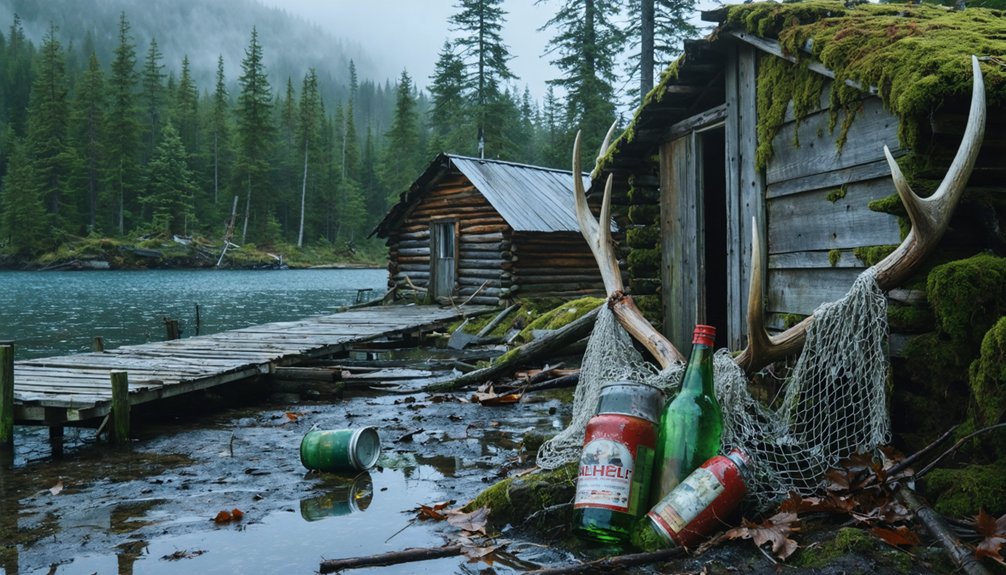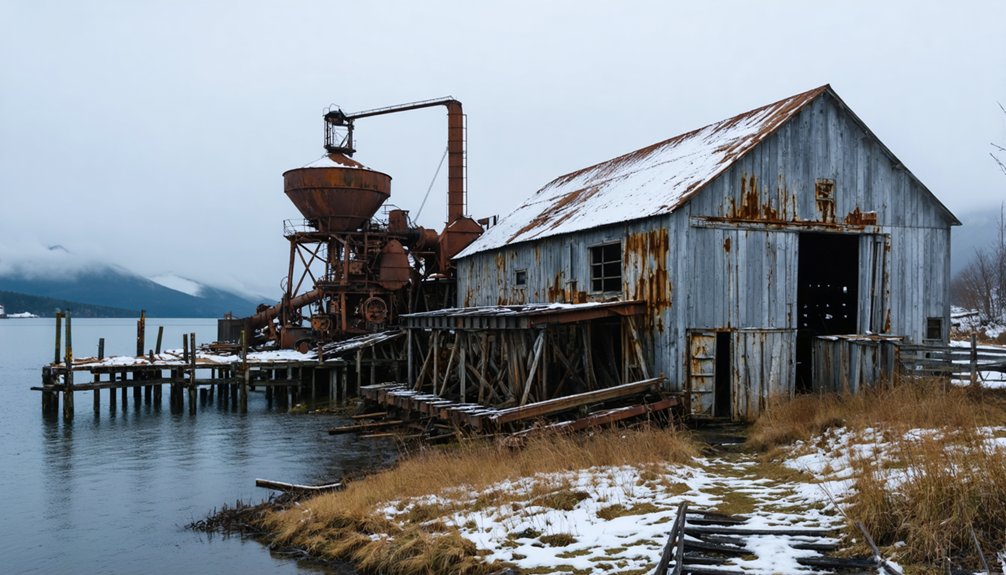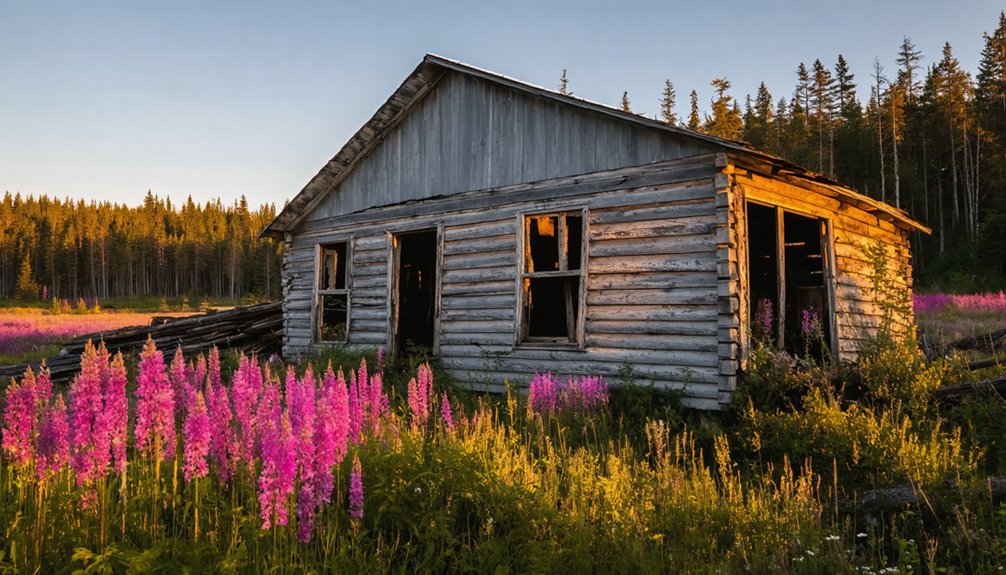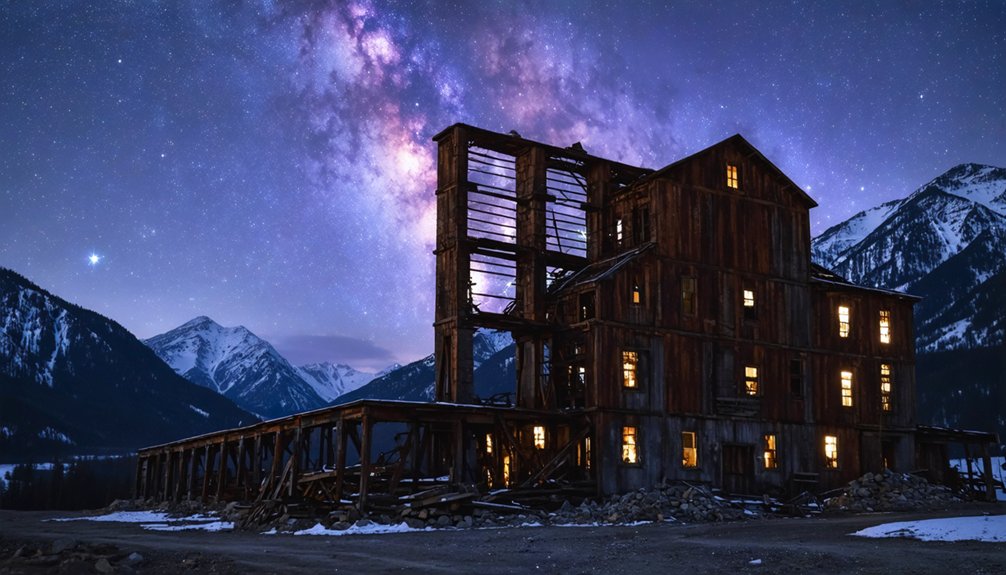
You’ll find Alaska’s premier ghost towns for astrophotography along the Dalton Highway and near Nome’s Council Road. The abandoned mining structures at Kennecott, Coldfoot’s historic saloons, and Wiseman’s preserved cabins offer compelling foregrounds against pristine dark skies. These remote locations provide pre-industrial darkness levels ideal for capturing the Milky Way and aurora borealis. Pack your full-frame camera, wide-angle lens, and sturdy tripod – the technical challenges of night photography in these locations yield remarkable rewards.
Key Takeaways
- Kennecott offers stunning night photography opportunities with its 14-story concentration mill silhouetted against dark skies and aurora displays.
- Coldfoot Camp along the Dalton Highway provides excellent dark sky access and historic gold rush structures from 1902.
- Solomon ghost town near Nome features abandoned beachside structures perfect for Milky Way compositions.
- Wiseman’s preserved cabins and vintage saloon create compelling foreground elements for aurora photography from August to April.
- The “Last Train to Nowhere” site at mile 33 of Council Road presents unique locomotive ruins against pristine dark skies.
Why Ghost Towns Make Perfect Dark Sky Locations
While urban areas continue to brighten the night sky with artificial lighting, ghost towns offer photographers and astronomers pristine dark sky conditions that rival certified dark sky reserves.
You’ll discover skies as dark as pre-industrial times, free from the light domes and horizon glow that plague 82% of America’s population centers.
These abandoned settlements provide ideal conditions for celestial navigation and astrophotography, with crisp, dry air that amplifies stellar visibility.
You’ll encounter unobstructed views across vast wilderness tracts where nocturnal wildlife thrives undisturbed by artificial illumination.
The complete absence of infrastructure means no streetlights, billboards, or residential glare to interfere with your view of the cosmos.
Without light pollution ordinances or retrofitting requirements, these sites naturally maintain the dark sky conditions that modern astronomical parks endeavor to achieve.
The undisturbed darkness of ghost towns helps maintain healthy biological rhythms in local wildlife populations.
Ghost towns provide excellent opportunities for public education about dark sky preservation and astronomical phenomena.
Essential Gear for Ghost Town Night Photography
Five essential gear categories form the foundation for successful ghost town astrophotography in Alaska: camera bodies, specialized lenses, sturdy tripods, lighting tools, and critical accessories.
Ghost town astrophotography in Alaska requires five core gear types: cameras, lenses, tripods, lighting, and essential accessories for success.
You’ll need a camera with manual settings and focus capabilities – full-frame bodies like the Nikon D750 excel in low light. Consider using multiple exposures to create layered effects that capture both the stars and ghost town structures.
For lens choices, opt for wide-angle glass that stops down to f/2.8 or wider, with the Rokinon 12mm fisheye delivering stellar Milky Way shots. Consider investing in prime lenses to achieve superior low-light performance in the dark Alaskan night.
Mount your setup on a reliable tripod like the MeFOTO Roadtrip for car-accessible locations, or pack a JOBY GorillaPod for remote sites.
Keep multiple flashlights and LED panels ready for foreground lighting, and don’t forget your red headlamp for preserved night vision.
Round out your kit with a remote shutter release and portable power banks to combat battery drain in Alaska’s cold conditions.
Planning Your Ghost Town Astrophotography Trip
Before heading to Alaska’s ghost towns for astrophotography, you’ll need to pack essential gear including a sturdy tripod, wide-angle lens, remote shutter release, and cold-weather protection for both yourself and your equipment.
Spring and autumn provide the most balanced conditions for ghost town photography with moderate temperatures and good visibility. Exploring abandoned copper mills adds unique architectural elements to night sky photographs at locations like Kennecott. You’ll find the most accessible ghost town sites along established routes like McCarthy Road to Kennecott and the Dalton Highway to Coldfoot, though winter conditions often require four-wheel drive vehicles and emergency supplies.
For ideal safety and success, you should monitor aurora forecasts, check weather conditions frequently, and consider joining guided tours when exploring remote locations like Kennecott during winter months.
Essential Gear Checklist
Successful ghost town astrophotography in Alaska requires four essential gear categories: imaging equipment, mounting systems, alignment tools, and environmental protection.
You’ll need a full-frame mirrorless or DSLR camera with fast wide-aperture lenses for ideal camera settings and composition techniques in low-light conditions. The Baader MPCC coma corrector is essential when using fast telescopes for capturing ghost town details against the night sky. Consider including a counterweight case setup to properly balance and protect your tracking equipment during transportation to remote locations.
- Pack multiple batteries, memory cards, and a sturdy tripod rated for your equipment’s weight – cold temperatures drain power quickly and stability is vital for sharp images.
- Invest in a reliable star tracker with autoguiding capability to capture long exposures of deep-sky objects above abandoned structures.
- Deploy dew heaters, insulated battery warmers, and weatherproof cases to protect your gear from moisture, snow, and subzero temperatures that can damage sensitive electronics.
Always test your setup before heading to remote locations.
Site Access and Safety
Accessing Alaska’s ghost towns for astrophotography demands extensive planning and safety protocols beyond standard gear preparation.
You’ll need to research multiple access routes, as road conditions vary greatly – from the adventurous McCarthy Road to Kennecott, to the coastal Council Road near Nome. Monitor weather forecasts and Aurora activity indices before departing. For optimal viewing, plan your photography sessions during the midnight to 3AM window. Layered clothing is essential for warmth during the chilly spring nights.
Pack thorough safety equipment for these remote locations, including extra fuel, food, and emergency supplies.
Consider guided options for winter expeditions, particularly if you’re new to backcountry travel. Sites like Kennecott offer local accommodations, while others require self-sufficient camping.
Most ghost towns sit in areas of minimal light pollution, but their isolation amplifies risk. Always inform others of your planned route and establish communication protocols before venturing into these historic, remote locations.
When planning a trip, it’s also essential to consider the optimal seasons for visiting Alaska, as weather conditions can greatly affect visibility and accessibility. During the summer months, you can experience the midnight sun, while the winter showcases the breathtaking northern lights. Each season offers a unique perspective on the stunning landscapes and rich history of the area.
For those looking to capture the beauty of Alaska’s remote landscapes from above, it’s important to research the best drone spots in Alaska to maximize your experience. These locations not only provide stunning visuals but also ample opportunity for creativity and exploration. Ensure you check local regulations regarding drone usage, as some areas may have restrictions to protect wildlife and the environment.
Top Ghost Town Sites Along the Dalton Highway
You’ll find numerous ghost sites dotting the Dalton Highway’s 414-mile stretch from Livengood to Deadhorse, including both historic mining outposts and abandoned pipeline construction camps.
The old mining supply post of Coldfoot at mile 174.8 offers an ideal base for nighttime photography, with its dark skies and remnants of seven saloons and gambling houses from its 1902 peak.
For more remote shooting locations, you can venture to Wiseman’s gold rush structures or the remnants of Dome City, though you’ll need to factor in the presence of grizzly bears and plan around the summer’s midnight sun.
Abandoned Pipeline Work Camps
During the Trans-Alaska Pipeline‘s construction in the 1970s, thirty-one work camps dotted the 414-mile Dalton Highway corridor.
Today, these abandoned sites offer prime locations for astrophotography. These pipeline remnants provide isolated vantage points with minimal light pollution and unobstructed views of the northern sky, though atmospheric conditions can change rapidly.
- Coldfoot Camp (MP 175) – Converted to seasonal services, offers staging near Marion Creek with existing infrastructure.
- Galbraith Lake (MP 275) – Former camp footprint north of treeline provides superior dark-sky access.
- Happy Valley (MP 334) – Remote site with charter access, ideal for aurora viewing when industrial lighting is minimal.
Consider timing your shoots between August and April to avoid the midnight sun, and monitor geomagnetic forecasts for auroral activity.
Historic Mining Supply Posts
The historic mining supply posts along Alaska’s Dalton Highway offer photographers strategic positions for capturing the night sky against architectural remnants of the gold rush era.
You’ll find Coldfoot’s abandoned structures from its 1902 peak, when seven saloons and a gambling house served gold-seeking prospectors. Its historical significance as one of Alaska’s earliest Koyukuk mining settlements makes it an ideal foreground for astro shots.
Nearby Wiseman, with its preserved cabins and vintage saloon museum, provides authentic mining relics against dark skies.
For more remote options, explore Marion Creek’s equipment remnants or venture to Nolan Mine’s washouts. The elevated ridges surrounding Nolan Creek valley create natural platforms for night photography, while the site’s steel gates and padlocked entrance add industrial elements to your compositions.
Historic Mining Structures in Kennecott
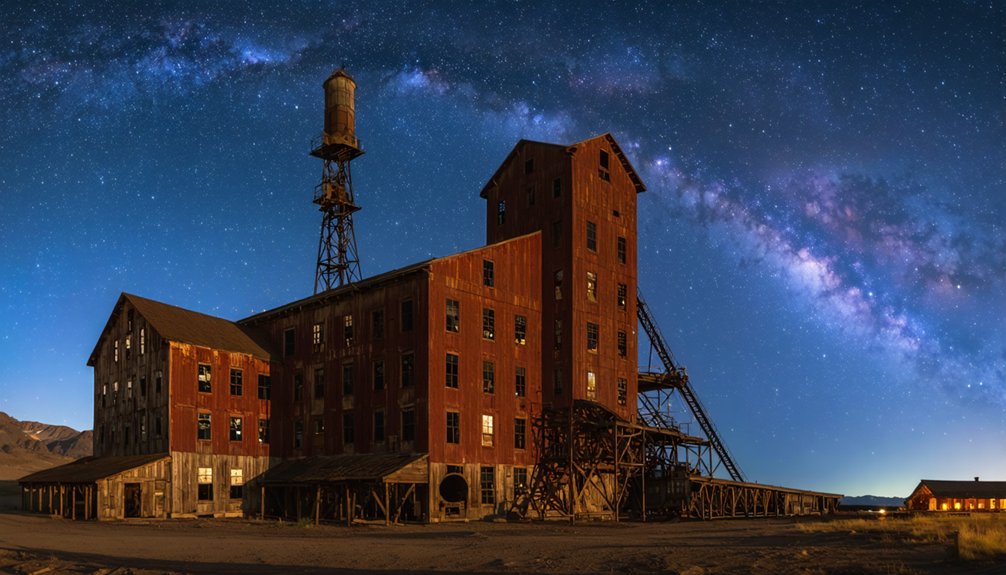
Rugged mining structures dot the historic Kennecott landscape, crowned by its iconic 14-story concentration mill that cascades down the hillside in signature deep red with white trim.
This abandoned copper mining complex offers you unparalleled opportunities to capture the Milky Way against compelling industrial architecture that defined Alaska’s mining era.
For ideal astrophotography compositions at Kennecott, you’ll find these prime shooting locations:
- The massive concentration mill, where ore processing equipment still towers against the night sky
- The original 1907 log company office, now partially buried in mining tailings
- The interconnected mine buildings of Bonanza Ridge, including remnants of the Bonanza, Jumbo, and Mother Lode operations
These preserved structures create striking silhouettes against the aurora borealis, especially during winter’s dark skies.
Hidden Gems Near Nome’s Council Road
Stretching 72 miles northeast from Nome, the historic Council Road offers exceptional dark-sky shooting locations punctuated by three partially submerged steam locomotives known as the “Last Train to Nowhere.”
You’ll encounter this striking collection of rusting rail equipment near mile 33, where the Bonanza Bridge crosses Solomon Creek.
For ghost town exploration along this route, you’ll discover the abandoned settlement of Solomon, where beachside structures create compelling silhouettes against the Milky Way.
Further northeast, Council’s old cabins and foundations blend with spruce stands for unique night compositions.
The route’s remoteness guarantees pristine dark skies, particularly suitable for aurora photography during geomagnetically active periods.
You’ll need offline GPS navigation and a high-clearance vehicle, as seasonal conditions can make river crossings challenging.
Nome history comes alive through these forgotten landmarks.
Safety Considerations for Night Shooting in Abandoned Sites
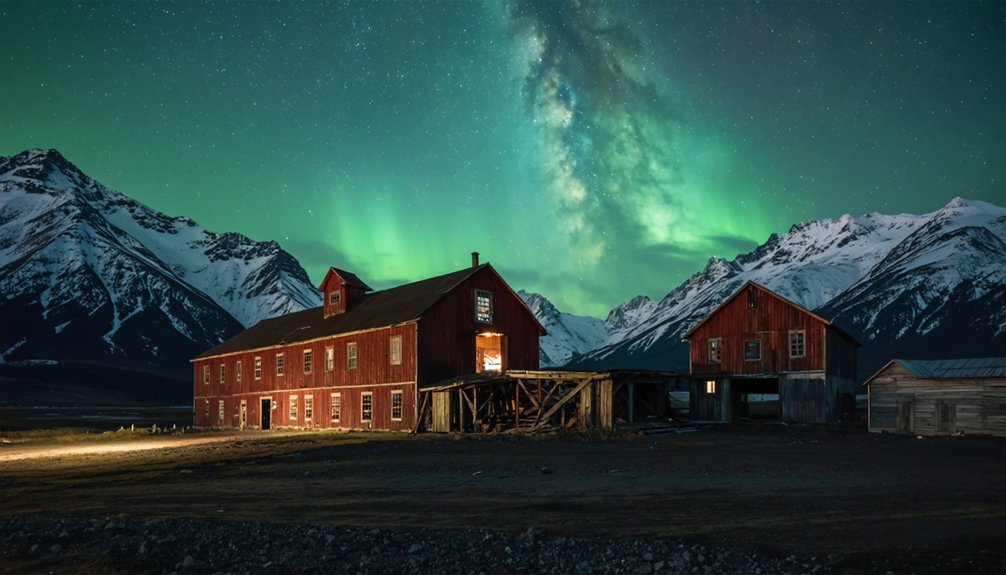
Successful astrophotography in abandoned Alaskan sites demands meticulous safety protocols that extend beyond basic wilderness preparedness.
You’ll need heightened nighttime awareness while maneuvering through deteriorating structures and unpredictable terrain. Scout locations during daylight to map hazards, exits, and composition points while marking GPS coordinates for reliable orientation after dark.
- Pack cold-weather gear rated for sudden temperature drops, including camera-compatible gloves and weather-resistant bags.
- Maintain environmental precautions by carrying fire safety equipment when light painting, especially near wooden structures.
- Scout with a partner, share your location details, and avoid headphones to stay alert to approaching wildlife or vehicles.
Consider placing small marker lights on your tripod for visibility without compromising long exposures, and always respect site preservation protocols to protect these historic locations.
Best Seasons for Ghost Town Milky Way Photography
With your safety protocols in place, timing becomes the next critical factor for capturing the Milky Way above Alaska’s ghost towns.
To enhance your photography techniques, target late February through early March when the galaxy rises prominently in the east, offering manageable conditions and extended dark skies.
For dramatic seasonal variations, you’ll find peak opportunities from late July through mid-August, when the Milky Way’s core reaches maximum height in the southwest.
During this period, you’ll experience ideal shooting conditions with the galactic center visible all night.
If you’re seeking panoramic shots, plan your expedition for late May when the full arc becomes visible around 2:00 AM in the southeastern sky.
The Perseid meteor shower in mid-August adds another dimension, providing natural light shows against abandoned structures.
Technical Tips for Long Exposures in Remote Locations
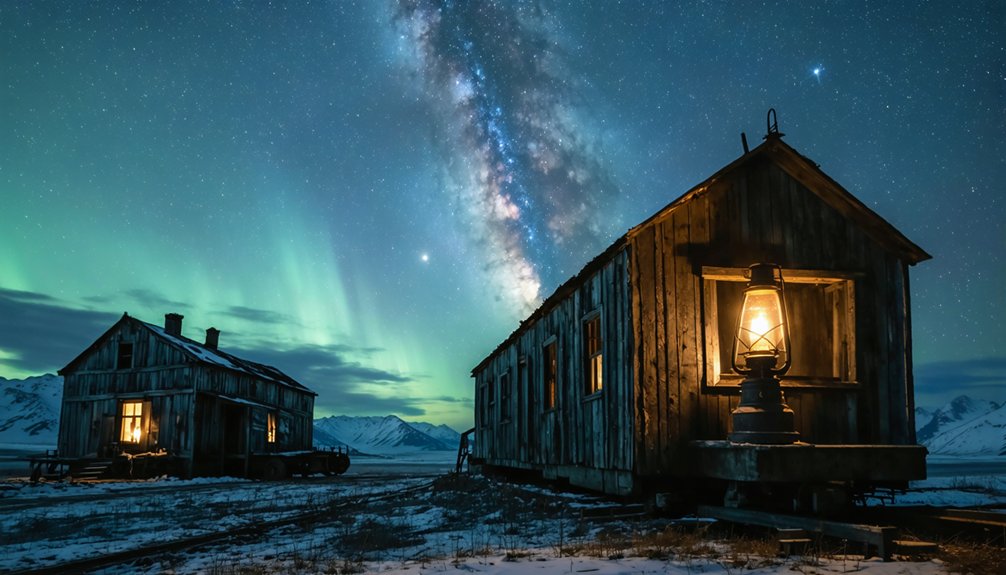
Technical mastery of long-exposure astrophotography in Alaska’s ghost towns requires precise equipment configuration and exposure control.
When shooting in remote locations, you’ll need robust power management and precise exposure settings to capture the dark skies above these abandoned settlements.
For best results in these isolated environments:
- Deploy a sturdy tripod rated for your gear weight and use an intervalometer to prevent camera shake during long exposures up to several minutes.
- Pack multiple batteries and a 12V power solution, as cold temperatures will greatly reduce battery life during extended shooting sessions.
- Apply the 500 rule for your focal length, then stack multiple shorter exposures instead of single ultra-long frames to reduce noise while maintaining star sharpness.
Remember to set manual focus to infinity using live view on a bright star, confirming with test shots as temperatures change throughout your session.
Frequently Asked Questions
Are Ghost Towns Legally Protected From Photography Equipment Damaging Historic Structures?
Like fragile museum artifacts, you’ll need to follow preservation laws and photography ethics. You can’t modify or damage historic structures while shooting – it’s illegal under federal heritage protection statutes.
How Do You Find Exact GPS Coordinates for Lesser-Known Ghost Towns?
You’ll need to combine GPS mapping tools with historical society records, then verify coordinates using USGS databases, BLM records, and satellite imagery for ground-truthing your exact location.
Which Ghost Towns Allow Overnight Camping for Star Trail Photography?
Like constellations guiding weary travelers, you’ll find unrestricted camping near Kennecott and Coldfoot. Follow park camping regulations, set up your tripod, and capture star trails through the night’s endless dance.
Can Drones Be Used for Aerial Night Photography of Ghost Towns?
You’ll need proper FAA night waivers and anti-collision lighting to fly drones after dark. Consider thermal challenges, wildlife impacts, and advanced aerial photography techniques like exposure stacking in Alaska’s remote conditions.
Do Any Ghost Towns Have Active Claims or Private Owners Restricting Access?
You’ll find many ghost towns have active mining claims and private ownership. Check state/federal databases and obtain proper permissions, as sites like Funter Bay and Nabesna actively restrict unauthorized access.
References
- https://alaskansongcharters.com/6-lesser-known-spots-in-alaska-perfect-for-stargazing-adventures/
- https://koa.com/blog/alaska-stargazing-guide-the-best-places-to-see-winter-stars-in-alaska/
- https://www.cruiseamerica.com/trip-inspiration/alaska-stargazing
- https://hollandamericahotels.com/blog/things-to-do-in-alaska/your-guide-to-stargazing-in-alaska/
- https://www.go-astronomy.com/dark-sky-parks-stargazing-state.php?State=AK
- https://www.aaa.com/tripcanvas/article/top-dark-sky-destinations-in-the-us-CM1656
- https://www.uaf.edu/news/one-big-earthquake-two-alaska-ghost-towns.php
- https://www.alaska.org/detail/kennicott-mine-ghost-town-walking-tour
- https://www.montenido.org/blog/why-dark-sky-communities-are-important
- https://darksky.org/news/3-benefits-of-a-dark-sky-designation/