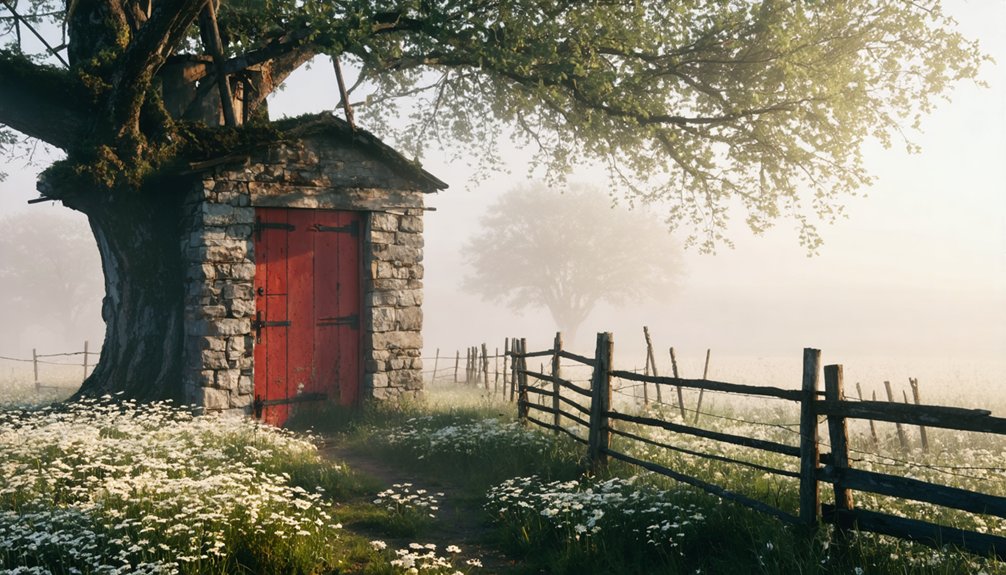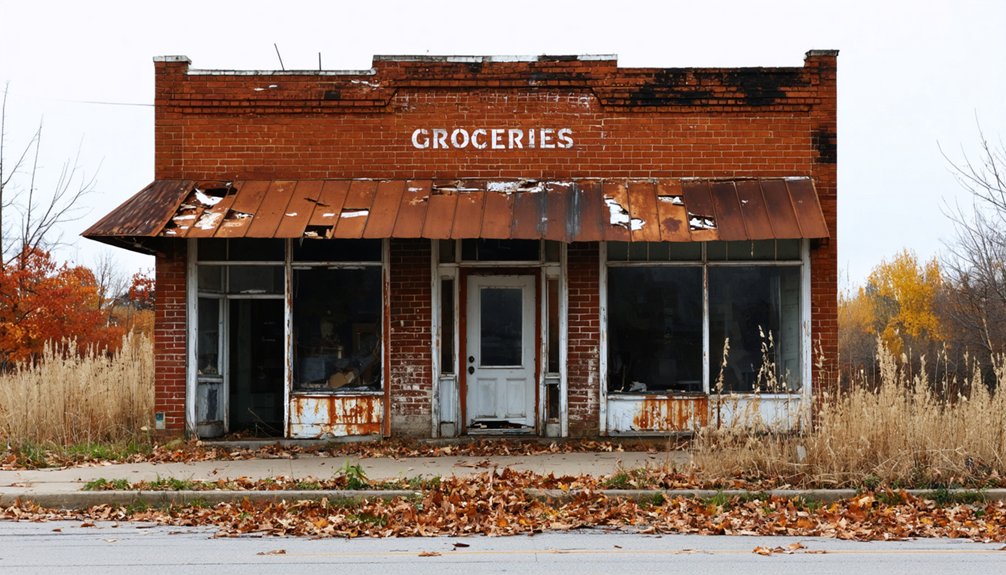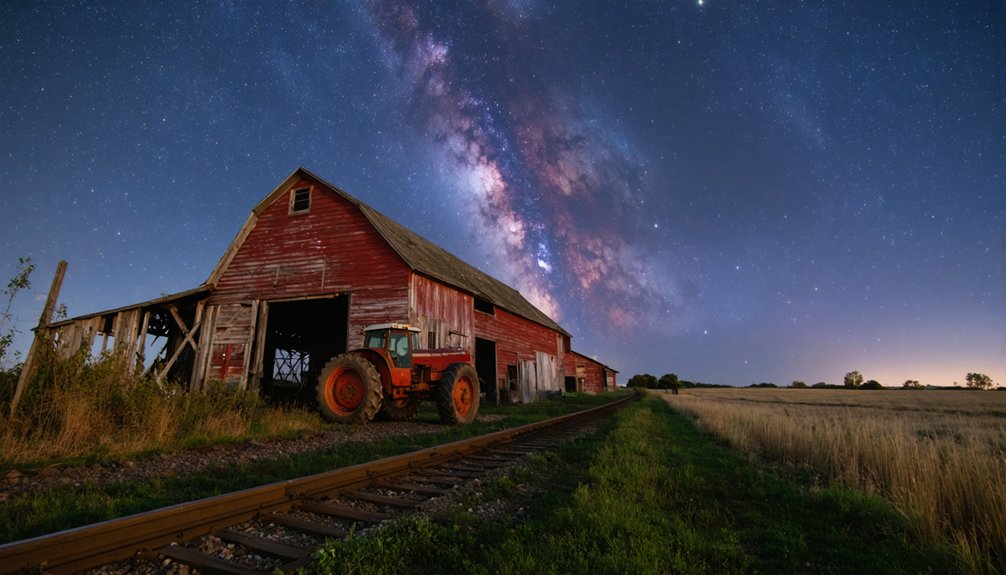
You’ll find exceptional astrophotography conditions at Iowa’s ghost towns, where Bortle 3-4 dark skies meet historic architecture. Edinburgh Manor and Terra Haute’s abandoned schoolhouse offer minimal light pollution for Milky Way shots, while Banwell Bridge’s iron framework creates striking star trail compositions. Pack your DSLR, wide-angle lens, and star tracker like the Sky-Watcher Star Adventurer. These locations combine pristine dark skies with compelling structural elements that’ll transform your night photography portfolio.
Key Takeaways
- Edinburgh Manor provides exceptional Bortle 3-4 darkness levels and compelling architectural elements for Milky Way photography year-round.
- Terra Haute’s abandoned schoolhouse offers minimal light pollution interference and unobstructed horizons for star trail photography.
- Grand River ghost town features multiple abandoned structures perfect for silhouette compositions against dark rural skies.
- Buckhorn and Mount Etna maintain pristine dark sky conditions with 21.0 mag/arcsec² brightness levels ideal for deep space imaging.
- Gitchie Manitou combines expansive viewing angles with historically significant structures while maintaining minimal light pollution interference.
What Makes Iowa Ghost Towns Perfect for Night Sky Photography
While many photographers struggle to find pristine dark sky locations, Iowa’s ghost towns offer exceptional conditions for nightscape and deep-sky imaging.
You’ll discover remarkably dark skies in these abandoned settlements, with Bortle ratings in the mid-to-high rural range – perfect for capturing the Milky Way’s intricate details. Ghost town history provides unique architectural elements that create striking foregrounds, from weathered churches to historic grain elevators. Many old structures like stone grist mills stand as haunting silhouettes against the starlit sky.
These remote locations offer unobstructed horizons and minimal light pollution, enabling you to employ advanced astrophotography techniques without urban interference. Many of these sites have become ghost towns naturally due to changes in transportation and industry over time.
You’ll find ideal conditions for long exposures, as the surrounding agricultural landscape keeps tree lines low and reduces ambient light reflection. With minimal modern access restrictions, you’re free to set up equipment for multi-hour shoots while incorporating light-painting techniques on century-old structures.
Essential Equipment and Planning for Ghost Town Astrophotography
Four core equipment categories form the foundation of successful ghost town astrophotography: imaging devices, tracking mounts, optics, and support accessories.
You’ll need essential gear like a DSLR or mirrorless camera paired with an equatorial mount for precise star tracking. Planning logistics should account for weather protection and power needs during remote night shoots.
- Start with a full-frame or APS-C camera coupled to wide-angle lenses for capturing ghost town silhouettes against the Milky Way.
- Mount your setup on a portable star tracker like the Sky-Watcher Star Adventurer to prevent star trails.
- Pack critical accessories including tripods, intervalometers, and extra batteries – abandoned locations won’t offer power sources.
For the best image quality in low light, consider the Canon EOS 6D Mark II with its expandable ISO range up to 102,400.
Maximize your freedom to shoot by bringing dew heaters and backup memory cards. Consider upgrading to an apochromatic refractor telescope for enhanced detail in your nightscape compositions.
Consider joining local astronomy clubs to learn site-specific techniques.
Dark Sky Ratings and Light Pollution Maps for Iowa’s Abandoned Sites
Since dark-sky conditions directly impact your astrophotography results, you’ll need to leverage specialized light pollution maps and rating systems to locate Iowa’s darkest ghost towns.
The state’s zenith sky brightness ranges from 21.0 mag/arcsec² in rural pockets to below 18.0 near cities, with most abandoned sites falling into Bortle class 3-4 zones. The 43 non-private charts available for Iowa help identify optimal viewing locations.
National parks and forests offer some of the darkest and most accessible ghost town locations for overnight photography sessions.
To find ideal locations, cross-reference VIIRS/Black Marble satellite data with DarkSiteFinder’s historical overlays to identify stable dark-sky areas away from urban light domes.
Watch for local factors that can alter baseline readings by 0.2-0.5 mag/arcsec², like wind turbines or farm lights.
For precise site evaluation, combine LightPollutionMap.app’s real-time SQM estimates with ClearDarkSky forecasts to plan your shooting schedule around the darkest conditions.
Top Ghost Town Locations and Their Astronomical Features
Iowa’s most photogenic ghost towns offer unique combinations of historical structures and pristine dark skies for astrophotography. Each location blends ghost stories and historical significance with excellent conditions for capturing the cosmos.
- Edinburgh Manor delivers exceptional Milky Way shooting angles against its imposing 1910 architecture, while the structure’s dark history and reported paranormal activity create compelling foreground elements. Over 150 confirmed deaths at the former poor farm add an extra layer of intrigue to nighttime photography sessions.
- Terra Haute’s abandoned schoolhouse provides an ideal southern vantage point with minimal light pollution, perfect for tracking celestial objects across clear rural skies. With a population under 200, Grand River’s abandoned buildings create haunting silhouettes against the starlit backdrop.
- Banwell Bridge’s iron framework creates striking silhouettes for star trail photography, with the Des Moines River reflecting starlight for enhanced compositional depth.
You’ll find these remote locations offer unmatched creative freedom, with crumbling architecture and dark sky zones combining to produce unique astronomical imagery.
Seasonal Photography Opportunities at Deserted Iowa Settlements
You’ll find Iowa’s ghost towns offer distinct seasonal opportunities, from winter’s crisp dark skies perfect for long-exposure deep space imaging to summer’s sweeping Milky Way core shots against abandoned structures.
As you venture through these ghost towns to explore in Iowa, you’ll uncover a rich tapestry of history and stories hidden within the decaying walls. Each location not only provides a unique backdrop for photography but also serves as a reminder of the vibrant communities that once thrived there. Don’t forget to visit during the fall when the foliage adds a stunning contrast to the deserted landscapes.
The warmer months let you capture dramatic storm systems moving across the plains while maintaining stable tracking and camera temperatures above dewpoint. The 91 acres of Gitchie Manitou provide expansive views of the night sky without light pollution interference. One prime location is Buckhorn’s historic old Creamery building, offering compelling foreground elements for night sky compositions.
Winter’s stark landscapes and bare trees provide unobstructed sightlines for telescope setups, though you’ll need to carefully monitor battery performance and bring portable warming solutions for your gear.
Winter’s Stark Night Skies
During winter’s darkest months, ghost towns across Iowa offer exceptional opportunities for astrophotography, thanks to the convergence of ideal atmospheric conditions and extended nighttime shooting windows.
You’ll find prime locations like Rockville and Buckhorn within Bortle 3-4 zones, where cold, dry air enhances stellar clarity and contrast.
- Target new moon periods near abandoned settlements like Stiles and Elkport for maximum dark-sky potential and extended exposure times.
- Position your setup on higher ground to avoid temperature inversions common in river valleys, particularly during winter ghost town adventures.
- Leverage winter’s stable atmospheric conditions for sharp long-focal-length shots, but pack extra lithium batteries to combat cold-weather power drain.
When conditions align, you’ll capture pristine winter photography from these forgotten outposts, potentially including rare auroral displays during active solar periods.
Summer Milky Way Views
While Iowa’s abandoned settlements offer compelling opportunities year-round, the summer months provide peak conditions for capturing the Milky Way’s galactic core against historic ghost town backdrops.
You’ll find ideal shooting windows from June through August when the core reaches its highest altitude for dramatic compositions.
Plan your ghost town shoots during new moon periods (±3 days) for maximum contrast.
Sites like Buckhorn and Mount Etna offer perfect Bortle 3-4 darkness levels essential for celestial navigation and detailed core capture.
Scout locations at dusk to identify potential light pollution sources and plan your compositions accordingly.
The humid summer conditions may reduce contrast, so consider stacking multiple exposures to preserve faint details.
For the clearest shots, wait until astronomical twilight ends, when the sun drops 18° below the horizon.
Spring Storm Photography
Spring thunderstorms transform Iowa’s ghost towns into dramatic photography locations, where you’ll find perfect conditions for capturing lightning strikes and storm formations against abandoned structures from March through May.
Pack your wide-angle lens and sturdy tripod to capitalize on storm dynamics at locations like Buckhorn’s abandoned church or Elkport’s riverside ruins.
- Set up at Preparation Canyon State Park’s 344 acres for pristine storm viewing with minimal light pollution.
- Position your camera at Eden Valley’s observation tower for 360-degree lightning photography across 201 acres.
- Scout Rockville’s deserted buildings for dramatic storm silhouettes against starry backgrounds.
For peak results, use 15-30 second exposures during peak thunderstorm activity, and monitor radar closely while shooting in these remote locations.
The Loess Hills region’s intense spring winds will clear skies post-storm, revealing excellent opportunities for Milky Way composites.
Safety Tips and Legal Considerations When Visiting Ghost Towns
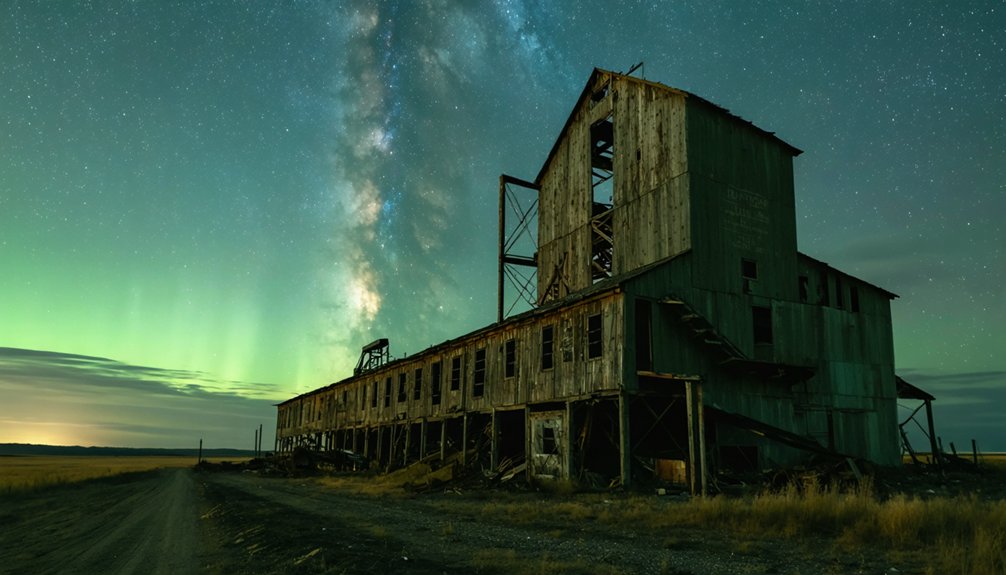
Before venturing into Iowa’s ghost towns for astrophotography, you’ll need to navigate essential legal and safety protocols. Secure property access permissions by contacting owners or historical societies, and verify public access status to avoid trespassing charges.
Always bring safety gear including sturdy boots, headlamps, and protective clothing.
When shooting at night, watch for structural hazards like unstable floors and collapsing walls. Document conditions with photos before setting up equipment, and scout locations during daylight hours.
You’ll need to comply with Iowa Code 657A regarding dangerous buildings and obtain any required administrative search warrants for site access. Avoid contaminated areas and maintain situational awareness while focusing on your astrophotography.
Pack out everything you bring in, and never remove artifacts or historical items from these locations.
Composition Techniques Using Historic Structures Under Stars
Successful astrophotography of Iowa’s ghost towns requires mastering specific composition techniques that blend historic architecture with celestial elements. When implementing celestial framing methods, you’ll want to position historic structures using the rule-of-thirds while aligning them with prominent star features or the Milky Way core for maximum visual impact.
Frame abandoned Iowa structures beneath starlit skies, using the rule-of-thirds to align architecture with celestial features.
- Layer your compositions with a foreground building silhouette, midground ruins, and background starfield to create compelling depth.
- Utilize low-angle viewpoints to make structures appear monumental, positioning rooflines against bright star regions.
- Deploy historic silhouette techniques by capturing recognizable architectural shapes like windmills or silos against star trails or the Milky Way.
For ideal results, capture separate exposures for the sky and structure, then blend in post-processing while maintaining authentic illumination through controlled LED light painting or natural moonlight.
Weather Patterns and Best Times for Ghost Town Star Shots
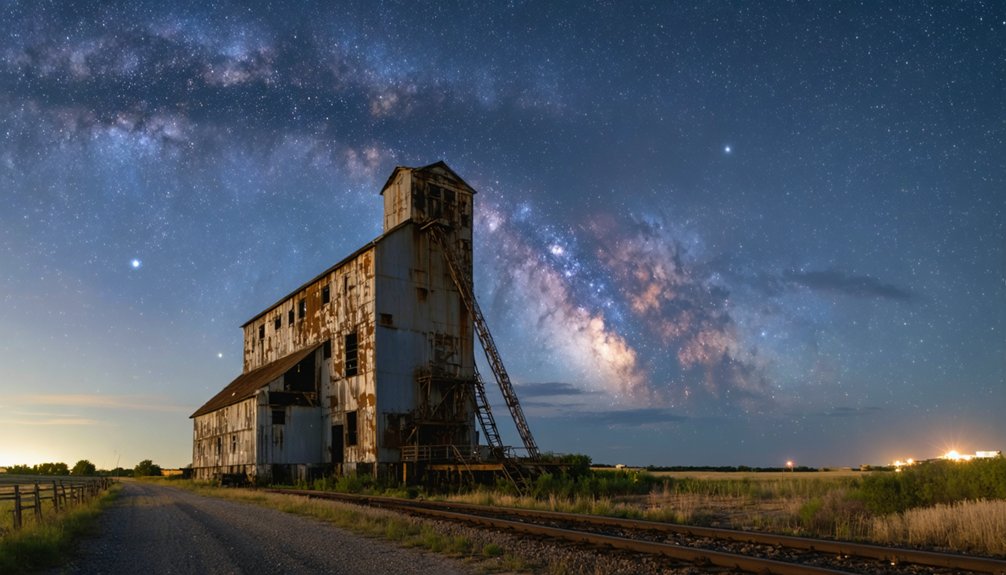
You’ll optimize your ghost town astrophotography by consulting ClearDarkSky charts for Des Moines and Dixon to forecast ideal shooting conditions, particularly during winter’s crystal-clear nights.
Your planning should account for the moon’s phase, as new moons provide the darkest skies for capturing both architectural details and the Milky Way’s faint details.
To maximize visibility through your camera’s sensor, schedule shoots during periods of low humidity and minimal cloud cover, typically occurring 2-3 hours after sunset when transparency readings indicate less than 30% cloud obstruction.
Clear Night Forecasting Tips
Planning clear-night astrophotography sessions at Iowa ghost towns requires mastering both astronomical forecasting tools and local weather patterns.
You’ll want to leverage ClearDarkSky charts to monitor cloud cover forecasts 24-48 hours ahead, focusing on the dark blue indicators that signal ideal shooting conditions.
- Track twilight timing precisely – avoid astronomical twilight (5:05-5:41 am, 8:40-9:16 pm) and maximize darkness between midnight and pre-dawn.
- Monitor NOAA’s graphical forecasts for cloud cover, visibility metrics, and sky conditions specific to your ghost town location.
- Align your shoots with crescent or new moon phases when tracking moon illumination through star chart apps.
Winter’s stable cold air provides the crispest viewing conditions, particularly from September through March when aurora opportunities peak at Iowa’s 50° magnetic latitude.
Seasonal Sky Viewing Windows
Four distinct viewing seasons shape Iowa’s ghost town astrophotography calendar, with winter’s crisp air and extended darkness offering prime shooting conditions from December through March.
You’ll maximize your exposure windows during winter’s 14-hour nights, when prominent constellations like Orion dominate the sky. Track aurora visibility from September through March, with peak activity during late fall and winter months.
Summer presents challenges with shortened nights, though you can capture the Milky Way and meteor showers.
Fall changes bring ideal conditions as darkness increases, particularly at sites like Preparation Canyon and the Loess Hills where light pollution remains minimal.
For technical precision, note that twilight ends around 7:16 pm and begins at 6:39 am, providing ample time for long-exposure shots of abandoned structures against starlit backdrops.
Moon Phase Planning Guide
Beyond seasonal windows, lunar phases fundamentally shape the quality of ghost town astrophotography in Iowa.
You’ll need to precisely time your shoots around the moon’s position to capture the perfect balance of foreground detail and star visibility. For ideal results, leverage moon phase calculators and planning tools to identify prime shooting windows.
- Target new moon periods (±3 days) for maximum Milky Way core visibility and capturing faint nebulosity behind ghost town structures.
- Use waxing/waning crescent phases for balanced natural lighting that reveals structural details without washing out stars.
- Schedule around astronomical twilight during autumn’s clear skies, ensuring the moon remains below the horizon during your exposure window.
Consider downloading a planetarium app to track lunar altitude and phase – this essential astrophotography tip will help you nail the perfect ghost town night shot.
Frequently Asked Questions
Are There Guided Astrophotography Tours Available to These Ghost Towns?
Like an uncharted star map, you won’t find guided tours or photography workshops specifically targeting Iowa’s ghost towns. You’ll need to plan your own self-guided astrophotography adventure through these abandoned places.
As you explore abandoned towns in Iowa for photography, each decaying structure tells a story frozen in time. The eerie silence envelops you, offering a unique canvas for capturing hauntingly beautiful images. Remember to bring extra batteries and a tripod to fully seize the magical light and unexpected details that emerge in these forgotten spaces.
Which Ghost Towns Have Cell Phone Reception for Emergency Situations?
You’ll find reliable cell tower locations near Ashawa, Ortonville, and McDivitt’s Grove, enabling emergency communication. Avoid underwater sites at Lake Red Rock where signals can’t penetrate. Pack a satellite device backup.
Do Any Sites Require Special Permits for Overnight Photography Access?
You’ll only need explicit permission for Buckhorn’s overnight access. While other sites lack documented permit regulations or overnight restrictions, it’s wise to verify local trespassing laws before setting up equipment.
Are There Nearby Camping Facilities or Accommodation Options for Multi-Night Shoots?
You’ll find designated camping amenities at Preparation Canyon and Eden Valley, while Whiterock requires primitive gear setup. Annett Nature Center’s proximity to Indianola offers both campgrounds and lodging accommodation options.
Which Ghost Towns Have the Most Intact Structures for Foreground Compositions?
You’ll find Buckhorn’s church and Sunbury’s abandoned architecture offer the most complete historical structures. Their preserved buildings give you reliable foreground elements without worrying about further deterioration compromising your night compositions.
References
- https://en.wikipedia.org/wiki/List_of_ghost_towns_in_Iowa
- https://www.onlyinyourstate.com/experiences/iowa/ia-ghost-town
- https://jackandkitty.com/iowa-ghost-towns/
- https://www.go-astronomy.com/dark-sky-parks-stargazing-state.php?State=IA
- https://www.onlyinyourstate.com/iowa/ia-ghost-towns/
- https://kdat.com/exploring-iowa-ghost-towns/
- https://www.onlyinyourstate.com/nature/iowa/best-stargazing-in-the-world-ia
- https://fabulousiowa.com/iowas-best/5-best-places-to-stargaze-in-iowa/
- https://astrobackyard.com/astrophotography-equipment/
- https://astrotelescopium.com/blogs/news/essential-astrophotography-gear-for-beginners