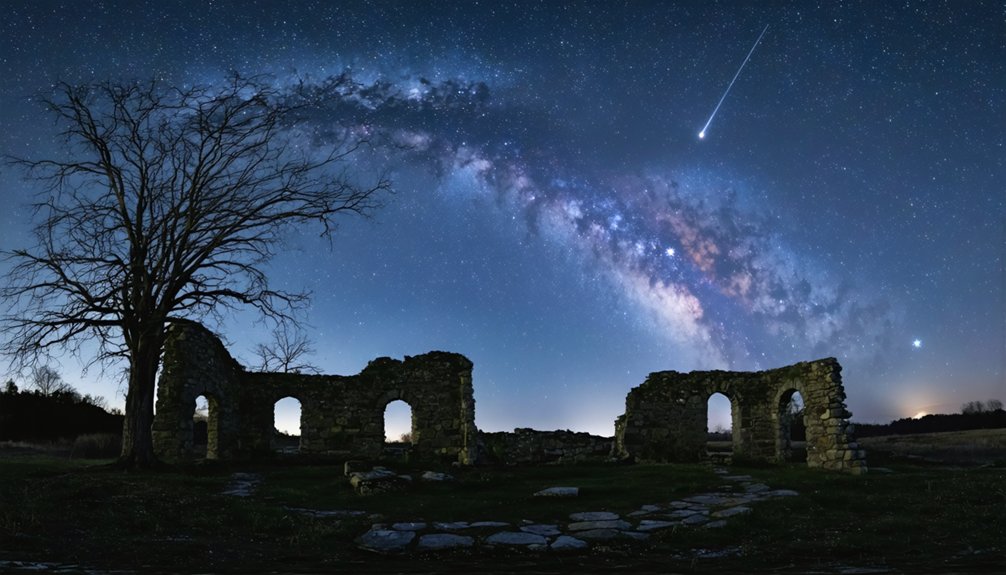
You’ll find prime astrophotography conditions at Massachusetts’s historic ghost towns, where Bortle scale ratings dip below 4. Focus on Dogtown’s stone ruins for dramatic foregrounds, or head to Cape Cod’s lost villages like Whitewash and Billingsgate Island. Shoot with f/4, ISO 6400, and 30-second exposures while light painting the ruins. Time your visits during new moons between March and October for ideal Milky Way visibility. These forgotten settlements hold countless compositions waiting to be discovered.
Key Takeaways
- Dogtown’s stone ruins provide excellent dark-sky conditions with ancient walls and glacial boulders as dramatic foreground elements.
- Cape Cod’s lost villages, especially Helltown’s remnants, offer minimal light pollution for capturing the Milky Way and star trails.
- Whitewash Village features partially submerged structures and pilings that create haunting silhouettes against starlit skies during low tide.
- Long Point’s 19th-century remnants present striking opportunities for nighttime photography with historical foundations against star-filled backgrounds.
- Monomoy Island’s abandoned settlements near Monomoy Point Light deliver exceptional dark-sky conditions from autumn through early spring.
Understanding Dark Sky Photography at Ghost Towns
When photographing ghost towns under dark skies, you’ll need to master both architectural and astro techniques to create compelling nightscapes.
Start by identifying key structures like saloons, churches, and abandoned vehicles that’ll serve as dramatic foregrounds against the star-filled sky.
Your exposure settings are critical: shoot foregrounds at f/4 and ISO 6400 with a 30-second shutter speed while light painting. Like the iconic shot at Mojave, try using a single light source to dramatically illuminate key structures.
Perfect your nighttime ghost town shots with f/4, ISO 6400, and 30-second exposures while light painting the foreground elements.
For the stars, adjust your ISO to 3200, accounting for any light pollution.
You’ll want to use LED tube lights and colored gels to illuminate building interiors, creating depth and atmosphere that matches the moonlight’s natural glow.
Consider using multiple flash pops at varying powers to craft layered ghost effects.
In dark sky locations, remember to set your white balance to 4000K for an authentic nighttime feel.
A Move Shoot Move tracker ensures sharp star details during longer exposures of the Milky Way.
Essential Gear for Night Photography at Abandoned Sites
Success in ghost town astrophotography hinges on bringing the right combination of tools to these challenging sites.
Manual mode settings give you essential control over exposure in dark abandoned locations. You’ll need multiple light sources – pack both a high-lumen flashlight and LED panels like the Lume Cube 2.0 for traversing dark corridors and illuminating scenes. A sturdy tripod is non-negotiable for those vital long exposures ranging from 2-30 seconds.
For camera settings, you’ll want to leverage your full-frame DSLR’s low-light capabilities with ISO up to 800. Pair this with fast glass – either prime lenses or f/2.8 zooms like the 17-50mm range. Using wide-angle lenses allows you to capture the full scope of abandoned structures against the night sky.
When shooting without a tripod, rely on image stabilization to achieve sharp shots at 1/10 second. Always carry backup batteries and secure your gear with gaffer’s tape for those unexpected field repairs.
Exploring Dogtown’s Stone Ruins After Dark
When traversing Dogtown’s maze of stone walls after sunset, you’ll need both a reliable GPS unit and a red-light headlamp to safely cross the five square miles of historic ruins while preserving your night vision.
You can use the numbered cellar holes as waypoints in your GPS, creating a route that connects these archaeological features for both safety and photographic planning.
The ancient stone walls serve as compelling linear elements in your compositions, especially when side-lit with a low-power LED panel to reveal their weathered textures against the starry sky. Since the area was initially used for cattle grazing until the mid-20th century, many cleared pasture areas now offer unobstructed views of the night sky.
The area’s distinctive glacial boulders scattered throughout the landscape provide unique foreground elements for nighttime photography compositions.
Maneuvering Dogtown’s maze of stone ruins and cellar holes after dark demands specialized equipment and methodical planning.
You’ll need dual light sources – a wide-beam headlamp for scanning the terrain and a backup handheld light for inspecting sudden drop-offs and tricky footing. Load your GPS with pre-marked waypoints and bring a paper map, since cell service can’t be trusted in these dense woods. The area’s 3,000-acre park requires thorough route preparation.
Many of the numbered cellar holes that mark former homesteads can be dangerous in low light, so proceed with caution.
Don’t rely solely on night vision when traversing the crisscrossing trails. Set checkpoints every 10-20 minutes and use prominent landmarks like the Babson Boulders and reservoir edges as natural trail markers.
Keep track of your pace – if it changes unexpectedly, you’ve likely wandered onto one of Dogtown’s many confusing side paths. When photographing in teams, maintain vocal contact and assign clear lead/sweep positions.
Stone Walls Under Stars
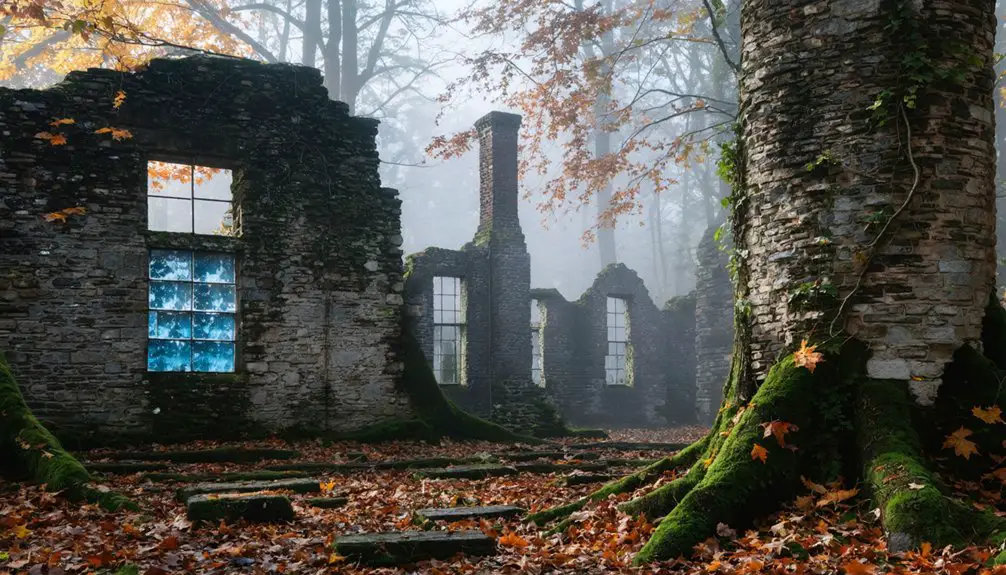
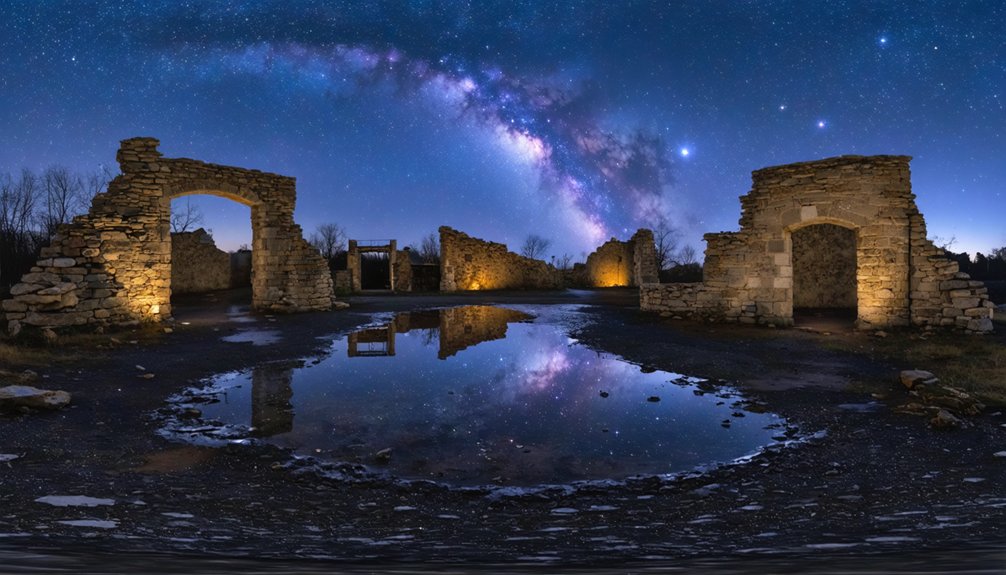
The ancient stone ruins of Dogtown offer unique compositional elements for night sky photography, with weathered granite walls and cellar holes providing compelling foreground interest against the stars.
You’ll find these historical remnants scattered across 3,600 acres of Cape Ann highlands, where 17th-century settlers once lived until the 1830s. The area became a ghost town after residents moved to the harbor to escape pirate attacks. The dense pine forest that now covers the land grew naturally after the settlement’s abandonment.
When shooting these stone wall textures after dark, consider:
- Low-level lighting to accentuate the carved Babson inscriptions and granite textures
- Wide-angle compositions incorporating both cellar holes and the Milky Way
- Multiple exposure blending to balance foreground details with star trails
- Strategic positioning on elevated ridges for unobstructed celestial views
The site’s distance from urban light pollution makes it ideal for deep-sky work, especially during winter’s crystal-clear nights.
Cape Cod’s Lost Villages Under the Stars
You’ll find exceptional dark-sky conditions for Milky Way photography at Cape Cod’s abandoned fishing settlements, where Long Point’s lighthouse and surviving earthen mounds create compelling foreground elements against the stars.
Your wide-angle lens and sturdy tripod setup at Helltown’s remnants near Race Point will capture dramatic star trails over the historic winter refuge site, requiring exposures between 20-30 seconds at f/2.8 or wider.
For minimal light pollution interference, time your shoot during the new moon and position yourself along the remote stretches of Bound Brook Island or Whitewash Village’s hidden shores, where clear skies and desolate ruins provide ideal conditions for deep-sky imaging.
Dark Sky Beach Ruins
Along Cape Cod’s dark outer shores, abandoned settlements and submerged villages provide haunting foregrounds for astrophotography, with the darkest skies in Massachusetts illuminating centuries-old ruins.
You’ll capture ghostly silhouettes against starry landscapes at these remote locations:
- Bound Brook Island’s abandoned village ruins in Wellfleet offer clear Milky Way compositions at f/2.8, ISO 3200.
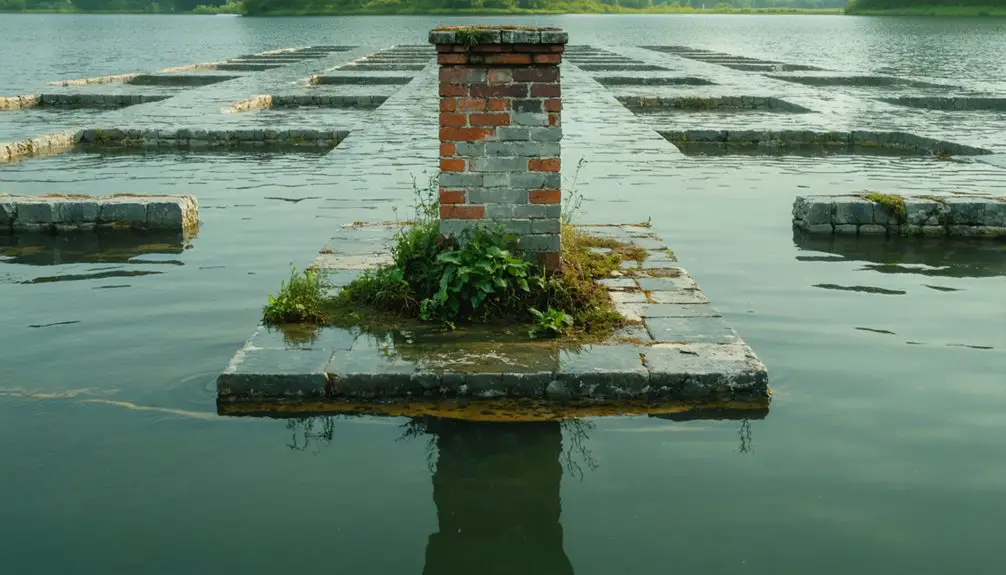
- Billingsgate Island’s submerged remnants create ethereal long exposures during low tide near Jeremy Point.
- Fresh Brook’s forgotten foundations pair perfectly with 30-second star trail shots.
- Paradise Hollow’s weathered structures stand sentinel under Outer Cape’s pristine dark skies.
For ideal results, time your shoots during new moons when these historical sites emerge from darkness, revealing centuries of coastal abandonment against nature’s celestial display.
Pack wide-angle lenses and sturdy tripods for these challenging night shoots.
Photographing Abandoned Fishing Villages
Moving beyond beach ruins, Cape Cod’s abandoned fishing villages offer prime astrophotography locations with compelling historical elements.
You’ll find rich fishing heritage at Long Point’s 19th-century remnants, where wharf pilings and hull fragments create striking silhouettes against star-filled skies.
Pack your wide-angle lens for Billingsgate Island’s low-tide exposures, where brick-strewn flats and exposed foundations reveal the historical significance of this lost whaling community.
For technical mastery, time your shoots with tide charts at Whitewash Village, where partially exposed pilings emerge from shifting sands.
Mount your camera low to capture foundation stones against the Milky Way.
Remember to check wildlife closure periods and bring GPS coordinates – these remote locations demand precise navigation and careful timing for ideal dark-sky conditions.
Monomoy’s Hidden Night Wonders
While Monomoy Island’s abandoned settlements have largely vanished beneath shifting sands, the site offers exceptional dark-sky opportunities for astrophotography.
To capture Monomoy’s history under the stars, you’ll need to navigate carefully around night wildlife and seasonal restrictions.
- Position your tripod near Monomoy Point Light’s stone foundations for dramatic foreground silhouettes against the Milky Way.
- Scout landing points during daylight – shifting sand bars can trap photographers after dark.
- Pack weather-sealed gear – coastal humidity and sea spray can damage exposed electronics.
- Time your visit between autumn and early spring when skies are clearest and wildlife restrictions are minimal.
Remember to secure necessary permits and monitor tide tables.
The island’s dark skies reward patient photographers with minimal light pollution interference from mainland Cape Cod.
Hidden beneath the dark Berkshire skies, the industrial ruins of Massachusetts’ historic paper and silk mills provide compelling foreground elements for astrophotography.
You’ll find the Turkey Mill ruins particularly striking, where the pure spring waters once powered paper production. Position your tripod near the stone foundations for dramatic low-angle Milky Way shots.
Among weathered stones of Turkey Mill, pure springs still whisper stories as stars wheel overhead, inviting photographers to capture eternal moments.
For ideal starlight navigation, scout the North Becket Historic District‘s 1890 silk mill during daylight. The brick structure’s angular remains create stark silhouettes against the night sky.
You’ll want to set up your gear where Yokum Brook meets the ruins – perfect for capturing star trails reflecting off the water. Pack your widest lens and arrive before astronomical twilight to catch the deep blues shifting to true darkness over these remnants of industrial heritage.
Coastal Ghost Towns: Whitewash Village and Beyond
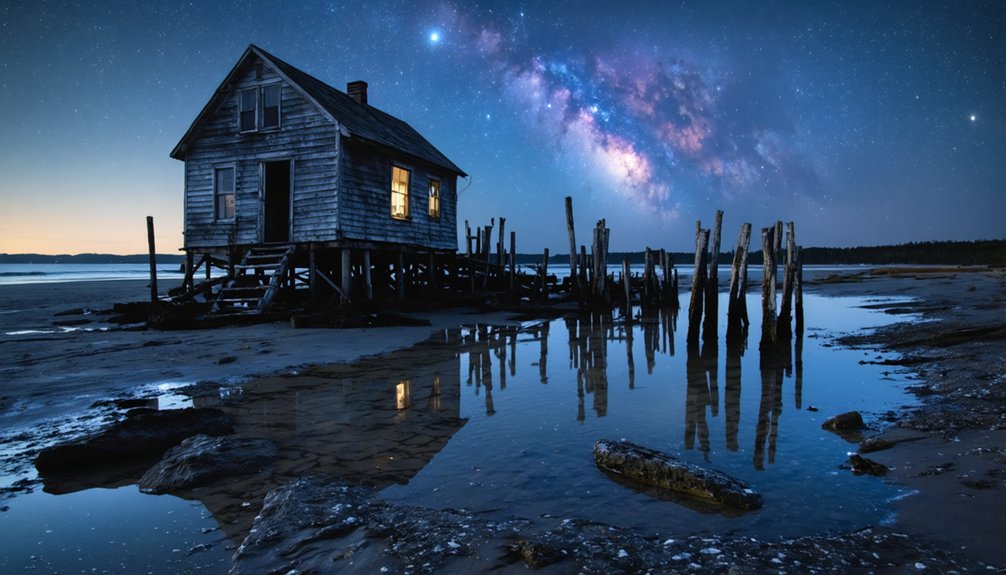
Along the windswept shores of Monomoy Island, Whitewash Village‘s skeletal remains offer some of Massachusetts’ most pristine dark-sky locations for astrophotography.
You’ll discover an abandoned 18th-century settlement with historical significance stretching from its 1710 founding to its dramatic 1870s desertion.
- Position your wide-angle setup near the Monomoy Point Light for dramatic Milky Way compositions over authenticated ruins.
- Scout tide tables and GPS waypoints before nightfall – the barrier island’s morphology demands precise escape routes.
- Leverage folklore elements by capturing star trails above Stewart’s Tavern foundations where shipwreck legends persist.
- Pack light-painting gear to illuminate centuries-old stone walls while maintaining natural starlight ambience.
You’ll need boat transport and wildlife refuge permits, but the site’s isolation rewards you with minimal light pollution and endless compositional possibilities.
Weather, Seasons, and Timing Your Ghost Town Shoots
To capture stellar ghost town images in Massachusetts, you’ll need to plan around both celestial mechanics and New England’s fickle weather patterns.
Exploring the best locations for drone shots in Massachusetts can elevate your photography to new heights. From the stunning coastal views of Cape Cod to the historic charm of Salem, each site offers unique opportunities for breathtaking aerial shots. Keep in mind that early mornings often provide the clearest conditions for capturing the perfect image.
The prime Milky Way core visibility window runs late March through early October, with ideal shooting between midnight and pre-dawn when artificial lighting diminishes.
Track weather patterns carefully – coastal areas battle marine-layer clouds in spring and summer evenings, while inland sites offer more stability in late summer and autumn.
You’ll find clearest skies post-cold front, though watch for strong winds that can shake your gear.
Combat high humidity and dew risk from late spring through early fall with dew heaters or frequent lens maintenance.
For maximum contrast, time your shoots during new moon ±3 nights, and favor Bortle 2-4 locations like the Outer Cape and western highlands for deeper sky detail.
Safety and Legal Considerations for Night Access
Before venturing out for nighttime ghost town photography in Massachusetts, you’ll need to navigate a complex web of permits, permissions, and access restrictions. Most locations require special-use permits and liability insurance with minimum $1,000,000 coverage, naming the managing agency as additional insured.
- Secure all necessary permit requirements from relevant authorities (state parks, national parks, municipal properties, or private land trusts).
- Verify insurance obligations and obtain proper Certificate of Liability Insurance (COI).
- Check access restrictions – many sites close at dusk and require explicit night photography authorization.
- Review safety protocols including temporary closures, wildlife restrictions, and resource protection measures.
Don’t risk fines or equipment confiscation – obtain proper documentation before your shoot.
Most permits require advance planning, so start the application process early and keep approvals on-hand during your session.
Composition Tips for Ghost Town Astrophotography
While capturing ghost town astrophotography requires technical expertise, mastering composition transforms ordinary nightscapes into compelling visual narratives.
You’ll achieve foreground focus by positioning abandoned structures along the lower third of your frame, with the Milky Way arching through the upper diagonal third for natural balance.
Apply strategic light painting to reveal texture in derelict buildings while maintaining the mystique of the night sky.
Light painting breathes life into abandoned structures, revealing their weathered details while preserving the ethereal drama of starlit skies.
For silhouette strategies, leverage the stark shapes of ruins against star-filled negative space. Position your camera to align architectural elements with the galactic core, creating natural leading lines that draw viewers through your image.
Use burst mode exposures of 15-30 seconds at f/2.8 while light painting, then blend multiple frames in post-processing for complete scene coverage.
Frequently Asked Questions
Are There Any Documented Paranormal Activities at These Ghost Town Sites?
You won’t find documented ghost sightings or urban legends at these locations – they’re remarkably free of paranormal claims, making them ideal for clear, uninterrupted night photography without supernatural distractions.
Which Locations Offer Cell Phone Coverage for Emergency Communication?
Like a digital safety net, you’ll find reliable cell service in inland ghost towns near populated areas. Pack a signal booster and check carrier maps, as coastal ruins may have spotty emergency coverage.
How Do Local Wildlife Encounters Differ Between Coastal and Inland Sites?
You’ll encounter marine mammals and shorebirds at coastal sites, while inland locations host deer and coyotes. Wildlife behavior varies with tides at coastal habitats but follows day-night cycles inland.
What Backup Locations Are Recommended When Primary Sites Are Inaccessible?
Ever feel locked out of your prime spot? You’ll find alternative sites at Cape Ann’s waterfront zones, ATMOB’s field, or Mount Greylock’s accessible routes – each offering clear skies for your imaging setup.
Can Drones Be Used for Aerial Night Photography of These Locations?
You’ll need FAA registration, anti-collision lights, and remote pilot certification for night drone photography. Most ghost towns restrict drone use, but you can seek permits for specific locations.
References
- https://www.go-astronomy.com/dark-sky-parks-stargazing-state.php?State=MA
- https://www.cloudynights.com/topic/778545-dark-sky-sites-massachusetts/
- https://www.frederickwilliamhouse.com/post/the-lover-s-trail-guide-to-cape-cod-stargazing-spots
- https://www.youtube.com/watch?v=T4yhm_S-dHc
- https://wnaw.com/ma-ghost-towns-hiking/
- https://berkshires.org/explore-the-spookier-side-of-the-berkshires/
- https://www.bostonmagazine.com/travel/2023/08/11/stargazing-new-england-photos/
- https://darksky.org/locations/northeast-united-states/
- https://www.youtube.com/watch?v=eB2bBsKJIVw
- https://www.nationalparksatnight.com/blog/2021/10/23/from-shadows-of-the-past-5-photos-of-ghost-towns-at-night