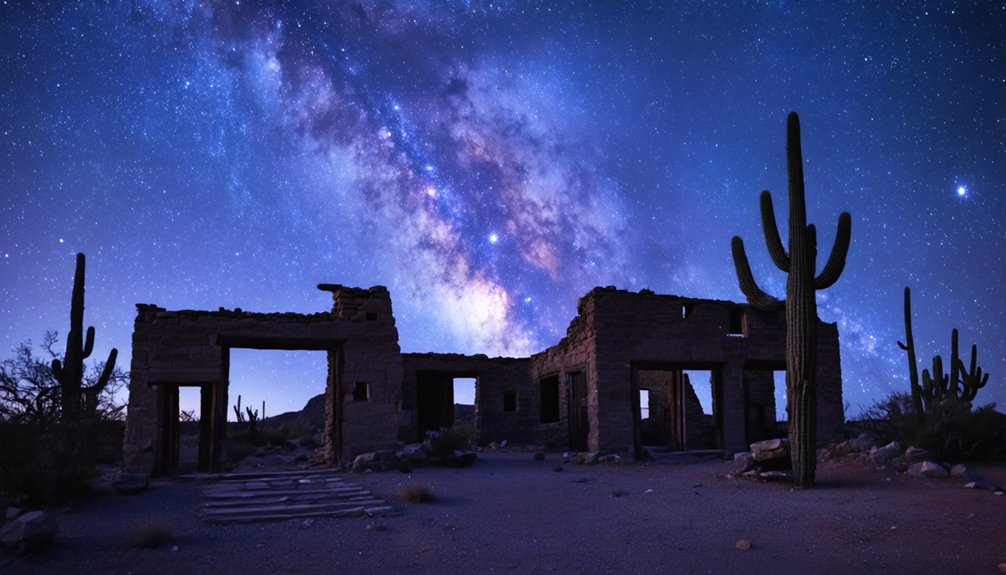
You’ll find Texas’s premier astrophotography locations among its historic ghost towns. Terlingua, nestled between Big Bend parks, offers exceptionally dark skies at 800 meters elevation – perfect for capturing the Milky Way core with long exposures. Marfa and Valentine, within the Greater Big Bend International Dark Sky Reserve, provide unobstructed horizons and unique architectural elements. Fort Griffin’s cavalry ruins and Pontotoc’s stone structures create compelling foreground compositions for your night sky imagery. These abandoned outposts hold secrets waiting to be revealed through your lens.
Key Takeaways
- Terlingua Ghost Town offers exceptionally dark skies near Big Bend, with ideal conditions for capturing the Milky Way during moonless nights.
- Fort Griffin State Historic Site combines minimal light pollution with historic U.S. Cavalry ruins as compelling foreground elements for photos.
- Marfa’s dark sky reserve status and unique structures like Prada Marfa provide distinctive astrophotography compositions with cultural elements.
- Pontotoc’s stone ruins of San Fernando Academy create dramatic foregrounds against dark Hill Country skies for nighttime photography.
- Bankersmith’s railroad tunnel and Morris Ranch’s hotel facades offer varied architectural elements under low light-pollution conditions.
Dark Sky Paradise: Terlingua Ghost Town
While many ghost towns dot the Texas landscape, Terlingua stands out as an astrophotographer’s paradise, nestled between Big Bend National Park and Big Bend Ranch State Park at coordinates 29.30-29.33°N, 103.57-103.62°W.
Amid the desolate Texas desert, Terlingua beckons stargazers with pristine dark skies between two majestic Big Bend parks.
As a census-designated place, Terlingua retains its historical character while remaining accessible to visitors.
The area enjoys year-round sunshine and stable descending air, creating ideal atmospheric conditions for nighttime photography.
You’ll find exceptionally dark skies and minimal light pollution, perfect for capturing nocturnal landscapes of the Milky Way core during moonless nights.
The ghost town’s elevation of 800-810 meters offers improved atmospheric stability for long exposures, while preserved mining ruins and the historic cemetery provide compelling foreground elements for your compositions.
Access via Highway 118 or 170 leads to prime shooting locations, though you’ll want a high-clearance vehicle for the best spots.
For ideal Terlingua photography conditions, plan your shoot during late spring to early fall when the galactic core rises above the southern horizon’s unobstructed view.
Marfa and Valentine: Where Art Meets Stars
Located within the Greater Big Bend International Dark Sky Reserve, Marfa and Valentine offer unique astrophotography opportunities where contemporary art installations merge with pristine dark skies.
You’ll find prime shooting locations at the Marfa Lights Viewing Area, nine miles east of town on US-90. Set up your tripod well back from the road to avoid headlight interference while capturing both the mysterious Marfa Lights and the Milky Way arching overhead. A convenient parking lot provides easy access for photographers.
The site’s unobstructed horizon is perfect for low-elevation phenomena. El Cosmico’s red-glow exterior lights create minimal light pollution for nighttime shoots.
For a distinctive cultural element, head to Valentine to shoot the iconic Prada Marfa installation. Consider low-angle wide fields with subtle off-camera lighting or dramatic silhouettes against starfields.
Scout your compositions at dusk and verify parking logistics, as you’ll be working along rural roads with limited amenities.
Pontotoc’s Stone Ruins Under the Stars
Deep in Mason County, the stone ruins of Pontotoc offer astrophotographers a compelling blend of historic architecture and dark Hill Country skies.
You’ll find prime nightscape compositions among the sandstone remains of San Fernando Academy and the burnt-out shells of the old downtown, where crumbling walls frame the Milky Way core from spring through fall.
Located about an hour north of Fredericksburg, you’ll need to plan your shoot carefully. The site’s private ownership requires permission, and the fragile ruins demand cautious distance. In 2003, Carl Money purchased most of the abandoned town.
Watch the weather – Hill Country’s humidity affects transparency, but clear nights following cold fronts provide excellent conditions. While local vineyard lighting creates minor light domes, the remote setting still delivers dark skies perfect for historic photography. The area’s devastating droughts and harsh winters in 1887 led to the town’s initial decline.
Set up near the granite outcrops or historic cemeteries for layered compositions that capture both Pontotoc’s past and the cosmos above.
Fort Griffin’s Historical Night Skies
As one of North Texas’s premier dark-sky destinations, Fort Griffin State Historic Site rewards astrophotographers with pristine views of the cosmos above authentic 19th-century ruins.
You’ll find minimal light pollution thanks to surrounding ranches and sparse development, making it perfect for night photography of the Milky Way core from late winter through summer.
Located northeast of Abilene, the site provides easy access for photographers throughout the region.
The site’s U.S. Cavalry Fort remnants offer compelling foreground elements for your compositions.
You can frame the stockade outlines and historic structures against star-filled skies, or incorporate the Official State of Texas Longhorn Herd during blue hour shots.
Monthly astronomy events are offered to help photographers learn about celestial objects and optimal shooting techniques.
While you’ll need to pack your own power and gear for primitive camping, the Clear Sky Chart helps you plan ideal shooting conditions.
Just verify park hours and secure any needed permits before your overnight session.
Hidden Hill Country Haunts: Off-the-Beaten Path Locations
While Fort Griffin offers excellent dark-sky conditions in North Texas, the Hill Country harbors its own set of lesser-known ghost towns perfect for capturing the night sky. Exploring drone photography opportunities in Texas can unveil stunning aerial perspectives of these abandoned locales, showcasing their haunting beauty against the vast, starry background. Each ghost town tells a story, and capturing them from above adds a unique dimension to their history. As the sun sets, the interplay of shadows and light offers a perfect canvas for photographers looking to capture something truly extraordinary. This season is particularly ideal for exploring some of the best season for Texas ghost towns, where the cool evenings invite long walks through crumbling structures and forgotten streets. As temperatures drop, the atmosphere becomes charged with a mysterious energy that enhances the experience of wandering through these historical sites. Photographers and adventure seekers alike will find that the stunning fall colors contrast beautifully with the remnants of the past, making it a perfect time for capturing breathtaking images.
For Bankersmith astrophotography, you’ll find an intact railroad tunnel and scattered structures that create compelling foreground elements for Milky Way panoramas, with low-to-moderate light pollution enabling clear star visibility on moonless nights. Many photographers are drawn to the unique bat colony tunnel, which provides distinctive wildlife silhouettes against starlit skies.
Morris Ranch silhouettes deliver rich compositional possibilities through its decaying hotel facades and metal silos. The site’s minimal light pollution makes it ideal for star trails, especially during winter’s extended dark periods. Visitors should note that guided tours are recommended for safety when exploring these dilapidated structures at night.
At Cherry Springs, the historic 1889 dance hall stands isolated against open terrain, offering unobstructed 180-360° sky views. You’ll want to time your shoots during late spring when skies are clearest and humidity is low.
Frequently Asked Questions
What Camera Equipment Is Essential for Ghost Town Astrophotography?
Under starlit skies, you’ll need a full-frame camera, fast wide-angle lens (f/2.8 or wider), rock-solid tripod, remote shutter, and tracking mount to capture ghost structures against the cosmos.
Are There Guided Astrophotography Tours Available at These Ghost Towns?
You’ll find guided tours at Terlingua Ghost Town, where experts teach ghost town photography and astrophotography techniques. They’ll help you capture deep-sky objects, the Milky Way, and comets with their telescopes and tracking mounts.
How Safe Is It to Photograph Alone at Night?
Like walking a tightrope, solo nighttime photography isn’t recommended. You’ll want a buddy system, reliable communication gear, and well-researched locations. Tell someone your plans and expected return time.
What’s the Best Time of Year for Meteor Shower Photography?
You’ll find peak meteor activity during August’s Perseids and December’s Geminids, with ideal dark skies and high hourly rates. Plan your shoots between midnight and dawn when meteor shower timing maximizes your captures.
Do You Need Special Permits for Commercial Astrophotography Shoots?
You’ll need commercial use permits at Big Bend and Fort Griffin State Park, but Terlingua’s ghost town allows unrestricted astrophotography. Check permit regulations before setting up your pro gear and tripods.
References
- https://www.airial.travel/attractions/united-states/terlingua/terlingua-ghost-town-dz_V9hNR
- http://astronomy.robpettengill.org/pontotoc.html
- https://texashillcountry.com/5-stunning-stargazing-towns-texas/
- https://www.jasonrweingart.com/blog/2016/2/13/the-ten-best-stargazing-spots-in-texas
- https://www.traveltexas.com/articles/post/stargazing-in-west-texas/
- https://www.hipcamp.com/journal/camping/texas-ghost-towns/
- https://darkskytexas.org/texas-dark-sky-places/
- https://www.onlyinyourstate.com/trip-ideas/texas/remote-town-terlingua-tx
- https://en.wikipedia.org/wiki/Terlingua
- https://www.latlong.net/place/terlingua-tx-usa-4426.html