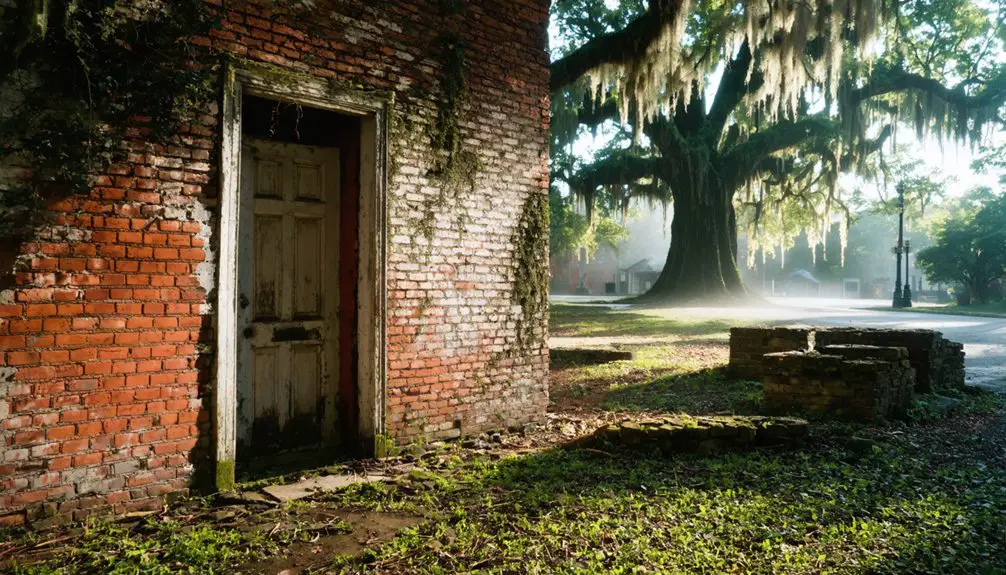
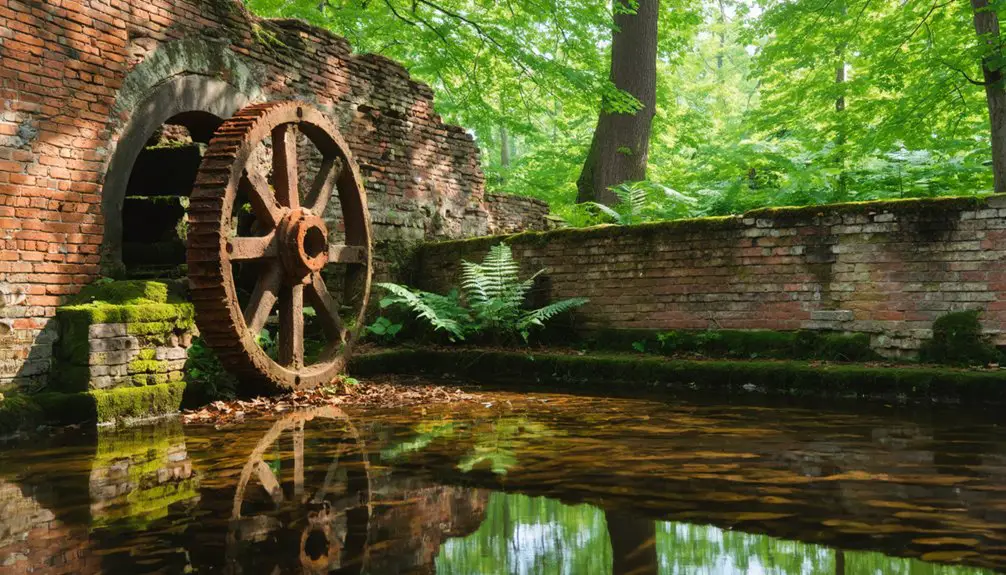
You’ll find prime ghost town astrophotography at Virginia’s Dark Sky locations near Falling Creek Ironworks and Grace Episcopal Church at Ca Ira. These sites offer minimal light pollution and compelling architectural elements for Milky Way compositions. Pack your full-frame camera, 14-24mm wide-angle lens, and sturdy tripod for long exposures between April and August. Schedule shoots during new moons, and don’t forget your red headlamp and permits. The secrets to capturing these forgotten places under starlit skies await.
Key Takeaways
- Ca Ira’s Grace Episcopal Church ruins offer exceptional Milky Way photo opportunities with minimal light pollution interference.
- Falling Creek Ironworks provides historic industrial ruins beneath dark skies, perfect for combining star trails with architectural elements.
- Abandoned tobacco warehouses near Staunton River State Park combine unobstructed horizons with International Dark Sky Park conditions.
- Highland County’s deserted farmsteads feature remote locations with Bortle scale ratings ideal for astrophotography.
- Rosewell Plantation’s brick ruins create dramatic vertical compositions against the night sky in a light pollution-free setting.
Essential Equipment for Ghost Town Night Photography
When photographing ghost towns under starlit Virginia skies, you’ll need specialized equipment to capture both architectural details and celestial elements in low light conditions. A full-frame camera with strong high-ISO performance will handle long exposures while minimizing noise in your starry backgrounds. A wide-angle zoom lens between 14-24mm is ideal for capturing expansive views of abandoned structures against the night sky.
For essential camera settings, you’ll need manual controls and focus capabilities. Choose appropriate lenses that combine wide angles for sweeping scenes with fast apertures for light gathering. Experimenting with multiple flash bursts can create ethereal effects in your architectural shots.
Mount your setup on a carbon fiber tripod marked with phosphorescent tape for nighttime visibility. Don’t forget your remote release or intervalometer for exposures beyond 30 seconds.
Pack LED lights and an off-camera flash at low power to illuminate building details while preserving the mood. A headlamp with red light mode will help you navigate while maintaining your night vision.
Safety Measures and Legal Considerations
Before venturing into Virginia’s ghost towns for astrophotography, you’ll need to navigate a complex web of legal requirements and safety protocols. Start by verifying property status through county records and securing necessary permits for commercial shoots. Your legal access strategy must include written permissions and location releases when shooting on private land. Consider visiting locations near Dark Sky Parks for optimal stargazing conditions. Union Level offers unique opportunities with its eight abandoned storefronts creating dramatic silhouettes against the night sky.
Research property ownership and obtain proper permits before photographing Virginia’s ghost towns to ensure legal access and avoid costly penalties.
- Always work with a buddy system, carrying emergency beacons and backup lighting for quick extraction if needed.
- Check structural integrity of buildings before approaching – unstable masonry and collapsed floors pose serious risks.
- Pack wildlife deterrents and first-aid supplies specific to local species and terrain hazards.
- Maintain copies of all permits on-person and establish clear communication protocols with your team.
Don’t risk fines or injury – proper preparation guarantees you’ll capture stunning night shots while staying safe and legal.
Top Dark Sky Locations Near Abandoned Sites
Virginia’s five International Dark Sky Parks anchor a network of premier astrophotography locations near ghost towns and historic ruins.
You’ll find James River State Park’s open fields perfect for capturing the Milky Way above Falling Creek’s mill ruins, while Natural Bridge State Park offers minimal light pollution near Central Virginia’s abandoned structures.
Staunton River State Park provides extensive shoreline opportunities for long exposures of derelict ferry crossings. The historic town of Lackey once thrived nearby before being abandoned in the 1940s.
For more remote shoots, head to Highland County’s deserted farmsteads or explore Patrick County’s forgotten properties near Meadows of Dan. Near Crawford Road, photographers have captured mysterious phantom vehicles appearing in their nighttime exposures.
The coal camp regions of Southwest Virginia deliver exceptional dark skies above abandoned mining facades.
Don’t miss Rosewell Plantation’s brick shell – its formal lines create striking vertical elements for star trail compositions against the dark sky backdrop.
Planning Your Ghost Town Shoot
Since ghost town astrophotography requires careful coordination of gear, timing, and location access, you’ll need a thorough shooting plan before heading out.
Check ghost town accessibility and secure photography permits well before your shoot date, especially for locations like Wash Woods that demand backcountry permits through False Cape State Park. Astronomy enthusiasts should consider visiting during free viewing nights at George Mason University Observatory.
- Pack your wide-angle lens and tripod for capturing dramatic building silhouettes against star-filled skies.
- Time your arrival for post-sunset golden hour, targeting new moon phases for minimal light pollution.
- Bring red-filtered flashlights to maintain night vision while maneuvering through historic ruins safely.
- Consider joining local astronomy events at places like Sky Meadows to scout locations and connect with fellow photographers.
Plan your route through public access points, noting that some sites like Matildaville offer guided markers to help you find your way in low light. Consult the Bortle scale rating of your chosen location to ensure optimal dark sky conditions for your ghost town shoot.
Weather and Seasonal Factors
While planning ghost town astrophotography sessions throughout Virginia’s diverse regions, you’ll need to account for distinct seasonal patterns that affect image quality and shooting conditions.
The best season to explore Virginia’s ghost towns is during the fall when the foliage adds vibrant colors to your photographs. This season not only provides stunning visual contrasts but also cooler temperatures, making exploration more enjoyable. Additionally, the atmospheric conditions are often ideal for capturing haunting images, allowing for a perfect blend of nature and history.
When considering photogenic locations in Virginia, be sure to include spots like the historic town of Abingdon and the stunning landscapes of Shenandoah National Park. These areas offer breathtaking backdrops for your photography, especially during twilight when the light enhances the scenery. Exploring these sites not only enriches your portfolio but also deepens your connection to Virginia’s rich heritage.
Late autumn offers your best seasonal visibility, with mid-October through early December providing exceptionally clear nights and reduced atmospheric interference. The Blue Ridge and Highland regions deliver superior dark-sky conditions during this period, especially near abandoned mountain settlements.
You’ll face challenging cloud patterns along coastal ghost towns like Wash Woods, where maritime humidity and fog can disrupt shoots from spring through summer. False Cape State Park requires advance planning since accessing this remote location involves hiking or biking.
For Milky Way captures, schedule around new moons between late April and early August.
Winter months, while cold, reward you with steady seeing conditions and extended moonless periods – just prepare for equipment challenges from frost and battery strain.
Historical Significance of Virginia’s Abandoned Places
Deep within the Mid-Atlantic’s historical fabric, abandoned settlements across Virginia offer compelling documentation of colonial enterprise and industrial evolution spanning four centuries.
You’ll discover ghost town origins dating back to pre-1700 settlements, where colonial expansion and plantation agriculture shaped the landscape. These architectural remnants serve as perfect foreground elements for your astrophotography compositions. Union Level’s tobacco farming legacy stands as testament to Virginia’s agricultural prominence.
- Falling Creek Ironworks ruins showcase America’s earliest industrial heritage against the star-filled sky
- Grace Episcopal Church at Ca Ira stands as a solitary sentinel beneath the Milky Way
- Abandoned tobacco warehouses provide stark silhouettes for night sky photography
- Former railroad towns offer unobstructed horizons free from light pollution
When shooting these locations, you’ll be capturing more than just stars – you’re documenting Virginia’s rich historical tapestry through architectural significance and forgotten places.
Light Painting Techniques for Ghost Town Features
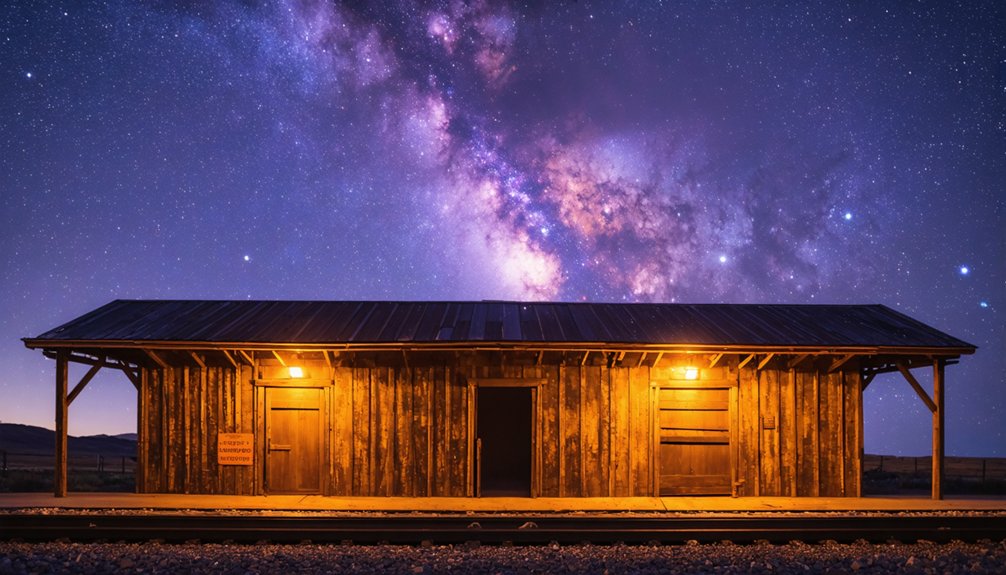
You’ll need specialized light painting gear including a sturdy tripod, wide-angle lens, and powerful flashlight with optional gels to capture Virginia’s ghost town features after dark.
Your camera settings should emphasize long exposures with low ISO and f/8 aperture, allowing you to selectively illuminate weathered walls, rustic doorways, and period details while maintaining natural ambiance.
Equipment for Light Painting
Essential light painting equipment for ghost town astrophotography combines specialized illumination tools with precise control systems.
You’ll need diverse light sources, from high-CRI RGB panels to fiber-optic wands, paired with robust battery management solutions using high-capacity power banks and spare 18650 cells.
Master control through specialized modifiers and beam shapers to protect night sky detail.
- RGB LED panels with diffusers create soft, controlled color fills across weathered facades
- Variable-output flashlights with snoots precisely accent architectural details and textures
- LED light tubes sweep clean lines across walls while preserving dark sky conditions
- Magnetic-mount cube lights provide subtle interior illumination through broken windows
Pack your gear in weather-resistant cases and maintain strict battery discipline with on-site charging capabilities to guarantee reliable performance throughout your nocturnal shoots.
Balancing Ambient and Artificial
With your light painting equipment ready, mastering the interplay between ambient starlight and artificial illumination becomes your next technical challenge.
You’ll need to carefully balance exposures to prevent light pollution from overwhelming the stars while still revealing the ghost town’s character. Start with test shots at ISO 3200-6400 for 15-30 seconds to capture the night sky, then blend these with shorter exposures where you’ll paint the structures.
Use controlled, directional lighting to accent architectural features without flooding them. When painting, keep your brightest highlights below the peak values in your sky frame.
Check your histogram frequently and employ multiple gentle passes rather than one intense burst. This preserves depth and texture while maintaining the moody atmosphere that makes ghost town astrophotography so compelling.
Preserving Historical Atmosphere
Mastering historical authenticity in ghost town astrophotography requires precise light-painting techniques that honor each structure’s original character.
You’ll want to emphasize architectural details while maintaining the weathered atmosphere these abandoned sites naturally possess. Use directional strobing with narrow-beam lights and careful gel selection to recreate period-appropriate illumination.
- Apply low-angle grazing light to reveal textural elements like peeling paint and worn wood grain while preserving shadowed depth.
- Employ warm gels (1/4 to 1/2 CTO) to simulate vintage incandescent lighting common in early 20th-century structures.
- Isolate focal artifacts with short, controlled bursts using handheld snooted lights to maintain historical hierarchy.
- Layer multiple short passes instead of continuous sweeps to build subtle highlights that suggest natural aging.
Keep your movements swift and wear dark clothing to remain invisible during long exposures, ensuring your presence doesn’t disrupt the scene’s abandoned authenticity.
Capturing the Milky Way Above Forgotten Structures
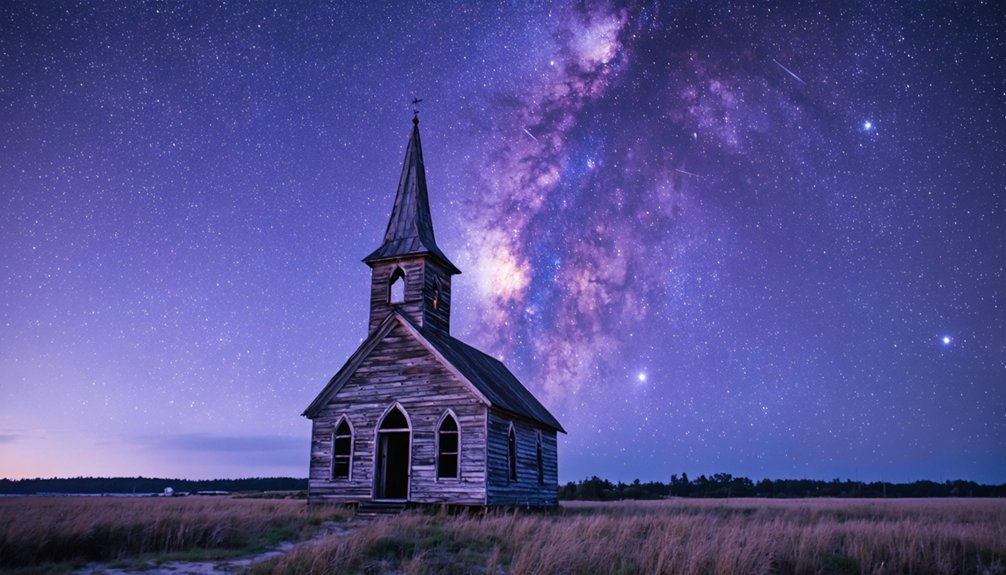
You’ll need to carefully time your Milky Way shoots during moonless nights between April and August when the galactic core reaches its highest visibility above Virginia’s abandoned settlements.
To safely capture these remote locations, scout your chosen ghost town during daylight hours to identify hazards, mark GPS coordinates, and plan multiple composition angles that align with the core’s arc between astronomical twilight and moonrise.
When shooting at night, always bring backup lighting, emergency supplies, and a shooting partner while maintaining awareness of your surroundings in these isolated historic sites.
Planning Dark Sky Access
Virginia’s designation of five International Dark Sky Parks creates an exceptional network of locations for capturing the Milky Way above abandoned structures.
These regulated dark sky zones let you access prime ghost town locations while minimizing light pollution interference with your shots.
- Sky Meadows’ Turner Pond area offers after-hours self-guided astronomy with 22 miles of trails to reach remote structures
- Staunton River’s open field provides ideal telescope setups with Bortle 2-3 skies
- James River’s 1,561 acres feature cabins and campgrounds for extended night shoots
- Natural Bridge pairs historic architecture with strictly controlled lighting for dramatic compositions
Plan your shoot around these parks’ dark sky regulations, which protect against light pollution while ensuring 24/7 access to forgotten buildings and remarkable night skies.
Safety First Night Shooting
Before venturing into Virginia’s abandoned structures for Milky Way photography, conducting a thorough safety assessment is critical to protect both photographer and gear.
You’ll need to verify structural stability through recent inspection records and watch for obvious signs of collapse. Check for hazardous materials like asbestos and lead paint, using proper protective equipment when necessary.
Team protocols are essential – always shoot with a buddy and maintain regular radio check-ins.
Share your detailed itinerary and GPS coordinates with an off-site contact, and carry a charged personal locator beacon in areas without cell coverage.
Map out potential hazards like broken stairs and exposed nails beforehand, and use red headlamps to preserve night vision.
Don’t forget to secure proper permissions and carry documentation to avoid legal issues during your shoot.
Frequently Asked Questions
How Can I Find Reliable Guides for Exploring Remote Ghost Towns at Night?
Fortune favors the prepared – you’ll find trustworthy guides through state park ranger programs, astronomy club online forums, local meetups, and vetted commercial photo workshops that secure proper permits and insurance.
Which Ghost Town Locations Offer the Best Protection From Sudden Weather Changes?
You’ll find ideal weather protection at Union Level, where abandoned buildings block wind and the low elevation stabilizes patterns. Scout multiple emergency exit routes through South Hill during your location scouting.
Are There Any Ghost Towns With Existing Power Sources Nearby?
Off the beaten path, you’ll find Union Level’s historic main street has power lines running nearby, while Jewell Valley and New Hampden offer grid access through their proximity to inhabited areas.
What Paranormal Activity Has Been Reported During Night Photography Sessions?
You’ll encounter mysterious orbs in long exposures, spooky sightings of mist formations, unexplained light streaks, and night sounds like footsteps. Temperature drops and equipment interference often accompany these paranormal encounters.
Which Ghost Towns Have Cell Phone Reception for Emergency Communication?
Keep your head above water at Thurmond’s visitor center and Pamplin City’s main streets – they’ve got decent cell coverage. Deep valleys lack emergency signals, so pack a satellite messenger for safety.
References
- https://vadogwood.com/2024/12/16/your-guide-to-virginias-international-darksky-parks/
- https://colonialghosts.com/top-ten-haunted-places-in-eastern-virginia/
- https://www.virginia.org/blog/post/stargazing/
- https://www.go-astronomy.com/dark-sky-parks-stargazing-state.php?State=VA
- https://www.dcr.virginia.gov/state-parks/dark-sky-parks
- https://southsidedaily.com/abandoned-places-in-virginia/
- https://darksky.org/news/new-virginia-idsps/
- https://www.dcr.virginia.gov/state-parks/blog/protecting-virginias-dark-sky-parks-from-light-pollution
- http://www.onlyinyourstate.com/virginia/underwater-ghost-town-hiding-in-va
- https://www.nationalparksatnight.com/blog/2019/10/31/photographing-phantoms-how-to-capture-ghosts-and-spirits-in-night-images