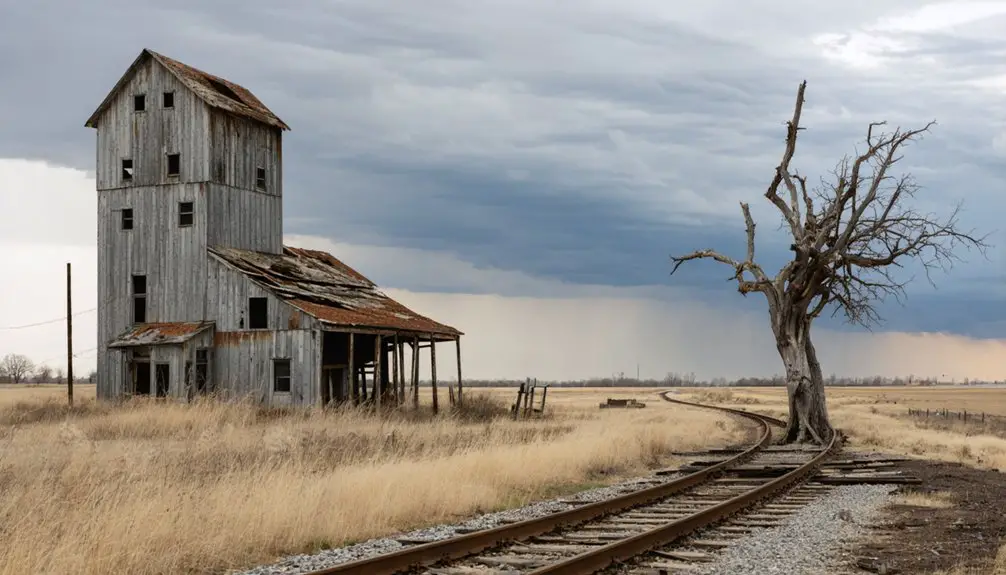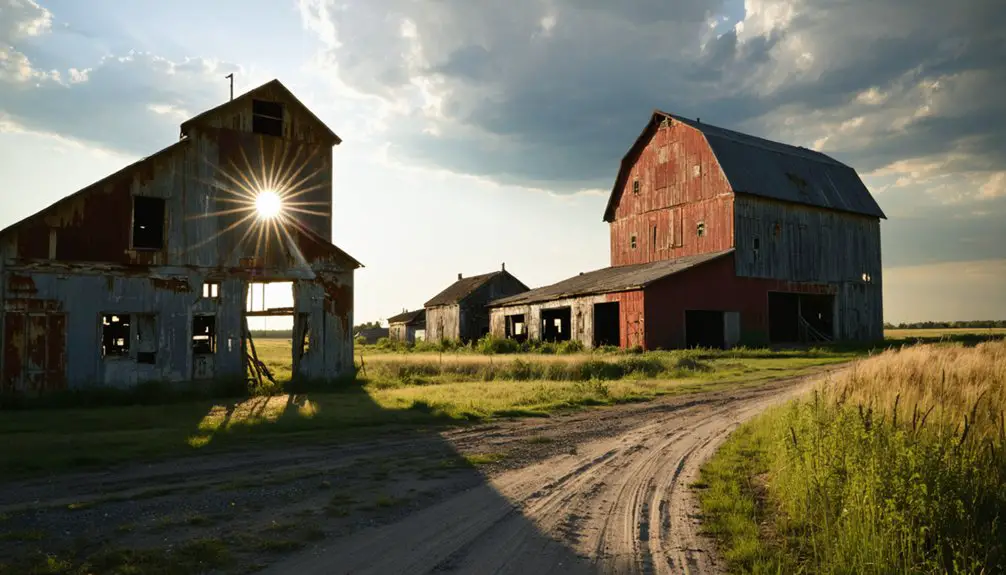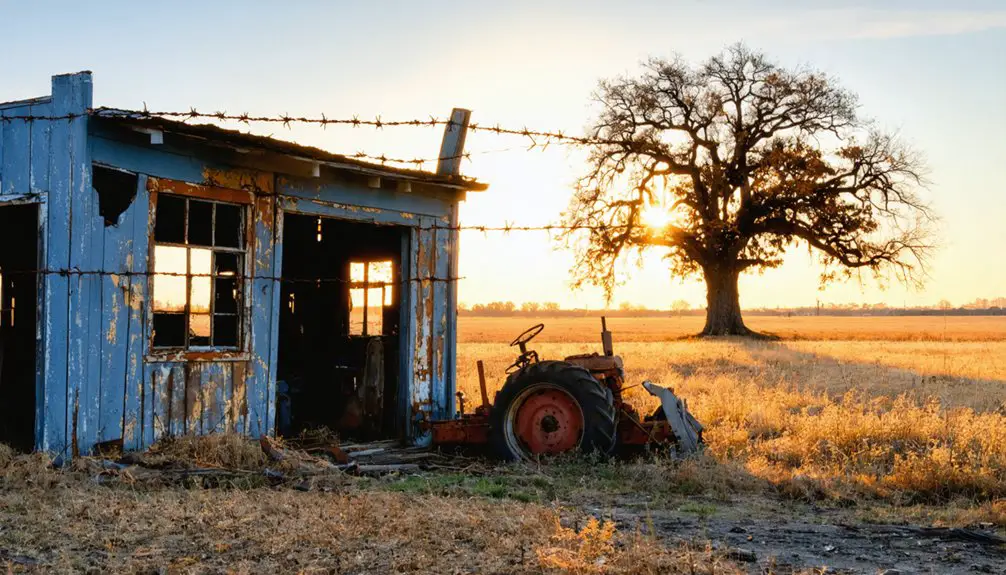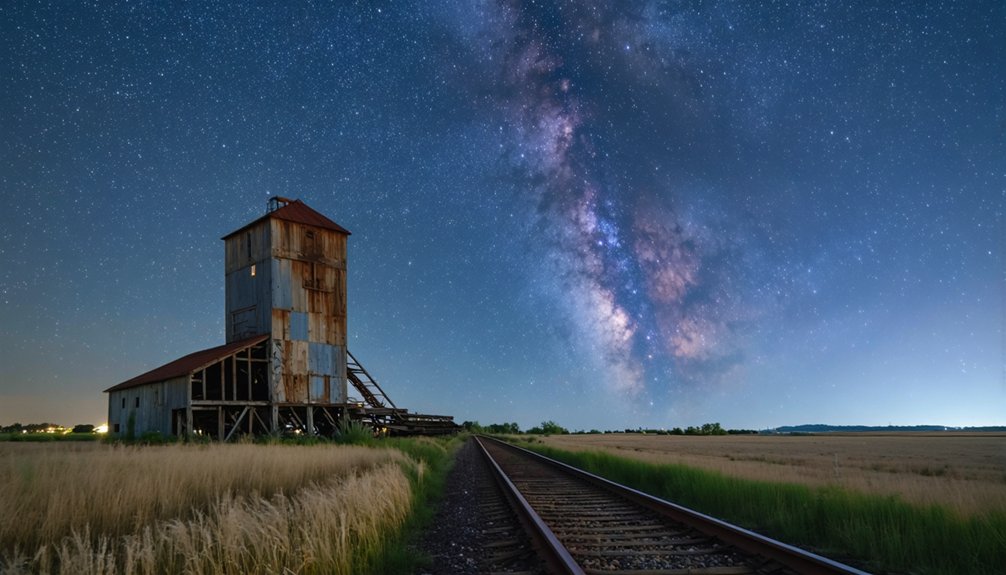
Minnesota’s ghost towns offer exceptional astrophotography opportunities, with Taconite Harbor and Forestville leading the list for their pristine dark skies and compelling foreground elements. You’ll find ideal conditions at Dorothy’s Railroad Ruins (47°55′40″N, 96°26′48″W) and Elcor’s mining remnants, particularly during winter months when atmospheric moisture decreases. For best results, target moonless nights and bring essential gear like full-frame cameras, tracking mounts, and safety equipment. Each location harbors unique compositional potential waiting to be revealed.
Key Takeaways
- Taconite Harbor offers minimal light pollution and unobstructed northern views perfect for aurora photography with compelling abandoned structures.
- Forestville’s location within a state park provides dark skies and historic buildings ideal for Milky Way compositions.
- Dorothy’s Railroad Ruins in Red Lake County provides exceptional dark-sky conditions for Milky Way photography during winter months.
- Elcor’s Mining Remnants near Gilbert features industrial artifacts and foundations that create unique foreground elements for night photography.
- Old Wadena’s Trading Post combines historical structures with the reflective Crow Wing River for distinctive night sky compositions.
What Makes Minnesota Ghost Towns Perfect for Night Sky Photography
While many locations offer opportunities for astrophotography, Minnesota’s ghost towns provide an exceptional combination of attributes that make them ideal for capturing the night sky.
You’ll find these abandoned settlements nestled in regions with remarkably low Bortle-scale ratings, particularly near the Boundary Waters and Voyageurs National Park, where light pollution is minimal.
Most ghost towns being situated within 100 miles of Rochester means photographers can maximize shooting time by planning efficient multi-location visits in a single night.
These locations also attract abandoned towns for drone enthusiasts who are eager to capture stunning aerial views of decaying structures against the backdrop of sprawling landscapes. As twilight descends, the intricate details of these once-thriving communities become illuminated, presenting a unique opportunity for creative exploration. Adventure seekers can find a blend of history and artistry as they navigate through the remnants of the past.
The historic lime kiln on Grey Cloud Island creates a particularly striking silhouette against starlit skies. The ghost town history enhances astrophotography techniques through structural remnants that create compelling foreground elements. You can position your equipment effectively using surviving foundations and porches as wind blocks, while accessible rural roads enable easy transport of imaging gear.
The sites’ proximity to state parks facilitates legal overnight shooting sessions, and winter’s frozen ground expands your access to remote locations where you’ll discover pristine dark skies.
Essential Gear and Planning for Ghost Town Astrophotography
Before you set up your imaging gear at a ghost town site, you’ll need essential safety equipment like bright flashlights, first-aid supplies, and emergency communications devices.
Color DSLR cameras are ideal for capturing both the ghost town architecture and stunning Milky Way scenes in a single frame.
Your core astrophotography kit should include a full-frame camera body, fast wide-angle lenses, and a robust tracking mount for capturing both foreground detail and pristine night sky compositions. A Bahtinov mask will help achieve precise focus on stars when light pollution is minimal at these abandoned locations.
While automated tracking mounts and remote camera controls enhance your shooting capabilities, don’t underestimate the importance of basic stability tools like sturdy tripods and vibration dampening accessories in these remote locations.
Safety Equipment First
Successful astrophotography in ghost towns demands thorough safety preparation and specialized equipment. Your safety protocols should include a detailed first aid kit with band-aids, antiseptic wipes, and pain relievers.
For emergency preparedness, pack a headlamp to keep hands free and maintain situational awareness in dark conditions.
You’ll need multiple protective layers to combat Minnesota’s dramatic temperature changes. Pack insulated clothing, thermal wear, and winter accessories. Don’t forget your red light flashlight for checking star maps while preserving your night vision.
Make sure you’re equipped with insect repellent to ward off nocturnal pests during long exposures. A sturdy tripod is essential for capturing clear, stable images during extended photography sessions. A multi-tool, zip ties, and duct tape provide quick fixes for equipment issues.
When selecting sites, test all gear during daylight hours and verify weather conditions before departure.
Remember to pack a beach towel – it’ll cushion dropped accessories and provide emergency ground protection.
Night Photography Gear Essentials
To capture stellar ghost town images under dark skies, you’ll need specialized photography equipment that balances portability with technical capability. A full-frame mirrorless or DSLR camera with strong high-ISO performance (800-6400) forms your foundation, paired with fast wide-angle lenses like the Rokinon 14mm f/2.8 for Milky Way shots and telephotos for compressed building compositions. The Canon 6D camera is particularly well-suited for ghost town night photography due to its exceptional low light capabilities. Consider using field flatteners to ensure your stars appear sharp and round across the entire frame.
Mount your gear on a sturdy tripod with vibration dampening accessories to handle uneven ghost town terrain. Consider a portable star tracker for longer exposures without star trails.
You’ll want reliable power solutions for overnight sessions, including 12V batteries and distribution hubs to run your equipment. Critical focus aids like Bahtinov masks guarantee sharp stars, while camera controllers enable automated sequences and live histogram checks.
Northern Lights Viewing at Taconite Harbor’s Abandoned Structures
While abandoned industrial sites often present challenges for nighttime photography, Taconite Harbor’s ghost town offers exceptional conditions for capturing the northern lights.
You’ll find minimal light pollution and unobstructed northern views across Lake Superior, creating ideal conditions for aurora photography. The site’s remnant structures – including rusted streetlights and an old basketball court – provide compelling foreground elements for your compositions. The pre-fabricated homes that once housed mining families have left behind concrete foundations that add unique architectural elements to nighttime shots. The area was renowned for shipping 10 million tons of taconite pellets annually during its peak operations.
For best ghost town exploration and aurora shots, position yourself near the harbor’s upper parking lot, where you can frame the abandoned ore dock against the northern horizon.
The lake’s reflective surface amplifies the auroral display, particularly during geomagnetic storms from late fall through early spring. Peak viewing typically occurs between midnight and pre-dawn when clear skies prevail.
Capturing the Milky Way Above Forestville’s Historic Buildings
Moving south from Lake Superior’s industrial remains, Forestville’s historic ghost town presents another prime dark sky destination for astrophotography. The site’s remote location within Forestville/Mystery Cave State Park minimizes light pollution, creating ideal conditions for capturing the Milky Way above preserved 19th-century structures.
You’ll find multiple compositions using the Meighen store, homestead, and farm buildings as striking foreground elements. Historic preservation efforts have maintained these structures’ authentic character, providing unique architectural elements to frame against the night sky.
For best results, plan your shoot during moonless nights and position yourself along park trails to align the galactic core with building silhouettes. The covered Gillette-Hertzog bridge and main street buildings offer additional vantage points for astrophotography techniques like stacking or panoramas.
Dark Sky Photography Opportunities in Dorothy’s Railroad Ruins
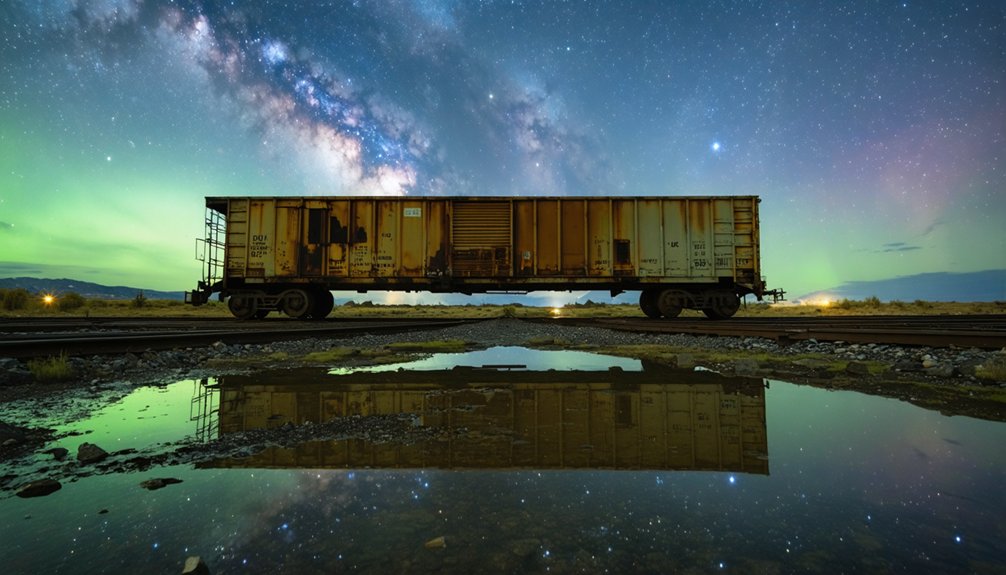
Dorothy’s abandoned railroad site offers photographers a unique dark-sky destination in northern Minnesota’s Red Lake County. You’ll find minimal light pollution and excellent conditions for capturing the Milky Way, particularly during moonless nights.
The site’s coordinates (47°55′40″N, 96°26′48″W) place you in a prime location for astrophotography, where remnant railroad features provide compelling foreground elements.
Plan your shoot during winter or early spring when structural visibility peaks and atmospheric clarity is superb. The elevated railroad grade creates unobstructed horizon views perfect for wide-field star photography.
You’ll need to verify access routes and obtain necessary permissions, as the site spans various land parcels. Consider seasonal weather patterns and bring high-clearance vehicles to navigate unpaved township roads.
Monitor aurora forecasts, as geomagnetic activity can impact your dark sky images.
Photographing Star Trails Over Elcor’s Mining Remnants
Set against the backdrop of Minnesota’s Mesabi Iron Range, Elcor’s abandoned mining site presents compelling opportunities for star-trail photography at coordinates near Gilbert in St. Louis County.
The site’s scattered foundations and mining artifacts create striking foreground elements for night sky compositions.
You’ll find ideal shooting conditions during late fall and winter when skies are darkest and clearest.
Position your camera to use concrete foundations and rusting metal fragments as anchoring elements, while avoiding light pollution from Gilbert to the north.
The site’s various linear features – from old roadbeds to foundation edges – provide natural leading lines into your celestial compositions.
For best access, plan your shoot during dry conditions, as local roads can become challenging during winter snow and spring thaw.
Always verify current land ownership and secure necessary permissions before night shooting.
Night Photography Tips for Old Wadena’s Trading Post Setting
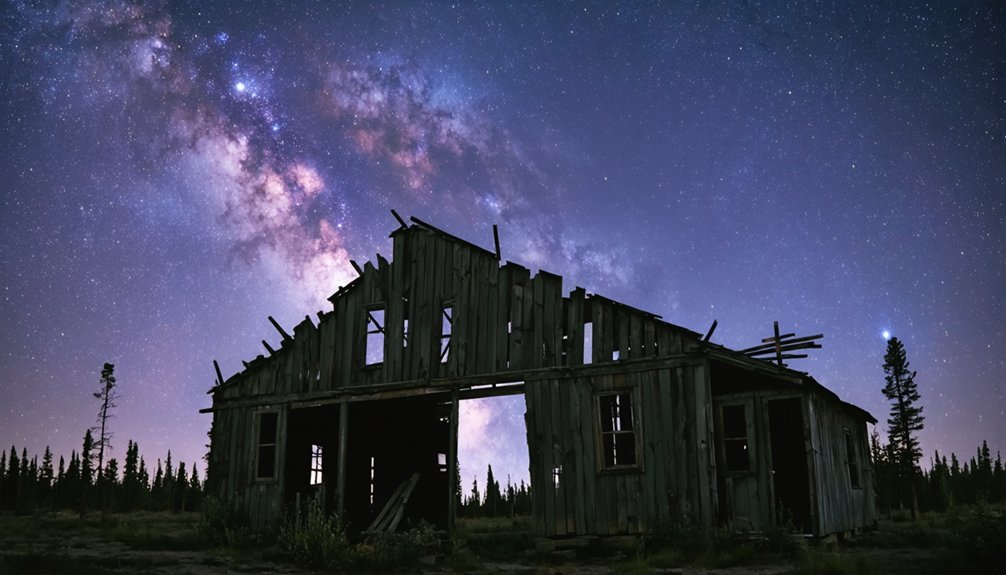
While exploring Old Wadena‘s trading post remnants for night photography, you’ll encounter unique compositional opportunities at the Little Round Hill Trading Site within Old Wadena County Park.
The historical context of Réaume’s and Cadotte’s trading posts provides documented footprints for strategic camera placement, while the site’s archaeological features offer compelling foreground elements.
For ideal astrophotography results at this location:
- Position your camera near the remnant signpost at 4th & Main during new moon phases to capture the Milky Way core without light pollution.
- Utilize the Crow Wing River’s reflective surface during still conditions for symmetrical star trail compositions.
- Frame your shots using the ferry cut traces as leading lines, incorporating both historical elements and celestial features.
Light Pollution Considerations at Minnesota’s Abandoned Sites
You’ll find Minnesota’s abandoned sites offer varying dark sky quality ratings, from pristine Bortle 1 conditions in northern ghost towns to moderately light-polluted Bortle 4-5 zones near metropolitan areas.
Your best astrophotography opportunities occur during winter months when atmospheric moisture decreases and nights lengthen, though you’ll need to monitor moon phases and weather conditions.
For ideal results, consult NOAA satellite imagery and sky quality meter readings above 21.7 mag/arcsec² to identify ghost town locations with minimal light dome interference from nearby communities.
Dark Sky Zone Ratings
Because light pollution greatly impacts astrophotography conditions, understanding Minnesota’s dark sky zones through the Bortle Scale is essential for ghost town shoots.
Dark sky conservation efforts in northern Minnesota, particularly Cook County, offer the best opportunities for capturing abandoned structures against pristine night skies.
Your astrophotography techniques need to account for these critical exposure factors:
- Sites 100+ miles north of Minneapolis-St. Paul provide Bortle 2-3 conditions suitable for Milky Way visibility.
- One hour of exposure at Bortle 1 locations equals nearly 10 hours in Bortle 5 suburban areas.
- Northern locations near Split Rock Lighthouse offer Bortle 2 ratings excellent for star trails and deep-sky imaging.
Monitor satellite-based light pollution maps to track seasonal changes and find ideal shooting windows in these remote locations.
Seasonal Light Conditions
Seasonal light conditions present distinct challenges and opportunities for astrophotography at Minnesota’s ghost towns throughout the year.
The best seasons for Minnesota ghost towns offer unique atmospheric backdrops ideal for capturing stunning celestial images. During autumn, the changing foliage adds vibrant colors, enhancing the eerie beauty of these abandoned places. Conversely, winter nights provide clear skies and crisp air, perfect for showcasing the brilliance of the stars.
You’ll find ideal visibility during winter months when extended dark periods combine with typically clear skies, particularly in northern locations near the Boundary Waters region. During these periods, the 1.3 million acres of preserved dark skies offer exceptional imaging conditions.
Summer presents shorter nights, intensifying the impact of any ambient light pollution, while spring and fall equinoxes deliver prime aurora viewing opportunities.
Moon phases greatly influence seasonal visibility at these remote sites, where minimal artificial lighting allows natural celestial cycles to dominate the nightscape.
To maximize your shoots, track lunar schedules and coordinate your visits during new moon periods when pursuing deep-sky targets at these abandoned locations.
Frequently Asked Questions
Are Ghost Towns Legally Accessible at Night for Photography?
You’ll need to verify ownership and posted restrictions, as ghost town regulations vary. Public sites allow night photography, but private abandoned properties risk trespassing charges even after dark.
What Wildlife Precautions Should Photographers Take When Visiting These Locations?
While stars twinkle above, wildlife lurks below. You’ll need bear spray, permethrin-treated clothing, sealed food containers, and sturdy boots to minimize dangerous encounters. Keep your distance and stay alert.
Do Any Ghost Towns Require Special Permits for Night Photography?
You’ll need specific night photography permits at privately owned ghost towns, while public sites may require commercial permits. Check each location’s regulations, as requirements vary between properties.
Which Seasons Offer the Best Astronomical Viewing Conditions at These Sites?
Like a crystal lens clearing your view, you’ll find ideal stargazing when fall skies bring low humidity (September-October) and winter wonders deliver pristine transparency (December-February) between cold fronts.
Are There Guided Astrophotography Tours Available to These Ghost Towns?
You won’t find dedicated guided tours or photography workshops to ghost towns for astrophotography. Your best option is connecting with local astronomy clubs that occasionally organize informal nighttime viewing sessions.
References
- https://daytripper28.com/9-designated-dark-sky-viewing-spots-in-northern-minnesota/
- https://thievesriver.com/blogs/articles/ghost-towns-in-minnesota
- https://quickcountry.com/minnesota-ghost-towns/
- https://www.youtube.com/watch?v=MZ1Gt5E7VXQ
- https://www.voyageurs.org/darkskies
- https://www.go-astronomy.com/dark-sky-parks-stargazing-state.php?State=MN
- https://mnprairieroots.com/tag/ghost-towns/
- https://darksky.org/news/boundary-waters-canoe-area-wilderness-named-the-largest-dark-sky-sanctuary/
- https://www.youtube.com/watch?v=SK_qpflb_ao
- https://www.exploreminnesota.com/outdoors/dark-skies/dark-skies-minnesota