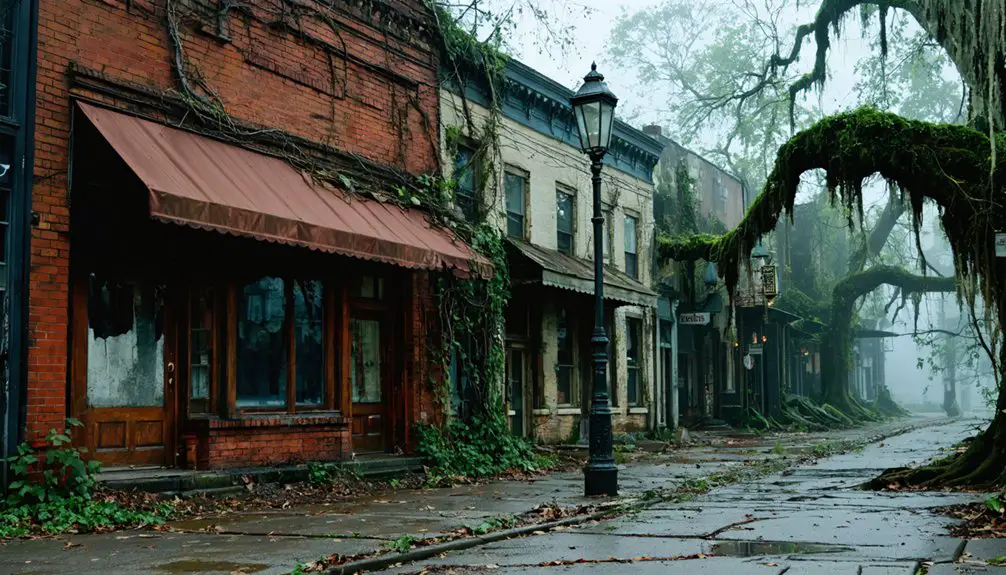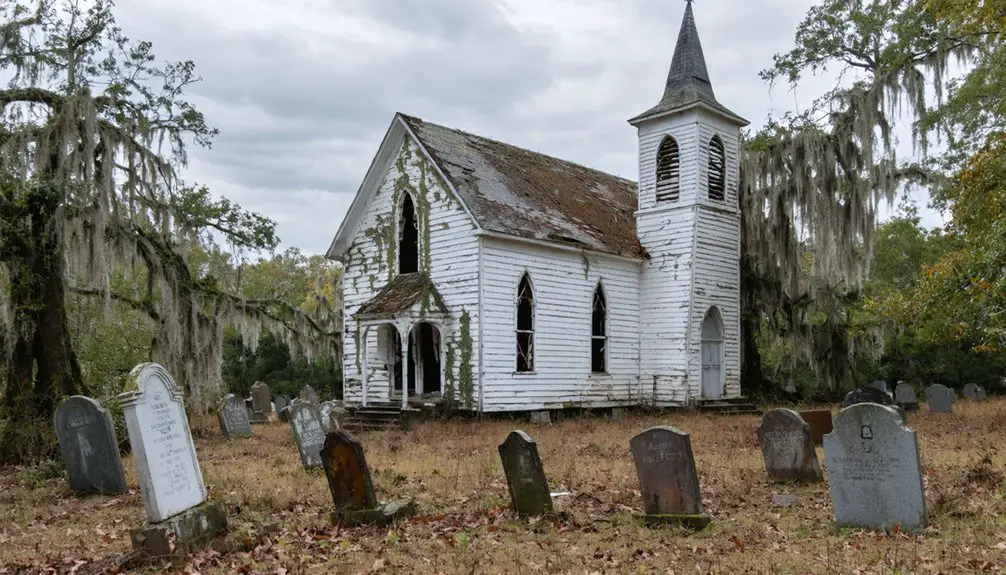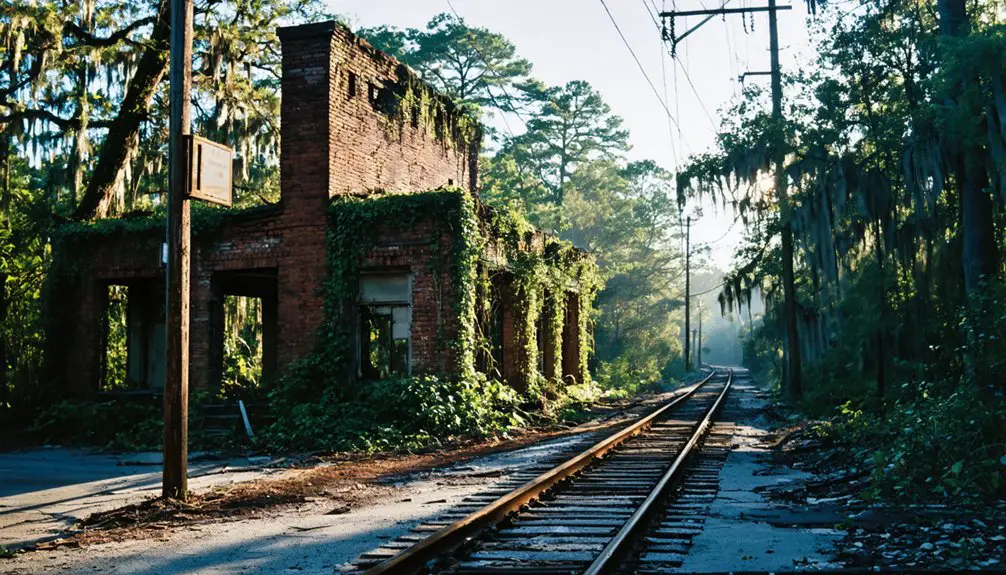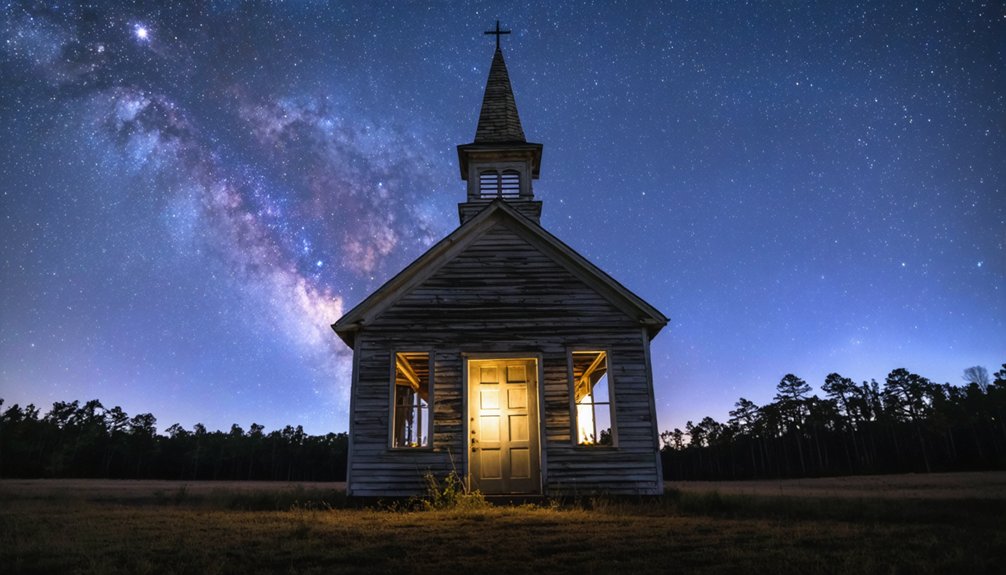
You’ll find exceptional astrophotography conditions at South Carolina’s ghost towns, with Maysville and Ella’s Grove offering prime Bortle 3-4 dark sky ratings. Pack your full-frame camera and fast wide-angle lens for capturing the Milky Way from May through August, especially during new moons. Winter months provide extended dark hours, while spring delivers 75% clear nights for long exposures. Scout these locations during daylight and secure proper permits – there’s much more to contemplate for a successful shoot.
Key Takeaways
- Maysville offers exceptional dark skies with 110 clear nights annually and minimal light pollution, making it ideal for ghost town astrophotography.
- Francis Marion National Forest ghost town sites provide Bortle 3-4 ratings, perfect for capturing detailed night sky photographs.
- Ella’s Grove features pristine dark sky conditions with 80% clear-sky probability and virtually no light pollution interference.
- Pinckneyville and Pickens Courthouse areas show five times less sky radiance due to their remote locations 30+ miles from urban centers.
- Dorchester’s ghost town sites, while accessible, may face coastal fog challenges but offer historic ruins as compelling foreground elements.
Dark Sky Advantages of Abandoned South Carolina Sites
While South Carolina’s ghost towns might seem like mere historical curiosities, they offer astrophotographers exceptional dark-sky conditions that rival dedicated observation sites.
The ghost town significance extends beyond historical context – these abandoned settlements deliver Bortle 3-4 ratings in prime locations like Francis Marion National Forest, perfect for capturing the Milky Way and deep-sky objects.
You’ll find the darkest skies in rural corridors away from major cities, where ghost towns like Pinckneyville and Pickens Courthouse sit in minimal light pollution zones.
Sites over 30 miles from urban centers show up to five times less sky radiance, dramatically improving your limiting magnitude.
These abandoned settlements attract adventurous visitors seeking unique photography opportunities throughout the year.
Winter nights in the Upstate offer superior transparency compared to humid Lowcountry summers, while new moon periods maximize contrast for shooting faint nebulae. Using high-quality telescopes and cameras will significantly enhance the detail captured in your astrophotography at these locations.
Essential Gear for Ghost Town Night Photography
Five essential gear categories form the foundation for successful ghost town astrophotography: a capable camera body, wide-angle lenses, sturdy tripod support, remote shutter releases, and strategic lighting tools.
Master ghost town astrophotography with five essential tools: camera body, wide lenses, tripod, remote release, and strategic lighting equipment.
You’ll want a full-frame camera for ideal high ISO performance, though any body with manual camera settings will work. Choose wide-angle lenses that excel in low light for capturing expansive star-filled scenes. Your lens choices should prioritize manual focus capability and minimal aberrations. Be sure to familiarize yourself with any new lens gear by practicing with it several days ahead of your trip.
Mount everything on a carbon fiber tripod like the MeFOTO Roadtrip for stability during long exposures. A wireless remote release prevents camera shake while enabling exposures beyond 30 seconds. Experiment with multiple flash bursts to create ethereal ghost effects in your long exposures.
Pack multiple flashlights in accessible pouches and consider an off-camera flash at low power to add depth without overwhelming the night sky.
Safety Tips for Nighttime Ghost Town Exploration
Since ghost town photography involves unique risks after dark, thorough safety protocols must guide your nocturnal explorations.
Before heading out, scout locations during daylight to identify hazards and mark safe pathways. You’ll need to verify land permissions and bring proper documentation for legal access. Remember to leave no trace during your photography session. Allow your eyes 10-15 minutes to fully adapt to the darkness before starting your shoot.
Implement a buddy system with regular check-ins every 20-30 minutes, and share your detailed plans with a reliable contact who’s landline access.
For nighttime navigation, use layered lighting with dim red headlamps for close work while preserving your night vision. Keep your GPS loaded with offline maps and bring a backup compass.
Take wildlife precautions by researching local species and wearing appropriate protective gear.
Always test structural integrity before entering buildings, and carry basic emergency supplies including first aid equipment and emergency contact information.
Best Seasons for Ghost Town Stargazing
You’ll maximize your ghost town astrophotography during winter’s extended dark hours from December through February, when the Geminids meteor shower offers prime shooting conditions under Bortle 3 skies.
For capturing the Milky Way’s galactic core against abandoned structures, schedule your shoots during summer new moons when the core rises highest in the southern sky. Like Bulls Island’s dark sky refuge, these remote locations offer pristine views away from urban light pollution. Photographers often choose Caesars Head State Park for its elevated views at over 3,000 feet above sea level.
Spring offers consistently clear weather patterns ideal for long exposures, with March’s equinox providing balanced celestial views minus the summer humidity or winter chill that can impact sensor performance.
Peak Winter Dark Hours
During South Carolina’s winter months, astronomical darkness stretches to its maximum duration of 7-9 hours, creating perfect conditions for deep-sky astrophotography at ghost town locations.
With current temperatures at 36 degrees Fahrenheit, conditions are optimal for capturing crisp, detailed nighttime images.
Similar to Dark Sky Park conditions at Cape Lookout, these ghost towns provide exceptional visibility of the Milky Way.
You’ll find excellent dark hour photography conditions when targeting winter constellations like Cassiopeia, Perseus, and Andromeda, especially during new moon periods.
Here’s what makes winter nights prime for ghost town shoots:
- Post-midnight transparency peaks as cold air reduces moisture and atmospheric scatter.
- Longest continuous dark periods occur near December solstice, maximizing integration time.
- Clear skies often follow cold frontal passages, ideal for multi-night exposure stacking.
- Astronomical darkness begins early (18:00-19:30 EST), extending your shooting window.
For best results, schedule your sessions during high-pressure systems and avoid coastal locations where sea breeze can introduce unwanted humidity and cloud cover.
Summer Milky Way Views
The Milky Way core presents South Carolina’s most spectacular summer imaging opportunities from May through August, when the galactic center rises prominently in the southeastern sky.
You’ll find ideal shooting conditions during new moon periods in June and July, when the core transits near local midnight, offering extended dark-sky sessions after 22:00.
For summer photography success, target post-frontal nights with humidity below 60% to maximize nebulosity contrast.
While summer’s increased moisture and storm activity can challenge your shoots, careful timing around stable high-pressure systems will reward you with stunning galactic detail.
Plan your ghost town shoots during June’s peak viewing window, but don’t overlook late May’s moderate conditions or August’s early-evening opportunities.
Remember to scout locations with minimal artificial lighting and clear southern horizons for the most dramatic Milky Way compositions.
Spring Storm-Free Nights
When planning spring astronomy sessions in South Carolina’s ghost towns, understanding storm-free patterns maximizes your shooting potential. The data reveals favorable conditions for capturing pristine night skies during March and April.
- March delivers 75% clear nights across rural sites, with Sumter NF offering 20-day storm-free windows perfect for long-exposure photography techniques.
- Coastal ghost towns like Dorchester benefit from 10-14 day clear stretches in early spring.
- Mountain locations near Table Rock hit peak clarity in May, with temperatures around 40°F reducing atmospheric turbulence.
- Ghost town sites in the Pee Dee region average 50°F nights, advantageous for sensor performance and minimal thermal noise.
For best results, target late March through early April, when storm-free windows align with dark sky conditions at Bortle 3 locations.
Planning Your Astrophotography Trip to Historic Ruins
You’ll need to thoroughly research your chosen ghost town’s access permissions and secure any required permits before attempting night photography at historic ruins.
Your essential gear should include a sturdy tripod, wide-angle lens with manual focus capability, and a powerful headlamp with both white and red modes for navigation and preserving dark adaptation.
Check the weather forecast for clear skies and plan your visit around ideal moon phases, particularly the new moon period when deep-sky objects are most visible against the darkened landscape.
Night Access Guidelines
Planning successful night access to South Carolina’s historic ruins requires careful timing and advance permissions.
You’ll need to coordinate with local historical societies and secure proper documentation before attempting night photography at these atmospheric locations. Many ghost town sites have specific entry protocols to balance preservation with photographer access.
For ideal shooting conditions, follow these critical guidelines:
- Arrive 30 minutes before sunset to scout compositions and unpack gear.
- Obtain gate keys or passes from Union County Museum for restricted sites.
- Position remote flashes 10 feet from your camera for controlled lighting.
- Use sound echoes in the night air for timing long exposures.
Remember that some locations marked as private require advance coordination, despite their historical status.
Water levels at Lake Marion sites and seasonal foliage around lighthouses can impact shooting conditions.
Essential Equipment Checklist
Successful astrophotography at South Carolina’s ghost towns demands specialized equipment beyond standard night photography gear.
You’ll need a full-frame or APS-C mirrorless camera with strong low-light performance, paired with fast lenses ranging from 14-200mm for versatile composition options. Equipment compatibility is vital – verify your mount can handle your gear’s weight with at least 25% capacity margin.
For tracking the night sky, pack a portable star tracker or equatorial mount with autoguiding capability.
Don’t forget essential power solutions like LiFePO4 batteries sized for full-night sessions. Your lens selection should include fast f/1.8-f/4 options for wide-field shots and f/4-f/6 for deep-sky work.
Round out your kit with dew heaters, focusing aids, and calibration tools for peak image quality in the humid Carolina climate.
Weather and Timing Tips
While South Carolina’s ghost towns offer compelling astrophotography opportunities, perfect shooting conditions depend on precise timing and weather variables.
In addition to these locations, there are several drone photography spots in South Carolina that provide stunning aerial views of the state’s diverse landscapes. From the picturesque coastline to the lush forests, each site offers unique perspectives that can enhance your photographic collection. Exploring these areas during golden hour can yield mesmerizing results, making them ideal for both novice and seasoned drone enthusiasts.
You’ll need to align your shoots with optimal atmospheric conditions and lunar phases to capture those ethereal long exposures of abandoned structures against star-filled skies.
- Schedule your ghost town visits during new moon periods when lunar interference won’t wash out the Milky Way’s detail.
- Time your arrival for astronomical twilight, typically 1-2 hours after sunset, when skies reach maximum darkness.
- Monitor humidity levels, aiming for below 60% to minimize lens condensation and atmospheric distortion.
- Target wind speeds under 10 mph to prevent camera shake during long exposures, especially when shooting from historic ruins.
Consider joining local astronomy clubs for real-time site reports and synchronized shooting sessions at prime locations.
Light Pollution Maps of Former Settlement Areas
Before heading out to photograph abandoned settlements under dark skies, you’ll need to analyze multiple light pollution datasets to identify the most promising locations.
Cross-reference historical town coordinates with LightPollutionMap and DarkSiteFinder overlays to pinpoint ghost towns with Bortle 3 or darker skies – essential for capturing the Milky Way core.
Locate prime ghost town photo sites by overlaying light pollution data with historical maps, targeting areas dark enough for Milky Way visibility.
The most viable sites typically lie in the northern Oconee region, where you’ll find mag/arcsec² values above 21.0.
Avoid coastal and Piedmont ghost towns, which often suffer from excessive skyglow exceeding 0.5 nW/cm²/sr.
For best results, focus on abandoned settlements near state forests, where protective land use maintains darker conditions.
Always verify site quality using VIIRS, World Atlas, and Black Marble data to confirm you’re not wasting precious dark hours.
Capturing the Milky Way Above Historic Structures
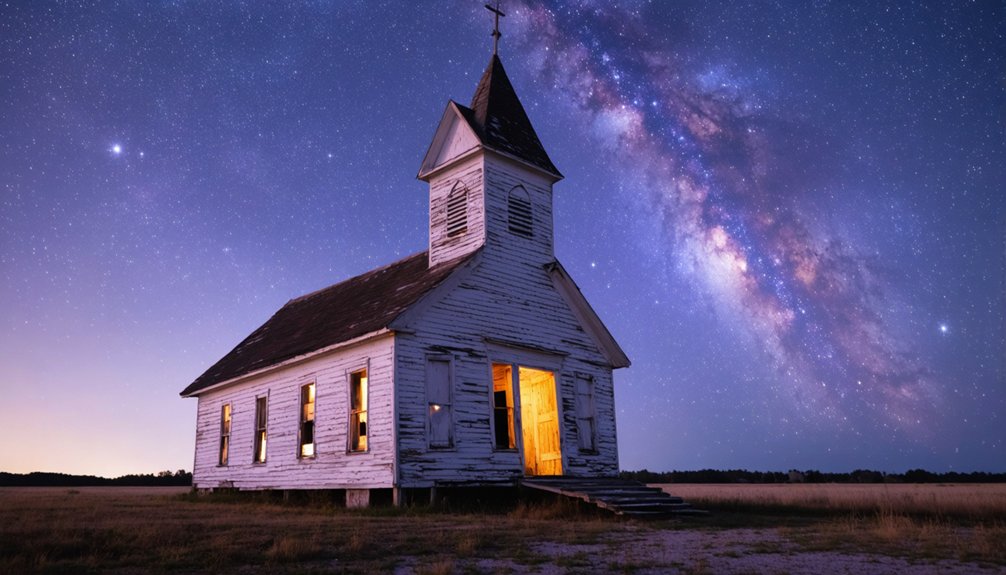
To capture compelling Milky Way compositions above ghost town structures, you’ll need to align multiple technical and astronomical factors. Successful silhouette framing requires precise timing and gear setup during the peak visibility months of May through August.
- Scout your location during daylight to identify clean structure profiles and determine ideal camera positions that’ll showcase both architecture and the galactic core.
- Time your shoot during the new moon (±3 days) when astronomical twilight ends.
- Use exposure bracketing: ISO 1600-6400 at f/2.8 for sky detail, then separate lower-exposure frames for structure.
- Focus stack your shots by combining infinity-focused sky frames with near-focused structure frames.
Remember to check local permissions before setting up near historic sites, and pack minimal lighting gear for subtle foreground illumination without overwhelming the natural starlight.
Long Exposure Techniques at Forgotten Sites
Mastering long exposure techniques at South Carolina’s forgotten sites demands precise knowledge of local Bortle scale ratings and strategic positioning.
You’ll find ideal conditions at Battle of Rivers Bridge and Francis Marion National Forest, both rated Bortle 3, enabling exposures from 30-60 seconds without star trailing.
For ghost town shoots at Ella’s Grove, stack 10-20 exposures to enhance signal-to-noise ratio while maintaining sharp detail.
Position your gear on stable ground at Pinckneyville’s rubble sites, and use forest cover at Francis Marion to block unwanted eastern light during westward shots.
At coastal locations like Hunting Island, adjust your exposure times to 2-5 minutes, accounting for maritime conditions.
Apply the Rule of 500 to calculate maximum exposure times that prevent star trails, ensuring your abandoned structure compositions remain tack-sharp against the night sky.
Obtaining Photography Permits for Protected Locations
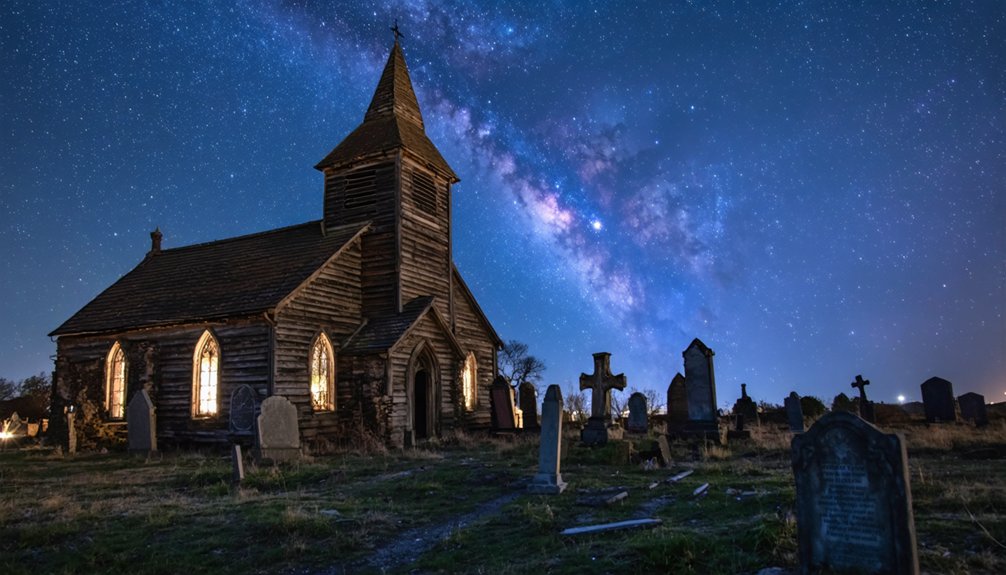
Maneuvering the permit landscape for ghost town astrophotography requires thorough research across multiple jurisdictions. Your location scouting must start with identifying property ownership and required authorizations before planning your shoot.
- Start your permit application process 14 days before shooting by determining if the site falls under city, county, state, or federal jurisdiction – each has distinct requirements.
- Secure written landowner permission for private properties, plus any municipal permits if your setup affects public areas.
- Obtain FAA Part 107 certification if you’re planning drone-based astro shots.
- Submit detailed shoot plans including timeframes, equipment lists, and crew size – most authorities require specific documentation of your intended setup and impact.
Weather Patterns and Star Visibility at Ghost Towns
Understanding South Carolina’s weather patterns proves essential for capturing pristine night sky images at ghost town locations. You’ll find ideal conditions during winter months when humidity drops and skies clear, particularly from midnight to 4 AM.
The best seasons for exploring South Carolina offer a unique combination of mild temperatures and vibrant fall foliage. During spring, the blooming azaleas and dogwoods create a picturesque backdrop for outdoor adventures. As summer approaches, the longer days provide ample opportunity to discover the state’s rich history and natural beauty.
Weather anomalies like coastal fog can challenge your shoots in lowcountry sites like Dorchester, while inland locations such as Maysville offer more reliable viewing with 110 clear nights annually.
To overcome stargazing challenges, target inland Pee Dee ghost towns during fall and winter when atmospheric transparency peaks at Bortle 3-4 levels. You’ll get your sharpest shots during new moon phases, especially in rural areas like Ella’s Grove where light pollution remains minimal.
For best results, schedule your expeditions between November and February when clear-sky probability hits 80% in protected locations.
Frequently Asked Questions
Are There Any Paranormal Photography Opportunities at These Ghost Town Sites?
You won’t find documented ghostly encounters at these sites, but Colonial Dorchester’s brick tower and Ella’s Grove’s abandoned buildings offer atmospheric long exposures that could capture interesting paranormal investigations.
Which Ghost Towns Allow Overnight Camping for Star Trail Photography?
You’ll find overnight camping sanctioned at Elkmont’s primitive grounds, with ranger-approved photography permits. Ferguson offers lakeside camping near Hide Away, while Andersonville permits boat-anchored stays for your star trail shots.
How Accurate Are the Original Town Layouts for Composition Planning?
You’ll find historical accuracy varies widely, so scout your composition during daylight. Most original layout changes mean you’ll need to verify shooting positions against both Mills Atlas and USGS quad maps.
Do Any Sites Offer Guided Night Photography Tours?
You’ll need to arrange private guides, as dedicated ghost town night photography tours aren’t widely available. Local haunted walks and paranormal groups sometimes allow tripods, but they don’t focus on astrophotography instruction.
Can Drones Be Used for Aerial Night Photography of These Locations?
You’ll need FAA registration and anti-collision lighting visible for 3 miles to fly drones at night. Most ghost town sites require property owner permission and adherence to strict drone regulations for night visibility.
References
- http://sites.rootsweb.com/~scghostn/ellenton/ellenton.htm
- https://www.randomconnections.com/ghost-towns-of-the-pee-dee-part-1-ellas-grove-and-palmer/
- https://www.onlyinyourstate.com/trip-ideas/south-carolina/haunted-road-trip-sc-ghost-towns
- https://sctravelguide.com/2018/06/11/south-carolina-ghost-towns/
- https://wnok.iheart.com/content/2023-10-11-abandoned-south-carolina-town-named-the-creepiest-ghost-town-in-the-state/
- https://www.youtube.com/watch?v=-kK74wq5NUQ
- https://www.atlasobscura.com/things-to-do/south-carolina/abandoned
- https://www.go-astronomy.com/dark-sky-parks-stargazing-state.php?State=SC
- https://en.wikipedia.org/wiki/List_of_ghost_towns_in_South_Carolina
- https://www.youtube.com/watch?v=ZnREXJL6cdo