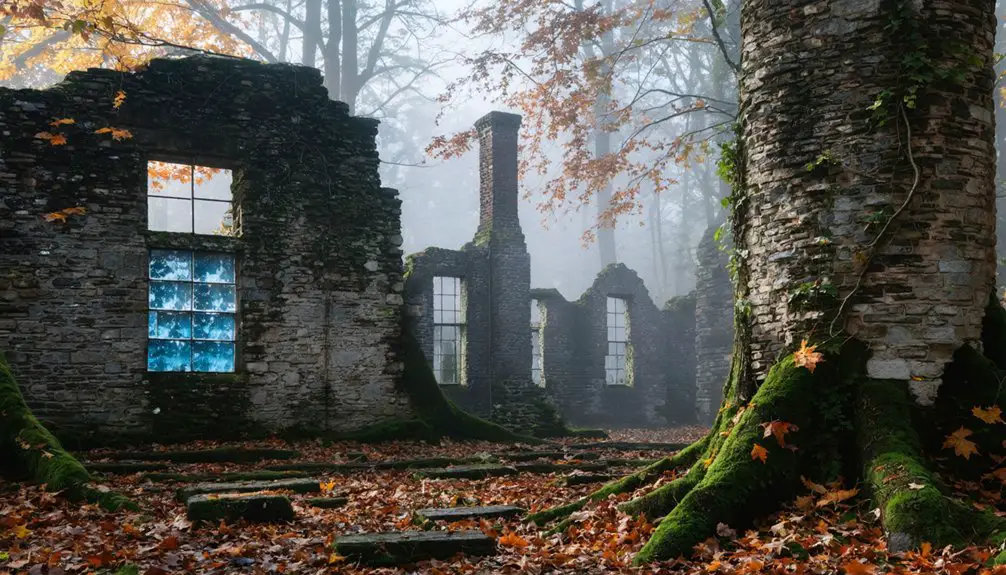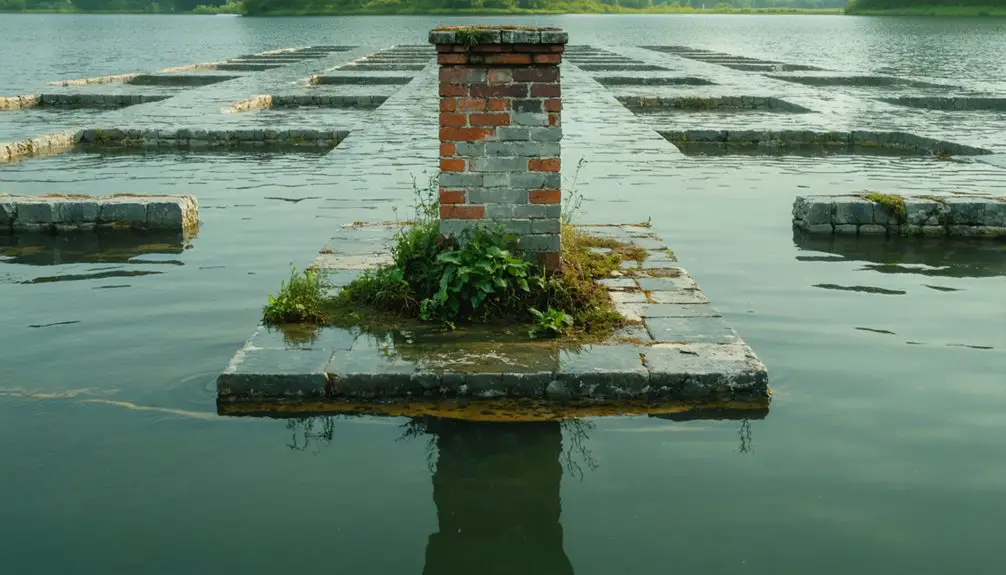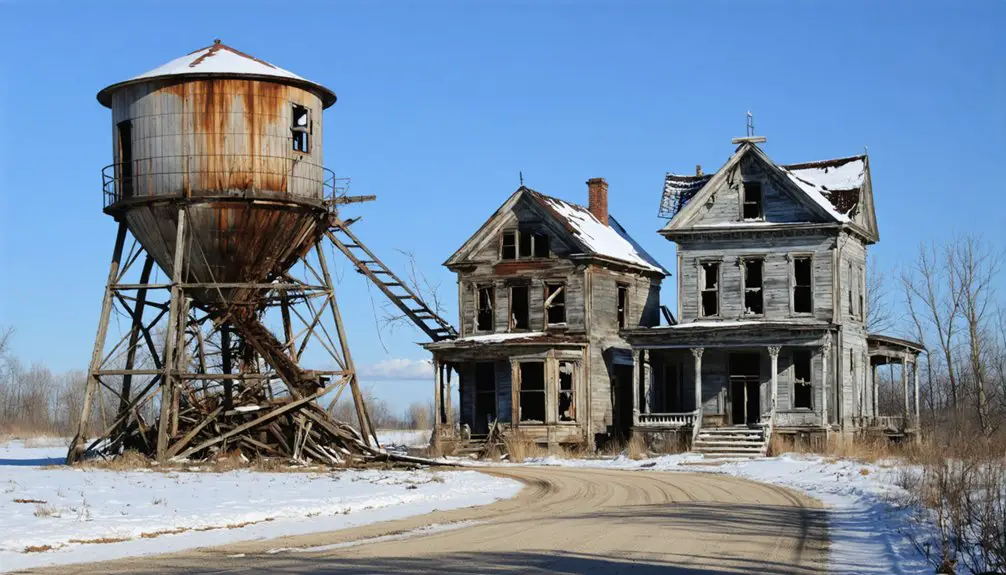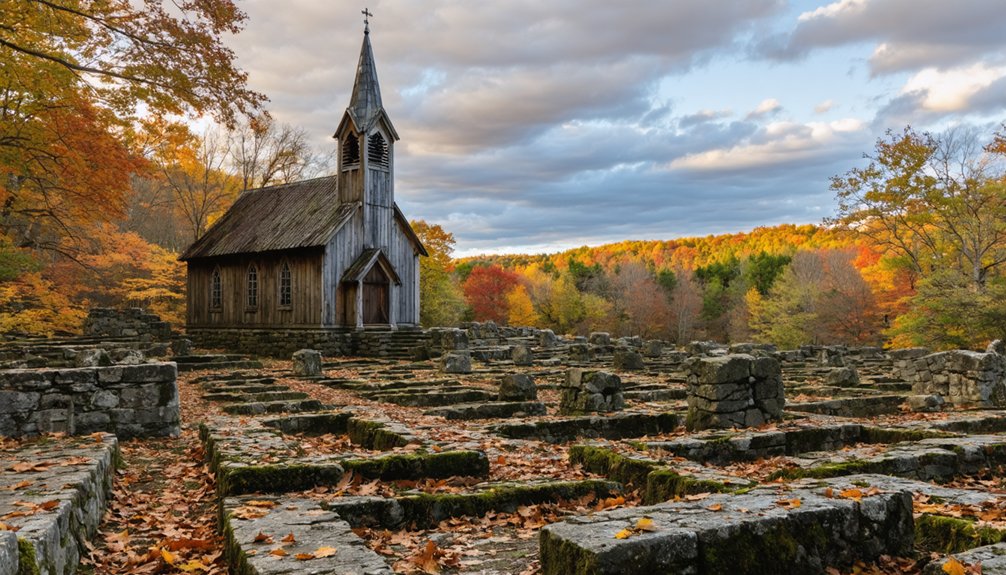
You’ll find Massachusetts’s most photogenic ghost towns at Danvers State Hospital with its gothic towers, Metropolitan State Hospital’s decaying grounds, and Fort Revere’s strategic harbor views. For ideal drone shots, visit during fall’s peak foliage (mid-September to early November) or winter’s revealing snow cover. Pack your Mavic Air 2 with multiple batteries for 20-40 minutes of flight time per location. Master exposure settings and figure-8 flight patterns to capture these haunting sites’ hidden layers of history.
Key Takeaways
- Danvers State Hospital offers exceptional gothic architecture with over 50 abandoned buildings perfect for dramatic aerial compositions.
- Metropolitan State Hospital’s decaying grounds provide extensive photography opportunities with diverse structural elements and natural reclamation.
- Fort Revere delivers strategic harbor views and historical structures, ideal for capturing both architectural details and scenic coastal landscapes.
- Belchertown State School features a sprawling abandoned campus with multiple buildings and varied angles for comprehensive drone coverage.
- Fall foliage season (mid-September to November) offers the most visually striking conditions for photographing Massachusetts ghost towns.
Uncovering Hidden History Through Aerial Photography
When exploring Massachusetts’ abandoned institutions through aerial photography, you’ll discover how drone technology reveals hidden layers of regional history.
Your aerial storytelling captures compelling perspectives of Gothic towers at Danvers State Hospital and Metropolitan State’s decaying administration building, offering fresh angles on these forgotten monuments. The sprawling campus showcases over 50 buildings that stand as silent witnesses to history.
Through your lens, historical narratives emerge from above – from Fort Revere’s colonial-era bunkers overlooking Boston Harbor to the Gilded Age opulence of Houghton Mansion. Pilots can explore these sites from the convenience of Class G airspace in surrounding areas.
You’ll document Belchertown State School’s isolated grounds and Metropolitan State Hospital’s conversion to parkland, exposing institutional legacies previously hidden from view.
Each flight reveals architectural details, strategic defensive positions, and patterns of abandonment that ground-level photography simply can’t capture, helping preserve these sites’ stories for future generations.
Essential Drone Equipment for Ghost Town Documentation
You’ll need a robust collection of high-capacity batteries to power your drones and cameras during extended ghost town shoots, including backup packs that support the 53-minute hover capabilities of enterprise drones.
Your camera setup should integrate stabilization solutions like the MeFOTO RoadTrip Classic tripod for ground shots and dual lower gimbals for aerial work, ensuring steady footage in challenging conditions.
Consider packing the Mavic Air 2 drone which excels at capturing detailed aerial imagery and creating comprehensive site maps.
Storage planning is essential for your documentation efforts, so pack sufficient memory cards to handle both the high-resolution imagery from your Sony A7 IV and the extensive 3D mapping data your drones will collect.
Consider bringing a portable EMF detector to monitor electromagnetic activity while conducting aerial surveys of abandoned structures.
Batteries and Storage Planning
Three critical aspects of battery management can make or break your ghost town drone photography session: flight time enhancement, proper storage practices, and temperature control.
You’ll need to plan for 20-40 minutes of flight time per battery, accounting for New England’s variable weather affecting performance by up to 30%. Modern drones rely on high density LiPo batteries that power their advanced motors efficiently. Always use certified chargers to ensure safe and optimal battery charging performance.
For battery maintenance, store your LiPo batteries at 30-60% charge in fireproof containers, keeping them at 40-70°F for ideal longevity.
Before heading to abandoned sites, charge batteries to 100% just before launch, and pack extras for extended shoots.
Essential storage tips include avoiding hot car trunks during summer exploration and using protective cases that shield from Massachusetts’ notorious temperature swings.
Remember to cycle your batteries every few months to maintain their 200-300 charge lifecycle potential.
Camera and Stabilization Gear
You’ll need robust stabilization gear to capture Massachusetts ghost towns effectively.
For gimbal selection, opt for a 3-axis system to achieve cinematic smoothness during panning and orbit shots around abandoned structures. Remote control capability allows precise camera adjustments while in flight. Mount your camera using proper balance across all axes, and guarantee your gimbal’s payload capacity exceeds your camera setup weight. Motor vibrations ranging up to 0.5g can impact image quality, so proper dampening is essential.
Choose wide to moderate focal lengths (12-50mm equivalent) for capturing full building contexts while minimizing vibration sensitivity. Lens stabilization should complement your gimbal – just remember to configure IS settings properly to prevent conflicting corrections.
For the best results, integrate electronic image stabilization with your mechanical stabilization system, though be mindful that EIS will crop your frame. Regular IMU calibration maintains precise control when documenting these historic sites.
Weather and Lighting Considerations for Abandoned Sites
You’ll need to carefully consider the dramatic seasonal lighting shifts that affect abandoned sites, from winter’s brief 9-hour shooting windows to summer’s extended blue-hour opportunities lasting until 11 PM.
Massachusetts’ coastal fog and inland snow present significant weather hazards that can compromise both drone stability and battery performance, particularly when temperatures drop below 32°F.
Your ideal shooting conditions will typically occur during golden hour periods, which offer 20-40 minute windows of warm, directional light that enhances architectural textures while minimizing harsh shadows across deteriorating structures. The mystique of places like the Fernald State School takes on an especially haunting quality during these moments.
Like at the Rhode Island Summer Camp, capturing ghostly atmospheres is often best achieved during chilly, overcast days when natural elements create an ethereal mood.
Seasonal Light Effects
While capturing abandoned locations presents unique photographic challenges, understanding seasonal light patterns can dramatically enhance your drone imagery of ghost towns.
You’ll find fall’s vibrant foliage creates stunning backdrops at locations like Townsend State Forest and Lowell Cemetery, while winter snow produces stark contrasts at Danvers State Hospital and Fort Revere bunkers.
Spring’s soft illumination perfectly complements the decay at Belchertown State School and Fort Taber Park’s ruins, revealing subtle textures.
During summer’s golden hour, you can capture warm tones at Pawtucket Falls or along the Squannacook River.
For consistent lighting techniques across seasonal variations, overcast conditions at Metropolitan State Hospital and Clinton Tunnel minimize harsh shadows, allowing you to focus on architectural details and weathered surfaces.
Weather Hazards When Flying
Successful drone photography at abandoned locations demands careful attention to New England’s diverse weather hazards.
You’ll need to monitor wind resistance carefully at coastal ruins like Fort Revere, where gusts from Boston Harbor can destabilize your aircraft. At quarry sites like Mineral Hills, wind tunnels between rock faces amplify drift risks, requiring precise control adjustments.
Precipitation effects pose serious challenges to your equipment. Coastal fog can reduce visibility below 1/4 mile, while rain-slicked surfaces at deteriorating hospitals increase crash risks.
Winter operations face additional hurdles – snow accumulation burdens propellers at sites like Belchertown State School, while sub-zero temperatures at locations like Houghton Mansion can slash battery life by up to 30%.
Always check local weather patterns and pack waterproof gear to protect your investment.
Legal Guidelines for Drone Operations at Historic Locations
Operating drones at historic locations requires strict adherence to a multi-layered framework of federal, state, and local regulations.
Flying drones near historic landmarks demands careful compliance with complex regulations at every government level to ensure proper operation.
You’ll need to navigate FAA restrictions, which prohibit drone flights within 400 feet of sites like the U.S.S. Constitution, and obtain necessary permits from DCR for state-managed historic properties.
Local ordinances add another layer – you’ll need written permission from property owners in places like Chicopee and Holyoke.
Before launching your drone at any historic site, you must register it with the FAA if it weighs over 0.55 pounds and complete the TRUST test.
For commercial shoots, you’ll need a Remote Pilot Certificate under Part 107.
Always check FAA maps for restricted zones and maintain flight altitudes below 400 feet.
Planning Your Ghost Town Flight Path
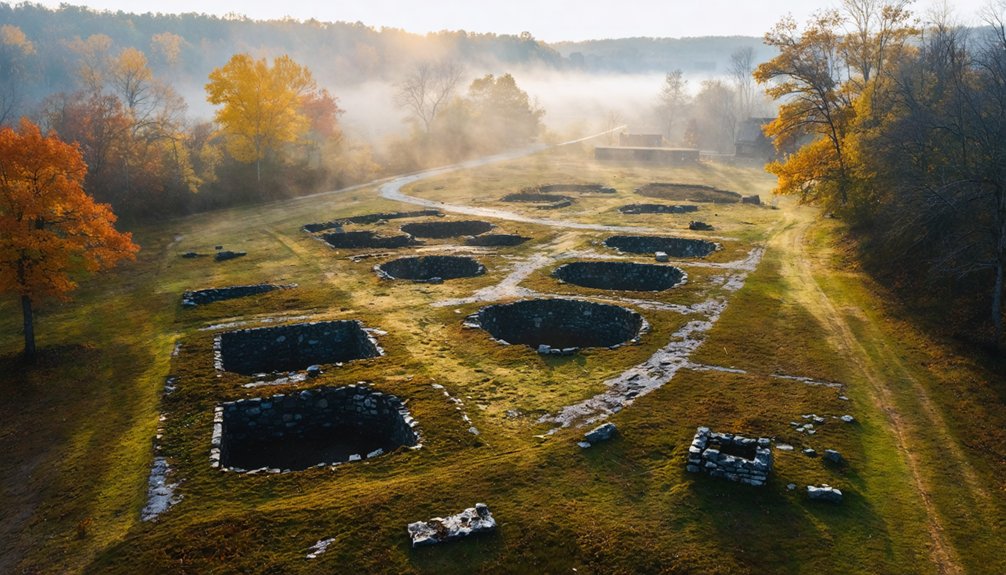
To capture compelling aerial footage of ghost towns, you’ll need methodically planned flight paths that maximize both safety and visual impact. Through flight path optimization, you can document these abandoned locations systematically while respecting site boundaries and preserving historical integrity.
Start with perimeter flights at varied altitudes – 150 to 300 feet provides ideal vantage points for contextual shots. Execute figure-8 patterns and clockwise orbits to reveal structural relationships and decay patterns.
When drone maneuvering techniques are mastered, incorporate dynamic movements like gradual descents for architectural details and low-altitude sweeps along treelines. Schedule flights during golden hour or dawn for dramatic lighting effects.
Map your routes in grid patterns for systematic coverage, and use waypoint navigation to guarantee consistent passes over key features.
Capturing Architectural Details From Above
While mastering drone flight patterns is essential, understanding how to frame and capture architectural details from above will dramatically enhance your ghost town photography.
You’ll want to fly at low-oblique angles between 15-30° to reveal dramatic architectural perspectives of abandoned buildings, focusing on roof forms and façade details. Position your drone to align key features like towers and entrances along the rule of thirds for compelling compositions.
For the sharpest architectural details, shoot in RAW at base ISO with shutter speeds of 1/1000s or faster.
Choose drone angles during golden hour when the low sunlight creates long, soft shadows that highlight ornate cornices and weathered masonry. Capture both close-up detail shots and wider contextual frames to show how individual elements connect to the overall ghostly landscape.
Massachusetts Ghost Towns Worth Exploring
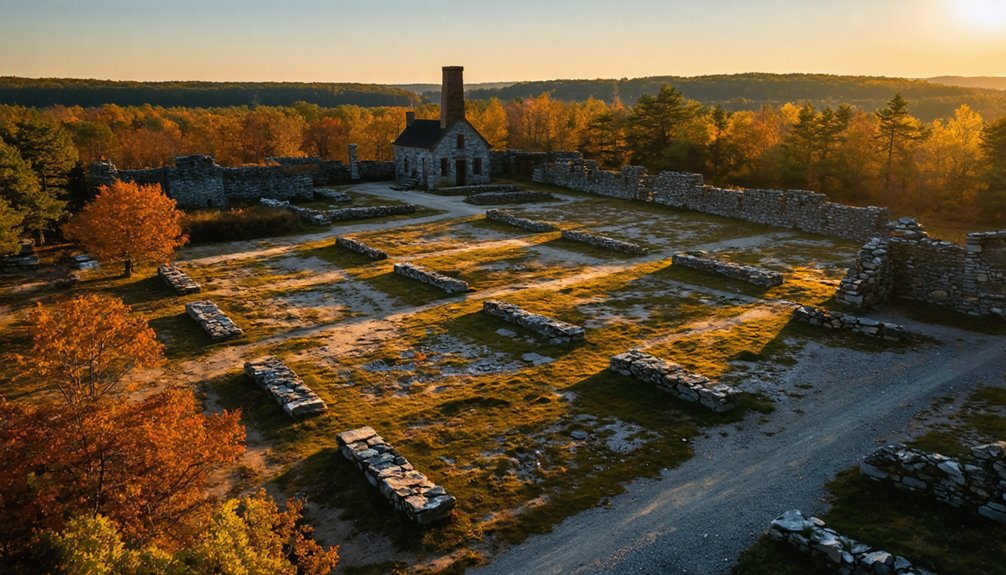
Massachusetts offers an impressive array of ghost towns perfect for aerial photography, with locations ranging from the submerged villages of Quabbin Reservoir to the historic ruins of Dogtown on Cape Ann.
Among the best ghost towns in Massachusetts, visitors can explore the remnants of the once-thriving community of Centralia, known for its haunting atmosphere. Each site tells a unique story, inviting adventurers to uncover the mysteries and history that lie within these abandoned places. From the eerie vibe to the stunning landscapes, these locations promise a captivating experience for both photographers and history enthusiasts alike.
As filmmakers have captivated audiences with tales of the supernatural, ghost towns in Massachusetts cinema have emerged as intriguing backdrops, enhancing the storytelling with their historic allure. With the haunting beauty of these deserted locations, directors often choose to showcase the poignant contrast between nature’s reclamation and human history. This fusion of cinema and real-life decay invites viewers to ponder the narratives left behind in these forgotten places.
You’ll find abandoned structures scattered across Dogtown’s 3,000-acre expanse, where cellar holes mark the remnants of a 17th-century settlement.
At Catamount State Forest, forgotten landscapes reveal the site of America’s first flag-flying schoolhouse.
The submerged towns beneath Quabbin Reservoir offer unique underwater photography opportunities, while Haywardville’s industrial ruins in Middlesex Fells provide compelling compositions against natural backdrops.
For coastal drone shots, head to Whitewash Village near Provincetown, where isolation and storms have preserved an authentic ghost town atmosphere.
Each location presents distinct challenges and rewards for aerial photographers seeking to document these historic sites.
Safety Protocols for Aerial Heritage Photography
Before launching your drone at heritage sites, you’ll need to navigate an extensive set of safety protocols that protect both historical structures and surrounding environments.
Your preflight checklist should include securing necessary permits 4-6 weeks ahead, particularly for restricted heritage areas. You’ll want to document your flight plan with GPS coordinates and maintain safe distances from historic structures for ideal drone safety.
Plan ahead by securing heritage site permits early and maintaining detailed flight documentation to ensure safe, compliant drone operations.
For heritage preservation, you must stay clear of private properties by at least 50 feet and fly at higher altitudes to minimize impact.
Scout your location beforehand, identifying obstacles like power lines or trees that could interfere with your shot. Remember to monitor weather conditions and coordinate with spotters while capturing these historic sites.
Always respect no-fly zones and be prepared with emergency procedures.
Best Seasons for Ghost Town Drone Shots
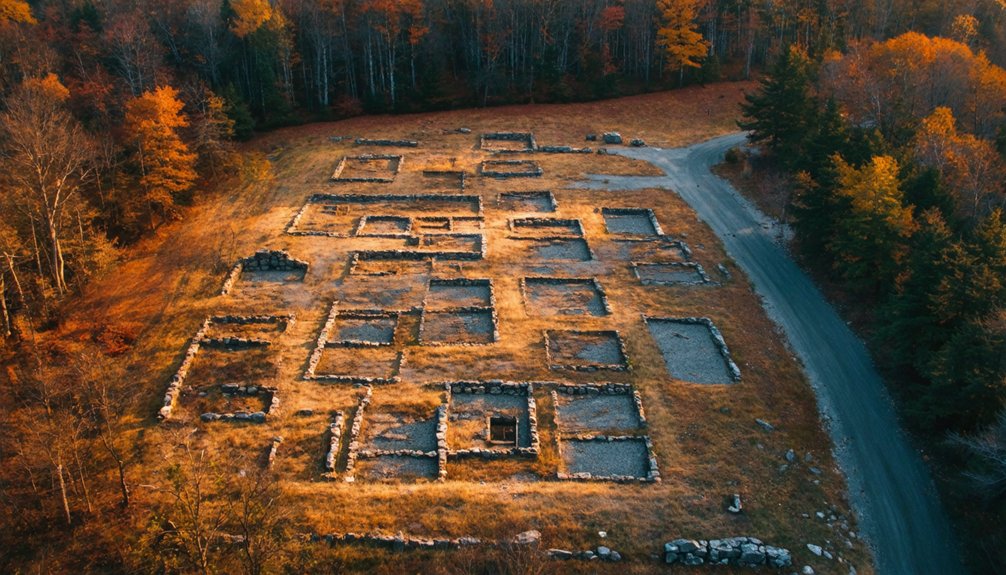
You’ll find the most striking ghost town drone compositions during fall’s peak, when vibrant oranges and reds create dramatic contrast against weathered structures and abandoned sites.
Winter strips away foliage to expose raw architectural details, offering unobstructed views of complete building footprints and forgotten infrastructure beneath pristine snow cover.
Summer’s dense greenery showcases nature’s gradual reclamation of these sites, with vines and overgrowth creating compelling visual narratives of abandonment against warm, golden light.
Fall’s Dramatic Color Contrast
During peak foliage season, ghost towns transform into vibrant canvases of red, orange, and yellow hues, creating stunning aerial compositions against weathered structures and forgotten pathways.
You’ll find your best shots between mid-September and early November, when sugar maples and birch trees reach their peak colors.
To capture vivid hues, plan your flights during early morning or late afternoon when low-angle sunlight intensifies the natural contrast.
Position your drone to frame abandoned mills and foundations against contrasting landscapes of mixed hardwoods.
On clear, cold mornings, you’ll often catch misty conditions that add depth between the canopy layers.
Choose locations with healthy foliage reports and wind speeds under 10 mph for the sharpest detail.
Consider higher elevations for telephoto perspectives that compress the colorful scenery against structural remains.
Winter’s Raw Structural Exposure
While summer foliage often obscures architectural details, winter’s bare landscape reveals ghost towns in their rawest structural form.
You’ll find enhanced winter visibility as dormant trees expose hidden rooflines, chimneys, and forgotten foundations. Snow creates dramatic contrast, helping your drone capture pristine compositions where dark structures stand boldly against white ground.
The season’s low sun angles cast long shadows that emphasize depth and dimension, while frost and ice highlight structural textures in remarkable detail.
You’ll need to master exposure settings to handle the high contrast between snow and shadowed ruins. Keep your batteries warm and monitor weather conditions closely. Launch from stable, cleared areas away from icy hazards.
With proper preparation, winter’s stripped-down aesthetic offers unmatched opportunities to document these abandoned places in their most revealing state.
Summer’s Lush Natural Overgrowth
Summer transforms ghost towns into dramatic studies of nature reclaiming civilization. You’ll find dense canopies casting intricate shadows across weathered structures, while vines like Virginia creeper create organic patterns against aged facades.
The interplay of golden-hour light through overgrown pathways reveals hidden textures in the understory, where honeysuckle and multiflora rose frame crumbling foundations.
Your drone shots will benefit from early morning mist and post-storm conditions, when saturated colors intensify the contrast between summer foliage and abandoned buildings.
Position your camera to capture the natural leading lines of broken walkways and breached rooflines filled with saplings. For maximum impact, use graduated ND filters during harsh midday light, or bracket your exposures to preserve both vibrant canopy detail and shadowed structural elements.
Preserving History Through Modern Technology
As modern drone technology reveals new perspectives of America’s abandoned places, photographers like Jason Allard are capturing essential historical documentation through their “Abandoned From Above” series.
You’ll discover how drones like the DJI Spark illuminate the historical significance of sites that might otherwise fade into obscurity, from Danvers State Hospital’s gothic architecture to Metropolitan State Hospital’s decaying grounds.
Modern preservation efforts benefit from aerial footage that contextualizes these massive properties.
You can now explore everything from Fort Revere‘s strategic harbor views to Belchertown State School‘s sprawling campus from angles previously impossible to capture.
These drone-enabled perspectives help document time capsules like Connecticut’s abandoned summer resort, where made beds and curtains remain untouched, preserving fragments of New England’s past for future generations.
Frequently Asked Questions
How Do Local Residents Feel About Drone Photography at These Abandoned Sites?
You’ll find mixed local opinions, with residents strongly opposing unannounced flights near homes and reservoirs, while showing limited support for permitted, coordinated drone photography that respects safety, privacy, and environmental community concerns.
What Wildlife Hazards Should Drone Pilots Watch for at These Locations?
You’ll need to watch for eagle and hawk attacks, deer bolting through launch zones, wasp nests in ruins, and ticks in tall grass during your wildlife encounters and hazard identification.
Are There Paranormal Investigation Groups That Conduct Drone Surveys Here?
You’ll find limited documented cases of paranormal groups using drones, though some investigators follow drone regulations while seeking paranormal sightings at Danvers State Hospital, Houghton Mansion, and Fort Revere.
Which Ghost Towns Offer the Best Night Photography Opportunities?
Like stars frozen in time, Dogtown’s granite cairns offer you perfect nighttime lighting conditions. You’ll get clean long exposures at ISO 800-1600, while Whitewash Village’s coastal ruins create stunning waterfront reflections.
How Have Seasonal Floods Affected Access to These Abandoned Locations?
You’ll find seasonal access severely restricted by river overflows at Danvers and Metropolitan, while Belchertown’s flood impact peaks during spring thaws. Fort Revere’s coastal location faces constant tidal challenges.
References
- https://thedronelifenj.com/top-7-best-places-to-fly-a-drone-in-massachusetts/
- https://www.birdlike.com/elevate-your-perspective-birdlike-blog/top-10-abandoned-places-to-explore-in-massachusetts-for-drone-photography
- https://www.youtube.com/watch?v=7X7TXuB8Pk4
- https://www.atlasobscura.com/things-to-do/massachusetts/abandoned
- https://www.youtube.com/watch?v=MmKyEc9aHJ0
- https://www.cbsnews.com/boston/news/jason-allard-abandoned-from-above-aerial-drone-camera-video-new-england-wbz-tv/
- https://www.golocalprov.com/lifestyle/new-drone-footage-shows-abandoned-historic-barrington-estate
- https://www.lemon8-app.com/@rustbeltfrights/7224457550287421958?region=us
- https://www.youtube.com/watch?v=866D41fnbss
- https://advexure.com/pages/environmental-compliance-reclamation-surveys-drones