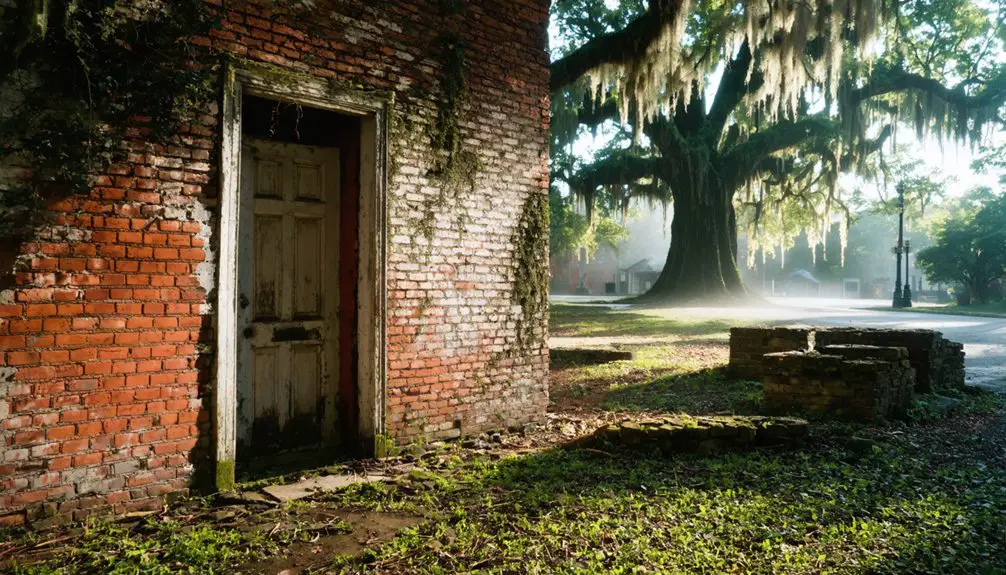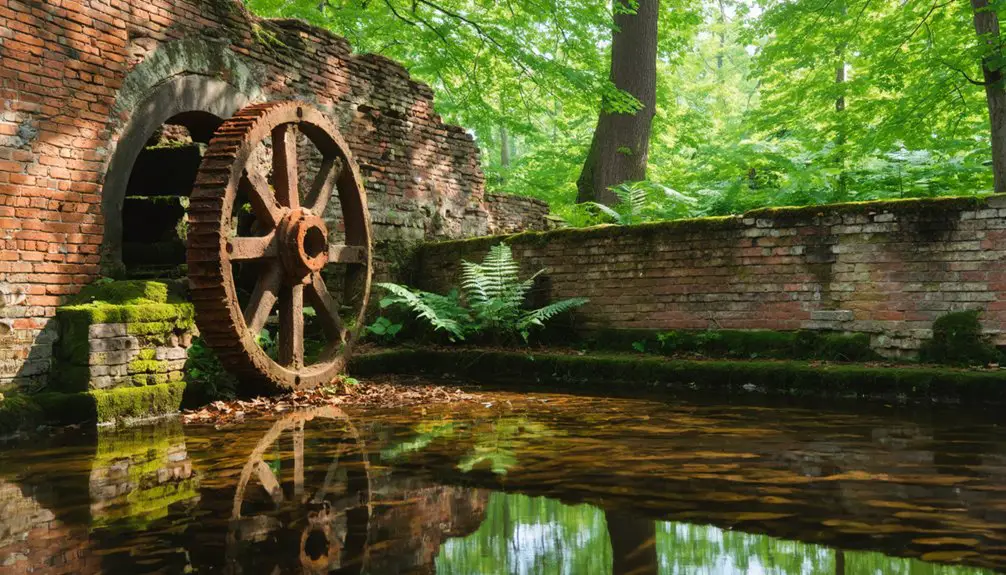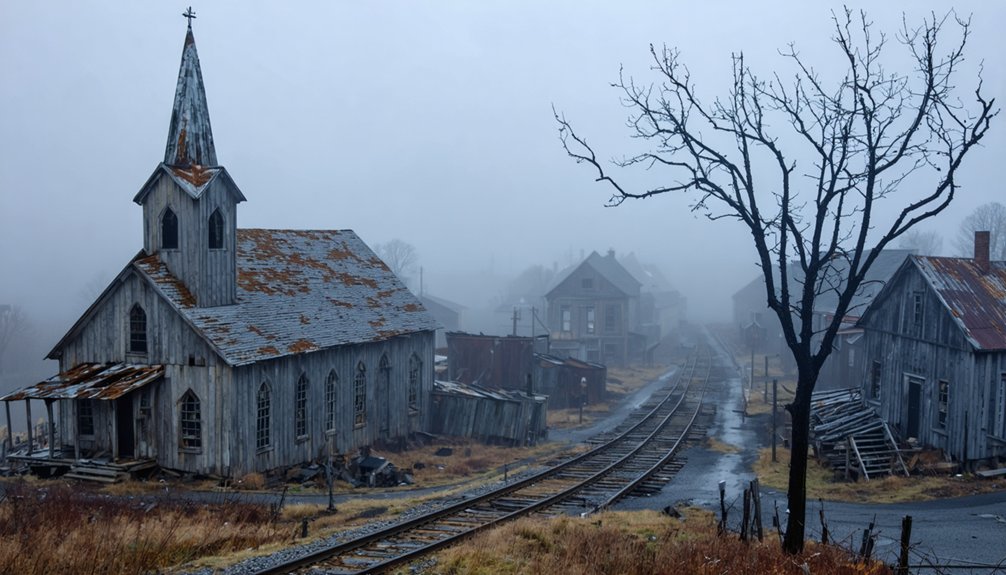
You’ll find Virginia’s most photogenic ghost towns scattered across diverse landscapes, from coastal ruins to mountain hollows. Pamplin City offers intact ironwork storefronts and an abandoned pipe factory, while Elko Tract reveals the fascinating geometry of a WWII decoy airfield. Union Level showcases eight abandoned storefronts along the Southern Railroad, and historic sites like Old Colchester blend maritime heritage with natural reclamation. Let these haunting locations guide your journey through Virginia’s forgotten chapters.
Key Takeaways
- Pamplin City offers exceptional drone photography opportunities with its well-preserved ironwork storefronts and abandoned pipe factory along Main Street.
- Elko Tract’s mysterious WWII decoy airfield provides unique geometric patterns and historical significance perfect for aerial captures.
- Union Level’s eight abandoned storefronts along Southern Railroad create compelling linear compositions for drone photography.
- Coastal ghost towns like Old Colchester combine maritime history with natural reclamation, offering diverse visual narratives.
- Boydton’s vertical landmarks, including its historic water tower, provide striking architectural elements for dramatic aerial shots.
What Makes Virginia’s Ghost Towns Perfect for Aerial Photography
While many ghost towns across America offer glimpses into the past, Virginia’s abandoned communities present a uniquely compelling canvas for aerial photographers.
From Pamplin City’s intact ironwork storefronts to Elko Tract’s mysterious WWII decoy airfield, you’ll discover abandoned beauty that’s best captured from above.
The state’s ghost towns feature distinctive architectural patterns that create striking aerial perspectives. You can capture the contrast between Pamplin’s weathered main street storefronts and surrounding wilderness, or document the haunting geometry of Union Level’s corner structures. The town’s historic status as a major producer of clay tobacco pipes adds intrigue to aerial compositions. Drone pilots should note that these areas typically fall within Class G airspace, making them easily accessible for photography.
With spacious launch sites like Forest Hill Park and Bryan Park nearby, you’ll find unrestricted access to these forgotten places. The varied textures of rust, overgrowth, and vintage signage tell rich visual stories of economic shifts and the passage of time.
Essential Drone Equipment and Settings for Ghost Town Photography
For ghost town photography, you’ll want a drone with at least a 1/2.3″ sensor and 3-axis stabilization to capture both the subtle textures of weathered buildings and smooth cinematic movements through abandoned streets.
Your kit should include multiple batteries for extended flight time, along with ND filters to maintain proper exposure as you shift between bright desert conditions and shadowy interiors. The DJI Air 2S offers excellent capabilities for capturing abandoned locations in stunning 4K resolution.
Planning your flight paths with careful attention to obstacles like unstable structures and overhead wires, while maintaining appropriate return-to-home altitudes, will help you safely document these historic sites from compelling aerial perspectives. As demonstrated in drone video footage of places like Zhejiang Houtouwan, aerial photography can dramatically showcase how nature reclaims abandoned architecture.
Camera and Gimbal Setup
As you prepare to capture the haunting beauty of abandoned ghost towns from above, selecting the right camera and configuring proper gimbal settings becomes essential for professional-quality results.
Similar to photographing the 20,000 historic mines that once dotted Colorado’s landscape, drone photography requires careful attention to detail and positioning. Choose a camera with a full-frame or 1″-type sensor for ideal dynamic range, allowing you to capture both bright skies and shadowy ruins in a single frame. For optimal image quality in varying light conditions, maintain ISO between 100-400 to minimize noise while preserving detail. Shoot in RAW format with at least 20MP resolution to preserve detail for large prints and creative cropping.
Set your gimbal pitch smoothness to low for cinematic reveals, and limit the tilt range to 30° to avoid propeller interference.
Enable both mechanical and electronic stabilization to combat micro-vibrations, especially in gusty conditions. For the smoothest footage, tune your gimbal’s damping settings according to manufacturer specifications, particularly when maneuvering close to weathered structures where air turbulence can affect stability.
Flight Planning Essentials
Before venturing into remote ghost towns with your drone, you’ll need a thorough equipment loadout to confirm successful aerial photography sessions.
Pack multiple high-capacity flight batteries to guarantee you’ve got 2-3 times your expected flight duration, allowing for creative exploration of these historic sites. Don’t forget your charging hub and portable power station for extended shoots. Using a Two-Way Charging Hub lets you efficiently charge multiple batteries simultaneously while in the field.
Your pre-flight checklist should include verifying local flight regulations through FAA-compliant apps and caching offline maps of the area. A Part 107 certification is legally required for any commercial drone photography of ghost towns.
Bring essential repair tools, including spare props and mounting hardware – you don’t want a minor mechanical issue cutting your shoot short. Proper battery management is vital: monitor levels closely and plan to land with 20-30% remaining.
Set conservative return-to-home altitudes above the tallest structures, and always use a spotter when maneuvering around abandoned buildings.
Top Ghost Town Locations Across Virginia
You’ll discover Virginia’s most enchanting ghost towns scattered across diverse landscapes, from Pamplin City’s iron-front ruins to Union Level’s vintage storefronts frozen in time.
The mysterious Elko Tract stands as a symbol of WWII ingenuity, with its deliberately constructed decoy town designed to protect Richmond from enemy attacks. Local families were forced to relocate when the government seized their land to build this secret wartime project.
Whether you’re drawn to accessible urban ruins like those in the Richmond area or seeking coastal abandonment along Virginia Beach’s shores, each location offers unique perspectives for aerial documentation of history’s remnants. Union Level’s eight abandoned storefronts along the Southern Railroad create a compelling sight as Virginia’s most photographed ghost town.
Accessible Urban Ruins
You’ll find some of Virginia’s most enchanting urban ruins hiding in plain sight. Union Level stands out as the crown jewel for drone photographers, with its remarkably preserved Main Street facades offering perfect symmetry for aerial compositions.
The CP Jones drugstore and Bank of Union Level create stunning leading lines that’ll make your footage pop.
Head to Pamplin City for a grittier urban exploration experience, where ironwork storefronts and an abandoned pipe factory merge into a haunting industrial landscape.
In Boydton, you’ll discover vertical landmarks perfect for dramatic drone panoramas, including a historic water tower and vintage rail artifacts.
These locations offer incredible opportunities for historical preservation through photography, but remember to maintain safe distances and secure proper permissions before launching your drone.
Coastal Ghost Sites
Virginia’s coastal ghost towns offer a hauntingly beautiful mix of maritime history and natural reclamation.
At Wash Woods in False Cape State Park, you’ll discover a lone church steeple and weathered headstones rising from the dunes – remnants of a once-thriving community of 300 residents.
The abandoned port of Old Colchester along Occoquan Creek reveals buried foundations and forgotten wharves where tobacco ships once docked.
Along the York River, the lost settlements of Lackey and Magruder showcase coastal ruins slowly returning to nature.
These historical landscapes tell stories through their remaining traces: overgrown roadbeds, scattered timbers, and foundation stones.
From above, drone photography captures the dramatic interplay between marsh, forest, and forgotten civilization, revealing how time and tide reshape Virginia’s coastal communities.
Remote Historical Settlements
While many ghost towns fade into obscurity, Virginia’s remote historical settlements offer drone photographers an extraordinary canvas of abandoned architecture and forgotten stories.
You’ll find compelling subjects at Pamplin City, where decaying Main Street facades and industrial remnants create dramatic leading lines for aerial compositions.
Union Level’s vintage storefronts and cultural landmarks tell rich historical narratives through your drone’s lens.
For a unique perspective, explore the WWII-era Elko Tract, where geometric patterns of the decoy airfield reveal fascinating wartime deception.
At Rosewell Plantation ruins, you can capture haunting aerial views of exposed courtyards and formal gardens among the abandoned structures.
These sites preserve Virginia’s past while providing remarkable opportunities for creative drone photography.
Best Times and Seasons for Ghost Town Drone Shots
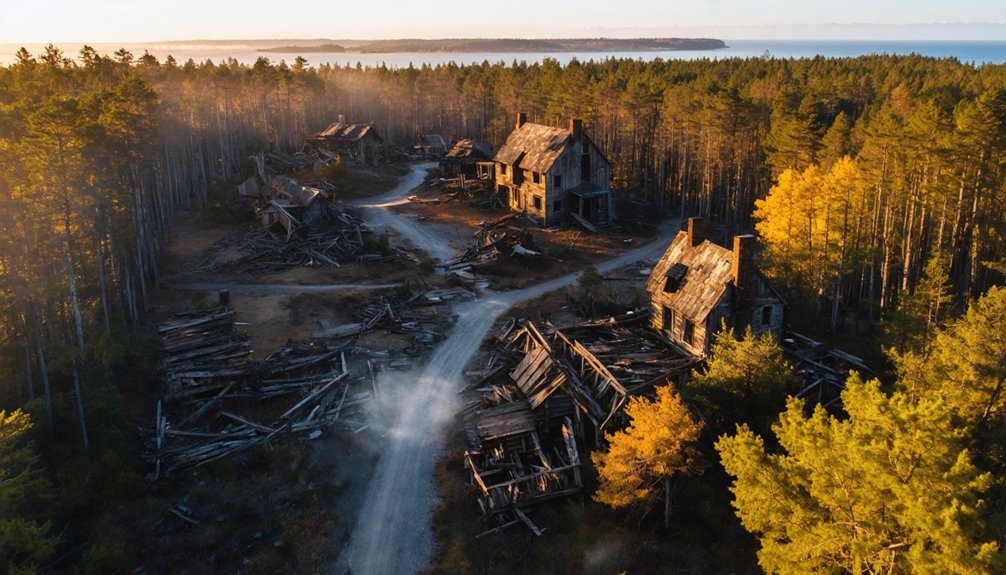
To capture the ethereal beauty of ghost towns through your drone’s lens, timing is everything.
You’ll want to catch the golden hour, either at sunrise when the soft light reveals intricate textures and backlit mountain views, or during sunset when dramatic shadows play across abandoned structures.
Fall delivers the most enchanting shots, as autumn foliage creates stunning contrasts against weathered buildings.
October’s cooler temperatures improve drone flight conditions, while seasonal shifts bring shorter operating hours from 9am-3pm between November and May.
For the most atmospheric footage, arrive 30 minutes before sunrise when the western ridges catch first light.
Clear, calm days around 65°F provide ideal conditions for stable drone flights and rich earth tones against desert-like landscapes.
Legal Requirements and Access Restrictions
Before launching your drone to capture those perfect golden hour shots, you’ll need to navigate a complex web of regulations that govern aerial photography in ghost towns. Your first step is completing the FAA’s TRUST test and registering any drone over 0.55 pounds.
Remember to keep your aircraft under 400 feet and within visual line-of-sight.
Since many ghost towns are on state parkland, you’ll need a special DCR permit, which is typically reserved for commercial or research purposes.
Be mindful of privacy concerns – capturing identifiable images without consent or flying within 50 feet of inhabited structures could land you a misdemeanor charge.
If the ghost town is in controlled airspace, you’ll need prior FAA authorization through LAANC.
Local ordinances may also require additional permits, especially for commercial photography.
Capturing Historic Architecture From Above
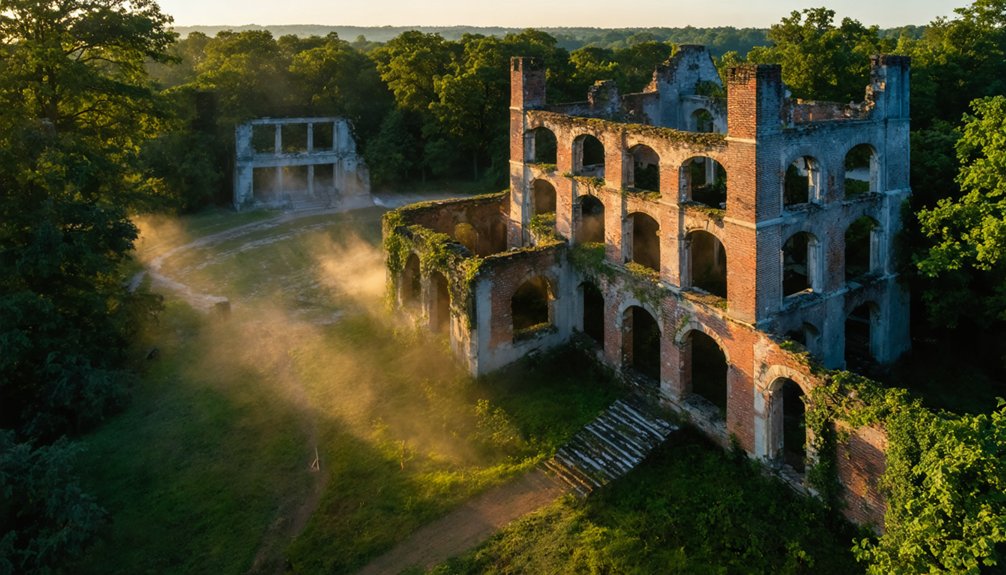
Since abandoned buildings tell their richest stories from above, capturing ghost town architecture through drone photography reveals intricate historical patterns that aren’t visible from ground level.
You’ll discover the architectural styles of Virginia’s past through Mesker-style cast-iron storefronts in Pamplin City and the dramatic ruins of Rosewell Plantation. The historical significance of these sites comes alive when you time your flights for ideal lighting conditions.
- Shoot during golden hour to capture deep shadows that highlight ornate cornices and pilasters
- Plan winter flights when bare trees reveal hidden building foundations and forgotten rail lines
- Combine low-altitude passes (30-60m) for facade details with high-altitude shots (100-120m) for full site context
Focus on industrial features like millraces and loading bays – they’ll tell you exactly how these towns once functioned.
Advanced Aerial Techniques for Abandoned Sites
When photographing ghost towns from above, you’ll need a complete pre-flight setup that includes backup batteries, propellers, and safety equipment to navigate deteriorating structures safely.
Your flight patterns should follow methodical paths—low, slow tracking shots along facades, spiral sequences around focal points like water towers, and careful vertical descents over open roofs that reveal interior spaces.
The harsh desert sun and unpredictable weather at abandoned sites demand careful timing: schedule your flights during golden hour for dramatic shadows, or on overcast days when diffused light helps capture the subtle textures of weathered wood and rusty metal.
Gear Setup and Safety
To master aerial photography in ghost towns, you’ll need specialized gear and safety protocols that go far beyond standard drone operations. Your drone safety depends on having redundant systems and thorough pre-flight checks when exploring these remote sites.
Always carry advanced obstacle-sensing drones equipped with HDR cameras and neutral density filters to handle the stark contrasts between sunlit ruins and shadowy interiors.
- Maintain 30% battery reserve for emergency maneuvers and signal loss recoveries
- Perform RF sweeps to map interference sources before launching
- Pack essential gear: first aid kit, backup controllers, and site safety equipment
Remember to document all flight paths and maintain visual line-of-sight while capturing Virginia’s forgotten places.
Your gear maintenance routine should include regular compass calibrations and sensor checks to handle the unique challenges of flying near metal-rich industrial ruins.
Optimal Flight Patterns
Mastering ghost town drone photography requires strategic flight patterns that bring decay and abandonment to life through the lens. You’ll want to start with circular orbits at 50-100 feet, capturing the haunting layouts of these forgotten places.
For the most dramatic aerial photography, execute variable altitude spirals descending from 200 feet – this technique reveals the layered progression of time’s toll on these historic structures.
During golden hour, employ slow descent patterns to balance exposure in shadowy ruins, while zigzag flights parallel to building facades isolate architectural details that tell the story of abandonment.
For ghost town exploration safety, always begin with high-altitude reconnaissance scans to identify hazards like exposed rebar or unstable structures. Remember to maintain backup waypoint circuits for quick retreats if conditions become unsafe.
Light and Weather Planning
The interplay of light and weather transforms ghost town drone photography from simple documentation into haunting visual poetry. Master light positioning during Virginia’s fickle weather patterns by timing your shoots during stable, low-wind periods when golden hour bathes abandoned structures in warm light.
For dramatic atmospheric effects, embrace the region’s frequent morning valley fog to create ethereal compositions that reveal hidden layers of history.
- Use directional drone-mounted LEDs at 2700-3500K during golden hour to highlight weathered textures and architectural details
- Exploit overcast conditions as natural diffusers, making it easier to blend ambient light with drone illumination
- Plan multiple passes with precise light positions recorded for seamless multi-layer compositing
Remember to monitor local microclimates, especially in mountain ghost towns where conditions can shift rapidly, affecting both flight performance and exposure settings.
Weather Considerations and Flight Planning
Whether you’re capturing haunting imagery of Pamplin City’s weathered storefronts or surveying Wash Woods’ coastal ruins, Virginia’s diverse weather patterns demand careful flight planning for drone photography.
Flight conditions vary dramatically across the state, with coastal areas facing 12-18 mph sea breezes and inland sites battling afternoon thermals up to 15 mph.
Spring offers your best window for ghost town exploration, with calm winds under 10 mph and comfortable temperatures between 50-70°F.
You’ll want to avoid summer midday heat that cuts flight times to 15-20 minutes per battery. Seasonal impacts are most severe during hurricane season, when winds can exceed 30 mph.
For ideal results, launch before 10 AM to dodge turbulence, and always check NOAA forecasts targeting wind speeds below 15 mph.
Post-Processing Tips for Ghost Town Footage
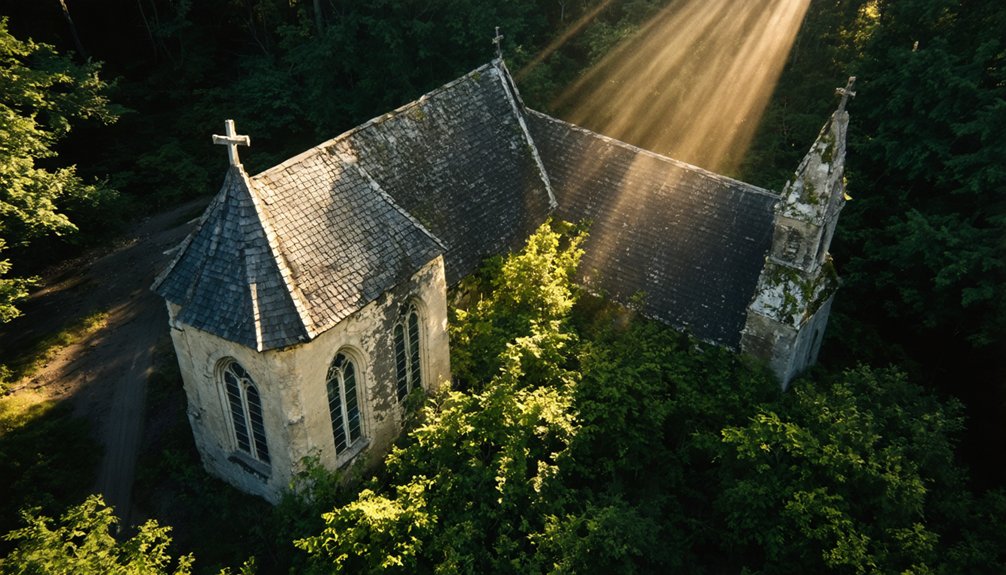
Successful ghost town drone footage emerges in post-processing, where you’ll transform raw aerial captures into compelling visual narratives.
Start by defining your mood – whether you’re aiming for a haunting documentary feel or a cinematic aesthetic. Your color grading choices, from desaturated warm tones for nostalgia to cool blues for abandonment, will shape the emotional impact of each scene.
Color sets the emotional foundation – warm tones evoke nostalgic memories while cool hues paint a picture of desolate abandonment.
- Use RAW files to maximize shadow recovery in dark building interiors while preserving bright sky detail.
- Apply selective detail enhancement to bring out weathered textures in wood and stone without over-sharpening.
- Add subtle film grain and split-toning to create an aged, period-appropriate look.
Consider using HDR techniques for high-contrast scenes, ensuring you capture both the mysterious shadows within structures and the dramatic Virginia skies above them.
Safety Protocols for Photographing Ruins by Drone
Beyond mastering post-processing techniques, safe drone operation around abandoned structures demands careful preparation and strict adherence to protocols.
When photographing Virginia’s ghost towns, you’ll need to conduct thorough pre-flight checks, paying special attention to GPS signal strength around metal ruins and unstable structures. Always maintain visual line of sight with your drone while staying below 400 feet.
Before launching, scout the location for hazards like protruding beams, partially collapsed walls, and overhead power lines.
You’re responsible for following drone regulations that protect both historic sites and wildlife habitats. Keep your distance from nesting areas and respect any “No Drone Zone” signage.
These safety guidelines aren’t just about legal compliance – they’re essential for preserving these atmospheric ruins for future explorers while capturing compelling footage.
Frequently Asked Questions
How Do You Handle Encounters With Other Photographers or Urban Explorers?
You’ll maintain proper encounter etiquette by introducing yourself, sharing flight plans, and suggesting photographer collaboration through alternating time slots. Stay friendly but firm about your permitted shooting schedule.
What Insurance Coverage Do I Need for Ghost Town Drone Photography?
With 85% of commercial drone claims involving property damage, you’ll need $1M-$5M in liability coverage plus hull insurance to protect your equipment and shield against accidents at abandoned locations.
Are There Ghost Hunting or Paranormal Groups I Should Coordinate With?
You won’t find dedicated ghost hunting groups at Virginia’s abandoned towns. Instead, focus on historical walking tours and photography meetups, since paranormal tours aren’t actively organized at Union Level or Pamplin City.
Exploring the best ghost towns for photography in Virginia can lead to some stunning and eerie captures that showcase the beauty of decay. Don’t forget to visit places like St. Paul and the remnants of Luray, where the juxtaposition of nature and forgotten structures creates a hauntingly picturesque scene. Whether you are a seasoned photographer or a casual snapshot enthusiast, these locations offer endless opportunities for captivating images.
Venturing deeper into the state reveals a treasure trove of historic movie settings in Virginia that bring cinematic history to life. Locations such as Monticello and the stunning landscapes of Shenandoah National Park have served as backdrops for numerous films, allowing visitors to walk in the footsteps of beloved characters. Capture these iconic sites and experience the stories they tell, merging the charm of Virginia’s history with the magic of the movies.
How Do You Document Historical Artifacts Discovered During Drone Flights?
Like unearthing time capsules, you’ll need to log GPS coordinates, capture geotagged photos with scale references, maintain detailed notes about artifact preservation, and report findings to proper authorities for historical significance documentation.
Which Ghost Towns Have Cellular Coverage for Drone Control Apps?
You’ll find reliable cellular signals for drone control in Wash Woods, Matildaville, and Lignite – all within range of metro coverage zones. Avoid western ruins near the WV border where regulations and spotty service limit flights.
References
- https://icatchshadows.com/photographing-the-abandoned-ghost-town-of-pamplin-virginia/
- https://www.youtube.com/watch?v=moYHlyQexj4
- https://thedronelifenj.com/places-to-fly-a-drone-in-virginia/
- https://www.youtube.com/watch?v=P906DPA_czw
- https://www.onlyinyourstate.com/experiences/virginia/vacant-ghost-town-va
- https://northernvirginiamag.com/67-advantures-ghost-towns-of-virginia/
- https://www.atlasobscura.com/places/wash-woods-settlement
- https://www.youtube.com/watch?v=W8XDq-bllj8
- https://nvtami.com/2021/10/18/virginia-city-less-known/
- https://www.youtube.com/watch?v=ULEkuLQ6v9Y