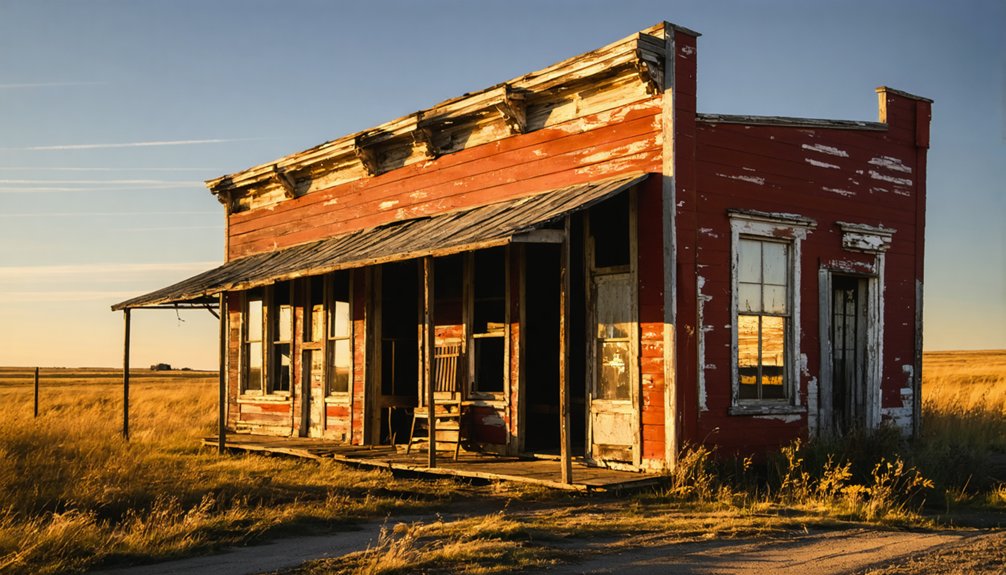
You’ll find fascinating ghost towns scattered across Iowa, from Buckhorn’s abandoned dairy empire to Carrollton’s railroad-bypassed ruins. The state’s most haunting sites include Sunbury’s historic dance hall, which operated until 1964, and Stiles’ mysterious structures where paranormal encounters are reported near the original settlers’ cemetery. Many of these forgotten communities, shaped by natural disasters and economic shifts, preserve compelling stories of ambition and decline in their weathered remains.
Key Takeaways
- Buckhorn features a historic cemetery, abandoned church, and deteriorating creamery building that produced 34 million pounds of butter until 1952.
- Carrollton, established in 1856 as Carroll County’s first county seat, declined after being bypassed by the railroad in 1866.
- Stiles, established in 1840, offers preserved structures and a cemetery of original settlers, with reported ghostly encounters.
- Sunbury showcases remnants of its railroad town past, including the site of a historic dance hall that operated until 1964.
- Elkport was completely abandoned after catastrophic flooding in 2004, leaving behind a pristine example of a modern ghost town.
The Eerie Remains of Buckhorn’s Dairy Legacy
Once home to the bustling Farmers Union Cooperative Creamery that produced over 34 million pounds of butter between 1899 and 1952, Buckhorn now stands as a haunting reminder of Iowa’s dairy farming past. Located near Highway 64, the site features a cemetery, abandoned church, and the deteriorating creamery building.
Carrollton: A Tale of Railroad Displacement
The pioneering settlement of Carrollton marked Carroll County’s first county seat in 1856, flourishing briefly as the region’s administrative center.
You’ll find its early development included a $3,000 courthouse, the county’s first school under Jane L. Hill, and a post office established in 1857.
But Carrollton’s destiny changed forever when the Chicago and Northwestern Railroad bypassed the town in 1866.
Instead, they established Carroll City, drawing the county seat away in 1869.
The railroad’s establishment of Carroll City proved decisive, as it lured away Carrollton’s cherished status as county seat.
While Carrollton struggled with Civil War disruptions and isolation, the railroad’s strategic placement of new towns sealed its fate.
You can trace the settlement’s decline as the Western Town Lot Company systematically developed rail-adjacent communities, leaving Carrollton to fade into Iowa’s landscape of forgotten places.
By the early 1900s, the town had dwindled to a population of just 45 residents, though the surrounding township maintained around 300 people.
When a devastating fire struck in 1886, the original courthouse burned, though fortunately its vital records remained protected in the building’s vaults.
Dancing Through Time: Sunbury’s Forgotten Streets
While railroad expansion swept across Iowa in the late 19th century, Sunbury emerged as a promising settlement in Cedar County’s southeastern region.
You’ll find its story marked by dramatic population swings, from just 13 residents in 1902 to 107 by 1925, before declining to 60 in 1940.
The town’s beating heart was its dance hall, operating from 1895 to 1964, where generations of locals gathered for nearly seven decades of rural entertainment.
The famed dance venue became a cornerstone of social life, drawing visitors from surrounding communities until its closure.
The Sunbury Savings Bank, established in 1901, stood as another pillar of the community until its eventual demolition in 2014.
Today, as you explore the intersection of County Roads F44 and Y26, you’ll discover a landscape rich with rural nostalgia, where abandoned structures whisper tales of a once-thriving railroad town.
The town’s decline began gradually as economic growth stalled, leaving behind scattered remnants of its vibrant past.
The Lost Settlement of Stiles
Nestled in Davis County’s rolling countryside, Stiles emerged as a promising settlement in 1840 under the namesake of Kernel Stiles S. Carpenter, the county’s first prosecuting attorney.
You’ll find this historic ghost town at the intersection of Peach Avenue and 233rd Street, where remnants of its vibrant past still stand.
The Stiles history showcases a once-thriving community with a population of 100 residents by 1858.
The general store, which operated for 91 years until 1943, served as the town’s heartbeat. The school building, relocated in 1870, educated 45 students and hosted community gatherings. A tragic devastating fire in 1903 marked a turning point in the town’s decline.
Today, ghostly encounters are frequently reported around the preserved store, post office, and cemetery, where original settlers rest. The town’s website requires JavaScript enabled for virtual tour access.
The Lister family maintains these historic structures, keeping the town’s legacy alive despite its evolution into one of Iowa’s most intriguing ghost towns.
Paranormal Encounters at the Villisca House
Since its tragic events of June 1912, Villisca Axe Murder House has emerged as one of America’s most haunted locations, drawing paranormal investigators and curious visitors from across the globe.
You’ll encounter ghostly whispers of children echoing from the attic where the killer allegedly waited, and spectral shadows that drift through the carefully restored rooms. Darwin and Martha Linn restored the house to preserve its historical integrity in the 1990s.
When the town’s train passes, witnesses report an inexplicable fog that moves between spaces – a phenomenon linked to the night of the murders.
The house, available for overnight stays, features electromagnetic disturbances detected by REM pods and unexplained object movements. Visitors can book the haunted experience for up to six people at a time.
While touring the property, you’ll find all details preserved as they were that fateful night, from the covered mirrors to the ax mark suggesting a left-handed killer.
Haunted History at the Squirrel Cage
The haunting legacy of Iowa’s ghost towns extends beyond Villisca to Council Bluffs’ infamous Squirrel Cage Jail, built in 1885 as the Pottawattamie County Jail.
Built in 1885, Council Bluffs’ historic Squirrel Cage Jail stands as a haunting reminder of Iowa’s ghostly past.
This innovative three-story rotary structure, with its Victorian gothic facade, holds more than just its unique architectural history – it’s also home to numerous ghostly encounters that have persisted for over a century.
You’ll find the jail’s haunted history traces back to its construction on a former church morgue site.
From the early 1900s through the 1950s, staff reported mysterious footsteps echoing through empty halls, doors opening by themselves, and unexplained whispers.
Even the jail’s fourth-floor apartment proved too unsettling for the jailer, who relocated to escape the inexplicable noises.
Today, it’s recognized as Council Bluffs’ most haunted attraction.
Preserving Iowa’s Abandoned Past
You’ll find meticulous historical records of Iowa’s ghost towns preserved through county museums, archaeological digs, and interactive mapping projects.
Local preservation commissions have documented everything from pottery shards to pioneer foundations, while marking significant sites like the Underground Railroad waypoints and flood-displaced communities.
The systematic archiving of photographs, personal accounts, and physical artifacts guarantees that these abandoned settlements won’t fade from Iowa’s collective memory.
Historical Records Matter
Preserving Iowa’s forgotten communities requires meticulous documentation, as evidenced by thorough records dating back to 1883 when historians first cataloged 34 lost towns in Johnson County alone.
You’ll find the historical significance of these vanished settlements captured in detailed township records, post office logs, and extensive ghost town inventories compiled by researchers like Mott and Weber.
Modern archival methods have revolutionized access to this crucial history. You can now explore digitized newspapers, cemetery indexes, and interactive maps through projects like Crawford County’s preservation initiative.
From the quirky names of Shoo Fly and Buttsville to the submerged remains beneath Lake Red Rock, these records guarantee Iowa’s lost communities won’t fade into obscurity.
The state’s 7,204 photographs spanning 213 towns stand as proof of preservation efforts.
Community Restoration Efforts
While many ghost towns across Iowa seem destined for permanent abandonment, substantial restoration efforts have breathed new life into historic properties through innovative funding programs.
You’ll find impressive community revitalization projects like Cedar Rapids’ Brucemore restoration and Davenport’s transformation of the J.F. Kelly Co. Warehouse into Bucktown Lofts.
Heritage preservation initiatives have secured over $23 million in tax credits for 11 historic properties, while programs like the Derelict Building Program assist smaller towns of 5,000 or fewer residents.
You can explore success stories in Council Bluffs, Malvern, and Waterloo, where the historic Rath Packing Co. building’s $25 million renovation into affordable housing demonstrates how preservation can catalyze economic growth in surrounding neighborhoods.
Hidden Stories of Rural Exodus
You’ll find Iowa’s ghost towns scattered across the landscape as silent witnesses to ambitious dreams that crumbled in the face of natural disasters, economic shifts, and changing transportation routes.
From Buxton’s integrated coal mining community to Civil Bend’s Underground Railroad way station, each abandoned site tells a distinct story of how once-thriving communities faced their eventual decline.
Whether shaped by devastating floods like those that destroyed Iowaville, railroad bypasses that isolated Conover, or coordinated religious migrations that emptied Mormon settlements, these lost towns reflect the complex forces that transformed Iowa’s rural landscape.
Lost Dreams, Empty Streets
Behind the facade of five abandoned Iowa towns lies a complex tapestry of dreams derailed by economic shifts, natural disasters, and changing transportation routes.
You’ll find forgotten dreams in Buxton, where racial integration flourished until mine fires extinguished its promise.
Empty memories echo through Conover’s vanished streets, where muddy thoroughfares once buzzed with commerce before railroad companies chose different paths.
Iowaville’s prosperity washed away with the flood of 1851, while Civil Bend’s noble mission as an Underground Railroad haven succumbed to relentless river erosion.
These ghost towns tell stories of communities that dared to build futures, only to see their aspirations swept aside by forces beyond their control.
Even today, rural flight continues to hollow out small towns across Iowa’s landscape.
Fading Rural Communities Echo
As rural Iowa grapples with unprecedented population shifts, a stark demographic transformation unfolds across its heartland counties.
You’ll find rural nostalgia etched into the landscape where sixty-nine of Iowa’s 99 counties have watched their populations dwindle between 2010-2020. Places like Monona County lost 400 residents in just two years, while Jefferson, Adams, and Fremont counties experienced devastating declines exceeding 8%.
Despite these losses, you’ll discover remarkable community resilience in towns like Grand Mound, where strong social connections help slow the exodus.
While birth rates fall and working-age residents depart, some communities embrace “smart shrink” strategies. Through initiatives like the Empower Rural Iowa program, these towns fight to preserve their essence, even as demographic trends reshape their future.
The heartland’s story continues to evolve, marked by both loss and adaptation.
Exploring Iowa’s Deserted Communities

Throughout Iowa’s rolling landscape, a fascinating collection of ghost towns tells stories of communities shaped by natural disasters, economic shifts, and changing times.
You’ll discover forgotten landmarks in places like Elkport, where catastrophic flooding in 2004 forced residents to abandon their homes, and Buckhorn, where only a cemetery and abandoned church remain.
Sunbury’s once-bustling railroad town now stands with faded infrastructure, though its historic dance hall operated until 1964.
In Davis County, Stiles vanished from modern maps despite once hosting multiple businesses and two medical practices.
Perhaps most dramatic are the Marion County communities – Coalport, Cordova, Dunreath, Fifield, and Red Rock – all submerged beneath Lake Red Rock‘s waters, their historical significance preserved only in memory and documentation.
Photography Tips for Ghost Town Adventurers
When photographing Iowa’s abandoned settlements, proper preparation and timing can transform an ordinary visit into a compelling visual narrative. Your ghost town photography will benefit from arriving at dawn when golden light streams through broken windows, highlighting the weathered architecture and creating dramatic shadows.
- Pack a cleaning kit for your lenses and a sturdy tripod for low-light shots of abandoned architecture.
- Use wide-angle lenses to capture entire building facades and cramped interior spaces.
- Focus on details like rusted hinges, peeling wallpaper, and historic signage.
- Shoot during golden hour for ideal lighting conditions and dramatic shadows.
- Consider black and white or sepia processing to enhance the historic atmosphere.
Remember to secure necessary permits before exploring these sites, and always prioritize safety while documenting Iowa’s forgotten places.
Frequently Asked Questions
Are There Guided Tours Available to These Ghost Towns?
You’ll find limited guided ghost tours to Iowa’s abandoned towns, though some historical societies offer scheduled visits highlighting the historical significance of these remote settlements when specifically arranged.
What Safety Precautions Should Visitors Take When Exploring Abandoned Sites?
Like a shadow in time, you’ll want proper safety gear, sturdy boots, and a buddy system. Watch for unstable structures, toxic materials, wildlife encounters, and always obtain permission before exploring abandoned sites.
Which Seasons Offer the Best Conditions for Ghost Town Exploration?
You’ll find the best times for ghost town exploration during fall and spring, when seasonal benefits include moderate temperatures, good visibility, and minimal weather disruptions to your adventures.
Do Any of These Locations Require Special Permits for Visits?
You’ll find most ghost towns don’t require formal permits, though you’ll need landowner permission for private properties. Cemetery sites are freely accessible, while overnight stays at Villisca require advance reservations and booking.
How Accessible Are These Ghost Towns During Winter Months?
With 32 former saloons, Conover’s remains are accessible year-round via plowed county roads. You’ll find Buckhorn and Bryantsburg manageable in winter conditions, while underwater ghost towns require cautious ice conditions.
References
- https://www.ghosttowns.com/states/ia/ia.html
- https://www.onlyinyourstate.com/experiences/iowa/ia-ghost-town
- http://www.iowapbs.org/article/8600/local-legends-around-iowas-haunted-locations
- https://khak.com/abandoned-attraction-ghost-town-buckhorn-iowa/
- https://www.discoverguthriecounty.org/ghosttowns
- https://pubs.lib.uiowa.edu/annals-of-iowa/article/id/13466/download/pdf/
- https://www.youtube.com/watch?v=L883pwCPOwE
- https://commons.wikimedia.org/wiki/File:Buckhorn_Creamery.jpg
- https://www.youtube.com/watch?v=1J0Qx64ZrwI
- https://krna.com/abandoned-iowa-buckhorn/