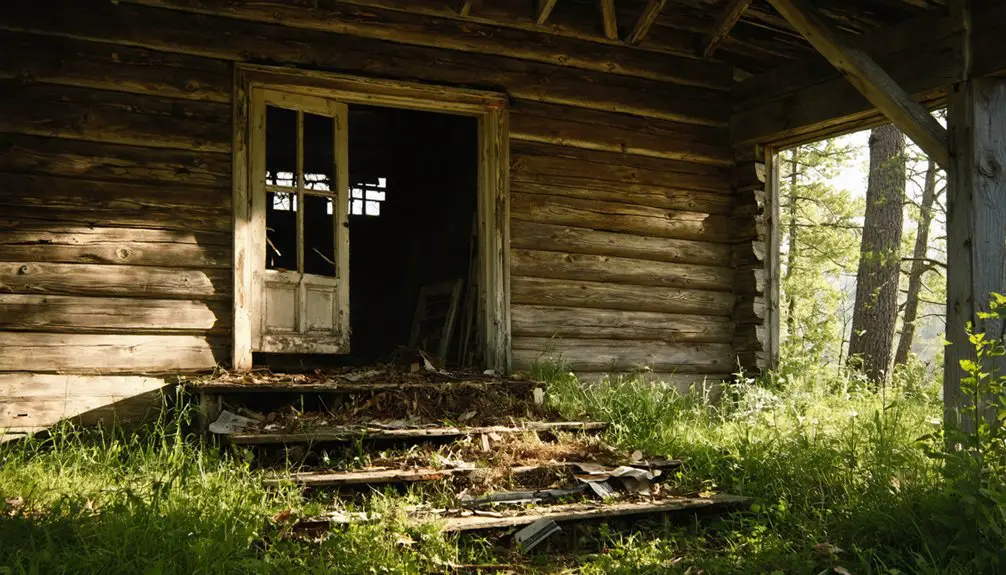
Maine’s most fascinating ghost towns reveal centuries of colonial, industrial, and agricultural history. You’ll find submerged ruins beneath Flagstaff Lake’s waters, where a 1950s dam project displaced entire communities. The Freeman Farm District showcases preserved 19th-century architecture, while Riceville’s abandoned tannery town tells tales of industrial boom and bust. In Madrid Township, remnants of mining operations and timber mills dot the landscape. These forgotten settlements hold countless untold stories waiting for your discovery.
Key Takeaways
- Flagstaff Lake features submerged ruins of displaced communities, with foundations and street outlines visible during low water levels.
- Riceville, a former tannery town founded in 1879, offers historical ruins and attracts both historians and paranormal investigators.
- Ligonia Village in South Portland showcases industrial-era stone foundations and abandoned structures from Maine’s manufacturing history.
- Madrid Township contains remnants of mining operations and timber industry sites, including historic railroad infrastructure.
- Freeman Farm District preserves colonial-era structures, including an 1812 Cape-style house and 1830s barn with a historic cemetery.
What Makes Maine’s Ghost Towns Unique
While many regions across America have their share of abandoned settlements, Maine’s ghost towns stand apart through their distinct combination of colonial heritage, industrial decline, and geographic isolation.
You’ll discover traces of colonial history in sites like Fort William Henry, dating back to 1692, alongside remnants of once-thriving mill towns and farming communities. These abandoned places tell a compelling story of economic shifts that forced residents to adapt or relocate. The early settlers of Freeman Township left behind architectural remnants that showcase the town’s vibrant past before its disincorporation in 1973.
You’ll find moss-covered granite foundations, forgotten cemeteries, and abandoned machinery scattered throughout Maine’s varied terrain. The state’s challenging topography and northeastern location created uniquely isolated communities, while its rich natural resources – from forests to waterways – initially drew settlers before eventually contributing to their departure.
What remains are haunting testimonials to waves of American settlement and industrial evolution. The evolution of hydropower development transformed entire communities, as evidenced by the submerged remnants of Flagstaff Village beneath Flagstaff Lake.
The Haunting Beauty of Flagstaff Lake
Beneath the rippling waters of Flagstaff Lake lies a submerged history of displaced communities and lost homesteads.
A sunken village sleeps beneath these Maine waters, its foundations forever silent beneath the gentle waves.
You’ll find Maine’s fourth-largest lake stretching across 20,000 acres, but its haunting tales run deeper than its waters. In 1950, Central Maine Power completed Long Falls Dam, flooding the valley where thriving communities once stood.
When water levels drop, you can glimpse remnants of the past – house foundations, street outlines, and structural remains emerge from their watery grave. Today, guided historical tours offer visitors a chance to explore these underwater ruins.
These traces tell stories of families forced to relocate, their homes either dismantled or abandoned to the flood. While the Flagstaff Memorial Chapel in Eustis preserves artifacts and memories, the submerged history beneath Flagstaff Lake serves as a powerful reminder of sacrifice in the name of progress. The final Old Home Days celebration in 1949 marked a bittersweet farewell as residents gathered one last time before their communities vanished forever.
Exploring Freeman’s Historic Stone Foundations
Another attestation to Maine’s vanishing communities stands in the historic Freeman Farm District, where weathered stone foundations tell a rich story of agricultural evolution.
As you explore this 100-acre parcel, you’ll discover remnants of a once-thriving township that peaked at 838 residents in 1840 before steadily declining into abandonment by 1937.
The Freeman foundations hold particular historical significance as they showcase the transformation from colonial settlement to modern farmstead.
You can trace the property’s development through its remaining structures, including an 1812 Cape-style house, an 1830s New England bank barn, and an 1880s chicken house.
These architectural elements represent five generations of Freeman family stewardship, bearing witness to the dramatic shifts in agricultural practices that reshaped Maine’s rural landscape. A former family cemetery in the northwest corner stands as a silent reminder of the generations who worked this land. The foundations incorporate stone from Kennebec County quarries, following the region’s rich tradition of granite production.
Discovering Riceville’s Hidden Past
Deep in Northern Hancock County, the forgotten settlement of Riceville stands as a tribute to Maine’s industrial past. Founded in 1879 by the Shaw brothers, this company town revolved entirely around the Riceville Tannery, where every resident worked to support the leather industry.
You’ll find its remains several miles east of Greenfield, though time has obscured much of what once thrived there. Stone foundations and old rusty remnants still dot the landscape. At its peak, the community reached a population of 130 or more residents by 1890.
The town’s fate was sealed during the winter of 1905 when a devastating fire destroyed the tannery. Without its economic lifeline, this tight-knit community quickly unraveled.
By 1910, Riceville had become an abandoned community, with only a store and boarding house surviving as silent witnesses.
Today, while the site rests on private logging land, it continues to intrigue historians and paranormal investigators alike.
Industrial Heritage at Ligonia Village
The bustling industrial powerhouse of Ligonia Village once stood as an essential manufacturing district within South Portland, Cumberland County. During Maine’s Industrial Revolution, you’ll find this area transformed through extensive landfilling to accommodate major manufacturing operations.
If you explore the industrial remnants today, you’ll discover traces of its rich heritage – from the iron rolling facilities to the Portland Kerosene Oil Company’s operations established in 1859. The village’s identity gradually faded into obscurity as South Portland expanded and absorbed the smaller community.
The historical significance of Ligonia Village extends beyond its manufacturing roots, marked by Henry Bodge’s 1866 land purchase and subsequent development along Main Street. Like many industrial areas, the village attracted skilled immigrant workers who found employment in its various manufacturing facilities.
While only stone foundations and abandoned structures remain, you can still witness the village’s industrial legacy through its surviving buildings, two historic cemeteries, and the environmental impact that shaped this once-thriving manufacturing hub.
The Mysteries of Swan Island (Perkins)
While Ligonia Village represents Maine’s industrial decline, Swan Island stands as a remarkable homage to both indigenous heritage and colonial development along the Kennebec River.
You’ll discover Swan Island’s history stretches back 9,000 years when the Abenaki Heritage first flourished here, with the name “Swango” meaning Island of Eagles.
Experience the island’s fascinating evolution through these key phases:
- From Native American summer hunting camps to European settlement in 1750
- Peak prosperity as the Town of Perkins in the 1860s with shipbuilding, ice harvesting, and shad fishing
- Gradual decline during the Great Depression, leading to the town’s abandonment by the 1940s
Today, you can explore five historic houses and numerous ruins that tell the story of this remarkable ghost town.
Mining Legacy of Madrid Township
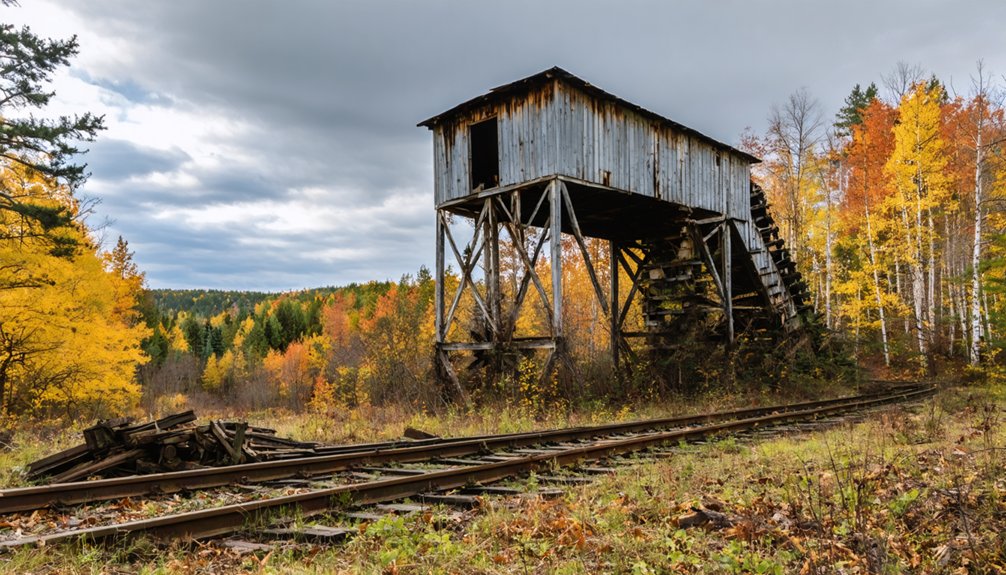
Originally granted as Plantation No. 1 in 1795, Madrid Township emerged as a significant mining frontier after gold prospectors arrived in 1822, followed by the discovery of bituminous coal at “Coal Bank.”
You’ll find this resource-rich area became particularly remarkable for its diverse mineral deposits, including graphite lenses in the Madrid/Smalls Falls Formations, which attracted the Oxford Mining Company in 1859.
The township’s gold mining legacy lives on in the Sandy River’s placer deposits, though today you’re restricted to hand tools for prospecting.
While mining operations ceased by 1890 due to ore depletion, Madrid’s timber legacy proved equally significant.
The arrival of the Sandy River Railroad transformed logging operations, with local mills producing over 19,000 railroad ties and establishing Madrid as the renowned “white birch town” until resources became depleted by 1900.
Planning Your Maine Ghost Town Adventure
When exploring Maine’s ghost towns, you’ll need to carefully time your visits around seasonal conditions, as summer and early fall offer the most accessible and safest viewing opportunities.
You should always bring navigation tools, emergency supplies, and notify others of your planned route, since many of these locations lie in remote areas with limited cell service.
For underwater sites like Flagstaff Lake, you’ll want to arrange boat transportation and monitor water levels to maximize visibility of the submerged structures.
Safety During Ghost Explorations
Before starting a ghost town exploration in Maine, understanding and implementing proper safety measures can mean the difference between an enriching adventure and a dangerous mishap.
Site safety requires thorough preparation and proper protective equipment to navigate these historical remnants safely.
When exploring Maine’s abandoned settlements, follow these essential guidelines:
- Always verify property ownership and obtain necessary permissions before visiting – you’ll avoid legal troubles and guarantee unrestricted exploration.
- Wear appropriate protective gear including N95 respirators, sturdy boots, and carry a well-stocked first aid kit.
- Map your route in advance and maintain situational awareness – mark your path, identify exit points, and keep emergency supplies within reach.
Best Visit Times Explained
As autumn paints Maine’s landscape in vibrant hues, ghost town enthusiasts can experience ideal exploration conditions from late September through October.
You’ll find peak foliage enhancing abandoned settlements like Freeman in northern Maine by late September, while coastal ghost sites near Pemaquid Point reach their colorful apex by mid-October.
For prime seasonal visits, plan your adventure after Labor Day when summer crowds dissipate from 9.1 million to 2.8 million visitors.
You’ll enjoy crisp morning fog and comfortable temperatures perfect for exploring forgotten places.
Time your trip to coincide with special events like Swan Island’s candlelight tours or Fort William Henry’s ghost walks.
While November offers peaceful exploration opportunities, many seasonal businesses close by mid-October, making early fall your best window for unrestricted ghost town access.
Frequently Asked Questions
Are There Any Underwater Diving Tours Available to Explore Flagstaff’s Remains?
You won’t find commercial underwater diving tours at Flagstaff Lake. For underwater exploration, you’ll need to arrange your own diving expedition while adhering to local diving regulations and safety protocols.
What Safety Precautions Should Visitors Take When Exploring Abandoned Mine Shafts?
Don’t enter abandoned mine shafts – they’re extremely dangerous with collapsing structures, toxic gases, and hidden drops. Stay behind barriers, respect warning signs, and only view historic mines through guided tours.
Do Any of These Ghost Towns Have Paranormal Investigation Permits?
Ever wondered about ghost hunting legalities? You won’t need paranormal permits for these locations – research shows no special permissions required for paranormal tours or investigations in Maine’s documented ghost towns.
Which Ghost Towns Are Accessible During Winter Months?
You’ll find reliable winter accessibility at all four locations: Flagstaff Lake’s submerged ruins, Swan Island’s preserved structures, Freeman’s mountain settlement, and Riceville’s mill remains. Each offers unique ghost town activities year-round.
Are Metal Detectors Allowed at These Abandoned Town Sites?
Like a hawk guarding its nest, metal detector regulations strictly prohibit detecting at ghost towns on public lands. You’ll need specific permits and landowner permission for private sites to search for historical artifacts.
References
- https://www.mooseriverlookout.com/post/ghost-towns-in-maine-9-fascinating-places-that-rose-fell
- https://en.wikipedia.org/wiki/List_of_ghost_towns_in_Maine
- https://www.americanghostwalks.com/the-ghosts-of-maine
- http://strangemaine.blogspot.com/2012/02/ghost-towns-of-maine.html
- https://92moose.fm/maines-spookiest-ghost-story-is-the-very-first-in-history/
- https://b985.fm/6-maine-ghost-towns-you-never-knew-existed/
- https://wcyy.com/6-maine-ghost-towns-you-never-knew-existed/
- https://www.hotels.com/go/usa/ghost-towns-maine
- https://wcyy.com/maine-underwater-ghost-town-flagstaff-lake/
- https://www.mentalfloss.com/geography/wanderlust/creepiest-ghost-towns-united-states