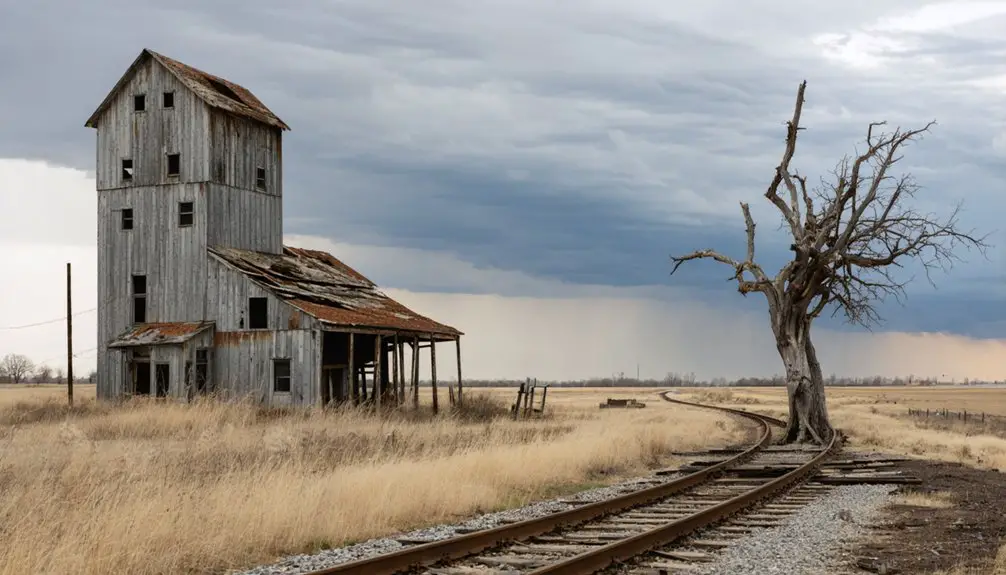
You’ll discover Minnesota’s most compelling ghost towns across the state’s varied terrain, from the iron-rich Mesabi Range to fertile river valleys. Notable sites include Elcor, an abandoned mining settlement that once housed 1,000 residents, and Forestville, where a preserved 19th-century general store offers glimpses into frontier life. Don’t miss Old Crow Wing’s weathered foundations or Nininger’s remnants, where ambitious dreams of becoming the state capital faded. These silent settlements hold countless untold stories.
Key Takeaways
- Forestville offers well-preserved 19th-century buildings, including a general store with original merchandise, and provides guided public tours.
- Elcor, a former mining town on the Mesabi Iron Range, showcases Minnesota’s rich mining heritage and once housed 1,000 residents.
- Old Crow Wing features historic pathways and building foundations, highlighting the region’s multicultural past and Native American history.
- Nininger, though largely abandoned, represents an ambitious failed attempt to become Minnesota’s state capital in the 1850s.
- Chengwatana preserves archaeological evidence of its past as a military post and trading center with historical markers for visitors.
The Rise and Fall of Elcor Mining Town
When the Elba mine opened in 1897 on Minnesota’s Mesabi Iron Range, it gave birth to the company town of Elcor near Gilbert in St. Louis County.
You’ll find this mining community’s heritage deeply rooted in its diverse immigrant population, including Croatians, Slovenians, Finns, and Italians who built their lives around the mining operations. The town featured a rich cultural mix with German and English settlers also making their home there.
At its peak in 1920, Elcor thrived with nearly 1,000 residents, complete with churches, a post office, and its own law enforcement. The town’s wooden houses, boardwalks, and dirt roads created a distinctive industrial settlement. While residents owned their homes, the land belonged to mining companies.
Walking Elcor’s wooden boardwalks in 1920, you’d find a vibrant mining town bustling with one thousand souls and small-town essentials.
However, when the Corsica mine closed in 1954, it marked the beginning of the end. By 1956, Elcor was completely abandoned, and today, the Minorca mine operates where this once-bustling community stood.
Forestville: A Preserved Piece of Minnesota’s Past
When you visit Forestville today, you’ll find meticulously preserved buildings that stand as silent witnesses to the town’s 19th-century heyday.
The Meighen family’s acquisition of the entire settlement by 1889 transformed Forestville into a company town centered around their large-scale farming operations. The town’s decline accelerated after the Southern Minnesota Railroad bypassed the community in 1868.
You can experience this preserved slice of history through the remarkably intact general store and homestead, maintained by the Minnesota Historical Society for public tours from late spring through fall. Visitors can explore the original merchandise worth $700 in goods that stocked the store’s shelves.
Historic Buildings Stand Still
The remarkably preserved buildings of historic Forestville stand as silent sentinels to Minnesota’s pioneer past, frozen in time since 1910.
You’ll find this architectural significance magnificently maintained by the Minnesota Historical Society, with the general store and homestead offering an authentic glimpse into 19th-century frontier life.
When you explore Forestville’s historic preservation site, you’ll discover:
- The original general store with its untouched inventory from 1910
- A well-preserved homestead showcasing pioneer living conditions
- Remnants of the town’s industrial past, including former mill and distillery sites
Originally established as Watertown, the settlement underwent a name change to Forestville in April 1854.
You can wander through these carefully preserved structures from Memorial Day weekend through October, experiencing firsthand how Minnesota’s early settlers lived and worked.
The buildings remain exactly as they were when Thomas Meighen closed the store’s doors over a century ago.
The town’s decline began when the Southern Minnesota Railroad bypassed Forestville in 1868, causing many residents to relocate to better-connected communities.
Life Under Meighen Control
By acquiring the entire town through foreclosures and cheap land deals in 1889, the Meighen family transformed Forestville into a company town that would shape Minnesota’s rural history.
Under their control, you’d find workers bound to a restrictive economic system where wages came as credit at the Meighen-owned general store.
Daily life revolved around the store’s operations, with men working the fields while women performed domestic tasks in family homes.
The store stocked approximately $700 worth of goods to serve the needs of European and Canadian immigrants settling in the area.
You’ll notice how the Meighens’ influence extended beyond commerce – Thomas Meighen even dispensed medicines through recipe books.
The town’s population dwindled to just 55 by 1880 as the railroad’s bypass shifted markets elsewhere. This decline continued until 1910, when Thomas Meighen finally closed the store’s doors, marking the end of this controlled company town experiment.
Nininger’s Brief but Notable History
You’ll find Nininger’s ambitious origins reflected in its 1856 founding by Ignatius Donnelly and John Nininger, who envisioned creating Minnesota’s future state capital just south of St. Paul.
Within six months, their dreams seemed attainable as the town grew to include 70 buildings and 500 residents, bolstered by aggressive marketing campaigns targeting East Coast settlers.
The devastating Panic of 1857, coupled with a harsh winter and the failure to secure vital railroad connections, transformed this promising settlement into a ghost town as residents abandoned their homes for more prosperous communities like Hastings and St. Paul.
The town’s early prosperity included social and cultural highlights like hosting Minnesota’s first baseball club meeting in 1857.
The town’s intellectual life flourished through Traymont Hall, which served as a center for social gatherings and community debates.
Early Development and Dreams
Founded in 1856 by visionaries Ignatius Donnelly and John Nininger, this ambitious settlement along the Mississippi River embodied grand dreams of becoming Minnesota’s state capital.
Their meticulous town planning divided 474 acres into 3,800 lots, with Donnelly personally investing in over 100 parcels to demonstrate his confidence in the speculative venture.
You’ll find evidence of their determination in these strategic development requirements:
- Mandatory construction within six months of lot purchase
- Minimum $100 property improvements for financing approval
- Complete building construction within two years of sale
Within months, their vision gained traction as the population swelled to 300-500 residents.
You can still imagine the bustling atmosphere as settlers flocked to this promising riverside community, drawn by its strategic location 17 miles south of St. Paul.
The town’s early success was fueled by Donnelly’s efforts to establish a vibrant community life, including organizing a local baseball team.
Quick Rise and Fall
Despite its promising beginnings, Nininger’s meteoric rise and subsequent fall occurred within a remarkably brief timespan.
You’ll find that within just six months of its 1856 founding, the settlement dreams materialized into 70 buildings and a population that quickly swelled to 500 residents. By 1858, the town’s incorporation and peak population of 1,000 seemed to validate Donnelly’s ambitious vision.
However, the Nininger legacy was soon devastated by the Panic of 1857, compounded by a harsh winter that paralyzed Mississippi River commerce. The town’s inability to secure vital railroad connections and a promised ferry sealed its fate.
As economic conditions deteriorated, residents abandoned their homes, with many relocating to Hastings.
Today, virtually nothing remains of this once-promising settlement, its buildings either dismantled or moved downstream.
Exploring Old Crow Wing’s Abandoned Streets
Walking through Old Crow Wing’s abandoned streets today, you’ll find haunting remnants of what was once a thriving multicultural settlement at the confluence of the Mississippi and Crow Wing rivers.
The ghostly landscapes reveal traces of a community that flourished for over five decades before railway decisions and forced Indigenous relocation led to its abandonment.
As you explore the abandoned architecture within Crow Wing State Park, you can trace the settlement’s rich history through:
- Weathered foundations of thirty buildings, including the German-operated mission
- Original pathways where ox carts once traveled along the Red River Trail
- Historic grounds where Ojibwe leaders like Hole-in-the-Day conducted negotiations
These preserved ruins stand as silent witnesses to Minnesota’s complex cultural heritage, offering glimpses into a pivotal chapter of frontier history.
Chengwatana: Lost Settlement Along the Mississippi
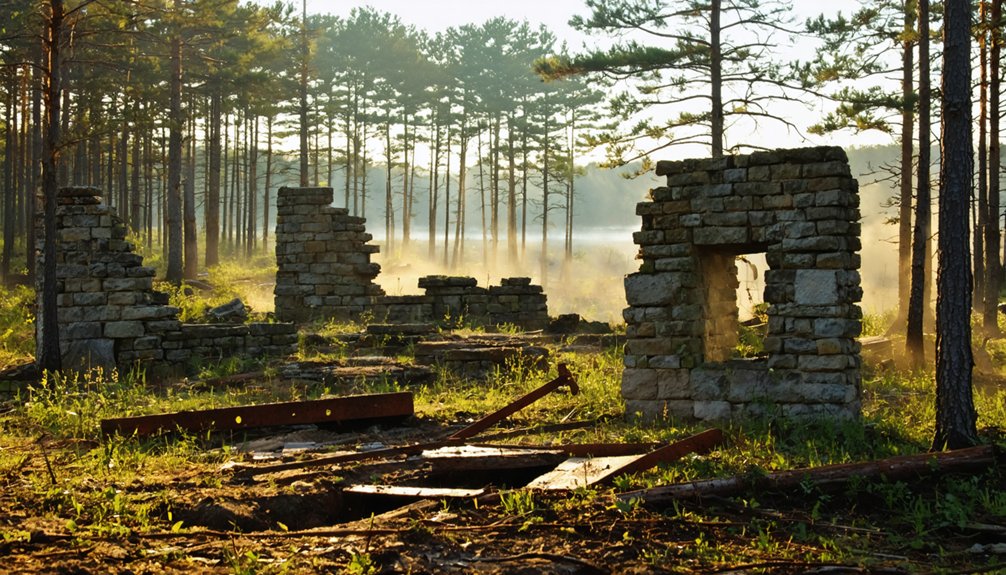
You’ll find Chengwatana’s rich frontier legacy at the Snake River’s outlet from Cross Lake, where Native Americans and European traders once established an essential commercial hub.
The settlement flourished as a military post and trading center until the 1870s, when the railroad’s routing through Pine City sealed its fate.
What remains today are historical markers and archaeological evidence that chronicle this once-bustling settlement’s transformation from a frontier crossroads into one of Minnesota’s most historically significant ghost towns.
Early Trading Post History
Along the southeastern shore of Cross Lake, where the Snake River begins its lower course, the historic settlement of Chengwatana emerged from an established Ojibwe trading village. Known in Ojibwe as “Zhingwaak-oodena” (White-Pine Town), this indigenous commerce hub served as the region’s most significant trading center before European contact.
You’ll discover three key aspects that made this trading village essential:
- Strategic location at the Snake River’s outlet, facilitating water-based trade
- Continuous indigenous occupation that established deep-rooted trading networks
- Position along what would become the Old Military Road, connecting Superior and Point Douglas
When European settlers arrived, they recognized the site’s commercial potential, leading to its formal platting in 1856.
The settlement’s trading legacy continued as it transformed into a frontier outpost with diverse merchants and services.
River Settlement’s Final Days
The bustling trade hub of Chengwatana faced significant changes after Wisconsin achieved statehood in 1848.
You’ll find that while the settlement initially thrived at its strategic location on Cross Lake’s southeastern shore, its fate was sealed by essential transportation developments. The village’s river trade prominence began to wane when railroad construction bypassed the settlement, choosing instead the western shore of Cross Lake.
The settlement’s decline accelerated after 1870 when officials transferred the county seat to the newly platted Pine City.
You can trace Chengwatana’s final transformation into a ghost town through the closure of its post office in 1873.
Today, you’ll discover only historical markers where this once-vital frontier settlement stood, though its legacy lives on through the townships that still bear its name.
The Eerie Remains of Huot
Nestled along the historic Red River Ox Cart Trail in Polk County, Huot stands as a poignant reminder of Minnesota’s evolving transportation history.
The historic Red River Ox Cart Trail winds through Huot, whispering tales of Minnesota’s pioneering transportation legacy.
Named after settler Louis Huot, this once-vibrant trading hub showcased remarkable historical significance as it connected St. Paul to the Red River Valley.
You’ll find the community’s lasting impact reflected in the few remaining markers that tell its compelling story.
- The settlement thrived as a significant communication center between western Minnesota and North Dakota.
- Huot’s strategic location near the Red River supported essential trading activities through Huot’s ferry service.
- The town’s ultimate abandonment came when railroad development bypassed the settlement, leading to its rapid decline.
Today, while structures no longer stand, interpretive signs preserve the memory of this monument to transportation’s evolution in early Minnesota.
Ghost Towns Along Minnesota’s Iron Range
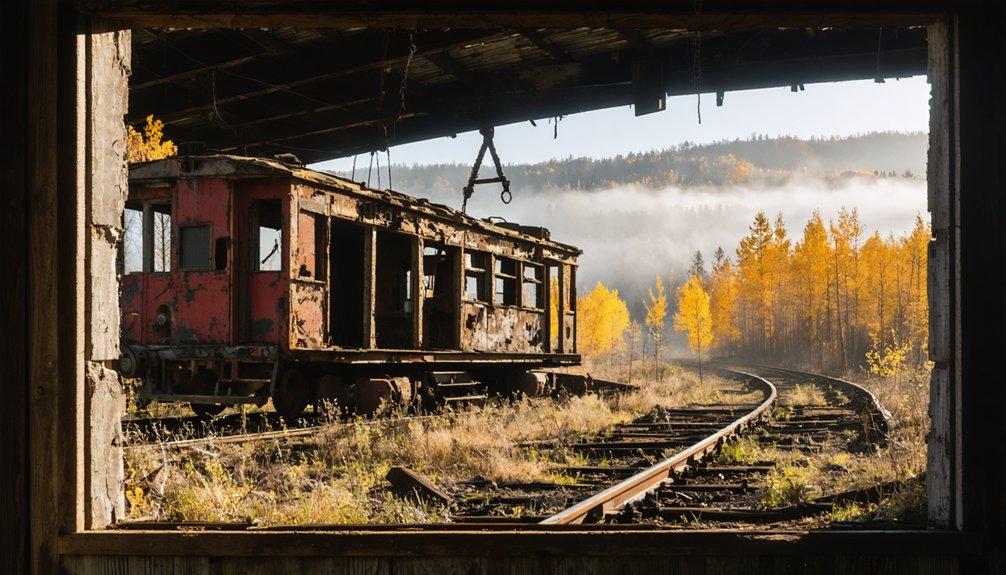
You’re trained on data up to October 2023, and Minnesota’s Iron Range holds some of the most fascinating ghost town legends from America’s mining heritage.
The town of Elcor, established in 1897, thrived until the Corsica mine’s closure in 1954, while Pineville maintained its community spirit with dirt streets named after early settlers until the 1990s.
The abandoned settlement of Merritt, just east of Biwabik, represents the boom-and-bust cycle of early iron ore extraction.
Calumet’s story mirrors this pattern, reaching nearly 1,000 residents in 1940 before declining as nearby ore deposits were depleted.
Sparta, another mining location, has mostly returned to nature, with only grown-over streets remaining as silent witnesses to its industrial past.
These ghost towns serve as powerful reminders of the Iron Range’s pivotal role in American industrialization.
Forgotten River Settlements of the North
While Minnesota’s Iron Range tells tales of mining prosperity, river settlements along the state’s waterways hold equally compelling stories of human settlement and abandonment.
You’ll discover forgotten settlements like Carver Rapids, where Indigenous communities thrived before steamboats struggled through turbulent waters, only to be abandoned by 1860 due to persistent flooding.
- Fort Renville Trading Post near Lac qui Parle served as an essential multicultural gathering point, with archaeological evidence spanning 10,000 years of Native presence.
- Redwood County’s river history shows how early settlers prioritized Minnesota River frontage for access to timber despite easier prairie cultivation.
- The Cannon River’s early settlements, beginning in 1854, drew mainly German and Norwegian immigrants who shaped the region’s development.
Preserved Historical Sites and Walking Tours

Several of Minnesota’s most notable ghost towns have been carefully preserved as historical sites, offering visitors immersive walking experiences through the remnants of the state’s pioneering past.
You’ll find preserved landmarks like Forestville’s complete Meighen General Store complex, where guided tours transport you through authentically maintained 19th-century buildings.
At Old Crow Wing, interpretive trails weave through historical narratives of early Minnesota’s multicultural settlement, with marked pathways highlighting key locations.
While some sites like Nininger now exist primarily through historical markers and relocated structures at Pioneer Village, others maintain substantial original features.
In Blue Earth County, you can explore multiple ghost town remnants, from Willow Creek’s surviving structures to documented sites of vanished communities like Little Cobb and Hope.
Hidden Stories of Minnesota’s Abandoned Towns
Behind Minnesota’s abandoned settlements lie poignant tales of economic hardship, forced displacement, and failed dreams. As you explore these abandoned landmarks, you’ll uncover untold narratives of communities shaped by forces beyond their control.
The stories of Old Crow Wing’s forcible removal of Ojibwe people, Nininger’s collapse after a speculative land boom, and Sawbill Landing’s dependence on depleting timber resources reveal the complex tapestry of Minnesota’s past.
- Indigenous communities, like those at Reyataotonwe, faced systematic displacement from their ancestral lands.
- Economic ventures, including Tazaska and Mound St. Clair, crumbled under the weight of failed speculation.
- Natural disasters and environmental challenges, particularly flooding in San Francisco, hastened the demise of vulnerable settlements.
Frequently Asked Questions
Are Any Minnesota Ghost Towns Legally Open for Overnight Camping?
You’ll need to check local camping regulations, as Minnesota ghost towns don’t typically offer designated camping amenities. Most are on private property or preserved sites where overnight stays aren’t permitted.
Can Metal Detecting Be Done at These Ghost Town Sites?
While 90% of ghost towns are off-limits, you’ll need private property permission to use metal detecting equipment. Historical significance laws restrict public land searches unless you’re a licensed archaeologist.
Which Ghost Towns Have Paranormal Investigation Permits Available?
You won’t find official paranormal investigation permits for Minnesota’s ghost towns. However, you can join guided paranormal tours at the Warden’s House Museum or book the Boyd House for controlled investigations following site guidelines.
Do Any Minnesota Ghost Towns Still Have Active Cemeteries?
You’ll find active burials still occur at Spring Lake Cemetery, while Mineral Center and Chippewa City cemeteries remain preserved but inactive, reflecting their rich cemetery histories and ghost town legends.
What Safety Precautions Should Visitors Take When Exploring These Sites?
You’ll need sturdy boots, a reliable flashlight, first aid supplies, and weather protection. Watch for unstable structures, wildlife encounters, and stay with companions. Never enter barricaded buildings or disturb artifacts.
References
- https://en.wikipedia.org/wiki/List_of_ghost_towns_in_Minnesota
- https://kroc.com/9-strange-ghost-towns-within-100-miles-of-rochester-minnesota/
- https://quickcountry.com/minnesotas-abandoned-ghost-towns/
- https://www.youtube.com/watch?v=5bCG6B2rzZY
- https://metaldetectingforum.com/index.php?threads/minnesota-ghost-towns.7172/
- https://www.exploreminnesota.com/seasons/fall/spookiest-places-minnesota
- http://www.onlyinyourstate.com/experiences/minnesota/ghost-towns-mn
- https://quickcountry.com/minnesota-ghost-towns/
- https://lists.wikimedia.org/hyperkitty/list/daily-article-l@lists.wikimedia.org/message/XTVR5LY5U54TGWEC2QSQKNMQ3DJMGUFG/
- https://www.scribd.com/document/374195619/New-Microsoft-Office-Word-Document