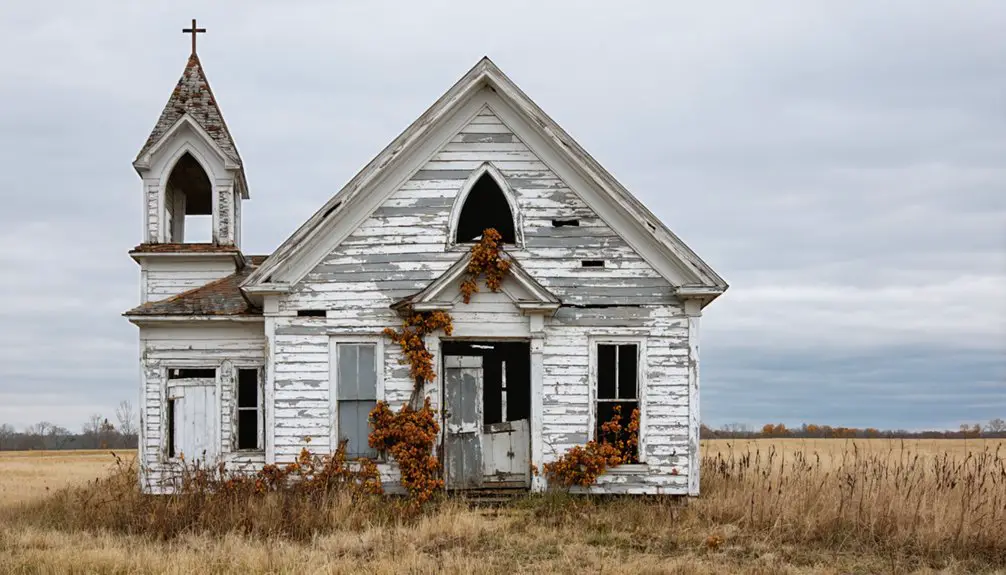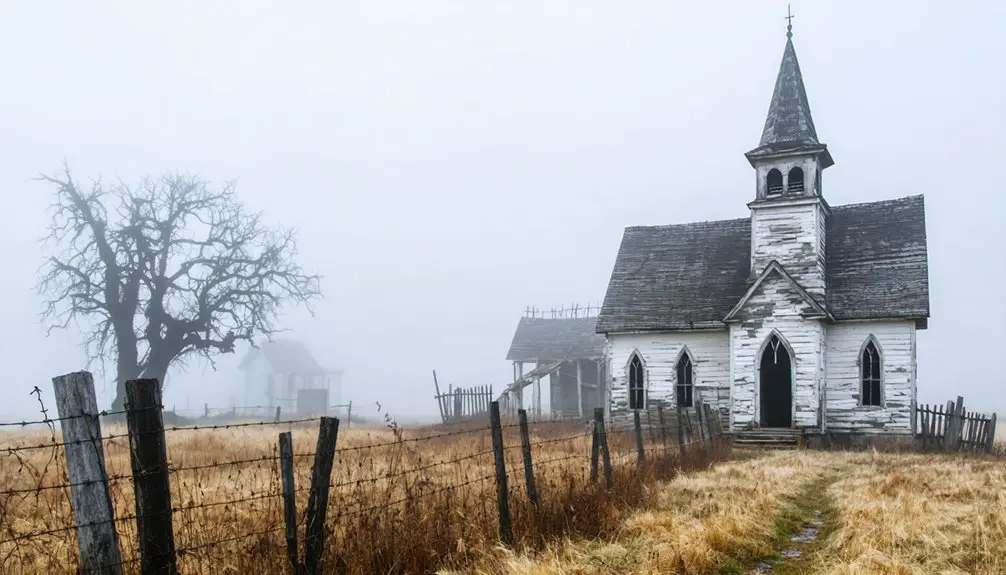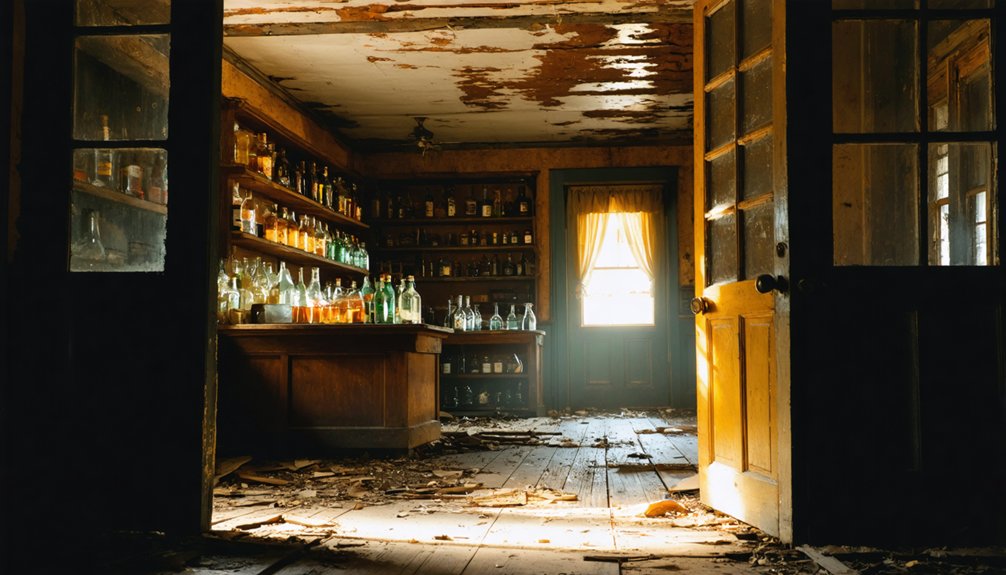
You’ll find Missouri’s most fascinating ghost towns scattered along historic Route 66, including Avilla, the “Capitol 66 Ghost Town,” and Halltown, once known as “Little Chicago.” These abandoned settlements feature authentic 1920s structures, like Spencer’s restored Phillips 66 station and Halltown’s 1902 general store with trees growing inside. Times Beach, now Route 66 State Park, and Red Oak II near Carthage offer compelling windows into Missouri’s pioneering past, with each site holding deeper historical significance.
Key Takeaways
- Avilla stands as Missouri’s “Capitol 66 Ghost Town,” featuring preserved historic structures and a compelling bank robbery story.
- Times Beach, now Route 66 State Park, offers a haunting glimpse into environmental disaster after dioxin contamination forced evacuation.
- Halltown’s abandoned 1902 general store and overgrown buildings create an authentic ghost town atmosphere along Route 66.
- Red Oak II near Carthage presents a uniquely preserved 1930s community with relocated historic buildings.
- Devil’s Elbow features John’s Modern Cabins and a dead-end section of original Route 66, showcasing authentic road history.
Exploring Missouri’s Route 66 Ghost Town Legacy
While Missouri’s stretch of Route 66 spans hundreds of historic miles, its ghost towns stand as some of the most fascinating remnants of the Mother Road’s golden age.
You’ll discover this rich heritage along Arlington Road’s vintage alignment, where Route Preservation efforts maintain authentic 1920s-era structures and roadbed features.
Ghost Town Tourism thrives in places like Avilla, the “Capitol 66 Ghost Town,” and Halltown, nicknamed “Little Chicago,” both offering glimpses into the highway’s bustling past. The town of Spencer draws visitors to its meticulously restored Phillips 66 station. The infamous O’Malley gang bank robbery of the 1930s adds to Avilla’s mystique.
Historic Route 66 ghost towns like Avilla and Halltown preserve memories of roadside Americana in their quiet, abandoned streets.
For an immersive experience, visit Paris Springs Junction’s restored gas station or explore Red Oak II, where relocated historic buildings create a living museum.
These destinations between Carthage and Joplin showcase the evolution of America’s most famous highway, from its early development to its current preserved state.
Historic Towns That Time Forgot
As you travel Missouri’s historic byways, you’ll encounter the haunting remains of communities like Times Beach along Route 66, where dioxin contamination forced 2,240 residents to abandon their homes in 1982.
Military expansion during World War II erased several St. Charles County towns, including Hamburg, Howell, and Toonerville, when the government seized land for the Weldon Spring Ordnance Works in 1941. These communities reflect how natural resource depletion contributed to the disappearance of many Missouri settlements.
The story of Phenix stands apart, as this once-prosperous Greene County settlement of 1,500 residents never recovered after an 1889 tornado reduced it to ruins, marking a different kind of displacement that shaped Missouri’s landscape of lost communities.
Abandoned Route 66 Communities
When Interstate 44 carved its path through Missouri in the 1970s, numerous historic communities along Route 66 faced rapid decline and eventual abandonment.
You’ll find poignant examples in Times Beach, which was demolished after dioxin contamination, and Arlington, a former resort town where only bridge remnants remain. The federal government spent millions in buyouts to relocate Times Beach residents after discovering toxic waste in 1983.
For enthusiasts of ghost town tourism, Halltown – once known as Little Chicago – offers glimpses of its past through an abandoned 1902 general store. Trees are now visibly growing inside buildings, marking the passage of time since its abandonment.
Route 66 nostalgia draws visitors to Avilla, a living ghost town that preserves its historic structures, while Red Oak II near Carthage represents a unique resurrection.
This recreated 1930s art community features relocated buildings from the original Red Oak, offering you an authentic glimpse into Missouri’s Route 66 heritage.
Mining Town Mineral Springs
Beyond the Route 66 corridor, Missouri’s ghost towns extend into the Ozark highlands, where Mineral Springs stands as a tribute to America’s 19th-century health tourism boom.
Located in Barry County, this once-thriving destination emerged in 1880 when mineral spring tourism transformed a simple water source into a healing haven.
Similar to Lithium’s practice, bottled spring water was transported to St. Louis for distribution to health-seeking customers.
- Professor Charles E. Waite’s analysis revealed extraordinarily high mineral content
- Tourists arrived by train to seek cures for ailments from rheumatism to deafness
- The Mineral Springs Hotel and Store became the town’s cornerstone
- Historical healing practices included water treatments and bottled remedies
- Town development mirrored nearby Lithium Springs’ 1883 incorporation model
Like many mining areas that operated virtually unregulated until 1971, the environmental impact of mineral extraction activities around Mineral Springs remains visible today.
You’ll find few remnants of this forgotten health resort today, but its legacy persists as a symbol of Missouri’s rich heritage of mineral spring tourism and unregulated mining impacts.
Military Base Displacement Impact
Through a series of military expansions during World War II, Missouri’s landscape underwent dramatic transformations that erased entire communities from the map.
You’ll find the starkest examples in St. Charles County, where Hamburg, Howell, and Toonerville vanished to make way for the Weldon Spring Ordnance Works. The military expansion effects rippled across the state, consuming towns like Bloodland and Cookville near Fort Leonard Wood. Along old Route 66, Arlington thrived until Stony Dell Resort became a major destination for servicemembers.
Ghost town narratives often focus on mining or economic decline, but these military-displaced communities tell a different story.
From Arlington’s demise following Interstate 44’s construction to Times Beach’s tragic combination of floods and contamination, you’re witnessing the legacy of national defense priorities reshaping local landscapes. The town’s residents faced devastating health consequences after waste hauler Russell Bliss sprayed roads with toxic chemical mixtures, leading to widespread illness and eventual evacuation.
These lost towns serve as powerful reminders of how quickly established communities can disappear in the name of progress.
Lost Communities Along Missouri’s Highways
As you travel Missouri’s historic highways, you’ll encounter the haunting remains of once-thriving communities like Times Beach and Arlington, which flourished alongside Route 66 before modern interstate development altered their destinies.
These transportation-dependent settlements, from Georgia City’s cemetery to Garber’s lone stone church, stand as silent testimonials to the essential role that railroads and early highways played in sustaining Missouri’s rural communities.
The most compelling examples cluster along the I-44 corridor, where former Route 66 settlements showcase how shifting transportation patterns transformed bustling towns into historic remnants. Visitors can explore conservation areas where communities like Columbia Bottom have vanished entirely, leaving only traces of their 19th-century existence.
Route 66 Abandoned Settlements
While Missouri’s section of Route 66 once bustled with vibrant communities and roadside attractions, many settlements along this historic highway now stand abandoned or considerably diminished.
You’ll discover haunting reminders of America’s Main Street through these ghost towns, each telling its own story of decline after Interstate 44’s arrival.
- Times Beach, evacuated due to dioxin contamination, transformed from a thriving community into today’s Route 66 State Park
- Devil’s Elbow, featuring deteriorating John’s Modern Cabins and a dead-end section of original roadway
- Avilla, a living ghost town with restored structures between Carthage and Springfield
- Halltown, once known as Little Chicago, now silent with its abandoned 1902 general store
- Red Oak II, a unique recreation of a 1930s community, showcasing relocated historic buildings near Carthage
Transportation Hub Remnants
Missouri’s transportation evolution left behind numerous forgotten communities that once thrived as significant links in the state’s rail and road networks.
You’ll find railroad remnants of the Chicago-Alton line that once connected Cedar City to Chicago, passing through towns like Hibernia and Carrington before tracks were torn up in the 1930s.
The Mindamine community flourished briefly as a shipping point along the Frisco Railroad, while Avilla served as an essential stagecoach stop before Route 66 brought a second wave of travelers.
Even small outposts like Zeta, built as a railroad siding, played critical roles in Missouri’s transportation history.
These ghost towns stand as silent witnesses to changing transportation patterns, from rail dominance to highway systems that eventually bypassed these once-bustling hubs.
Abandoned Places With Haunting Stories
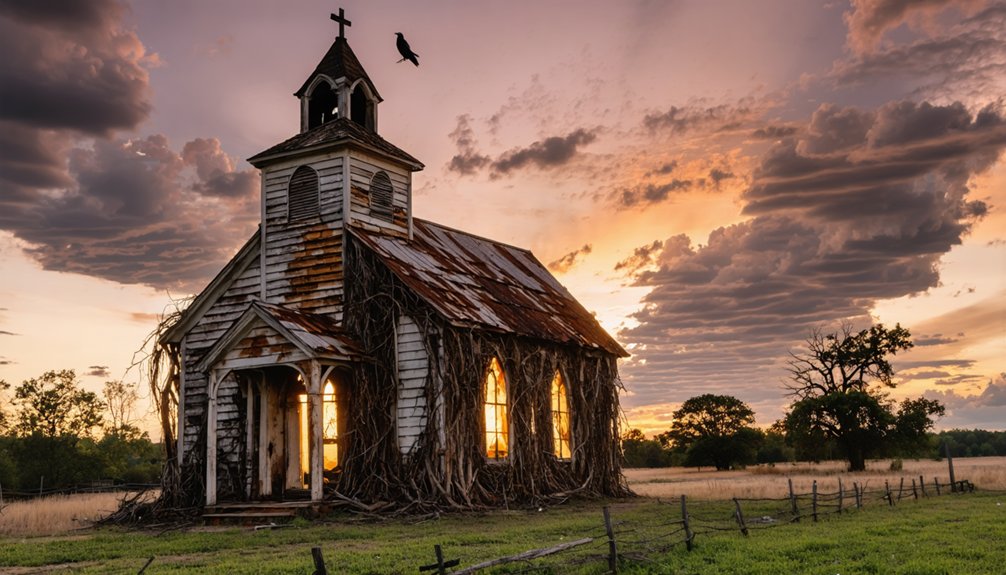
Throughout the Show-Me State’s rich history, numerous communities have transformed from bustling settlements into haunting reminders of America’s past.
You’ll discover abandoned structures across Missouri that tell stories of dramatic economic collapses, wartime displacement, and natural disasters that forever changed these once-thriving communities.
- Empire City’s swift decline from 3,000 residents after Galina’s ore discovery left behind ghostly remnants of its mining heritage
- Weldon Spring’s military acquisition forced entire communities to evacuate, creating an eerie landscape of wartime sacrifice
- Monark Springs’ devastating flood in the 1920s left haunting legends of a town that nature reclaimed
- Al Martha’s exodus of youth created a poignant reflection of rural America’s changing demographics
- Mindamines’ deterioration from 924 residents to abandonment showcases the harsh reality of boom-and-bust mining towns
Hidden Gems of Missouri’s Past
Beyond the well-known ghost towns lie remarkable forgotten settlements that showcase Missouri’s diverse historical tapestry.
You’ll discover forgotten landmarks like Windyville, named for its founders’ storytelling prowess, and Karlin, where Czech immigrants carved out their American dream.
The historical significance of mining communities like Mendenhall and Empire City reflects Missouri’s industrial heritage, with Empire City reaching an impressive 3,000 residents in its first year before being absorbed into Galena.
In St. Charles County, you’ll find traces of Hamburg, Howell, and Toonerville – communities that sacrificed their existence for the World War II effort.
These hidden gems tell stories of immigrant determination, industrial ambition, and wartime sacrifice, preserving chapters of Missouri history that might otherwise be lost to time.
Vanished Towns and Their Remnants
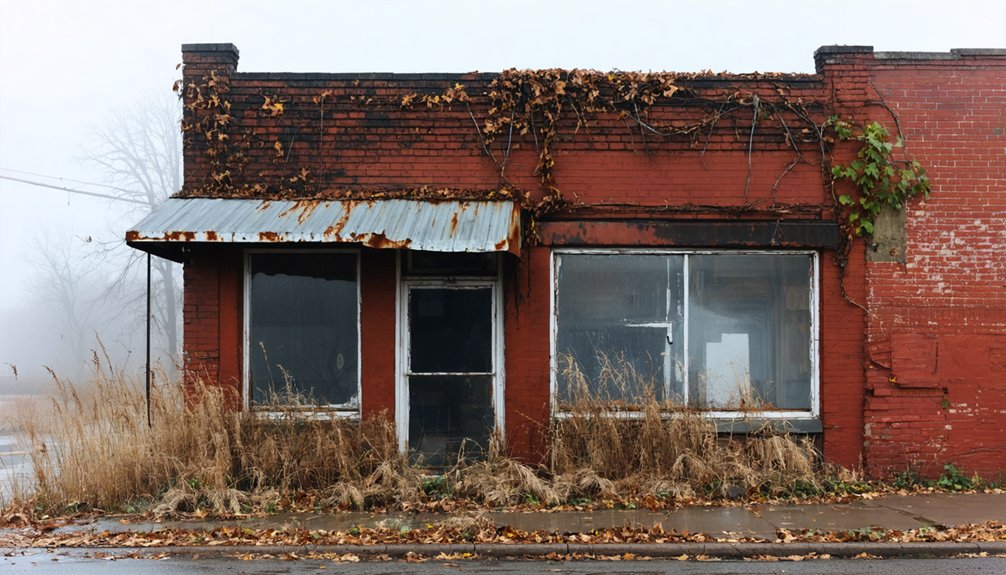
While many ghost towns leave visible traces of their former existence, several Missouri communities have virtually vanished from the landscape due to government initiatives and environmental challenges.
The ghost town architecture that once defined these settlements has been completely erased, leaving behind only historical records and memories.
- Hamburg, Howell, and Toonerville disappeared simultaneously in 1941 when the government acquired their lands for the Weldon Spring Ordnance Works.
- Times Beach’s environmental impact led to a complete evacuation after dioxin contamination, though you’ll now find Route 66 State Park in its place.
- Phenix stands apart as a mining ghost town with sparse ruins still visible.
- St. Charles County lost three communities to wartime production needs.
- These sites underwent extensive environmental remediation through WSSRAP and Superfund projects.
Preserving Missouri’s Ghost Town Heritage
As Missouri’s historic ghost towns face mounting preservation challenges, dedicated organizations and government agencies have implemented extensive programs to protect these irreplaceable cultural resources.
You’ll find that Missouri Preservation’s “Places in Peril” program plays a vital role in ghost town preservation by identifying threatened sites and rallying public support for their protection.
Through the State Historic Preservation Office’s all-encompassing plan, “Our Sense of Place,” you can participate in heritage education initiatives that connect you to these abandoned settlements.
The economic impact of preserving ghost towns is substantial, generating millions in revenue through tourism and rehabilitation projects.
Whether you’re exploring Arrow Rock or Ste. Genevieve, you’re experiencing the results of successful preservation partnerships between local communities and state agencies that guarantee these vanished towns’ stories won’t be lost to time.
Must-Visit Deserted Towns in the Show-Me State
cunosc
Frequently Asked Questions
Are Overnight Camping Permits Required to Explore These Ghost Towns?
You’ll need camping permits if you’re staying overnight, as ghost towns often sit on regulated lands. Check local camping regulations and submit permit applications through appropriate land management agencies.
What Survival Gear Should Visitors Bring When Exploring Missouri Ghost Towns?
With 90% of ghost town injuries being dehydration-related, you’ll need survival essentials like water filtration, first aid kit, navigation tools, weather-appropriate clothing, and emergency shelter. Don’t forget headlamps for safety.
Which Ghost Towns Are Accessible During Winter Months?
You’ll find winter exploration possible at Red Oak II, Hamburg, Howell, and Toonerville near St. Charles, plus Ozark sites like Melva and Rueter. These accessible sites maintain passable roads during colder months.
Do Any Ghost Towns Offer Guided Historical Tours?
While you’ll find guided history tours in haunted historic towns like Hannibal and Hermann, Missouri’s actual ghost towns don’t currently offer organized tours, though you’re free to explore their remaining structures independently.
Are Metal Detecting Activities Allowed in These Abandoned Towns?
You’ll find a gold mine of opportunities, but follow metal detecting guidelines: get landowner permission on private ghost towns, while public historic sites are strictly off-limits under Archaeological Resources Protection Act.
References
- https://en.wikipedia.org/wiki/List_of_ghost_towns_in_Missouri
- https://www.legendsofamerica.com/mo-ghosttowns/
- https://www.onlyinyourstate.com/trip-ideas/missouri/road-trip-through-mo-ghost-towns
- https://www.visitmo.com/articles/missouris-most-haunted-places
- https://www.undergroundozarks.com/forum/viewtopic.php?t=445
- https://www.youtube.com/watch?v=ApiGf0lxnSo
- https://www.ghosttowns.com/states/mo/mo.html
- https://www.youtube.com/watch?v=PuOFpsuWM2k
- https://www.theroute-66.com/missouri.html
- https://artsandculture.google.com/story/7-ghost-towns-on-route-66-national-trust-for-historic-preservation/YAVR-Hg8Tq4gdg?hl=en