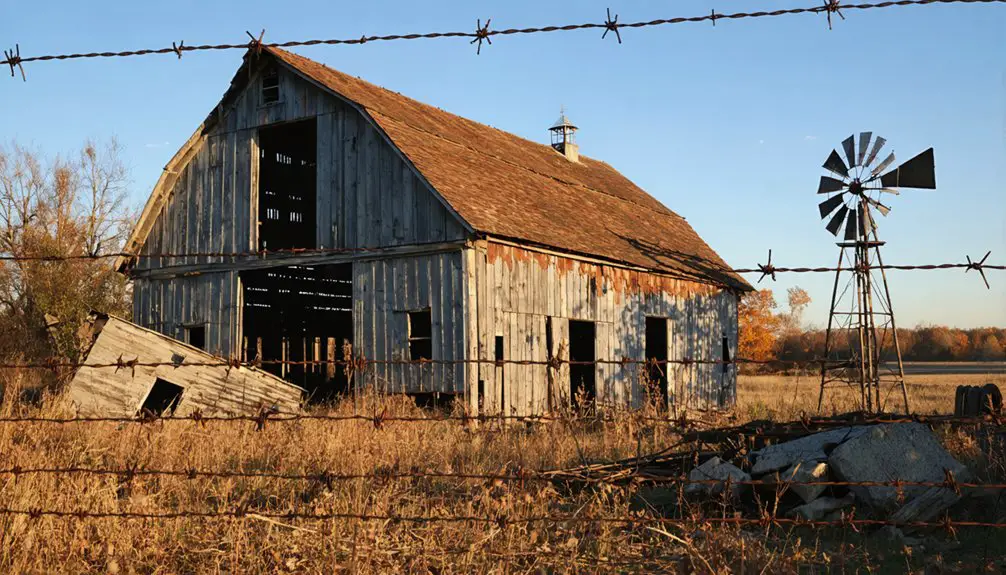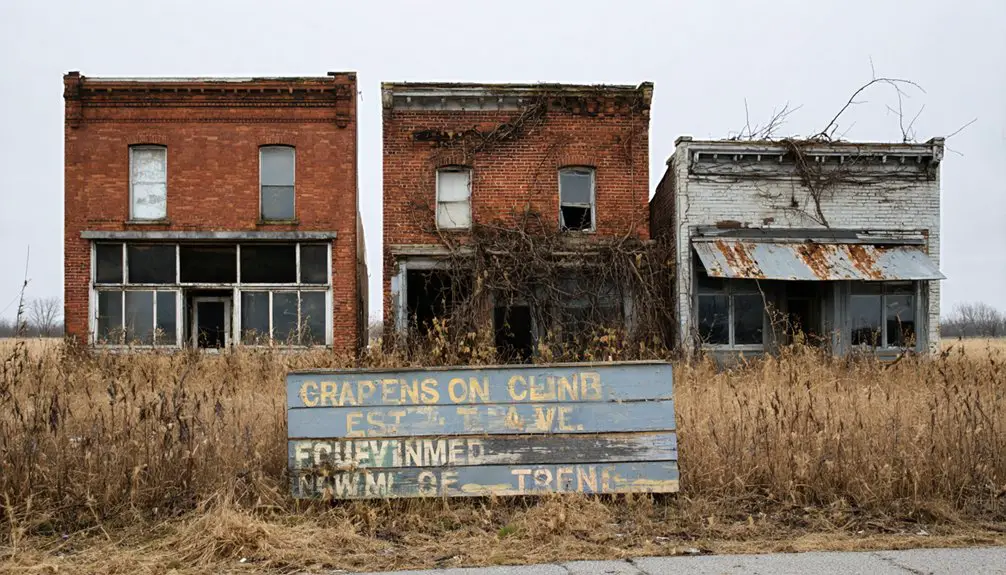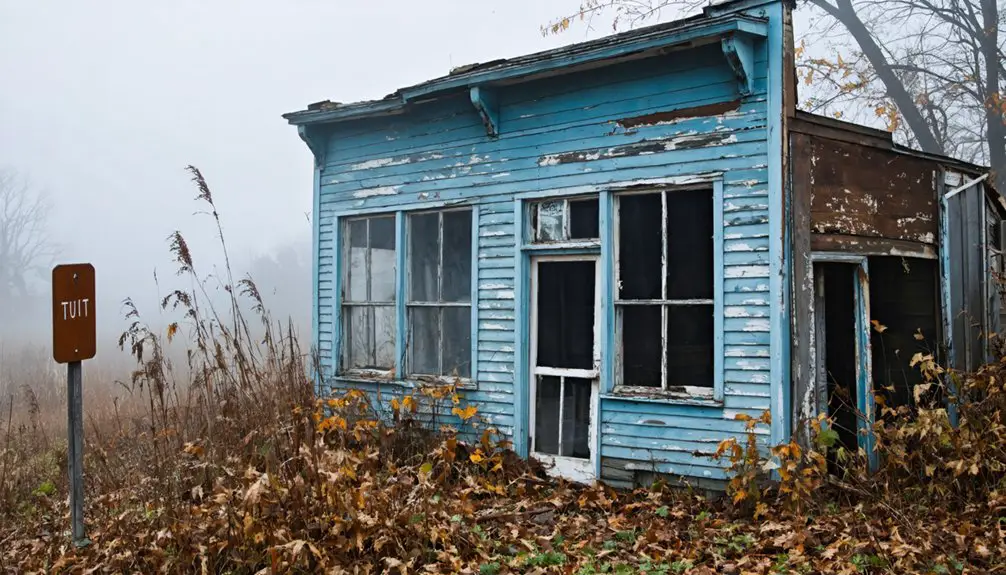
You’ll discover fascinating ghost towns across Ohio, each with its own haunting story. Moonville draws visitors to its historic tunnel and railroad heritage, while Helltown’s abandoned streets fuel urban legends. The submerged remains of Claylick, San Toy’s crumbling mining ruins, and Sprucevale’s canal-era structures showcase the state’s industrial past. From coal boom communities to flood-ravaged settlements, these forgotten places hold secrets waiting to be uncovered.
Key Takeaways
- Helltown offers fascinating abandoned structures and urban legends, now part of Cuyahoga Valley National Park with historic landmarks still visible.
- Moonville features a restored tunnel and railroad bridge, making it one of Ohio’s most accessible and well-preserved ghost towns.
- San Toy’s remnants showcase its coal mining history, including company store foundations and Robinson’s Cave where labor meetings occurred.
- Oreton maintains traces of Ohio’s coal boom era, with its brick safe from the general store standing as historical evidence.
- Sprucevale’s preserved Hambleton Mill serves as a testament to the town’s prosperous past along the Sandy & Beaver Canal.
The Haunted History of Moonville
In the 1800s, two pioneering families established the settlement that would become Moonville before coal was discovered. The area became crucial for transporting coal and other minerals via the Marietta and Cincinnati Railroad.
Exploring Helltown’s Abandoned Streets
You’ll discover the dark history of Helltown in Summit County, where federal acquisition of homes in 1974 forced residents out and left behind a haunting message: “Now it’s understood how the Indians felt.”
While many buildings stood abandoned for decades until their 2016 demolition, the area’s mysteries deepened with stories of a haunted school bus, the notorious Stanford Road (nicknamed “Highway to Hell”), and toxic contamination at Krejci Dump. The area’s legends grew from the numerous boarded-up properties that sat empty awaiting demolition.
The creation of Cuyahoga Valley National Park in 1974 through new legislation forever changed the landscape of Boston Township and surrounding communities. Though most urban legends about Satanic churches and mutants have been debunked, Helltown’s eerie atmosphere and genuine historical trauma continue to captivate visitors exploring its remaining streets within Cuyahoga Valley National Park.
Dark Local History Revealed
Deep in the heart of Ohio’s abandoned Boston Township lies a haunting reminder of government overreach that forever changed a tight-knit community.
In 1974, federal legislation stripped residents of their homes without warning or negotiation, forcing them to relocate from land they’d called home for generations. You’ll find bitter memories painted on abandoned houses, where displaced residents compared their fate to Native American forced removals.
While ghostly encounters and eerie folklore emerged around the Presbyterian church’s upside-down crosses and mysterious “Road Closed” signs, the true horror wasn’t supernatural – it was bureaucratic.
The area’s toxic legacy was revealed when the Krejci Dump, a Superfund site, sickened park rangers with chemical exposure. The town’s decline began decades earlier when the Ohio and Erie Canal construction dramatically shifted the local economy. The land was ultimately incorporated into Cuyahoga Valley National Park, transforming the once-vibrant village into protected parkland.
Even today, the scars of this forced exodus remind us how quickly government action can transform a thriving community into a ghost town.
Haunted Buildings Still Standing
Today, only a handful of structures remain standing in what locals once called Helltown, each bearing silent witness to the area’s troubled past.
You’ll find the iconic Helltown Barn perched precariously on Stanford Road, its weathered frame supported by structural braces as it defies decades of abandonment.
The Presbyterian church still draws attention with its unusual upside-down cross, while the historic mill workers’ duplex – often mistaken for a slaughterhouse – looms near Boston Cemetery.
The cemetery itself stands as one of the last permanent fixtures, its monuments untouched by the widespread demolition of 2016.
Inside these remaining structures, you’ll discover mesh-covered storage rooms, deteriorating basements, and walls marked with mysterious symbols – silent testimonies to years of neglect and the persistent legends that refuse to die.
The barn’s storied past includes being owned by the Lindley family for generations, with Bob and Evelyn maintaining the property until the National Park Service acquired it.
The area’s decline began when train travel emerged in the late 1800s, causing residents to migrate toward growing urban centers.
Urban Legends Live On
Even after most structures were demolished in 2016, Helltown’s urban legends continue to captivate visitors who venture down Stanford Road’s infamous dead ends.
While no historical evidence supports claims of Satanic cults or paranormal activity, the area’s abandoned landscape fueled decades of chilling urban myths.
You’ll find the roots of these stories in the government’s 1970s land acquisition, which left hundreds of homes boarded up and deteriorating.
The notorious Crybaby Bridge, where ghost sightings allegedly occur, remains one of Ohio’s most enduring legends.
Despite official records debunking tales of evil churches and mysterious slaughterhouses, these stories persist.
What began as simple “Road Closed” signs and vacant properties transformed into an elaborate tapestry of supernatural folklore that refuses to die.
The area became a National Recreation Area in Boston Mills after the government acquired the land in 1974.
Claylick: Lost to Rising Waters
Located at the intersection of Claylick and Licking River in Ohio’s Hanover Township, the once-thriving community of Claylick met a dramatic fate beneath rising waters.
Named after the nearby Clay Lick Creek, this settlement’s flood history tells a tale of nature’s relentless power. The first devastating blow came in 1919, forcing the closure of the town’s post office that had operated since 1852.
From creek to catastrophe: Claylick’s story shows how nature’s fury can reshape a community’s destiny in one devastating flood.
The community’s abandonment represents a stark example of how natural disasters force evacuations of entire towns.
When a second major flood struck in 1959, it led to complete town abandonment. The final chapter was written when the Dillon Dam flood control project submerged what remained of Claylick beneath its reservoir waters.
Today, you’ll find no physical traces of this ghost town – it’s completely hidden beneath the waters that claimed it, though historic maps can still guide you to its location.
The Canal Legacy of Sprucevale
While some ghost towns vanish beneath water, others fade into history through the rise and fall of America’s canal era.
Sprucevale’s canal history tells a compelling tale of ambition and economic decline along the privately-funded Sandy & Beaver Canal.
You’ll discover a fascinating story of boom and bust through these key elements:
- The 73-mile canal system, with its 90 locks, connected Bolivar to the Ohio River.
- Sprucevale flourished around Hambleton Mill as canal commerce grew.
- Two ambitious tunnels, completed in 1848, operated for just two years before disaster.
- A catastrophic dam failure, coupled with railroad competition, sealed the town’s fate.
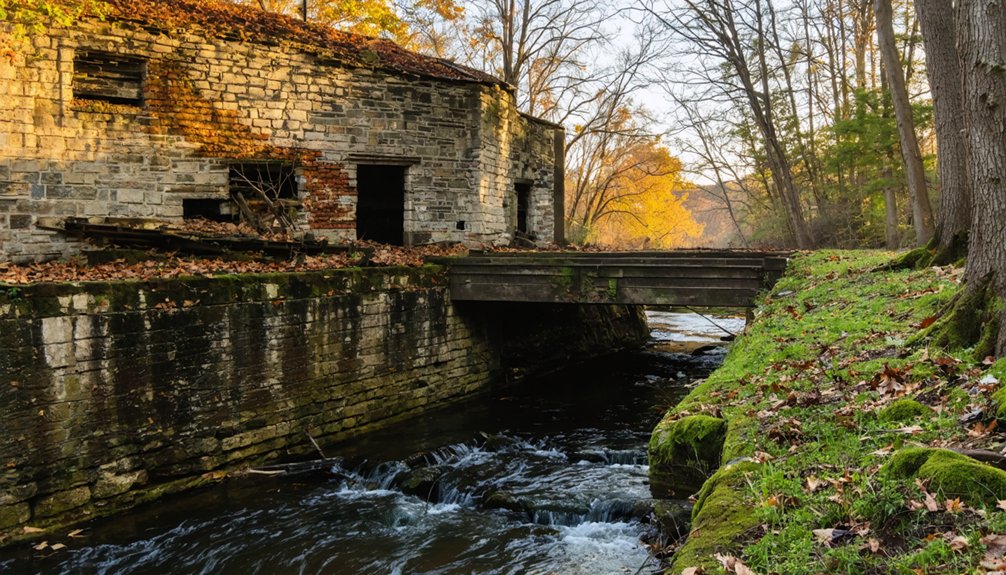
Today, only Hambleton Mill stands as a symbol of Sprucevale’s canal-driven prosperity, drawing visitors with its haunting presence along Beaver Creek’s shores.
San Toy: Echoes of Coal Country
You’ll discover San Toy’s dramatic rise and fall through its transformation from a bustling coal mining boomtown of nearly 1,000 residents to a ghost town in just a few short years.
The town’s wild reputation earned it recognition as Ohio’s most colorful and violent coal settlement, complete with numerous saloons, street brawls, and the county’s only hospital.
Among the haunting remnants that survive today, you can still find the weathered jail walls and mysterious steps that lead to nowhere, silent witnesses to San Toy’s tumultuous past in southeastern Ohio’s coal country.
Mining Boom and Bust
During the height of Ohio’s coal boom in the early 1900s, San Toy emerged as a proof to both the promise and peril of America’s industrial ambitions.
This mining legacy, now wrapped in ghost stories, tells a tale of rapid rise and dramatic fall that you’ll find fascinating.
The town’s destiny was shaped by four key factors:
- The New England Coal Company’s ambitious development in 1902
- An influx of immigrant workers seeking their fortune in Southeast Ohio
- The establishment of powerful labor movements fighting for workers’ rights
- A devastating mine shaft disaster that claimed five lives
You can trace San Toy’s transformation from a bustling coal town to an abandoned remnant of America’s industrial past, where the echoes of pickaxes and mining carts have long since faded into silence.
Haunted Company Store Remains
Among the haunting remnants of San Toy’s coal-mining past, the company store‘s crumbling foundation stands as a silent reminder to both commerce and controversy.
You’ll find these historic ruins nestled among newer homes that have sprouted up where thousands of miners once lived and worked. The company store, once the economic hub of this purpose-built mining community, served as more than just a mercantile – it was the heartbeat of San Toy’s daily life until the devastating mine fires of 1924.
Today, you can explore what’s left of this monument to Ohio’s mining heritage, though nature has largely reclaimed the site.
Like the nearby Robinson’s Cave where labor meetings once stirred revolution, the store’s remains tell a story of both prosperity and hardship in this former boomtown that saw one of America’s most dramatic population collapses.
Oreton’s Mining Heritage

The coal-rich hills of Vinton County once echoed with the sounds of miners extracting valuable Clarion coal from Oreton’s bustling operations.
Like many mining towns of its era, Oreton flourished during Ohio’s great coal boom, becoming an essential part of the region’s industrial heritage.
If you’re interested in Oreton’s history and mining operations, here are key aspects that shaped this ghost town:
- Miners worked grueling 10-12 hour days, six days a week
- Workers earned their wages by the ton of coal extracted
- Production peaked during the early 1900s as part of the Jackson Field coalfield
- The town supported nearby iron furnaces, including Eagle Furnace
Today, only a brick safe from the general store stands as evidence to Oreton’s once-thriving mining community, while concrete foundations hint at its industrial past.
Tips for Ghost Town Adventures
Before venturing into Ohio’s fascinating ghost towns, proper preparation and knowledge can make the difference between a rewarding expedition and a disappointing or dangerous outing.
Pack your hiking essentials including sturdy boots, water, and weather-appropriate gear. You’ll need flashlights for exploring dark tunnels and protective clothing against ticks and poison ivy.
Follow these essential safety tips: travel in groups, stay on marked paths, and inform others of your plans. Avoid entering unstable structures and watch for wildlife.
When traversing to remote locations like Moonville or Sprucevale, you’ll often need to park and hike in. Consider bringing metal detectors to uncover artifacts, and don’t forget your camera to document historical remnants.
Research your destinations through resources like the Center for Ghost Town Research to maximize your adventure.
Preserving Ohio’s Forgotten Communities
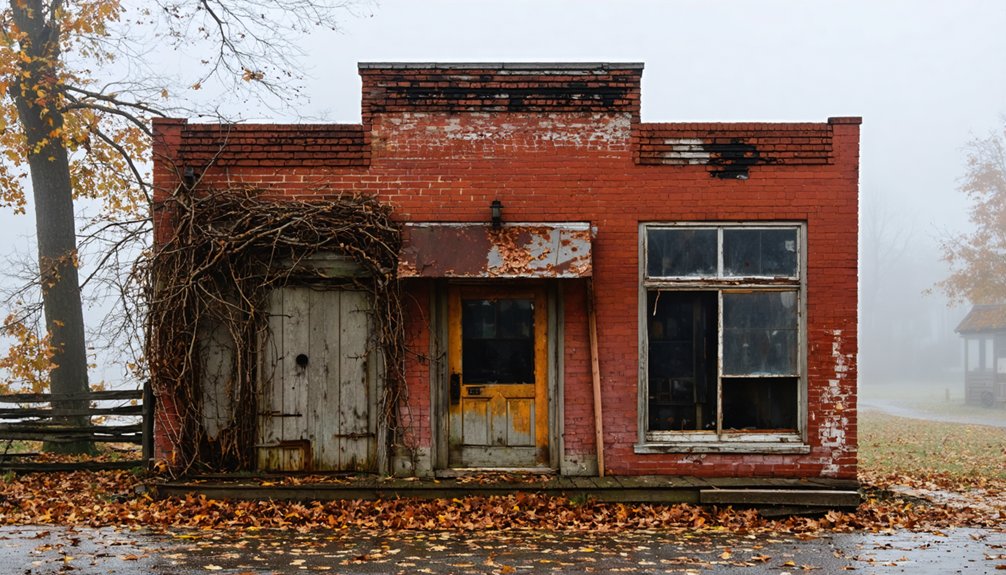
Dedicated preservation groups across Ohio work tirelessly to protect the state’s abandoned communities from falling into complete ruin.
Through community preservation initiatives and historical education programs, you’ll find remarkable efforts to keep these forgotten places alive for future generations.
You can experience these preservation success stories through:
- The restored Moonville tunnel and newly constructed pedestrian bridge over Raccoon Creek
- The “Preservation through Relocation” program that saves historic structures like the 1845 Jagger House
- The fully restored Gaston’s Mill in Beaver Creek State Park, which welcomes public visitors
- The Shaker Trace Trail’s 8-mile loop showcasing preserved buildings and a historic cemetery
These initiatives guarantee that Ohio’s ghost towns remain accessible while maintaining their authentic character and historical significance.
In addition to these efforts, many haunted locations in Ohio attract both tourists and paranormal enthusiasts, eager to explore the stories behind the eerie legends. Every visit provides a unique opportunity to connect with the past, drawing in those curious about the state’s rich history of hauntings and unexplained phenomena. As a result, these sites foster a deeper appreciation for Ohio’s cultural heritage while also supporting local economies.
Frequently Asked Questions
Are Camping Permits Required to Stay Overnight Near These Ghost Towns?
Like shadows in the night, you’ll need proper camping permits and pay overnight fees if you’re staying on public lands near ghost towns. Follow standard camping regulations for state parks or forests.
What Is the Best Season to Photograph Ohio’s Abandoned Ghost Towns?
You’ll get your best photography tips in winter when leafless trees reveal hidden structures, or autumn when seasonal colors pop. Spring requires bright clothing during hunting season, while summer offers lush overgrowth.
How Accessible Are These Locations for People With Mobility Limitations?
Through misty forest paths and weathered trails, you’ll find limited wheelchair access at most ghost towns. Your best bets are Hocking Hills’ Ash Cave and Blackhand Gorge, where paved paths and parking facilities exist.
Are Metal Detectors Allowed at Any of These Ghost Town Sites?
You’ll need written permission from property owners due to metal detecting laws, as ghost towns are protected by historical significance regulations. Don’t risk detection without proper authorization and documentation.
Which Ghost Towns Have Cell Phone Reception for Emergency Communication?
Like a digital lifeline, you’ll find reliable cell service availability at Shaker Village and Boston Mills/Helltown. Moonville’s isolation means spotty reception, so bring backup emergency communication options when exploring there.
References
- https://en.wikipedia.org/wiki/List_of_ghost_towns_in_Ohio
- https://www.youtube.com/watch?v=QWTtG6njIDs
- https://www.ohiotraveler.com/moonville-its-a-ghost-town/
- https://wrkr.com/ohio-ghost-towns/
- https://ohio.org/travel-inspiration/articles/haunted-ohio-must-visit-places
- https://hockingvacations.com/blog/exploring-the-ghost-towns-of-ohio-unearthing-forgotten-histories
- https://www.ideastream.org/2023-10-12/how-the-ghosts-of-moonville-are-keeping-the-towns-history-alive
- https://www.moonvilletunnel.net/Moonville_History.htm
- https://www.ravenwoodcastle.com/2015/07/14/legends-lore-moonville-tunnel/
- https://www.youtube.com/watch?v=XVwj5wpsgTM&vl=en-US