You’ll discover fascinating ghost towns across Rhode Island, from Hanton City’s 1600s stone foundations to Napatree Point’s hurricane-ravaged shores. The mysterious Ramtail Factory, haunted by its watchman’s death in 1822, draws paranormal enthusiasts, while Rocky Point’s abandoned amusement park tells tales of seaside entertainment. Fort Wetherill’s military ruins and Enchanted Forest’s overgrown fairy-tale remnants offer windows into the state’s rich past. Each site holds deeper stories waiting to be uncovered.
Key Takeaways
- Hanton City, established in the late 1600s, features explorable stone foundations and walls along the Hanton City Trail.
- Napatree Point transformed from a thriving summer community with 39 cottages into an uninhabited barrier beach after the 1938 hurricane.
- Ramtail Factory, Rhode Island’s only state-listed haunted location, holds a dark history and ruins from its 1813 woolen mill operations.
- Historic Rocky Point Amusement Park, though now a state park, stands as a ghost of its former glory after closing in 1995.
- The Enchanted Forest, abandoned since 2005, remains a decaying testament to Rhode Island’s entertainment history with its overgrown fairy-tale ruins.
The Hidden Ruins of Hanton City
Deep in the forested outskirts of Smithfield, Rhode Island, you’ll find the mysterious ruins of Hanton City, a settlement that dates back to the late 1600s.
The Hanton history began after King Philip’s War, when English families like the Hurtings, Paines, and Shippees established a small community of tanners and bootmakers. The settlement reached its peak in the 1730s but fell into decline by the early 1800s when a highway diversion cut off essential trade routes. The area once bustled with activity from its stone quarry operations. Historical records suggest the town may have harbored British loyalists during the American Revolution.
Nestled in colonial New England, Hanton City thrived as a hub of craftsmen until changing roads sealed its fate.
Today, you can explore the abandoned structures along the Hanton City Trail, where stone foundations and walls tell tales of this forgotten place.
You’ll discover remnants of a corn crib and a hidden dam deep in the woods, all that remains of this once-thriving rural trading stop that vanished from official maps by the 1850s.
Napatree Point: Swept Away by Nature
If you’d visited Napatree Point before September 1938, you’d have found a thriving summer community of beachfront homes along Fort Road.
The devastating Hurricane of 1938 struck this coastal settlement with catastrophic force, claiming 15 lives and destroying every single residence that once stood there. The storm’s powerful combination of wind and tide created unprecedented destruction, much like the devastation seen in other coastal Rhode Island towns. The area’s transformation had already begun decades earlier when the Fort Mansfield buildings were demolished in 1928.
What was once a populated beach community transformed overnight into an uninhabited barrier beach, marking one of Rhode Island’s most dramatic examples of a settlement completely erased by natural forces.
Hurricane’s Devastating Impact
When the devastating 1938 hurricane struck New England without warning that September, it released unprecedented destruction on Rhode Island’s coastal communities.
You would’ve witnessed fierce clockwise winds driving massive waves up to 25 feet high into Narragansett Bay, creating one of the region’s most catastrophic coastal ghosttowns.
Within minutes, the hurricane devastation transformed Napatree Point from a thriving summer community of 39 cottages into a wasteland. Of the 42 residents who stayed, 15 perished and 27 were swept into the raging sea.
The morning started mild and hazy before the destruction began.
The storm’s fury didn’t stop there – Providence found itself submerged under 14 feet of water, while Westerly lost 100 residents.
Survivors had no choice but to seek refuge in the upper floors of buildings as the waters rose.
The hurricane’s total toll was staggering: over 600 lives lost and 25,000 buildings destroyed, forever altering Rhode Island’s coastline.
Pre-Storm Coastal Community
Before nature’s fury reshaped Napatree Point forever, this narrow coastal peninsula thrived as an exclusive summer retreat. You would’ve found thirty-nine pre-storm cottages lining the 1.5-mile stretch between the Atlantic Ocean and Little Narragansett Bay by 1918, creating a vibrant seasonal community.
The area’s history was deeply tied to coastal artillery, with Fort Mansfield‘s presence giving the main road its nickname “Fort Road.” First established in 1898 on 60 acres, Fort Mansfield served as a critical military fortification at Napatree Point.
Sadly, the devastating 1938 hurricane destroyed all thirty-nine houses and claimed fifteen lives in the community.
While the military installation had been abandoned by 1917, the peninsula’s exclusivity remained fiercely protected. When a developer proposed subdividing Sandy Point into 674 lots in 1926, Watch Hill residents fought back.
Their determination to preserve the area’s character led to a private syndicate purchasing the land in 1928, promptly demolishing all remaining Fort Mansfield buildings that winter.
The Haunting Legacy of Ramtail Factory
The haunting tale of Ramtail Factory began in 1813 when William Potter, Peleg Walker, and their partners established the Foster Woolen Manufacturing Company on six acres of Rhode Island land.
The mill’s history took a dark turn when Peleg Walker, the night watchman, was found hanging from the bell rope in 1822 after a heated dispute over ownership. Financial troubles led him to acquire significant debts and mills during his expansion efforts. His last words warned that the mill key would be found in a dead man’s pocket.
In a chilling turn of fate, night watchman Peleg Walker was discovered lifeless, suspended from the factory bell rope.
You’ll still find evidence of these ghostly sightings that drove workers away and led to the mill’s eventual closure in 1850:
- The mysterious tolling of the work bell in the dead of night
- Machinery starting up on its own without power
- Walker’s spirit wandering with his lantern through empty buildings
- The official recognition as Rhode Island’s only state-listed haunted location in 1885
Even after arsonists burned it down in 1873, the ruins continue to draw those seeking supernatural encounters.
Rocky Point’s Silent Shores
While Ramtail Factory’s ghostly legacy haunts Foster’s wooded interior, Rhode Island’s coastal region harbors its own abandoned landmark at Rocky Point.
You’ll find a site that’s transformed dramatically since its 1847 origins as Captain William Winslow’s nature retreat. The park evolved from an elite resort to “the Coney Island of Rhode Island,” surviving multiple natural disasters including devastating hurricanes in 1938 and 1954.
Among the historical remnants, you can trace where ghostly attractions once stood – the massive Shore Dinner Hall that seated 4,000, the Olympic-sized swimming pool, and thrilling rides like the Skyliner and House of Horrors.
After closing in 1995 due to bankruptcy, this former amusement paradise lay dormant until 2013, when it became a state park, forever silencing its century-old carnival sounds.
Fort Wetherill’s Abandoned Military Past
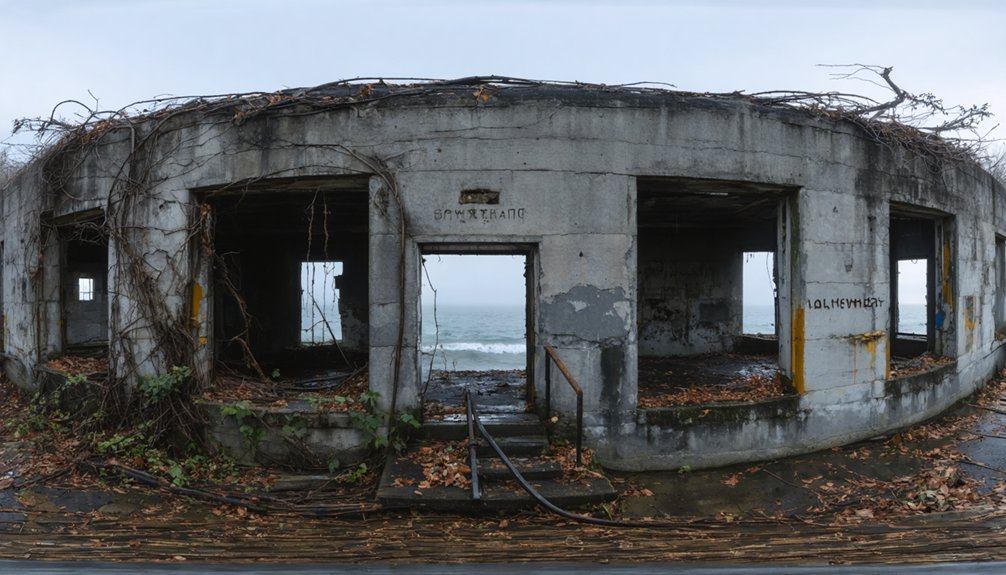
Along Rhode Island’s rugged coastline, Fort Wetherill’s military legacy began in 1776 when American colonists erected the Battery on Dumpling Rock to defend Newport from British forces.
The site’s coastal defenses evolved through major conflicts, from British occupation to World War II, marking nearly two centuries of military history.
You can still explore these haunting reminders of America’s defensive past:
- Massive concrete gun emplacements with 10-mile firing ranges
- Underground tunnels and bunkers from the Endicott period
- World War II-era barracks that once housed German POWs
- Observation posts where soldiers once watched for enemy submarines
After serving as a critical defensive position through multiple wars, Fort Wetherill fell silent in 1946.
The abandoned fort stood empty for 25 years until the state acquired it in 1972, preserving its military heritage for future generations.
The Lost Wonder of Enchanted Forest
Nestled among 31 wooded acres in Hope Valley, Enchanted Forest opened its gates on June 17, 1972, as Rhode Island’s premier fairy tale-themed amusement park.
You’d find Humpty Dumpty perched atop his wall, welcoming visitors to a wonderland of storybook attractions like the House That Jack Built and the Old Woman’s Shoe.
For over three decades, you could enjoy bumper cars, teacups, and The Scrambler, or pet goats and ride ponies at the small zoo.
Local Chariho High students even helped build many of the displays, making it truly community-driven.
Sadly, by 2005, declining attendance forced the park’s closure.
Today, nature’s reclaimed the grounds where nostalgic memories were made.
Though the iconic sign along Route 3 still peeks through the overgrowth, the park remains off-limits to visitors, preserved only in memory.
Frequently Asked Questions
Are Any of Rhode Island’s Ghost Towns Protected as Historical Landmarks?
You won’t find official historical landmark protection for Rhode Island’s ghost towns, despite their historical significance. While places like Hanton City and Napatree Point exist, formal preservation efforts remain absent.
Can Visitors Legally Explore These Abandoned Sites Without Special Permission?
While 90% of Rhode Island’s ghost towns allow legal exploration, you’ll need to stick to established visitor guidelines – staying on marked trails and accessing sites through public routes.
What Wildlife Has Taken Over These Deserted Rhode Island Locations?
You’ll find diverse urban wildlife thriving in these abandoned habitats – from deer and foxes at Hanton City to coastal birds at Napatree Point, plus raccoons, waterfowl, and amphibians everywhere in between.
Do Any Local Preservation Groups Offer Guided Tours of These Sites?
You won’t find organized guided tours at these ghost town sites through local preservation groups – they’re accessible mainly through independent exploration, though you should verify permissions before visiting.
Which Ghost Town Location Is Considered the Most Dangerous to Visit?
Playing with fire at Ellenton, South Carolina would prove lethal. Beyond typical haunted history, you’ll face severe safety concerns from radioactive contamination that’s made this ghost town Earth’s most dangerous abandoned site.
References
- https://www.youtube.com/watch?v=kpy7zlXYrAU
- https://newenglandwithlove.com/ghost-towns-in-rhode-island/
- https://carte-urbex.com/en/blogs/infos/top-10-abandoned-places-in-rhode-island
- https://podcasts.apple.com/us/podcast/57-ghost-town-hanton-city/id1554896421?i=1000563483124
- https://en.wikipedia.org/wiki/List_of_ghost_towns_in_Rhode_Island
- http://freepages.rootsweb.com/~gtusa/history/usa/ri.htm
- https://www.onlyinyourstate.com/state-pride/rhode-island/hanton-city-lost-town-ri
- https://www.youtube.com/watch?v=3bFcmv7IH40
- https://www.onlyinyourstate.com/experiences/rhode-island/hanton-city-haunting-ri
- https://www.chowdaheadz.com/blogs/news/new-england-myths-legends-the-ruins-of-hanton-city-rhode-island