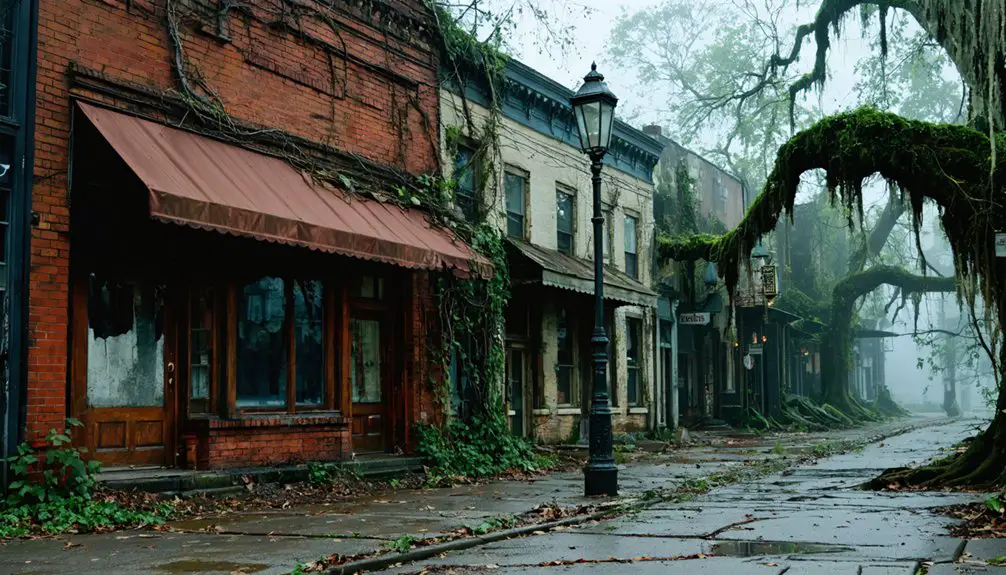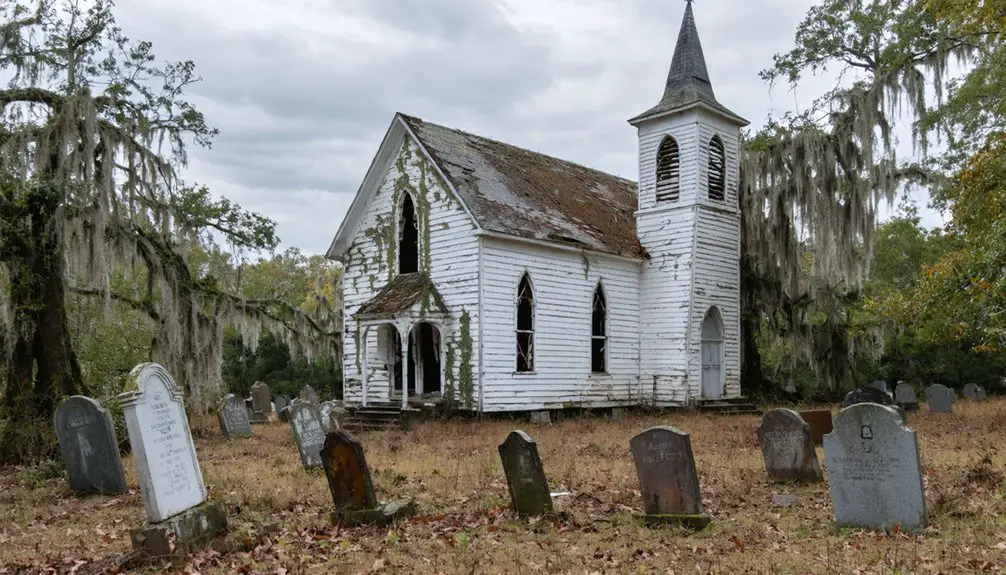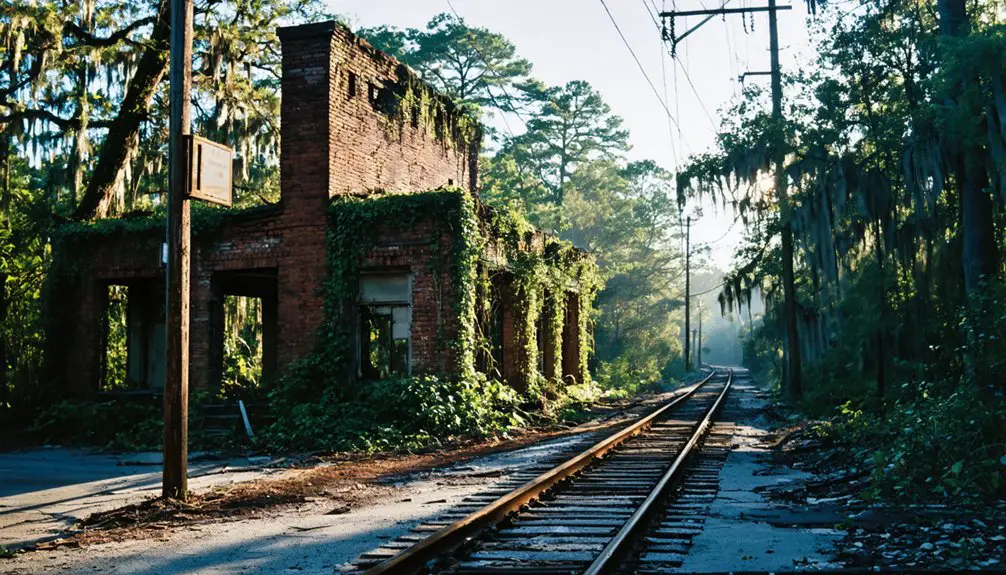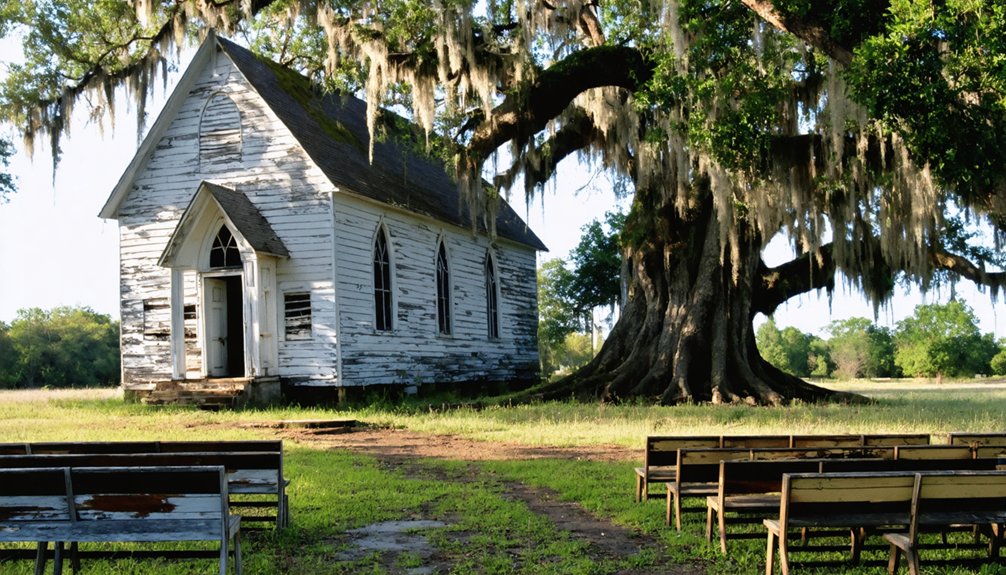
You’ll find South Carolina’s most fascinating ghost towns scattered across the state’s diverse landscape. The colonial-era Dorchester settlement showcases preserved 18th-century ruins, while Hamburg’s remnants recall its glory days as the state’s largest inland port. Don’t miss Andersonville Mill, the oldest mill on its original foundation, or the submerged communities beneath Lake Murray. The haunting remains of Ellenton and Dunbarton reveal a deeper story of Cold War sacrifice and nuclear ambition.
Key Takeaways
- Andersonville Mill, South Carolina’s oldest mill on its original foundation, stands as a preserved ghost town along North Tyger River.
- Dorchester, founded in 1696, features well-preserved ruins including St. George’s Anglican Church from 1751.
- Hamburg, once South Carolina’s largest inland port, now lies abandoned after flooding and absorption into North Augusta.
- Ferguson’s Company Town offers unique historical significance with remnants of the first South Carolina town with indoor plumbing.
- Lake Murray’s shoreline provides access to multiple submerged ghost towns, including nine complete communities beneath its waters.
The Rise and Fall of Andersonville’s Mill Empire
Along the rushing waters of North Tyger River, approximately 8 miles southwest of Spartanburg’s town square, stands one of South Carolina’s most significant mill sites.
You’ll find Andersonville Mill, established in the Revolutionary era, where the county’s first court convened in 1785. The site was originally known as Nicholl’s Fort, operating under various names before Anderson’s ownership. Under “Tyger Jim” Anderson’s ownership from 1831, the mill thrived as a crucial economic engine, grinding corn and wheat with locally-hewn millstones.
The mill’s prosperity continued through multiple renovations, including a twentieth-century rebuild featuring a twelve-foot metal water wheel. Today, digital archives preserve detailed records of the mill’s operational history.
But like many rural industries, economic decline took its toll. Operations ceased in 1975, leaving this historic structure dormant.
Though abandoned, the mill endures as South Carolina’s oldest on its original foundation, now awaiting restoration by the Tyger River Foundation.
Dorchester’s Colonial Heritage and Revolutionary War Legacy
When Congregationalist settlers from Dorchester, Massachusetts arrived in South Carolina’s lowcountry in 1696, they established what would become one of the region’s most significant colonial settlements.
Led by Reverend Joseph Lord, these colonial missionaries transformed 4,050 acres along the Ashley River into a thriving market village.
Under Reverend Lord’s guidance, colonial settlers carved out a bustling marketplace from 4,050 acres of Ashley River wilderness.
St. George’s Anglican Church and its distinctive bell tower, completed in 1751, became enduring landmarks of the settlement.
You’ll find Dorchester’s strategic importance peaked during the Revolutionary War when its tabby fort, built between 1757-1760, served as a essential military depot under Francis Marion’s command.
The village later declined as Summerville’s growth overshadowed it, particularly after the railway construction in 1831.
- Weekly markets and bi-annual fairs made Dorchester a crucial trading hub
- Revolutionary fortifications included a powder magazine storing gunpowder and cannons
- Both British and Patriot forces occupied the town during the war
- Colonial-era archaeological remains are well-preserved beneath the surface
- The settlement prospered for nearly a century until the Revolutionary period
Ellenton: A Town Sacrificed for Nuclear Progress
While you’d recognize Ellenton today as part of the sprawling Savannah River Site nuclear complex, this 70-year-old farming community faced complete displacement in 1950 when the U.S. government selected its location for hydrogen bomb production.
The town’s location was chosen specifically for its proximity to water, as the Savannah River would supply the necessary resources for the facility’s operations.
Today, public walking tours showcase the remnants of this historic town, allowing visitors to explore old streets and building foundations of former residences and businesses.
You’ll find that more than 6,000 residents from Ellenton and surrounding areas were forced to relocate, with many establishing New Ellenton just north of the nuclear site.
The transformation cost the government $19 million in land acquisition and relocation expenses, forever altering the region’s landscape from agricultural hub to restricted nuclear facility.
Mass Relocation Impact
In November 1950, the U.S. Atomic Energy Commission’s announcement shattered the peaceful existence of Ellenton, forcing an unprecedented mass relocation that would test the community’s resilience. The town had grown steadily since being established as a Port Royal Railroad depot in 1870. The evacuated area became home to the Savannah River Plant, which produced materials for America’s nuclear arsenal.
You’ll find that approximately 6,000 residents were uprooted from their homes, while historical memory lives on through Bonner Smith’s poignant shoe-polish sign expressing both patriotic duty and heartbreak.
- Over half of residents aged 50+ died within a decade of displacement
- Young residents scattered across the state and beyond
- 6,000 graves required relocation to new settlements
- New Ellenton and Jackson emerged as refuge communities
- 38,500 workers occupied trailer parks near the plant entrance by 1952
The mass exodus culminated on April 1, 1952, when the last resident departed, marking the end of original Ellenton’s vibrant community life.
Nuclear Site Development Cost
The staggering $9.8 billion initial projection for Units 2 and 3 marked the beginning of South Carolina’s most ambitious nuclear development project in 2008.
You’ll find that nuclear finance quickly spiraled out of control as Westinghouse implemented thousands of costly design changes, even charging $114 for nuts that should’ve cost $2.20 each. Local ratepayers continue to face monthly charges of $37 million for the failed project.
The project came to an abrupt end when Westinghouse filed bankruptcy in March 2017, leading to the complete abandonment of construction efforts.
Hamburg’s Journey From Cotton Hub to Historical Landmark
Founded by German immigrant Henry Shultz in 1821, Hamburg grew from a strategic riverside settlement into South Carolina’s largest inland port during the antebellum era.
This cotton legacy powerhouse shipped 60,000 bales annually, worth $2 million in its prime. You’ll find Hamburg’s rise was propelled by the South Carolina Canal and Rail Road terminus, making it a formidable rival to Augusta, Georgia.
However, the town’s fate shifted dramatically when the railroad bridge crossed the Savannah River in 1853, leading to its eventual transformation into a ghost town.
A prosperous river town’s destiny crumbled when a new railroad bridge redirected trade across the Savannah, leaving only echoes behind.
- Handled $2 million worth of cotton trade at its peak
- Served as western terminus of world’s longest railroad in 1833
- Became a Republican stronghold during Reconstruction
- Witnessed the tragic Hamburg Massacre of 1876
- Succumbed to devastating floods before being absorbed into North Augusta
Dunbarton’s Nuclear Age Exodus
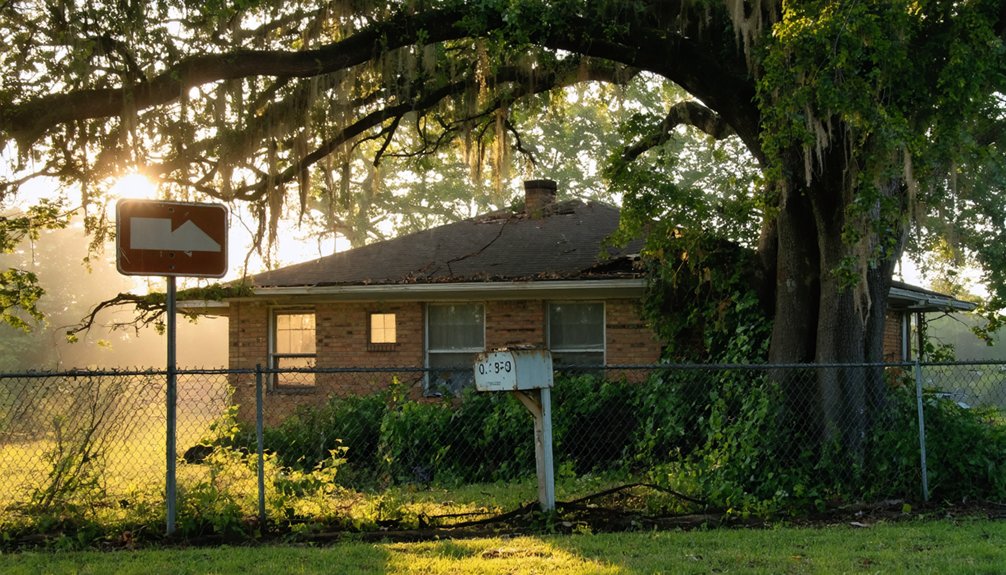
During the tense early months of 1950, Cold War fears transformed rural Dunbarton into ground zero for America’s nuclear ambitions when President Harry Truman authorized the massive Savannah River Plant project.
You’ll find Dunbarton history forever changed as the government seized 210,000 acres, forcing 6,000 residents from their homes. The nuclear displacement scattered entire communities, with many relocating to nearby Williston where pre-fab houses and trailer cities sprouted overnight.
For a mere $19 million, the government acquired land worth far more – the timber alone was valued at $28 million.
Today, Dunbarton lies buried beneath one of Earth’s most toxic sites, with decommissioned reactors entombed in concrete. The town’s sacrifice helped forge America’s hydrogen bomb program, forever altering the landscape of South Carolina’s countryside.
Ferguson’s Company Town Struggles
When Chicago lumber barons Francis Beidler and Benjamin Franklin Ferguson established their Santee River Cypress Lumber Company in 1881, you wouldn’t have guessed it’d transform into one of South Carolina’s most advanced company towns.
While labor conditions were better than most logging operations of that era, workers still found themselves bound to the company’s economic system through company scrip, which they could only spend at company-owned stores.
- First South Carolina town with indoor plumbing and gas-lit streets
- Peak population of 2,500 residents with state-of-the-art school and hospital
- Region’s largest cypress lumber operation with extensive railroad networks
- Workers earned company currency instead of government-issued money
The town thrived until 1915 when Beidler lost his eyesight and closed operations.
Lost Communities Beneath South Carolina Waters
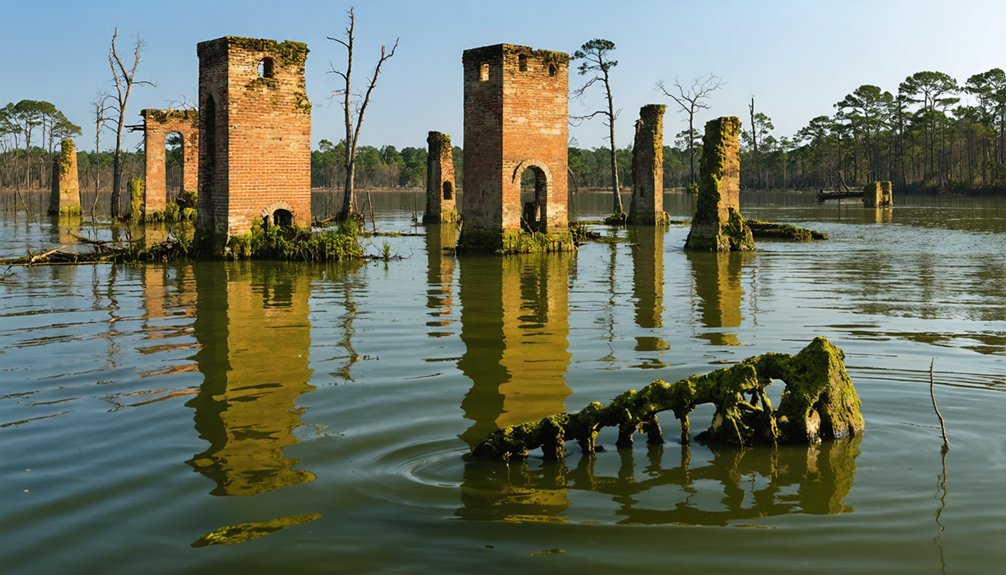
South Carolina’s landscape hides a remarkable secret beneath its waters – entire communities, churches, and graveyards now rest at the bottom of man-made lakes.
The creation of major reservoirs like Lake Murray, Hartwell, Marion, Jocassee, and Keowee has submerged countless historical settlements that once thrived along river valleys.
You’ll find the most extensive submerged settlements at Lake Murray, where nine towns housing nearly 5,000 residents disappeared beneath the waters.
The historic Dutch Fork and Saxe Gotha communities, settled by European immigrants in the 1750s, now lie silent below.
At Lake Hartwell, you can explore the story of Andersonville, a bustling textile town that vanished in the flood.
Even more haunting, over 2,300 graves rest at Lake Murray’s bottom, briefly exposed during a drawdown 20 years ago, reminding us of the profound historical significance of these lost communities.
Historic Preservation Efforts and Archaeological Discoveries
Recent archaeological discoveries across South Carolina reveal fascinating windows into the state’s rich past, from prehistoric settlements to colonial towns.
You’ll find remarkable preservation strategies at work, especially at Colonial Dorchester, where pristine 18th-century evidence awaits exploration. The archaeological significance of these sites can’t be overstated, with groundbreaking finds reshaping our understanding of early American history.
- Topper Site’s revolutionary artifacts push human presence back 20,000 years
- Colonial Dorchester’s untouched quarter-acre lots yield thousands of artifacts
- Chauga Mound’s mysterious structures now rest beneath Lake Hartwell
- Mayucha Mining Town’s scattered remnants tell tales of Confederate-era industry
- Columbia backyard digs uncover African-American family life through 60,000 artifacts
At these sites, you’re not just observing history – you’re free to participate in public excavations that connect you directly to South Carolina’s past.
Tales From Former Residents and Their Descendants

Through personal accounts and family memories, the heartbreaking stories of South Carolina’s ghost towns come alive in vivid detail.
Richard Mims’ exploration of Ferguson’s mill before Lake Marion’s flooding offers a rare glimpse into a vanished world, where millions of board feet of cypress now lie beneath the waters.
Ellenton memories paint a picture of bustling Main Street life, with its beloved Cassells store and Esso station, now accessible only through carefully chaperoned visits.
Dunbarton experiences reveal the deep trauma of displacement, as residents were forced into prefab homes in New Ellenton, where over half of the elderly didn’t survive a decade.
You’ll find these stories particularly poignant in their portrayal of communities uprooted for the Savannah River Plant, forever changing the landscape of their lives.
Accessing and Exploring South Carolina’s Abandoned Towns
When exploring South Carolina’s ghost towns, you’ll want to visit during fall or winter months when overgrowth is minimal and visibility is best through sites like Hell Hole Swamp and Pinckneyville’s stone ruins.
You’ll need sturdy boots, a fully charged phone with saved maps, and a full tank of gas since many locations sit far from main roads across the state’s 290-mile ghost town circuit.
Exercise caution around unstable foundations and abandoned structures, especially after rainfall when terrain becomes slick and hazardous at sites like Colonial Dorchester’s archaeological grounds.
Safety First When Exploring
Safety must be your top priority before venturing into South Carolina’s ghost towns, as these abandoned sites pose numerous hazards requiring careful planning and legal compliance.
You’ll need to navigate complex safety regulations and maintain emergency preparedness while exploring these historic locations.
- Always obtain necessary permits from the Planning Department and guarantee compliance with local safety codes.
- Keep a minimum 3-foot clearance for exits and follow marked trails under 1,000 feet.
- Watch for structural hazards in abandoned buildings and stay clear of radioactive areas.
- Never use open flames, temporary heaters, or smoke inside historic structures.
- Respect private property boundaries and obtain permission before accessing sites.
Best Times To Visit
Planning your visit to South Carolina’s ghost towns requires careful timing based on seasonal conditions and accessibility methods.
Summer offers the best visiting opportunities for water-based exploration, especially if you’re kayaking to submerged locations like Andersonville or Lake Hartwell’s forgotten communities.
Fall provides comfortable temperatures for extended ground exploration of mill ruins and cemetery sites.
You’ll want to avoid winter when remote road conditions can be treacherous, and spring flooding might limit access to certain areas.
Before heading out, check current water levels if you’re planning boat access to inundated towns.
For government-restricted sites like old Ellenton, verify access permissions in advance.
Remember that seasonal fluctuations can dramatically affect your ability to reach and explore these historical locations.
Frequently Asked Questions
Are There Any Ghost Town Legends or Paranormal Activities Reported?
You’ll find these locations lack documented ghost stories or confirmed paranormal activity, though their abandoned buildings and centuries-old ruins contribute to their reputation as haunted sites worth exploring.
What Wildlife Now Inhabits These Abandoned South Carolina Ghost Towns?
Through dense shadows, you’ll spot urban wildlife sightings: turtles in Ellenton’s contaminated waters, fish darting beneath Andersonville’s lake surface, birds soaring over Colonial Dorchester, and mammals scurrying through Pinckneyville’s stone ruins.
Can Visitors Take Artifacts Found in These Ghost Towns?
No, you can’t legally remove artifacts from South Carolina ghost towns. Artifact preservation laws protect these historical sites, and ethical considerations require leaving items in place for future research and documentation.
Which Ghost Town Is Considered the Most Historically Significant?
Like a time capsule frozen in moss-covered stone, you’ll find Dorchester holds the greatest historical significance. Its preserved Puritan ruins and active archaeological preservation efforts tell essential stories of colonial settlement patterns.
Do Any Descendants Still Hold Legal Rights to These Properties?
You’ll find that most property ownership rights have expired due to government seizures, unclear title chains, and time-barred legal claims, though some descendants maintain limited interests through historic preservation agreements.
References
- https://cityofdust.blogspot.com/2005/02/dead-towns-south-carolina.html
- https://sctravelguide.com/2018/06/11/south-carolina-ghost-towns/
- https://www.youtube.com/watch?v=e6EyXGUdasA
- https://www.randomconnections.com/ghost-towns-of-the-pee-dee-part-1-ellas-grove-and-palmer/
- https://www.blueridgeoutdoors.com/go-outside/southern-ghost-towns/
- https://www.atlasobscura.com/things-to-do/south-carolina/abandoned
- https://www.youtube.com/watch?v=-kK74wq5NUQ
- https://en.wikipedia.org/wiki/List_of_ghost_towns_in_South_Carolina
- http://www.onlyinyourstate.com/trip-ideas/south-carolina/haunted-road-trip-sc-ghost-towns
- https://wnok.iheart.com/content/2023-10-11-abandoned-south-carolina-town-named-the-creepiest-ghost-town-in-the-state/