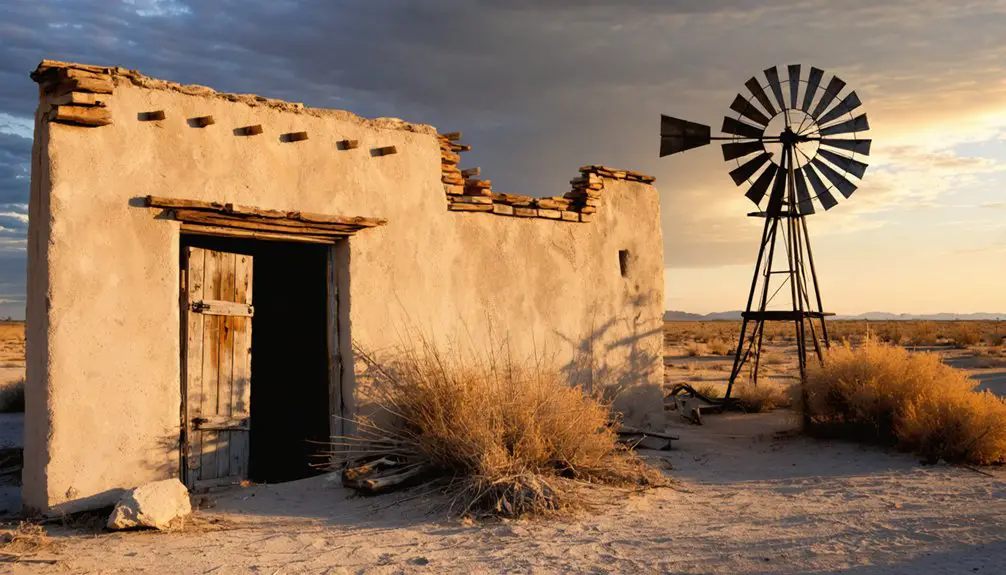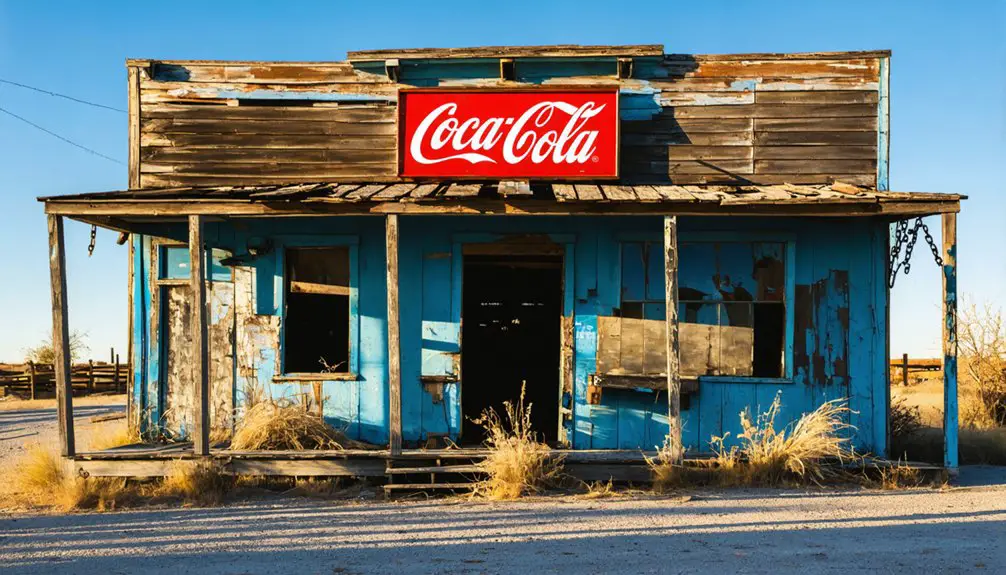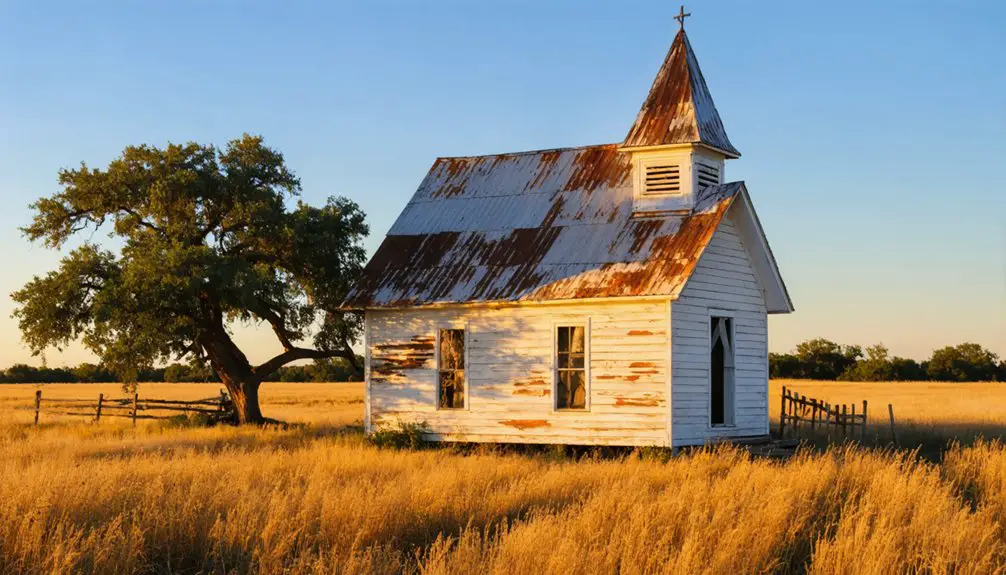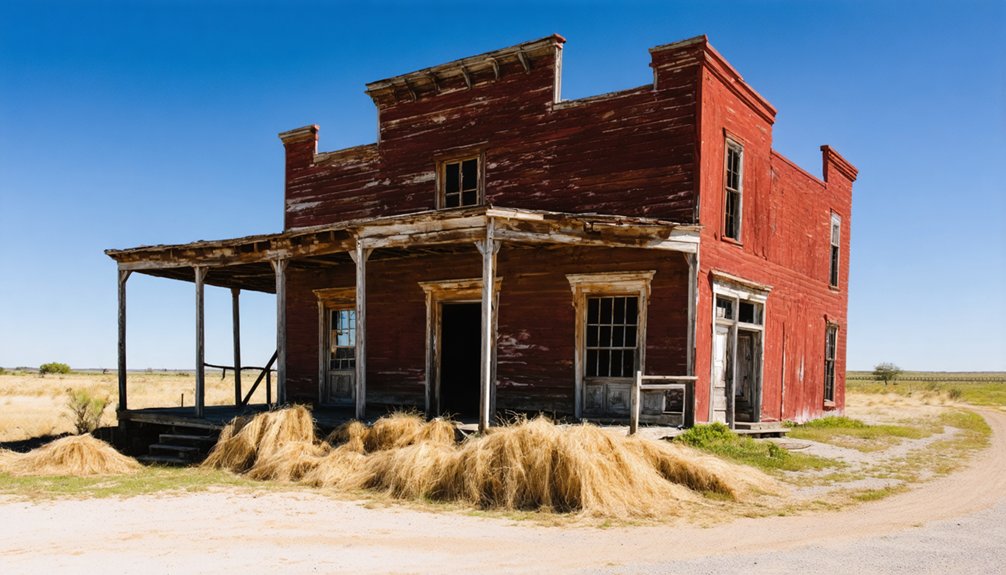
You’ll find Texas’s most enchanting ghost towns scattered across the state’s vast landscape. Terlingua offers a mercury mining legacy with its famous chili cook-off, while Old Bluffton lies mysteriously beneath Lake Buchanan’s waters. The border town of Glenrio showcases Route 66 history with seventeen abandoned buildings, and Toyah whispers tales from its 1906 past. These abandoned settlements tell fascinating stories of boom-and-bust cycles that shaped the Lone Star State.
Key Takeaways
- Terlingua offers rich mining heritage, historic structures, and hosts a famous annual chili cook-off attracting thousands of visitors.
- Old Bluffton reveals submerged ruins and archaeological treasures during drought periods, showcasing a preserved underwater ghost town.
- Glenrio features seventeen abandoned buildings along Route 66, including historic motels and a unique Texas-New Mexico border trading post.
- Thurber, once the largest city between Fort Worth and El Paso, preserves remnants of its 10,000-person coal mining community.
- Toyah maintains historic buildings and haunting stories from its railroad era, with dramatic population decline from 553 to 90 residents.
The Rise and Fall of Texas Ghost Towns
While the expansion of railroads and industry transformed Texas in the late 1800s, these same forces would eventually lead to the creation of the state’s ghost towns.
You’ll find these abandoned settlements scattered across the landscape, each telling a story of boom and bust cycles that shaped the Lone Star State.
During the industrial boom, you’d have seen towns spring up overnight around mining operations, oil discoveries, and railroad junctions. The discovery of oil in 1926 turned Otis Chalk into a booming oil town.
Towns materialized like mirages in the Texas desert, drawn by the promise of mineral wealth and iron rails.
Places like Thurber grew from nothing to become the largest city between Fort Worth and El Paso, boasting 10,000 residents at its peak.
But economic shifts proved unforgiving. When mines dried up, oil fields went bust, or railroad routes changed, these once-thriving communities often couldn’t survive.
Natural disasters, like the hurricanes that destroyed Indianola, sometimes delivered the final blow.
Today, Texas leads the nation with 511 ghost towns, standing as silent witnesses to the state’s dynamic past.
Exploring Terlingua: A Mercury Mining Legacy
Among Texas ghost towns, Terlingua stands out as a tribute to the state’s rich mining heritage. You’ll discover a town that boomed in the early 1900s when cinnabar significance drew prospectors seeking mercury-rich ore.
While indigenous peoples had long prized the area’s brilliant red cinnabar for body paint, it wasn’t until the Chisos Mining Company established operations in 1903 that Terlingua truly flourished. The Chisos Mining Company developed vital community structures including schools and churches.
At its peak, you’ll find the town supported over 1,000 residents, with Howard Perry’s impressive mansion overlooking a community complete with churches, schools, and segregated housing areas.
When World War I increased mercury demand, Terlingua thrived until the 1940s. Though the mines eventually ran dry, today you can explore this mining heritage while attending the famous chili cook-off that draws thousands each November. Located between two major parks, Terlingua offers stunning views of the Rio Grande and surrounding desert landscape.
Hidden Beneath Lake Buchanan: Old Bluffton’s Story
You’ll find Old Bluffton’s historic legacy uniquely preserved beneath Lake Buchanan’s waters, where the once-thriving agricultural community met its fate during the 1937 dam construction.
During severe droughts, particularly in 2009 when water levels dropped 26 feet, you can spot foundation stones and other remnants of this former settlement that housed 50 families at its peak. History enthusiasts can join guided lake cruises to explore the submerged town’s location.
While most traces of the town lie submerged under 30 feet of water today, periodic drought cycles continue to reveal glimpses of this remarkable piece of Texas Hill Country history, where pecan orchards and cotton fields once flourished. The town’s original Davis/Maxwell family established the settlement in 1852, laying the groundwork for what would become a vital agricultural center.
Historic Valley Life
Valley agriculture defined daily life in old Bluffton, where 50 families cultivated the rich soil along the Colorado River’s west bank.
You’ll find the story of community resilience in how residents sustained themselves through pecan harvesting, corn cultivation, and cotton production despite facing storms, drought, fire, and floods over the decades.
The town’s infrastructure supported a thriving rural economy, complete with a general store, cotton gin, school, and hotel serving both locals and stagecoach travelers.
The creation of Lake Buchanan forced residents to abandon their homes and livelihoods in 1937.
Family bonds ran deep, evidenced by the rural cemeteries that connected generations of residents. Engineers predicted a four-year fill time, but heavy rains accelerated the lake’s completion to just a few months.
Archaeological remnants tell a diverse story – from prehistoric findings to freed slaves’ graves, while discovered artifacts like metal tools, medicine bottles, and blacksmith equipment paint a picture of a self-sufficient frontier community adapting to life in the Texas Hill Country.
Waters Reveal Lost Town
When Lake Buchanan’s floodwaters rose in 1937, they swallowed Old Bluffton whole, submerging the historic town beneath 30 feet of water.
But you’ll find that lost history has a way of resurfacing. During severe droughts in 1984, 2009, and 2013, dropping water levels revealed submerged relics of this once-thriving Hill Country settlement.
If you visit during low water periods, you might spot foundation stones of the old schoolhouse, cotton gin, and store that residents left behind.
The stagecoach line settlement in the 1880s grew to house approximately 50 families at its peak.
The town’s remnants become visible when the lake drops to 1,000 feet above sea level, about 20 feet below capacity.
The Lower Colorado River Authority oversaw the relocation of about 100 graves before the flooding began.
Though heavy rains in 2016 concealed Old Bluffton once again, its periodic reemergence serves as a haunting reminder of the community that thrived here before Lake Buchanan’s waters claimed it.
Lake Preserves Mining Heritage
The tragic tale of Old Bluffton’s submersion beneath Lake Buchanan stands as a monument to both progress and loss in Texas history.
While lake preservation efforts have transformed the region’s economy, they’ve also created an unintended underwater museum of Texas heritage. You’ll find submerged artifacts from a once-thriving community, including a cotton gin, general store remains, and a hotel’s storm cellar, all resting about 30 feet below the surface.
Before flooding, workers chopped down ancient pecan orchards to protect future boaters, while teams relocated over 300 graves to New Bluffton.
The dam project, though controversial for forcing residents to sell their land, provided 20,000 Depression-era jobs and brought electricity to the Hill Country, forever changing the landscape of this historic Texas settlement.
Sacred Grounds of Medicine Mound
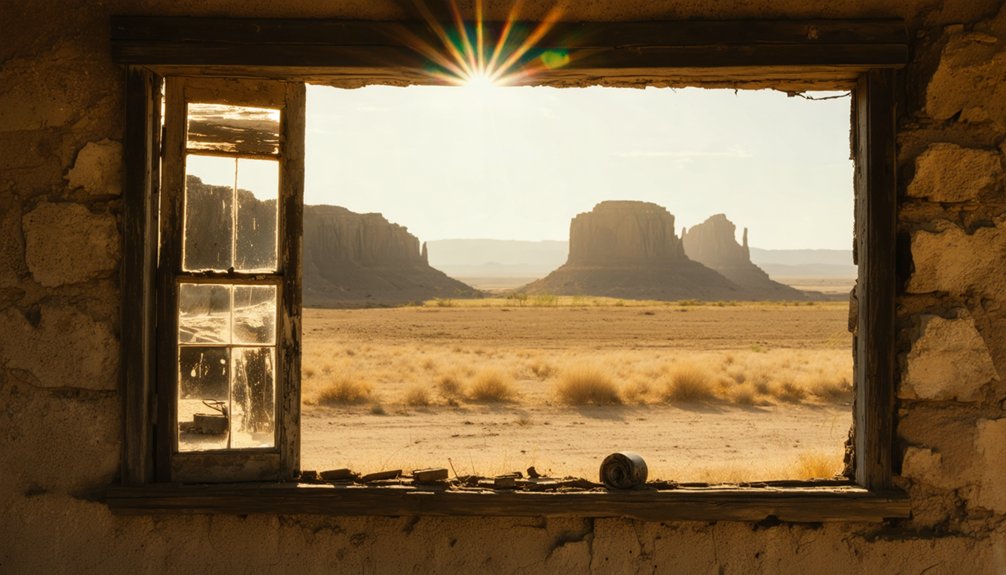
Four majestic conical hills rise from Texas’s sprawling plains, forming the sacred grounds that gave Medicine Mound its name. For generations, Comanche and Kiowa tribes sought sacred healing on these mounds, with warriors fasting atop Big Mound seeking visions.
You’ll find this once-thriving town, established in 1910 near these spiritual landmarks, holds layers of history beneath its weathered facade. At its peak in 1929, you could’ve joined 500 residents enjoying 22 bustling businesses.
But nature and fate intervened – devastating fires in 1932 and 1933, followed by drought and economic hardship, gradually emptied the streets.
Today, you can explore two surviving cobblestone buildings and visit the General Store Museum, while the ancient mounds still stand sentinel, welcoming tribal ceremonies as they’ve for centuries.
Route 66 Memories: The Border Town of Glenrio
As you walk through Glenrio’s historic district today, you’ll find seventeen abandoned buildings with distinctive concrete foundations that tell the story of this unique Texas-New Mexico border town.
You can explore the remains of strategically positioned businesses that once took advantage of different state laws – with Texas-side establishments selling gasoline due to lower taxes while New Mexico-side venues sold alcohol forbidden in dry Deaf Smith County.
The town’s architecture reflects its evolution from early adobe structures of the railroad era to mid-century roadside attractions that served Route 66 travelers, including vintage motels and service stations that still stand as silent witnesses to Glenrio’s vibrant past.
Historic Architecture Highlights
Located on the Texas-New Mexico border, Glenrio’s architectural legacy spans multiple transportation eras, from its 1901 railroad origins to its Route 66 heyday.
The town’s architectural significance is evident in its 17 preserved structures, which showcase the unique challenges of building across state lines. You’ll find fascinating adaptations like bars positioned on the New Mexico side due to Texas dry laws, while gas stations clustered in Texas to take advantage of lower fuel taxes.
- Explore the abandoned Rock Island Depot site, which served as the town’s heart until 1955
- Visit the remains of Route 66-era motels and Valentine Diner-style cafes
- Discover original adobe buildings from the early railroad days, now part of ghost town preservation efforts
The Interstate 40 bypass in 1973 sealed Glenrio’s fate, leaving these historic structures as silent witnesses to America’s changing transportation landscape.
Cross-Border Trading Past
Standing astride the Texas-New Mexico border, Glenrio thrived as a unique trading post where businesses strategically positioned themselves to exploit differing state regulations.
You’ll find the fascinating remnants of cross-border commerce that once defined this Route 66 town, where entrepreneurs masterfully leveraged state tax advantages to maximize profits.
If you’d visited during Glenrio’s heyday, you would’ve discovered bars exclusively on the New Mexico side due to Texas prohibition laws in Deaf Smith County, while gas stations clustered on the Texas side to avoid New Mexico’s higher fuel taxes.
Even the postal service reflected this split personality – mail arrived at the Texas railway depot but was distributed through the New Mexico post office, creating a seamless flow of goods and services across the state line.
Indian Gap’s Enduring Baptist Heritage
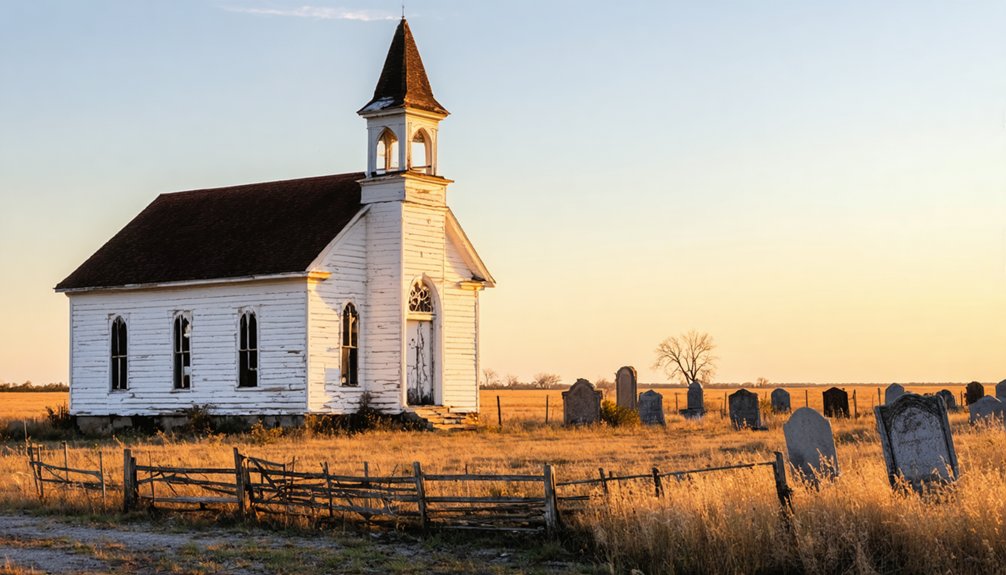
The humble beginnings of Indian Gap’s Baptist Church trace back to 1882, when J. W. Lovelace and 10 members established Baptist foundations in this frontier settlement.
You’ll find a remarkable story of pioneer resilience, as the congregation quickly joined the Hamilton County Baptist Association by 1883. Under Presley O’Keefe’s inaugural leadership, the church became a cornerstone of spiritual life in Indian Gap.
Pioneering Baptist settlers established firm spiritual foundations in Indian Gap, with the congregation swiftly joining regional fellowship under O’Keefe’s guidance.
- Four dedicated pastors guided the congregation through its first 15 years, from O’Keefe to W. M. Savage
- Church clerks like J. C. Martin and T. Slaughter maintained meticulous records of church affairs
- Active participation in regional Baptist associations showed through committed messengers like J. W. Lovelace and John Boler
The church’s endurance until 1997 testifies to its deep roots in Texas Baptist heritage.
Haunted Tales From Toyah’s Empty Streets
While Indian Gap’s Baptist heritage tells a story of spiritual perseverance, Toyah’s empty streets whisper darker tales from Texas’ frontier past.
You’ll find a haunted history etched into the town’s crumbling brick structures, where spectral sightings are said to echo the violence of 1906 when a mob lynched “Slab” Pitts from a telegraph pole.
As you walk past abandoned storefronts that once bustled with railroad commerce, you’re treading the same paths where W.T. Youngblood’s tent store grew into a thriving community of 553 residents.
Today, with just 90 inhabitants remaining, Toyah’s hollow buildings stand as silent witnesses to racial terror, economic decline, and lost prosperity.
The old school building and empty bank serve as stark reminders of a frontier town’s rise and fall.
Planning Your Ghost Town Adventure
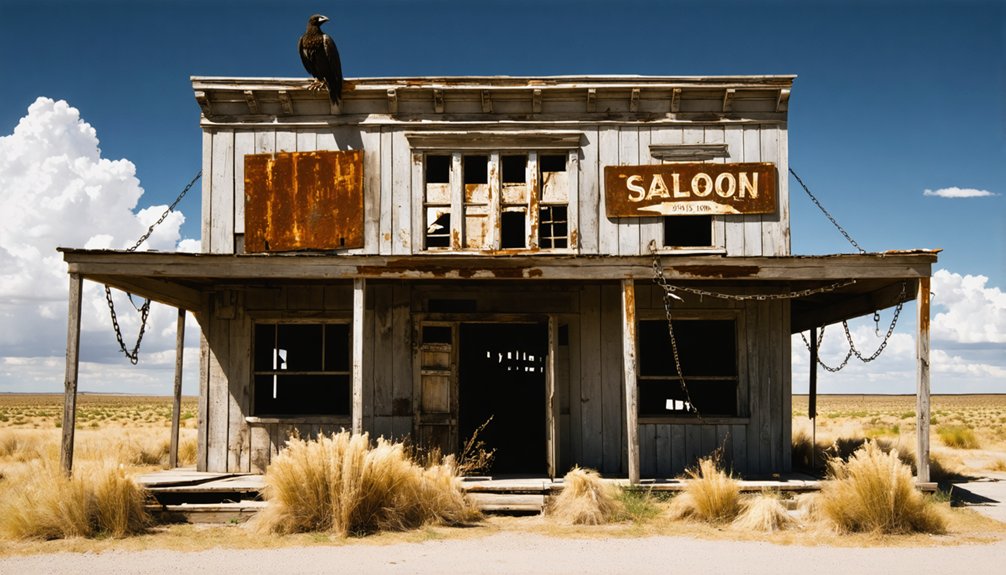
Before starting on your Texas ghost town expedition, you’ll want to strategically plan your route through the state’s most accessible abandoned settlements.
Consider travel times from major cities – Indianola lies 2.5 hours from Houston, while Terlingua requires a journey deep into West Texas near Big Bend.
Pack your ghost town essentials based on available amenities and seasonal events.
- Choose historic sites with established infrastructure like Jefferson’s antique shops and guided tours or Gruene’s preserved buildings and restaurants.
- Time your visit around special events like Terlingua’s famous chili cook-off or Día de los Muertos celebrations.
- Book accommodations in advance, whether at Terlingua’s rustic lodgings or nearby camping facilities.
These travel tips guarantee you’ll make the most of exploring Texas’s estimated 900 ghost towns while staying safe and comfortable during your adventure.
Frequently Asked Questions
Are There Any Restrictions on Taking Artifacts From Ghost Towns?
You can’t legally remove artifacts from ghost towns since they’re protected by artifact preservation laws. You’ll face fines and jail time for collecting without proper permits under Texas legal regulations.
Which Ghost Towns Are Accessible During Winter Months?
You’ll find year-round winter accessibility at Jefferson’s haunted historic district, Indianola’s coastal ruins, Glenrio’s Route 66 remnants, and Terlingua’s desert oasis, complete with dining and lodging options.
Do Any Ghost Towns Offer Guided Night Tours?
You’ll find guided nighttime exploration at Jefferson Ghost Walk and Fort Worth Stockyards, though these aren’t true ghost towns. Terlingua ghost town tours operate primarily during daylight hours for safety reasons.
Can You Legally Camp Overnight in Texas Ghost Towns?
You can’t legally camp in ghost towns without proper permits. You’ll need to verify land ownership and follow camping regulations – whether it’s private property, state park, or federal land.
Are Metal Detectors Allowed When Visiting These Historic Sites?
You can’t legally use metal detectors at ghost towns due to historical preservation laws and metal detecting regulations. You’ll need special permits, as these sites are protected by state antiquities codes.
References
- https://en.wikipedia.org/wiki/List_of_ghost_towns_in_Texas
- https://www.chron.com/life/travel/article/ghost-towns-texas-21221278.php
- https://www.youtube.com/watch?v=Zd8-gKw-5Hc
- https://www.hipcamp.com/journal/camping/texas-ghost-towns/
- https://tpwmagazine.com/archive/2018/jan/wanderlist_ghosttowns/
- https://www.tripadvisor.com/Attractions-g28964-Activities-c47-t14-Texas.html
- https://www.texasescapes.com/TOWNS/Texas_ghost_towns.htm
- https://www.county.org/county-magazine-articles/summer-2025/ghost-towns
- https://texashighways.com/travel-news/four-texas-ghost-towns/
- https://mix931fm.com/texas-ghost-towns-history/