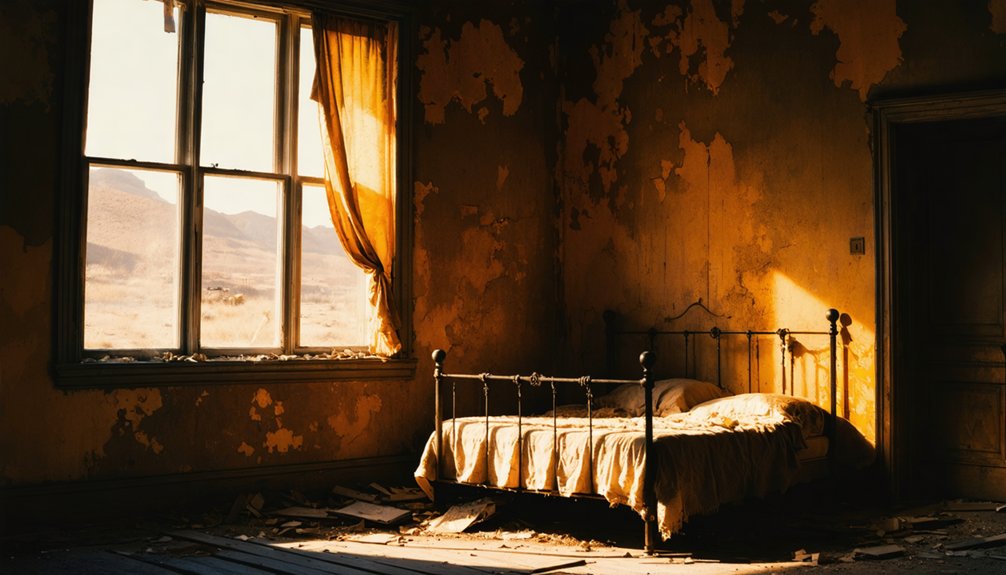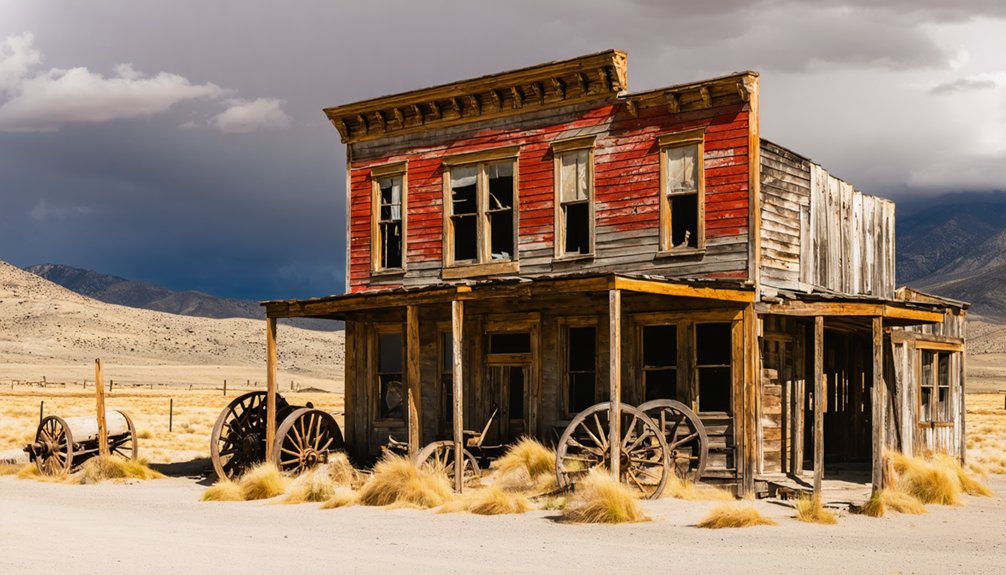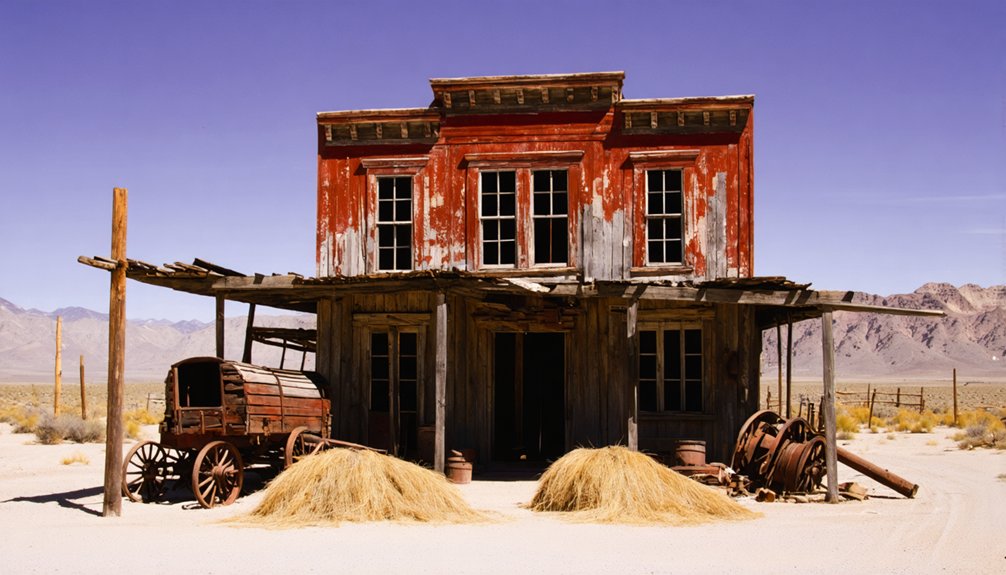
America’s most remarkable ghost towns include Bodie, California, with 170 structures in “arrested decay”; Virginia City, Nevada, where Comstock Lode silver fueled San Francisco’s growth; Bannack, Montana, with its vigilante justice history; and Centralia, Pennsylvania, abandoned due to an underground fire burning since 1962. You’ll find over 4,500 ghost towns across all fifty states, each offering unique windows into frontier life, mining booms, and industrial decline. The weathered remains await your exploration.
Key Takeaways
- Bodie, California maintains 170 original structures in “arrested decay” and is California’s official gold rush ghost town.
- Virginia City, Nevada features well-preserved Victorian buildings from its silver mining heyday when it had 25,000 residents.
- Bannack, Montana preserves over 60 original buildings and tells stories of frontier lawlessness and vigilante justice.
- Centralia, Pennsylvania offers a unique ghost town experience with its ongoing underground fire that has burned since 1962.
- St. Elmo, Colorado; Rhyolite, Nevada; and Kennecott Mines, Alaska are notable ghost towns with unique historical characteristics.
Bodie, California: The Gold Rush Time Capsule
Nestled in the Sierra Nevada foothills, Bodie stands as a remarkable symbol to America’s gold rush era. This authentic mining boomtown began in 1859 after W.S. Bodey’s gold discovery, though he never witnessed the town’s growth after perishing in a blizzard. The misspelled name “Bodie” stuck, becoming synonymous with frontier opportunity and lawlessness.
Amid rugged foothills, Bodie whispers tales of gold fever, frontier dreams, and the price of American ambition.
You’ll find Bodie’s mining legacy preserved in 170 original structures maintained in “arrested decay.” After its 1876 gold vein discovery, Bodie exploded to nearly 10,000 residents before declining as deposits diminished. At its peak, the town featured sixty saloons and a reputation for daily violence and crime. Two devastating fires in 1892 and 1932 further contributed to the town’s eventual abandonment.
The town’s notorious reputation prompted one girl to reportedly pray, “Goodbye God, we’re going to Bodie.”
Now California’s official gold rush ghost town since 2002, this National Historic Landmark offers unparalleled ghost town preservation, allowing you to witness authentic American frontier history.
Centralia, Pennsylvania: The Town That Still Burns
While Bodie preserves the remains of a once-thriving boomtown, Centralia, Pennsylvania represents a different type of ghost town—one created not by economic abandonment but by an ongoing environmental disaster.
In 1962, a routine landfill cleanup ignited an underground fire that penetrated the coal seams beneath the town. Despite numerous attempts to extinguish it—including pumping water into tunnels and smothering with clay—the fire persisted. Between 1962 and 1982, approximately $7 million was spent on unsuccessful extinguishing efforts.
Temperatures exceeding 900°F and toxic gas emissions forced residents to evacuate over several decades. From a population of roughly 1,400 in 1962, fewer than ten remained by the study period.
Today, abandoned infrastructure tells the story of this modern exodus. Roads lead nowhere, and foundations mark where homes once stood. The town has become a popular tourist destination despite safety warnings and even inspired Silent Hill, a famous horror movie.
The underground fire continues burning and may do so for another 250 years.
Virginia City, Nevada: Silver Boom to Tourist Haven
Unlike the tragic environmental disaster of Centralia, Virginia City represents the archetypal American boom-to-bust mining story with a surprisingly positive epilogue.
When you visit Virginia City, you’re walking through America’s most influential silver mining settlement. In 1859, the Comstock Lode discovery transformed a barren mountainside into a metropolis of 25,000 residents within years. The extraordinary wealth—over $600 million in silver and gold—financed San Francisco’s development and bolstered the Union during the Civil War.
Unlike many abandoned mining towns, Virginia City avoided permanent desertion. The city proudly holds National Historic Landmark status, providing crucial protection and financial support for its preserved historical sites. Just 30 minutes from Reno, historical preservation efforts have maintained its authentic Old West character. Charlie Bovey and his wife began critical restoration efforts in the 1940s, creating an impressive open-air museum concept.
Today, you’ll find Victorian buildings housing museums and shops rather than collapsing ruins. The town that made Nevada “the Silver State” now thrives on tourism rather than ore extraction.
Bannack, Montana: Lawlessness and Legends in the West
When you visit Bannack, Montana, you’ll encounter the dark legacy of vigilante justice that culminated in the 1864 hanging of Sheriff Henry Plummer, who allegedly led a murderous gang while holding his lawman position.
The Hotel Meade, once a courthouse before its conversion, stands as a silent witness to this turbulent past, with visitors frequently reporting cold spots, disembodied footsteps, and glimpses of apparitions in period clothing. Today, over 60 original buildings remain standing, preserved as part of this state park that offers an authentic glimpse into frontier life. This historic building sat abandoned after Dillon became the county seat in 1881, marking the beginning of Bannack’s decline toward ghost town status.
These spectral encounters connect you directly to Bannack’s violent frontier era, when the line between lawman and outlaw blurred and justice was dispensed at the end of a rope.
Violent Frontier Justice
As you stand amidst the weathered structures of Bannack, Montana today, it’s difficult to imagine the bloodsoaked history that unfolded in this quiet ghost town during the 1860s.
Frontier lawlessness reached its zenith here after the 1862 gold rush, with murders, robberies, and stagecoach holdups becoming commonplace. When conventional justice proved ineffective, vigilante justice emerged as the dominant force.
The saga of Sheriff Henry Plummer exemplifies this chaotic period—elected to restore order in 1863, he was himself hanged by vigilantes in January 1864 after being accused of leading an outlaw gang. The notorious Innocents gang that Plummer secretly led terrorized miners by leaving no witnesses alive after their robberies. Before his execution, Plummer convinced the town to fund Montana’s first jail through individual subscriptions from residents.
The preserved gallows and dual jails stand as stark reminders of this brutal era. Between 1864-1867, the Vigilante Committee executed dozens of suspected criminals without trial, until territorial authorities finally intervened to curtail these extrajudicial killings.
Hotel Meade Hauntings
Standing proudly in Bannack’s weathered landscape, Hotel Meade harbors paranormal secrets that have fascinated visitors for generations.
Originally built as the Beaverhead County Courthouse in 1875, this Italianate brick structure later transformed into the town’s premier luxury accommodation under Dr. John Singleton Meade’s ownership in 1890.
Your visit may yield ghostly encounters—cold spots permeate upstairs rooms, while spectral history manifests through apparitions glimpsed at windows and doors that open without explanation.
Children seem particularly attuned to the hotel’s spiritual residents, often reporting unusual communications.
The building’s varied past as courthouse, social hub, and temporary hospital enriches its paranormal reputation.
As Montana’s first brick building, it represents both civic ambition and frontier decline, standing now as a carefully preserved monument to Bannack’s boom-and-bust narrative.
St. Elmo, Colorado: Whispers of the Mining Past
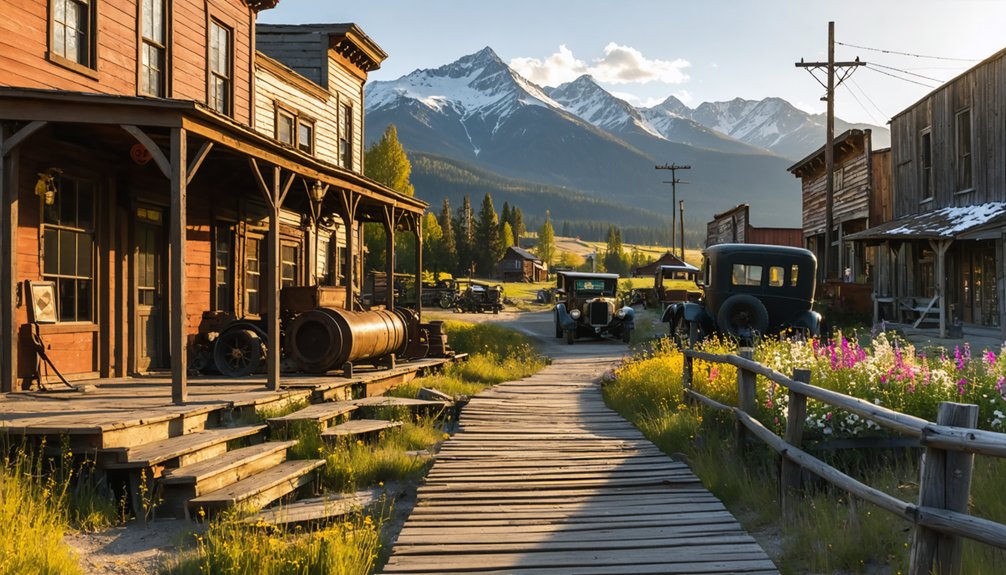
You’ll discover St. Elmo’s remarkably intact wooden structures nestled at 10,000 feet, offering one of the most authentic glimpses into 1880s mining life available in the American West.
The town’s preservation stems from its gradual abandonment rather than sudden catastrophe, leaving original buildings like the general store and schoolhouse frozen in time against the backdrop of the Sawatch Range.
Beyond architectural significance, St. Elmo has gained renown among paranormal researchers who investigate reported spectral phenomena, particularly surrounding the historic hotel where mining-era residents allegedly maintain their otherworldly presence.
Pristine Mountain Preservation
Nestled in Colorado’s rugged Rocky Mountains between Black Canyon and Gunnison Springs, St. Elmo stands as a symbol of historical preservation amid pristine mountain aesthetics.
As one of Colorado’s best-preserved ghost towns, you’ll witness Victorian-era structures that transport you to the 1880s mining era when gold and silver fueled frontier dreams.
The town’s remarkable preservation owes to:
- Dedicated local stakeholder groups and the Buena Vista Heritage Museum safeguarding historic properties
- The Stark family’s stewardship of authentic homes and artifacts
- Year-round accessibility through maintained Forest Service roads
- Surrounding undisturbed alpine terrain enhancing the authentic ghost town atmosphere
- Resilience despite a 2002 fire that threatened the town’s historical integrity
This living museum captures the essence of Western mining heritage while remaining connected to contemporary outdoor recreation opportunities.
Paranormal Investigation Hotspot
While St. Elmo stands as a remarkably preserved monument to mining history, it’s equally renowned as a paranormal investigation hotspot.
You’ll find the town’s original structures create an authentic setting for those seeking ghostly encounters. The eerie silence of abandoned streets and weathered buildings amplifies the spectral histories that draw investigators year-round.
Local lore abounds with reports of unexplained phenomena—mysterious noises echo through empty saloons and apparitions reportedly wander where miners once celebrated their “raunchy Saturday night sprees.”
The town’s isolation and dramatic decline from 2,000 residents to near abandonment intensifies its paranormal reputation.
Unlike nearby ghost towns such as Hancock, St. Elmo’s exceptional preservation offers investigators unparalleled access to explore the lingering energies of a once-vibrant frontier community now suspended between worlds.
Rhyolite, Nevada: Rise and Fall of a Desert Boomtown
The remarkable story of Rhyolite begins on August 4, 1904, when prospectors Frank “Shorty” Harris and Ernest “Ed” Cross struck gold in Nevada’s Bullfrog Hills, triggering one of America’s last great mining rushes.
Within this gold rush epicenter, a flourishing metropolis emerged, reaching nearly 5,000 residents during its mining boom peak in 1907-1908.
You’ll find Rhyolite’s history exemplifies the quintessential boom-and-bust cycle:
- From tent city to Nevada’s fourth-largest town in mere months
- Sophisticated infrastructure including a three-story bank building and modern water system
- Population plummeted from thousands to fewer than 700 by 1910
- Complete abandonment followed by 1924
- Now preserved by BLM with iconic structures like the bottle house still standing
Kennecott Mines, Alaska: Copper Dreams in the Wilderness
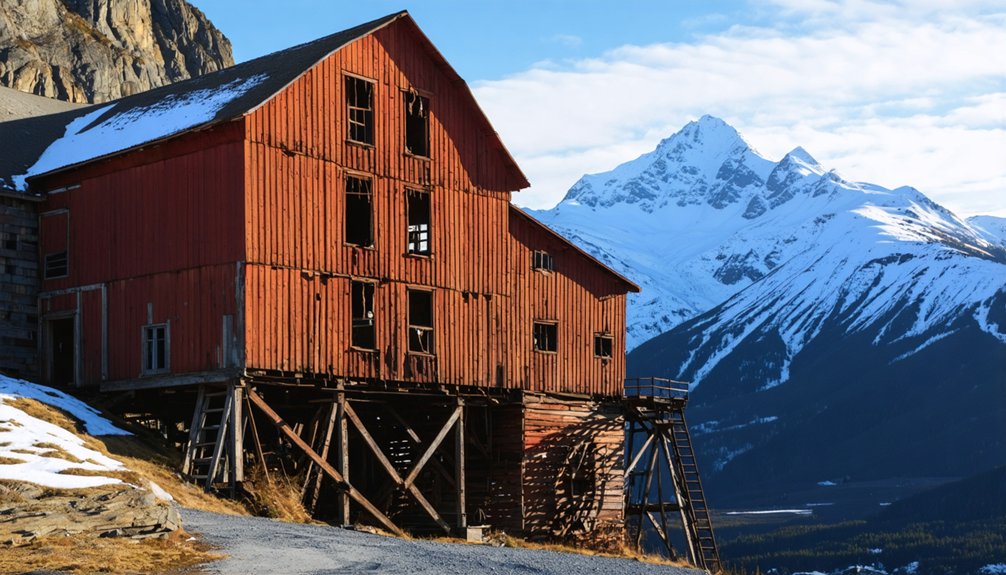
Deep in the Alaskan wilderness, a remarkable copper empire once thrived, forever altering the industrial landscape of America’s last frontier. Established in 1903 after prospectors discovered one of history’s richest copper veins, Kennecott quickly transformed into America’s most ambitious mining enterprise in Alaska.
Between 1909-1938, this industrial marvel produced over 1.1 billion pounds of copper, with ore so rich that initial shipments contained 72% copper.
You’ll find Kennecott history marked by extraordinary achievement—the corporation invested $25 million (equivalent to $730 million today) developing a self-contained community with its own railroad spanning 196 miles.
When high-grade deposits depleted by the 1930s, the operation abruptly ceased in 1938, leaving behind the iconic 14-story red mill that now welcomes modern explorers.
Exploring America’s Forgotten Places: Tips for Ghost Town Adventurers
Starting on a journey through America’s forgotten places reveals a parallel history etched into abandoned buildings and empty streets across the nation.
America’s abandoned places whisper stories of the past through weathered walls and silent pathways.
With over 4,500 ghost towns scattered across all fifty states, you’ll find these time capsules accessible through various exploration methods, each offering unique perspectives on America’s development and decline.
For successful urban exploration and ghost town preservation, consider:
- Utilize Geographic Information Systems to locate nearby ghost towns from your address
- Choose appropriate transportation – foot travel, 4×4 vehicles, or mountain biking
- Join guided tours for historical context about former residents’ experiences
- Explore western states like Texas (511 towns) and California (346 towns) for higher concentrations
- Research accessibility before visiting – many notable sites like Bodie, California offer established visitor infrastructure
Frequently Asked Questions
Are Ghost Towns Legally Accessible to Overnight Campers?
Yes, but it depends on ownership. You’ll need ghost town permits for historic sites, while public lands have camping regulations including 14-day limits. Always verify land status before setting up camp.
What Safety Equipment Should I Bring to Abandoned Mining Towns?
You’ll need safety gear including hard helmet, sturdy boots, gloves, and dust mask, plus emergency supplies like first aid kit, water, and multiple light sources for abandoned mining structures.
How Do Ghost Towns Differ Across Different U.S. Regions?
You’ll find Western ghost towns preserve mining history, Northeastern towns show industrial decline, Southern sites reflect plantation pasts, while Great Plains remnants showcase agricultural shifts—each holding distinct cultural significance and historical preservation value.
Can I Metal Detect or Collect Artifacts in Ghost Towns?
Like Indiana Jones treading carefully, you’re legally restricted from metal detecting in most ghost towns. Federal laws protect artifact preservation, requiring landowner permission and awareness of metal detecting laws before hunting historical treasures.
Which Ghost Towns Are Wheelchair or Mobility-Device Accessible?
Bannack and Garnet in Montana offer wheelchair access with broad streets and level trails. Bodie State Park in California provides specialized terrain wheelchairs by reservation. Most sites limit mobility devices to visitor centers and select buildings.
References
- https://nightofthejack.com/2025/01/23/top-creepy-ghost-towns-in-america/
- https://en.wikipedia.org/wiki/Wikipedia:WikiProject_Ghost_towns
- https://www.visittheusa.com/experience/5-us-ghost-towns-you-must-see
- https://freepages.rootsweb.com/~gtusa/history/
- https://www.christywanders.com/2024/08/top-ghost-towns-for-history-buffs.html
- https://www.outsideonline.com/adventure-travel/destinations/north-america/most-adventurous-ghost-towns-u-s/
- https://en.wikipedia.org/wiki/Lists_of_ghost_towns_in_the_United_States
- https://en.wikipedia.org/wiki/Ghost_town
- https://www.geotab.com/ghost-towns/
- https://www.youtube.com/watch?v=4DSrGFx_vG4