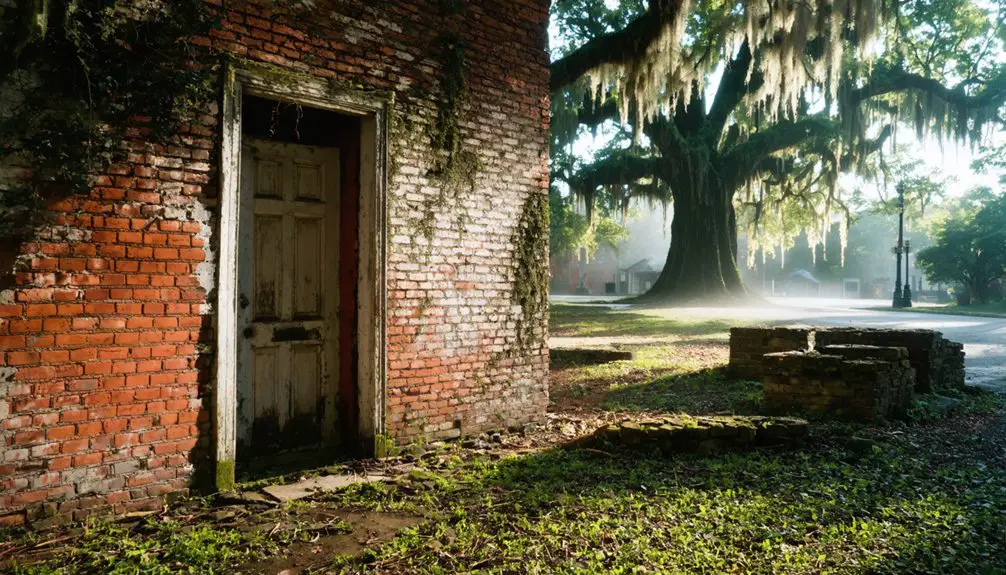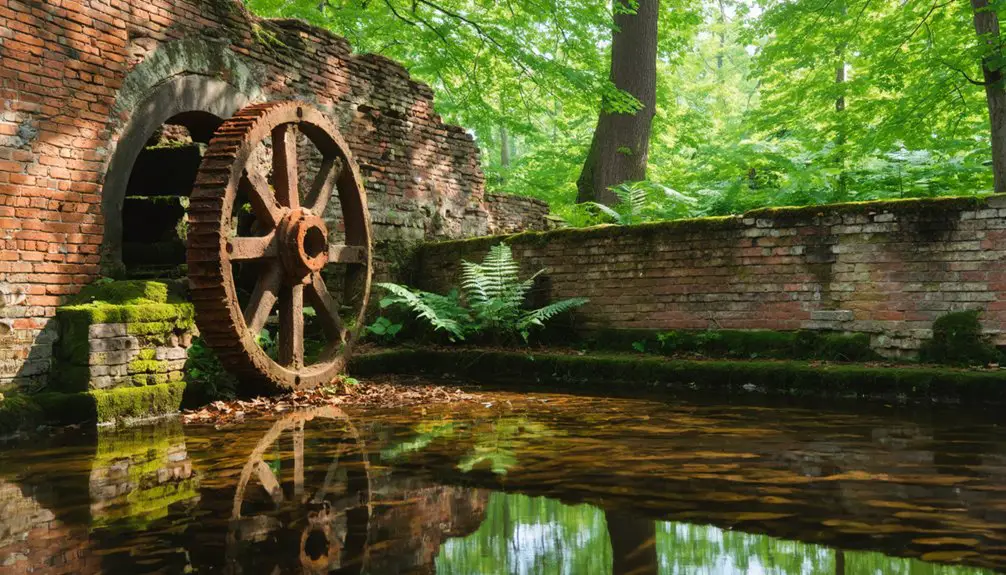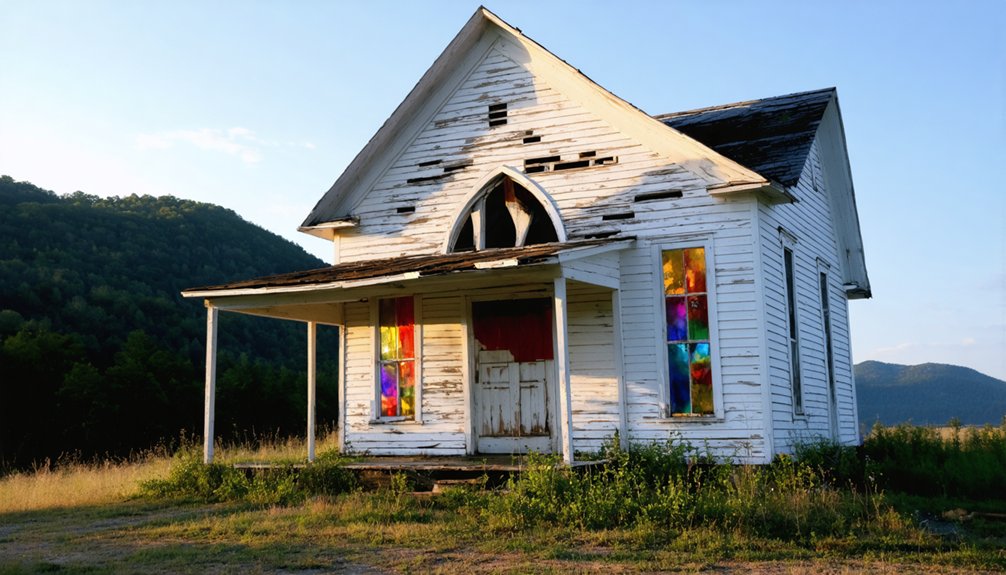
You’ll find Virginia’s most evocative ghost towns scattered across the Commonwealth, from Union Level’s tobacco trading legacy to Matildaville’s canal-era ruins. Don’t miss Colchester’s colonial port remnants along the Occoquan River or the intriguing World War II deception site at Elko Tract. Each abandoned settlement offers unique insights into Virginia’s economic and cultural evolution, from early ironworks to bustling marketplaces. These forgotten communities hold fascinating stories waiting to be uncovered.
Key Takeaways
- Union Level stands as a well-preserved ghost town showcasing Virginia’s tobacco trading legacy with remnants of 1920s businesses and warehouses.
- Matildaville, founded through George Washington’s vision, offers historic ruins of mills and foundries from the failed Patowmack Canal project.
- Colchester presents archaeological remains of a once-thriving colonial tobacco port, featuring foundations and artifacts from 1753-1840.
- Falling Creek Ironworks Park displays ruins of America’s first iron production facility, established in 1619, with interpretive historical signage.
- Elko Tract contains remnants of a WWII decoy airfield, including a water tower and foundations from the military’s elaborate deception strategy.
Historical Significance of Virginia’s Abandoned Towns
While many abandoned towns dot Virginia’s landscape, several stand out as particularly significant markers of the state’s economic and cultural evolution.
Union Level offers insight into the rise and fall of Virginia’s tobacco farming empire, serving as a testament to the agricultural heritage that once defined the region.
You’ll find tobacco history etched into Ca Ira’s past, where river commerce once flourished before progress chose different paths.
Falling Creek Ironworks represents America’s first attempt at industrial independence, though its promising start was cut short by violence in 1622.
Urban decay tells a unique story at Elko Tract, where a WWII decoy airfield now stands frozen in time.
Colchester’s colonial port reminds you of pre-Revolutionary commerce along the Occoquan River, while Pamplin’s endangered Victorian architecture showcases the preservation challenges facing these historic sites.
At Matildaville, stone ruins remain as silent witnesses to the ambitious Patowmack Company’s failed canal project.
Each ghost town offers a window into Virginia’s diverse economic shifts and cultural transformations.
Union Level: A Tobacco Trading Legacy
As tobacco fortunes shaped Virginia’s colonial landscape, Union Level emerged as an essential trading post in Mecklenburg County following its 1765 establishment. The town’s tobacco economy thrived through regulated warehouse auctions, where auctioneers’ rapid-fire chants of “Sold American” echoed through the facilities as bidders examined sorted crops. The town’s warehouses adhered to quality inspection laws established across Virginia to maintain high tobacco standards.
You’d find over 20 bustling businesses by 1920, including general stores, a pharmacy, and even a motorcycle dealer.
The Bank of Union Level’s 1915 founding by Drumwright, Thompson, and Jones created a financial backbone for local merchants.
The Southern Railroad’s arrival transformed the town into a significant trading hub, though post-Civil War warehouse expansions ultimately displaced many farmers.
Today, Union Level stands as a reflection of Virginia’s tobacco trading legacy, its abandoned structures whispering stories of colonial commerce and community resilience. The tradition of flue-cured tobacco processing dominated the region’s agricultural practices, distinguishing it from other farming communities.
The Rise and Fall of Matildaville
Moving east from Union Level’s tobacco legacy, the story of Matildaville unfolds along the banks of the Potomac River.
You’ll find this ambitious canal town’s origins in George Washington’s dream of navigable waterways, chartered through the Patowmack Company in 1785. “Light Horse” Harry Lee founded the settlement, naming it after his wife Matilda, while pioneering canal engineering efforts transformed the 40-acre site into a bustling community.
At its peak, you’d have seen a thriving town with mills, foundries, and boarding houses supporting the canal operations. Today, curious visitors can explore the town foundations while hiking the scenic Matildaville Trail. Washington himself visited frequently during the town’s operation to oversee progress.
But nature proved unforgiving – the canal was only usable briefly each year. Financial troubles mounted, and by 1828, the Patowmack Company failed.
When Virginia repealed the town charter in 1839, Matildaville’s fate was sealed, leaving only ruins to mark its ambitious past.
Elko Tract’s Secret Military Past
You’ll find one of Virginia’s most intriguing ghost towns in the Elko Tract, where in 1942 the federal government seized 2,400 acres of farmland to construct an elaborate military decoy.
The 936th Camouflage Battalion transformed this once-peaceful agricultural community into a mock airfield complete with plywood planes, canvas hangars, and fake infrastructure designed to fool potential Luftwaffe bombers targeting Richmond Army Air Base. The displacement affected over 40 farms in the area. Today, an aging water tower still stands among overgrown streets as a testament to this wartime deception.
The site’s military deception strategy incorporated sophisticated psychological elements from Army camouflage manuals, including deliberately imperfect camouflage to enhance authenticity—a theatrical approach that drew from Hollywood set design techniques.
Military Decoy Design Strategy
During World War II, the U.S. military deployed an ingenious deception strategy at Elko Tract, constructing a detailed decoy airfield to protect Richmond Army Air Base from potential Luftwaffe attacks.
The military camouflage techniques were remarkably sophisticated, designed by the 936th Camouflage Battalion following strict Army protocols. Corporal Charles Capitaine’s natural camouflage skills were instrumental in creating the site’s convincing visual deceptions. The site was established five miles from Byrd Field to effectively draw potential enemy fire away from the real airbase.
The deception tactics included:
- Plywood aircraft placed on wooden landing gear, strategically positioned to appear authentic
- Canvas and cloth structures mimicking hangars and support vehicles
- Surrounding vegetation trimmed into P-47 aircraft silhouettes
You’ll find the site’s design was intentionally crafted to appear partially camouflaged, directly countering enemy pilot training on identifying fake installations.
The 1896th Engineer Aviation Battalion maintained this elaborate ruse, regularly repositioning props to create the illusion of an active airfield.
Though the Luftwaffe never attacked, the decoy site served its purpose in America’s broader wartime defense strategy.
Hidden Farm Community Origins
Before becoming a military decoy site in 1942, the Elko Tract was home to a vibrant agricultural community of more than 40 farms southeast of Richmond, Virginia.
The area’s hidden histories reveal a primarily Black farming population who’d cultivated deep generational ties to the land, building their lives around seasonal harvests and homesteads they called their own.
You’ll find forgotten legacies of families who received just 30 days to abandon their properties when the federal government condemned approximately 2,400 acres for military use.
The government’s swift action forever altered this close-knit rural community, located five miles from Byrd Field airport.
While the physical traces of these farms have vanished, their story represents a poignant chapter in Virginia’s agricultural heritage – one of displacement and sacrifice during wartime America.
Colchester: From Bustling Port to Forgotten Settlement

If you’d lived in colonial Virginia, you’d have known Colchester as a thriving tobacco port rivaling Alexandria, with its six taverns and bustling merchant trade along the Occoquan River.
The town’s fortunes changed dramatically when river silting, the 1807 hurricane, and the War of 1812 disrupted its crucial shipping routes.
Today, archaeologists at Old Colchester Park and Preserve continue to uncover the settlement’s rich history, with the Fairfax Arms tavern standing as the last intact reminder of this once-prosperous colonial port town.
Colonial Trading Hub
Along the banks of the Occoquan River, where Captain John Smith first explored in 1608, the colonial port town of Colchester emerged as an important commercial hub in Northern Virginia.
You’ll find evidence of its bustling colonial commerce at the intersection of major trading routes, where the Potomac Path met the river crossing.
The town’s economic significance centered around:
- A thriving tobacco inspection and export station serving local plantations
- Diverse merchants like Alexander Henderson and Benjamin Grayson operating mercantile stores
- Important services including tanyards, salt houses, stables, and multiple taverns
The strategic location made Colchester a critical crossroads where merchants, planters, and workers – both free and enslaved – conducted business that shaped Virginia’s early economy.
German and Scottish immigrants added to the town’s commercial diversity, establishing ventures like Maurice Pound’s vineyard.
Decline Through River Changes
Colchester’s fate as a thriving colonial port would dramatically shift due to both natural and man-made changes affecting the Occoquan River.
You’ll find that river navigation became increasingly treacherous as silt from the Bull Run Mountains steadily choked the waterway. Spring floods created impassable barriers, while mounting sediment made the port virtually inaccessible to commercial vessels.
The construction of Thomas Mason’s bridge two miles upriver in 1795 dealt another devastating blow, redirecting crucial trade traffic away from Colchester’s crossing.
When that bridge collapsed in an 1807 storm, the town’s economic shifts had already begun. Merchants and sailors abandoned the struggling port for Alexandria and Occoquan, where deeper waters still accommodated their vessels.
Modern Archaeological Discoveries
Since 1979, archaeological teams have steadily unearthed the forgotten colonial settlement of Colchester through extensive excavations and research.
Modern archaeological techniques have revealed fascinating details about this once-bustling port town, with the Colchester Archaeological Research Team (CART) leading investigations since 2010.
Through careful artifact analysis, you’ll discover evidence of colonial life spanning nearly a century:
- Stone foundations and a well that served domestic dwellings from 1753-1840
- Everyday items like window glass, beads, and barrel spigots that paint a picture of daily colonial activities
- A complex town layout featuring 41 lots, a marketplace, and three colonial-era roads
Today, you can explore Old Colchester Park and Preserve, where interpretive panels guide you through the ghostly remains of this historic Virginia settlement, revealing 10,000 years of human activity beneath your feet.
Falling Creek Ironworks: America’s First Industrial Site
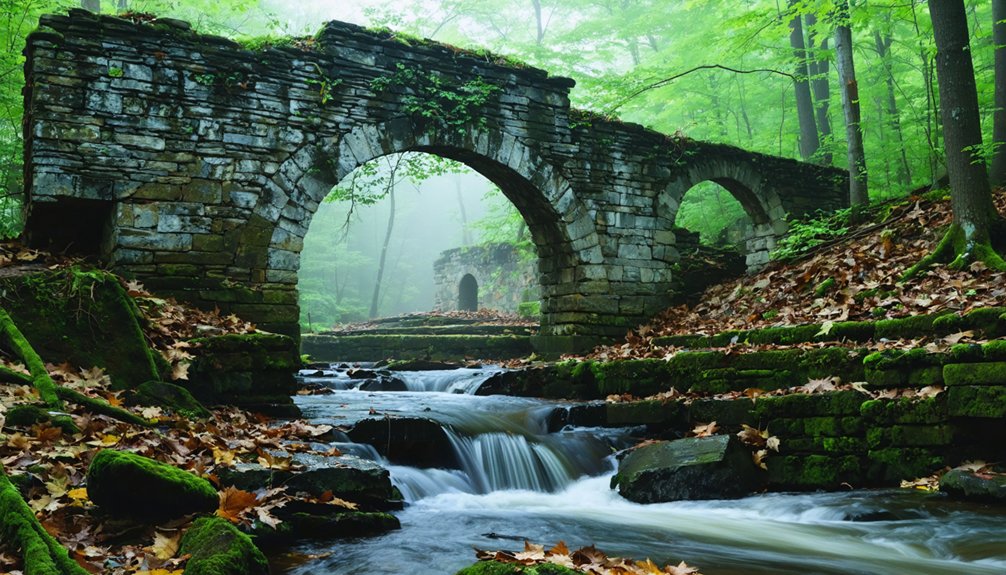
Established by the Virginia Company of London in 1619, Falling Creek Ironworks marked a pivotal moment in American industrial history as the first iron production facility in North America.
You’ll find the remnants of this pioneering industrial heritage site near the confluence of Falling Creek and the James River, where abundant ore deposits and water power once fueled colonial ambitions.
Though the facility operated briefly before its destruction in the 1622 Native American uprising, it represented America’s first steps toward industrial independence.
The site later resumed operations under Archibald Cary from 1750 until Benedict Arnold destroyed it in 1781.
Today, you can explore Falling Creek Ironworks Park in Chesterfield County, where interpretive signage guides you through the ruins of America’s earliest industrial venture, offering a glimpse into our nation’s manufacturing origins.
Rosewell Plantation’s Architectural Heritage
Rising majestically from the banks of the York River, Rosewell Plantation stood as colonial Virginia‘s largest and most ambitious residential structure when Mann Page I began its construction in 1725.
Drawing architectural influences from London’s post-Great Fire townhouses, this 12,000-square-foot mansion showcased the finest colonial craftsmanship in America.
- Three-and-a-half-foot-thick foundation walls supported three stories of exquisite Flemish bond brickwork, crowned by twin octagonal cupolas.
- Thirty-five rooms featured thirteen-foot ceilings, with a grand staircase wide enough for eight adults to walk side-by-side.
- Specialized London bricklayers supervised the elaborate detailing, while hundreds of enslaved laborers manufactured the rose-red bricks on-site.
Today, you’ll find only ruins of this architectural marvel, destroyed by fire in 1916, but the remaining walls still whisper stories of colonial ambition and craftsmanship.
Preserving Virginia’s Ghost Town Heritage

While grand structures like Rosewell stand as singular monuments to Virginia’s past, a broader network of preservation efforts now safeguards the Commonwealth’s abandoned communities.
You’ll find organizations like Preservation Virginia, founded in 1889, working alongside the Department of Historic Resources to protect these forgotten places. Through historical documentation and archaeological research, experts map foundations, document cemeteries, and create detailed records of Virginia’s ghost town heritage.
You can explore these preserved sites thanks to metal shell replicas and interpretive materials that bring vanished communities back to life.
Though challenges like data center construction and severe structural deterioration threaten these historic treasures, tax credits and financial assistance programs help property owners maintain architectural integrity while balancing preservation with growth.
Planning Your Ghost Town Adventure
Before setting out to explore Virginia’s ghost towns, you’ll need to carefully plan your adventure by considering accessibility, seasonality, and safety protocols.
Thorough preparation is essential for ghost town exploration – research access points, optimal seasons, and safety measures before your Virginia journey.
For ideal ghost town photography and visitor safety, focus on established sites with clear access points and documented histories.
- Start with Matildaville along the Potomac River, where you’ll find well-preserved canal remnants and riverbank viewing opportunities accessible via historical trails.
- Utilize the Blue Heron Loop’s 6.5-mile trail system for a structured exploration experience, complete with designated parking and trailhead facilities.
- Check with local historical societies before visiting remote locations like Elko Tract, as many sites have restricted access or require special permissions for entry.
Remember to verify current conditions, especially during winter months when weather can impact accessibility to these historical treasures.
Photography Tips for Exploring Abandoned Sites
As you venture into Virginia’s abandoned sites with your camera, mastering both safety protocols and photographic techniques becomes essential for capturing compelling images while protecting yourself and these historical treasures.
When documenting abandoned architecture, equip yourself with a wide-angle lens (14-24mm) and sturdy tripod for low-light conditions. You’ll want to shoot during golden hour or after dark, using long exposures of 2-30 seconds to capture the eerie atmosphere of these forgotten places.
For urban exploration photography, employ light painting techniques to highlight specific features, and always carry backup batteries. Remember to manually control your exposure settings and focus on telling the site’s story through careful composition.
Consider using a monopod when traversing unstable areas, and never sacrifice safety for the perfect shot.
Frequently Asked Questions
Are There Any Reported Paranormal Activities in These Ghost Towns?
You won’t find documented haunted legends or ghost stories in these Virginia ghost towns. Historical records and archaeological findings focus on colonial settlement facts rather than paranormal activities.
What Safety Precautions Should Visitors Take When Exploring These Abandoned Sites?
With 60% of injuries occurring from unstable floors, you’ll need proper safety gear including boots, gloves, and respirators. Stay alert for wildlife, bring a buddy, and always obtain permission before exploring.
Can Metal Detectors Be Used at These Ghost Town Locations?
You can’t legally metal detect at Virginia ghost towns since they’re protected historical sites. Metal detecting regulations strictly prohibit searching for historical artifacts without special permits from state authorities.
Which Ghost Towns Are Accessible During Winter Months?
You’ll find Thurmond, Pamplin, and Union Level accessible during winter exploration, with minimal accessibility challenges. These sites remain open year-round, though Thurmond’s mountain roads occasionally require extra caution during snowfall.
Are Guided Tours Available at Any of These Abandoned Locations?
You’ll discover countless guided explorations at these historic sites, where expert tour guides illuminate Virginia’s haunting past through organized walks in Williamsburg, Yorktown, Alexandria, and Lynchburg’s most fascinating abandoned locations.
References
- https://theforgottensouth.com/union-level-virginia-ghost-town-history/
- https://www.blueridgeoutdoors.com/go-outside/southern-ghost-towns/
- https://everafterinthewoods.com/deserted-ghost-towns-in-virginia-that-history-buffs-cant-resist-exploring/
- https://www.virginia.org/blog/post/virginias-haunted-sites/
- https://nvtami.com/2025/01/22/virginia-citys-forgotten-ghost-towns/
- https://northernvirginiamag.com/67-advantures-ghost-towns-of-virginia/
- https://www.youtube.com/watch?v=moYHlyQexj4
- https://abcnews4.com/amazing-america/discover-pamplin-virginia-a-nearly-forgotten-ghost-town-with-stories-still-standing
- https://www.peterlabau.com/blog/entry/virginia-ghost-town
- https://en.wikipedia.org/wiki/List_of_ghost_towns_in_Virginia