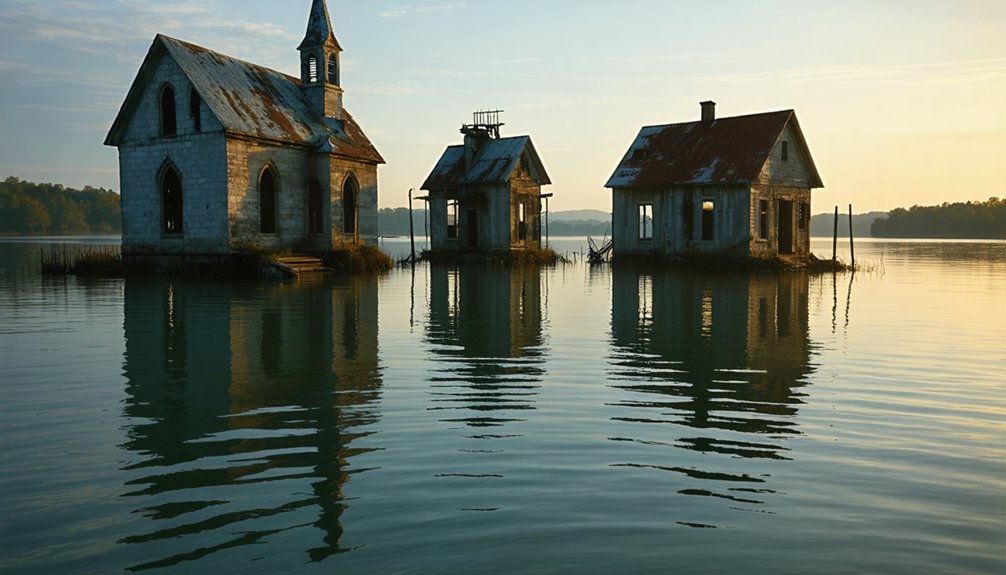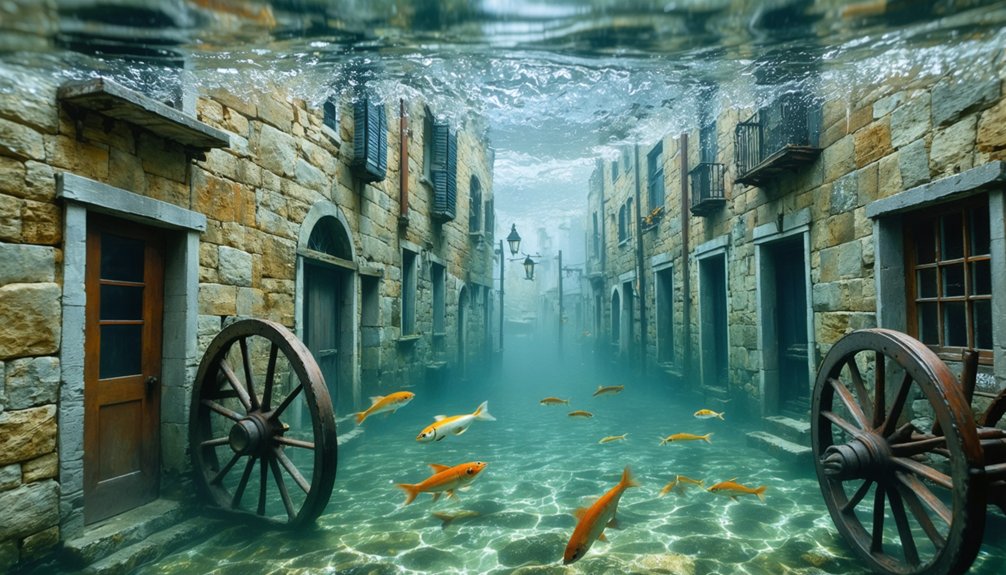
America’s underwater ghost towns offer fascinating glimpses into sacrificed communities. You’ll find Massachusetts’ four Quabbin villages, flooded for Boston’s water supply in 1938. West Virginia’s Gad remains remarkably intact beneath Summersville Lake. Utah’s pioneer settlement Hite disappears under Lake Powell. Maine’s Flagstaff and Dead River communities were submerged for hydroelectric power in 1950. Alabama’s Lake Martin conceals Kowaliga, once a thriving Black town. Each submerged location tells stories of displacement that surface during droughts.
Key Takeaways
- Quabbin Reservoir in Massachusetts submerged four towns including Dana and Enfield, with over 2,000 displaced residents.
- Gad, West Virginia lies beneath Summersville Lake, with underwater structures visible to SCUBA divers and during draining.
- Lake Powell in Utah conceals Hite settlement, a former mining community that becomes visible during drought periods.
- Flagstaff and Dead River communities in Maine were flooded for hydroelectric power, with remnants visible during low water.
- Lake Martin in Alabama submerged Kowaliga, a thriving Black community founded in the late 19th century.
Quabbin Reservoir’s Forgotten Massachusetts Villages
While Boston’s growing population demanded increasing water supplies in the early 20th century, few could have predicted the sacrifice that would be required from the communities of Massachusetts’ Swift River Valley.
At midnight on April 28, 1938, four towns—Dana, Enfield, Greenwich, and Prescott—vanished from the map, disincorporated by legislative decree. Over 2,000 residents were forced from their homes under eminent domain as the state prepared to flood the valley.
In a single night, four communities ceased to exist—a sacrifice deemed necessary for Boston’s growing thirst.
Unlike many submerged ghost towns, Quabbin Reservoir’s submerged history remains largely invisible; authorities methodically demolished structures, removed railways, and even exhumed 7,500 bodies from local cemeteries. The construction of Goodnough Dike began in 1933, named after the project’s chief engineer who had limited experience with such massive undertakings. Former residents received 108 dollars per acre as compensation for their lost properties and livelihoods.
Today, you’ll find few underwater remnants of these communities. Instead, visit the Quabbin Visitor Center and hike to vantage points like Enfield Lookout to glimpse where these sacrificed towns once thrived.
The Vanished Town of Gad Beneath Summersville Lake
Hidden beneath the crystal-clear waters of West Virginia’s Summersville Lake lies the forgotten community of Gad, a once-thriving rural settlement that met its fate in the 1960s.
This Appalachian town, established in 1889, was purchased by the Army Corps of Engineers to create a flood control reservoir. Gad’s history was submerged when Summersville Dam was constructed between 1960-1966, forcing residents to relocate and even move family graveyards.
- You can explore submerged structures when the lake is drained for repairs
- SCUBA divers report the ghost town remains largely intact underwater
- The dam was nearly named “Gad Dam” after the town it displaced
- Former residents’ carvings in rock and building foundations become visible during low water
When diving the “Bahamas of the East Coast,” you’re actually swimming through a preserved piece of West Virginia’s past. The farming community of Gad once featured a sawmill and church, along with a school, general store, and post office serving local residents. The dam has been remarkably effective, preventing an estimated $407,400,000 in flood damages since its construction.
Hite: Utah’s Hidden Underwater Settlement at Lake Powell
Nestled beneath the azure waters of Lake Powell lies Hite, a forgotten settlement that once served as an essential crossing point on the Colorado River. Founded in 1883 by prospector Cass Hite, who discovered gold where he sought silver, this riverside oasis originally known as “Dandy Crossing” thrived with fruit trees and a tent motel.
In 1964, Glen Canyon Dam’s completion submerged Hite under hundreds of feet of water, erasing physical traces of its mining legacy. Arthur Chaffin, who built and operated a vital ferry service across the river, lost everything when the waters rose. You’ll find this underwater ghost town at Lake Powell’s northernmost section, where the Colorado and San Juan rivers meet. The area was part of the region where Powell named Glen Canyon for its peaceful side canyons during his historic expeditions.
During drought periods, water levels occasionally drop to reveal tantalizing glimpses of Hite’s history. Underwater exploration enthusiasts now seek out this submerged pioneer settlement, which represents a fascinating chapter in Utah’s past—forever altered by America’s quest for hydroelectric power.
Maine’s Lost Communities of Flagstaff and Dead River
Beneath the still waters of Flagstaff Lake in western Maine lie the remnants of three once-thriving communities—Flagstaff, Dead River, and Bigelow Plantations—sacrificed for hydroelectric power in the mid-20th century.
After decades of planning, Central Maine Power completed Long Falls Dam in 1950, permanently submerging towns that had flourished since the 1800s. The flooding transformed a thriving valley landscape into an underwater ghost town filled with historical significance.
The final Old Home Days celebration on July 4, 1949 marked the end of these riverside settlements before the valley flooded. Residents experienced painful displacement as lawyers knocked on doors to discuss relocation terms.
- Visit the Flagstaff Memorial Chapel to honor displaced residents and their lost homeland
- Explore visible submerged structures during low water periods when foundations emerge
- Join scuba diving expeditions to witness the underwater ghost towns up close
- Search shorelines for remnants of streets and buildings from these once-vibrant communities
Kowaliga: Alabama’s Submerged Town Beneath Lake Martin
The remarkable story of Kowaliga, a thriving Black community founded in the late 19th century, now rests silently under Alabama’s Lake Martin.
John Benson, a formerly enslaved man, established this self-sufficient community along Kowaliga Creek, amassing over 3,000 acres where Black entrepreneurship flourished. Through hard work and strategic farming practices, Benson developed various crops to maximize agricultural efficiency. The settlement boasted farms, businesses, and the prestigious Kowaliga Industrial Institute, which counted Booker T. Washington among its trustees.
Kowaliga’s history tragically shifted in 1923 when Alabama Power began constructing Martin Dam. By 1926, rising waters had intentionally flooded the entire community, forcing residents to abandon their homes and livelihoods.
This submerged culture represents one of America’s most successful Black towns before its deliberate destruction.
Today, Lake Martin attracts tourists largely unaware they’re boating above a significant piece of African American heritage—a poignant reminder of infrastructure’s cost to marginalized communities. Visitors can learn about this compelling history at Kowaliga Restaurant, which offers both southern cuisine and views of the lake that conceals the town’s remains.
Frequently Asked Questions
Can Divers Legally Explore Submerged Ghost Towns in US Reservoirs?
Picture yourself exploring underwater history. You can plunge into some submerged towns, but you’re bound by strict legal restrictions. Most reservoirs require permits and follow diving regulations protecting historical sites and water quality.
What Personal Items Were Commonly Left Behind During Town Evacuations?
You’ll find photos, diaries, furniture, clothing, and kitchenware among abandoned belongings. These historical artifacts tell stories of hasty departures when residents couldn’t transport everything during mandatory evacuations.
Exploring abandoned sites safely allows for a deeper understanding of the past while ensuring personal well-being. Engaging with these locations can reveal the emotional weight of memories left behind. As you navigate through these remnants, it’s essential to respect the history and preserve the integrity of the site.
How Do Seasonal Water Level Changes Affect Visibility of Submerged Structures?
Have you ever glimpsed history beneath the waves? You’ll face visibility challenges as seasonal impacts transform submerged structures—winter flooding conceals ruins completely while summer droughts dramatically expose forgotten architecture for exploration.
Were Any Residents Compensated for Their Relocated or Lost Properties?
Yes, you received compensation through government programs based on property valuation. Relocation assistance varied by region, with federal authorities managing different payment structures depending on assessment timing and local regulations.
Do Any Underwater Ghost Towns Contain Hazardous Materials or Contamination?
Yes, you’ll find hazardous materials in several submerged towns like Coalport, Iowa where mining operations left toxic residues. Contamination risks include lead paint, fuel tanks, and industrial chemicals from abandoned structures.
References
- https://kids.kiddle.co/List_of_flooded_towns_in_the_United_States
- https://blog.batchgeo.com/ghost-towns/
- https://intriguing-facts.com/13-lakes-and-rivers-that-hide-ghost-towns-underwater/
- https://en.wikipedia.org/wiki/Wikipedia:WikiProject_Ghost_towns
- https://www.thewanderingappalachian.com/post/underwater-ghost-towns-of-appalachia
- https://en.wikipedia.org/wiki/List_of_flooded_towns_in_the_United_States
- https://www.atlasobscura.com/articles/drowned-towns-lost-to-progress
- https://vitabrevis.americanancestors.org/2019/09/lost-towns-of-the-quabbin
- https://www.thetravel.com/what-is-under-quabbin-reservoir/
- https://app.ar-tour.com/guides/stories-of-submerged-towns-1/the-lost-towns-of-quabbin-valley.aspx