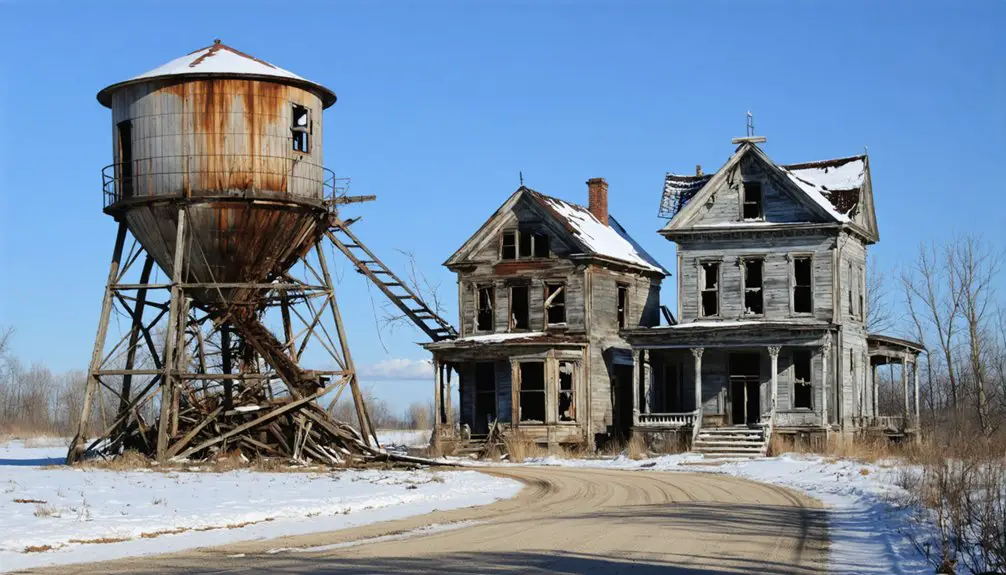
You’ll discover Massachusetts’ most enchanting dog-friendly ghost town in Dogtown, where your canine companion can roam five square miles of abandoned wilderness filled with mysterious carved boulders and crumbling cellar holes. This haunting landscape offers maintained trails perfect for dogs to explore alongside moss-covered stone walls and seasonal wildflowers. While most Massachusetts ghost towns require leashes, Dogtown’s remote location provides unique off-leash opportunities for well-trained dogs. Your adventure through this witch-legend-filled terrain promises unforgettable exploration ahead.
Key Takeaways
- Dogtown offers off-leash adventures for dogs with reliable voice control on maintained trails through abandoned 18th-century settlement ruins.
- Massachusetts generally requires leashes in public spaces, but some ghost towns like Dogtown Woods allow off-leash exploration.
- Stone-dust trails accommodate dogs of all sizes for boulder scrambling among moss-covered walls and carved motivational boulders.
- Pack protective booties, water, GPS devices, and tick prevention when exploring rocky ghost town terrain with dogs.
- Other dog-friendly abandoned sites include Medfield State Hospital and Hawley’s Beehive Kiln for hiking and photography adventures.
Dogtown: Massachusetts’ Most Famous Abandoned Settlement
When you and your four-legged companion venture into Dogtown’s haunting landscape, you’ll discover Massachusetts’ most compelling ghost town spread across five square miles of preserved forest on Cape Ann.
Your adventure begins at trailheads off Dogtown Road, where hiking paths wind through dense woods hiding stone cellar holes and crumbling foundations from the abandoned 18th-century settlement.
Ghost town exploration here reveals remnants of a community that thrived until post-Revolutionary economic shifts drew residents coastward. By 1830, the last inhabitant had departed, leaving only feral dogs roaming empty streets—hence the evocative name. The settlement originally served as a safe inland refuge for families seeking protection from coastal pirates during its founding in 1693. This historic location shares its name with various other places, creating potential confusion for visitors researching the area.
Dogtown folklore weaves tales of witches and eccentric hermits into the historical narrative, while your dog can safely explore the maintained trail network that connects archaeological sites through this atmospheric wilderness preserve.
Historical Origins and the Rise of Commons Settlement
Between 1646 and 1650, colonists carved out their settlement in this inland wilderness, fleeing the constant threat of pirate raids and Native American attacks that plagued Gloucester’s vulnerable coastline.
You’ll discover these freedom-seeking pioneers established what they called the Commons Settlement across five square miles of defensible terrain.
The settlement history reveals a practical community that adapted to harsh realities. Poor, rocky soil forced residents to abandon traditional farming for livestock raising—cattle and sheep thrived where crops failed. Like many early settlements, communities often faced constant flooding that threatened their survival and forced difficult decisions about relocation.
Community dynamics centered on shared survival, with the area serving as communal land for timber harvesting and resource gathering. The area was eventually purchased by Roger Babson who transformed it into a public park in 1935.
Why Dogtown Earned Its Mysterious Name
Yet there’s a darker explanation rooted in societal stigma.
“Dogtown” functioned as a pejorative label targeting the settlement’s final inhabitants—widows, alleged witches, and society’s outcasts.
The name Dogtown became a cruel slur, branding the settlement’s marginalized residents as society’s unwanted outcasts.
Period accounts suggest “dog” imagery served as cruel shorthand for social scorn rather than literal canine presence.
Notable residents included Thomazine “Tammy” Younger, known as the Queen of Witches, who lived near Alewife Brook and allegedly bewitched local oxen for tolls.
The rocky terrain made agricultural life particularly difficult for these marginalized residents, contributing to the community’s eventual decline.
Whether you believe in ghostly dog packs or recognize deliberate marginalization, the name stuck after 1830’s final abandonment, cementing Dogtown’s eerie reputation.
Trail System and Natural Features for Pet Exploration
Wooded canopy paths offer layered scent environments from leaf litter and small-mammal activity, perfect for natural tracking behavior.
Your four-legged explorer can practice canine activities like boulder scrambling around the famous Babson Boulders while you discover cryptic inscriptions carved into stone.
Field edges host seasonal wildflowers and berry patches, adding visual and olfactory enrichment that changes throughout the year. The stone-dust trail provides excellent paw-friendly footing that’s gentle on joints while maintaining good traction for dogs of all sizes.
Dogs can safely explore the moss-covered stone walls that once marked former property lines of Dana’s historic homes, creating natural boundaries for off-leash adventures.
Leash Policies and Pet-Friendly Access Information
You’ll need to keep your furry companion leashed while exploring most of Massachusetts’ historic ghost towns, as state and local regulations typically require dogs to remain under physical control on public trails and properties.
Before setting out on your adventure, check with the specific managing entity—whether it’s the Department of Conservation and Recreation, local municipalities, or private land trusts—since leash requirements can vary dramatically between different sites and seasons. Some properties may have temporary on-leash rules during bird nesting periods that could affect your planned visit.
Your dog’s safety becomes paramount in these often remote locations where old foundations, debris, and wildlife encounters pose unique hazards that proper restraint and preparation can help you navigate together. Ensure your dog has current rabies vaccinations as required by Massachusetts law for dogs six months or older before venturing into areas where wildlife contact may occur.
Dogtown Leash Requirements
While Massachusetts doesn’t enforce a blanket statewide leash law, maneuvering Dogtown’s pet policies requires understanding both local Gloucester regulations and the unique freedom this historic settlement offers your four-legged explorer.
You’ll find Dogtown Woods welcomes off-leash adventures, but your dog must demonstrate reliable voice control. This abandoned colonial settlement becomes your pup’s playground where leash length restrictions fade into forest trails.
Park off Cherry Street on Dogtown Road, where trail maps guide your journey through these haunted ruins.
However, dog control remains your responsibility—ensure your companion doesn’t disturb wildlife or fellow hikers exploring these mysterious stone foundations.
While locals often allow off-leash roaming in Dogtown Common, voice commands must keep your adventurer close as you both discover this enchanting ghost town‘s secrets together.
Trail Access Rules
Three distinct layers of regulations shape your ghost town adventures with your canine companion across Massachusetts’ historic trails.
Municipal bylaws form your first consideration—towns like Acton require effective control or leashing on conservation lands, with $100 fines backing up their rules.
State agencies add another layer, as MassWildlife and DCR balance habitat protection with recreation, sometimes closing sensitive areas seasonally to protect nesting wildlife.
Your freedom to explore depends on understanding trail etiquette across these jurisdictions.
Accessible trail initiatives create shared-use corridors where leash requirements guarantee everyone’s safety.
Conservation efforts often restrict unauthorized trail creation, keeping you on designated paths.
Time limits frequently apply—many towns restrict access to sunrise-sunset windows.
Multiple enforcement agencies patrol these areas, so knowing local rules protects both your adventure plans and your wallet.
Pet Safety Guidelines
Before setting paw on Massachusetts’ haunted trails, you must navigate the state’s extensive leash laws that govern every public adventure with your four-legged explorer. The state mandates leashes in all public places, including those eerie abandoned settlements you’re enthusiastic to investigate. Your canine companion needs proper restraint to prevent unwanted encounters with wildlife or other visitors seeking ghostly experiences.
Smart pet travel preparation includes ensuring your dog’s current rabies vaccination and valid licensing—Massachusetts requires annual registration for dogs over six months.
Monitor your dog’s canine behavior closely in these atmospheric locations, as strange sounds and unfamiliar scents might trigger excitement or anxiety. Keep leashes at suitable lengths, allowing exploration while maintaining control.
Babson Boulders: Inspirational Messages Along the Hiking Paths
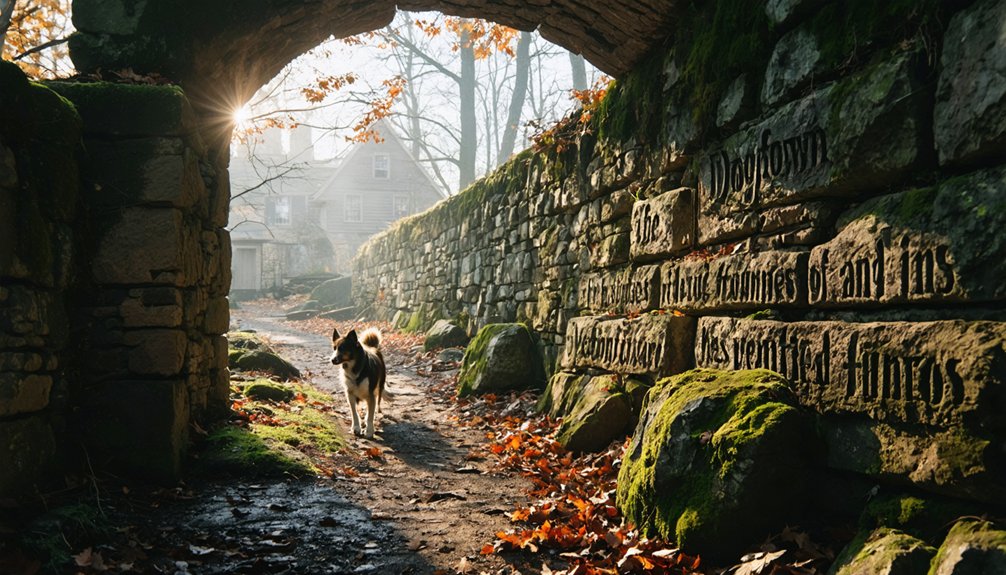
As you explore Dogtown’s overgrown paths with your off-leash companion, you’ll discover over 30 massive boulders carved with quirky motivational messages like “Get A Job” and “Help Mother” – a Depression-era project funded by millionaire Roger Babson to inspire struggling locals.
These scattered granite monuments now serve as fascinating trail landmarks, though their inspirational sayings might seem oddly out of place in today’s abandoned wilderness.
You’ll find yourself hunting for each carved boulder along the 6.47 km loop, where Babson’s philosophical reminders emerge unexpectedly from the forest like ghostly advice from the 1930s.
Great Depression Origins
When the stock market crashed in October 1929, Roger Babson wasn’t surprised—he’d predicted it just days before with his ominous warning that “a crash is coming, and it may be terrific.”
The Gloucester-born financier, descended from Dogtown’s original settlers, seized the moment to launch an unconventional project that would outlast his failed presidential ambitions.
As the Great Depression devastated communities, Babson’s predictions became his calling card. He channeled his newfound notoriety into something meaningful: hiring 35 unemployed Finnish stonecutters to carve inspirational messages into Dogtown’s granite boulders.
While others hoarded resources, Babson created jobs where none existed, transforming abandoned wilderness into an outdoor cathedral of hope.
He’d found freedom from convention, turning economic catastrophe into lasting art.
Carved Motivational Sayings
During the bitter winters of the 1930s, the sound of chisels striking granite echoed across Dogtown’s windswept hills as Finnish stonecutters carved Roger Babson’s philosophy into Massachusetts bedrock.
You’ll discover roughly 24 motivational messages scattered throughout these trails, each one a Depression-era time capsule. “Get A Job,” “Be On Time,” and “Keep Out Of Debt” remind you that economic hardship shaped these words. The historical significance runs deeper than simple slogans—Babson created paying work while spreading his self-improvement gospel.
Today, you can hunt for boulders bearing “Courage,” “Truth,” and “Industry” with your dog trotting beside you. Some stones hide behind decades of forest growth, making discovery feel like treasure hunting.
The twenty-foot “Spiritual Power” boulder stands as the crown jewel of this outdoor philosophy museum.
Finding your way through Dogtown’s 3,600-acre maze requires strategy, since the trail network resembles a giant puzzle where Babson’s inspirational boulders serve as your most reliable guideposts.
You’ll navigate by leapfrogging between these granite monuments, using inscribed messages like “Stay Out of Debt” and “Help Mother” as waypoints when official blazes fade or disappear entirely.
Your trail navigation improves dramatically when you treat boulder landmarks as natural checkpoints. The numbered cellar holes scattered throughout complement these stone markers, creating a dual navigation system that guides you through dense undergrowth where visibility drops.
Download offline maps before venturing out—cell service vanishes in forested sections. Your dog will appreciate the adventure, but keep water handy since granite expanses offer little natural hydration between these motivational milestones.
Witch Legends and Supernatural Stories
Although Massachusetts is renowned for its colonial history and coastal charm, the state’s abandoned settlements carry darker tales that intertwine historical tragedy with supernatural folklore.
Dogtown’s cellar holes hide stories of widows and outcasts who became legendary “witches,” demanding payment to lift cattle curses. You’ll find witch folklore throughout Cape Cod’s secluded ponds and Norton’s Devil’s footprint rock, where eccentric women faced accusations that transformed into ghostly legends.
Salem’s trial legacy haunts Proctor’s Ledge, where spectral victims allegedly wander near execution sites. These supernatural encounters often stem from historical injustice rather than actual witchcraft.
As you explore with your dog, remember these tales reflect social tensions and poverty, not paranormal activity—though the eerie landscapes certainly amplify the folklore that makes these ghost towns unforgettable.
Planning Your Visit to This Haunted Landscape
Before you and your canine companion venture into Massachusetts’ most haunted landscape, careful preparation transforms a potentially treacherous adventure into an unforgettable exploration of history’s shadows.
Dogtown Common’s rocky trails demand respect—pack protective booties for your dog’s paws and carry ample water since shade disappears on exposed ledges. Your hiking gear should include a GPS device or detailed map, as stone waymarkers can’t always guide you through the wilderness.
Pack protective booties and water—Dogtown’s exposed ledges offer little shade while stone waymarkers may lead you astray.
Check your dog’s tick prevention before entering these coastal woodlands, and pack a canine first-aid kit for emergencies. While Dogtown lacks traditional dog friendly amenities, its conservation status guarantees leash-required trails remain open year-round.
Plan weekday visits during spring or fall for ideal conditions and fewer crowds among the ghostly ruins.
Other Abandoned Places in Massachusetts Worth Exploring With Dogs
While Dogtown Common captures the imagination with its mysterious boulder inscriptions, Massachusetts harbors dozens of other abandoned places where you and your dog can explore forgotten chapters of New England history.
Among these hidden gems, ghost tales from Dogtown, Massachusetts, whisper stories of past residents and eerie encounters. As twilight descends, wander the forgotten pathways and imagine the lives that once thrived in this secluded locale. Each shadow and rustling leaf invites you to delve deeper into the history that surrounds you.
The sprawling grounds of Medfield State Hospital offer miles of trails through institutional ruins where your leashed companion can roam freely among crumbling facades.
Industrial ruins like Hawley’s Beehive Kiln provide dramatic backdrops for photography adventures, while abandoned quarries offer spectacular views from safe perimeter paths.
Metropolitan State Hospital in Waltham presents massive abandoned hospitals with accessible exterior routes perfect for urban exploration.
Each location tells stories of lives once lived—from utopian Brook Farm’s foundations to Fort Taber’s coastal military structures—creating unforgettable adventures for freedom-seeking explorers and their four-legged partners.
Frequently Asked Questions
Are There Any Restrooms or Facilities Available for Visitors at Dogtown?
No, you won’t find restrooms or facilities at Dogtown Common. Restroom availability doesn’t exist within this undeveloped wilderness, and facility conditions remain nonexistent. You’ll need to plan ahead and visit nearby Gloucester facilities beforehand.
What Should I Do if My Dog Gets Injured on the Rocky Terrain?
Stop bleeding with direct pressure using clean cloth, then flush wounds with water. For injury prevention, pack booties and first aid supplies. Carry small dogs; use makeshift slings for larger ones needing transport.
Are There Any Parking Fees or Time Restrictions for Visiting Dogtown?
You’ll find free roadside parking near Dogtown’s trailheads, though nearby municipal lots charge seasonal fees up to $45 and require reservations. Dog friendly policies don’t affect parking regulations here.
Can I Camp Overnight in Dogtown With My Dog?
Unfortunately, you can’t establish temporary residence overnight in Dogtown with your canine companion. This wilderness area lacks formal camping regulations and dog friendly amenities, making it unsuitable for sanctioned overnight adventures together.
What’s the Best Time of Year to Visit for Optimal Weather Conditions?
You’ll find the best seasons are late spring and early fall when weather patterns deliver perfect 60-75°F temperatures, minimal crowds, and clear trails for exploring Massachusetts’ haunting ruins with your adventurous companion.
References
- https://www.gopetfriendly.com/blog/pet-friendly-ghost-tours-howl-o-ween/
- https://historyofmassachusetts.org/ghost-towns-massachusetts/
- https://www.youtube.com/watch?v=T4yhm_S-dHc
- https://www.bringfido.com/attraction/27136
- https://coastalbyway.org/communities/rockport/dogtown-dogtown-common-or-dogtown-village/
- https://www.bostonhiddengems.com/blog/dogtown-ma
- https://theworthybone.com/blogs/the-worthy-archives/the-spookiest-dog-friendly-destinations-in-salem-massachusetts
- https://travelnoire.com/abandoned-town-in-northern-massachusetts
- https://en.wikipedia.org/wiki/Dogtown
- https://babsonassoc.org/indegeneous-presence-dogtown/