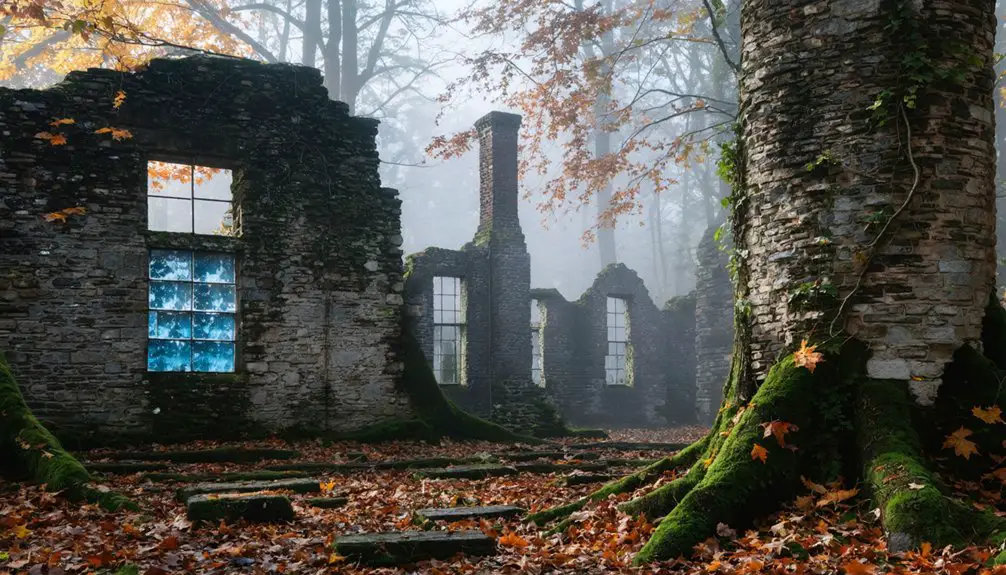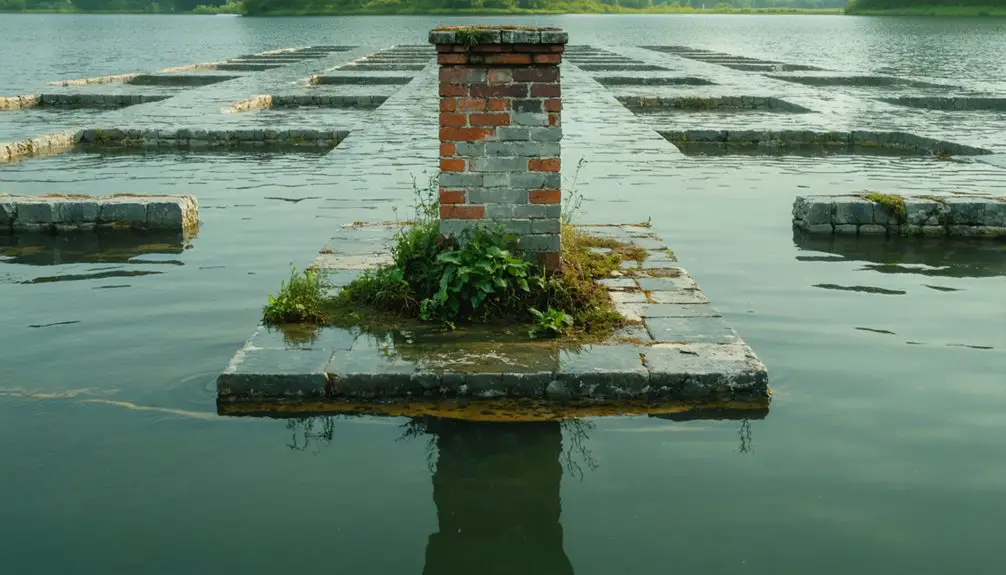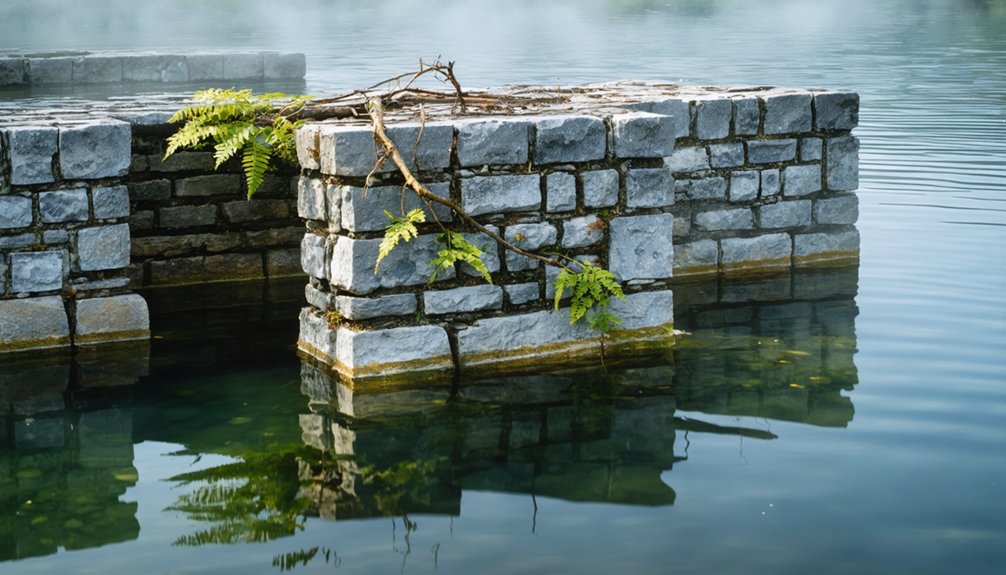
You can’t visit Enfield, Massachusetts today because this colonial town lies submerged beneath the Quabbin Reservoir. Founded in 1679 by the Pease family, Enfield thrived for over 250 years despite border disputes between Massachusetts and Connecticut. In 1938, the state exercised eminent domain to create Boston’s water supply, forcing 2,500 residents from their homes. The town was disincorporated on April 28, 1938, with all structures demolished by 1940, leaving only underwater remnants and memories of this lost community.
Key Takeaways
- Enfield was founded in 1674 but became a ghost town when forcibly disincorporated on April 28, 1938.
- The town was deliberately flooded to create the Quabbin Reservoir, forcing 2,500 residents to relocate permanently.
- All buildings were demolished by 1940, with structures and artifacts now lying submerged underwater in the reservoir.
- The Final Farewell Ball on April 27, 1938 marked the town’s end with over 2,000 attendees.
- Today, Enfield’s remains are preserved underwater as part of Boston’s water supply, inaccessible to public diving.
Early Settlement and Founding
When the General Court of Massachusetts granted land south to Asnuntuck Brook to Springfield in 1674, it set the stage for what would become Enfield’s founding.
John Pynchon built the first European structure that year—a saw mill on Freshwater Brook—but King Philip’s War destroyed it in 1675.
The founding families arrived in 1679 when John Pease, Jr. and Robert Pease came from Salem, Massachusetts.
They faced severe settlement challenges, spending their first winter camping in a shelter dug into a hillside.
You’ll find they were completely isolated—no other white persons lived in the area during that harsh winter. Settlers were required to occupy their lots within three years or forfeit them to the community. By the end of 1680, approximately 25 families had settled in the area.
Colonial Border Disputes
You’ll find that Enfield’s colonial history was shaped by a catastrophic surveying error in 1642, when sailors Nathaniel Woodward and Solomon Saffery incorrectly placed Massachusetts’ northern charter line 7-8 miles south of its true position.
This flawed survey shifted Enfield into Massachusetts territory, where it remained incorporated in 1683 despite belonging to Connecticut under the original charter boundaries.
The error created decades of jurisdictional confusion and violent border conflicts between neighboring towns as Connecticut’s 1695 resurvey proved the boundary mistake. These disputes weren’t resolved until 1713 when Massachusetts and Connecticut reached an agreement that ended the border wars.
The affected towns, growing weary of Massachusetts rule, pursued separation in 1747 through appeals to both colonial legislatures and London courts to resolve their territorial limbo.
Survey Error Consequences
Colonial surveyors working in the Swift River valley during the 18th century created lasting boundary disputes that would plague Enfield throughout its 122-year existence.
These survey inaccuracies stemmed from primitive measurement tools and challenging terrain around the east and west branches of Swift River. You’ll find that Enfield’s incorporation in 1816 from Greenwich and Belchertown portions didn’t resolve underlying boundary ambiguities—it merely masked them.
The town’s position bordering six communities amplified these problems. Overlapping land claims between Enfield, Belchertown, Pelham, Greenwich, Prescott, Ware, and Hardwick created persistent legal conflicts.
Survey errors shifted property lines unpredictably, hindering town growth and development. Railroad construction through disputed areas added further complexity to already contentious boundaries, making property ownership uncertain for generations of residents. The geographical location of Enfield at the intersection of multiple competing jurisdictions made resolution of these boundary disputes particularly challenging.
When the Swift River Act passed in 1927, these longstanding boundary disputes became permanently irrelevant as the state prepared to flood the entire valley for Boston’s water supply.
Massachusetts to Connecticut
While Enfield’s local boundary disputes created ongoing headaches, the town’s very existence stemmed from a colonial surveying blunder that shifted the Massachusetts-Connecticut border miles from its intended location.
In 1642, sailors Nathaniel Woodward and Solomon Saffery conducted an errant survey, sailing around Cape Cod instead of walking the line on foot. Their latitude miscalculations along the Connecticut River pushed the border 7-8 miles south, placing Enfield within Massachusetts territory.
You’d witness decades of resurvey efforts and failed negotiations as both colonies fought over land ownership. Connecticut’s residents preferred their colony’s lower taxes and governing freedoms, petitioning for annexation. The disputed territory also included Freshwater Plantation, which was incorporated in 1683 and helped establish the complex border arrangements.
The 1713 agreement temporarily solidified Massachusetts control, but border adjustments continued until 1749 when Connecticut finally reclaimed Enfield through legislative determination. Connecticut paid Massachusetts 683 pounds for the disputed territory, formally ending the decades-long border conflict.
The Great Awakening and Jonathan Edwards
As religious fervor swept through the Connecticut River Valley in the 1730s and 1740s, the small farming community of Enfield found itself caught in the transformative currents of what historians call the First Great Awakening.
You’d have witnessed Jonathan Edwards himself deliver his infamous sermon “Sinners in the Hands of an Angry God” right here in Enfield’s meetinghouse on July 8, 1741.
Edwards’ vivid imagery of divine wrath and human depravity electrified the congregation, causing listeners to cry out in terror and conviction. This dramatic moment represented the Great Awakening’s peak intensity in your region.
Edwards’ thunderous warnings of eternal damnation sent shockwaves through the packed meetinghouse, marking the revival’s most electrifying moment.
Edwards combined Calvinist theology with powerful emotional appeals, emphasizing humanity’s complete dependence on God’s sovereign grace. His preaching sparked genuine conversions while dividing communities between enthusiastic “New Lights” and skeptical “Old Lights.” The revivalist movement had actually begun years earlier when Edwards led a religious revival in nearby Northampton from 1734 to 1735. Edwards worked alongside George Whitefield to organize revival tours that rekindled religious fervor throughout the American colonies.
The Enfield Shaker Community
The religious awakening that transformed Enfield in the 1740s set the stage for an even more radical spiritual experiment decades later.
When Mother Ann Lee visited David Meacham’s home three times between 1781-1783, she planted seeds for something unprecedented.
You’d witness Joseph Meacham, a local Baptist preacher, converting around 1780 and bringing followers into this revolutionary movement.
The Quabbin Reservoir Project
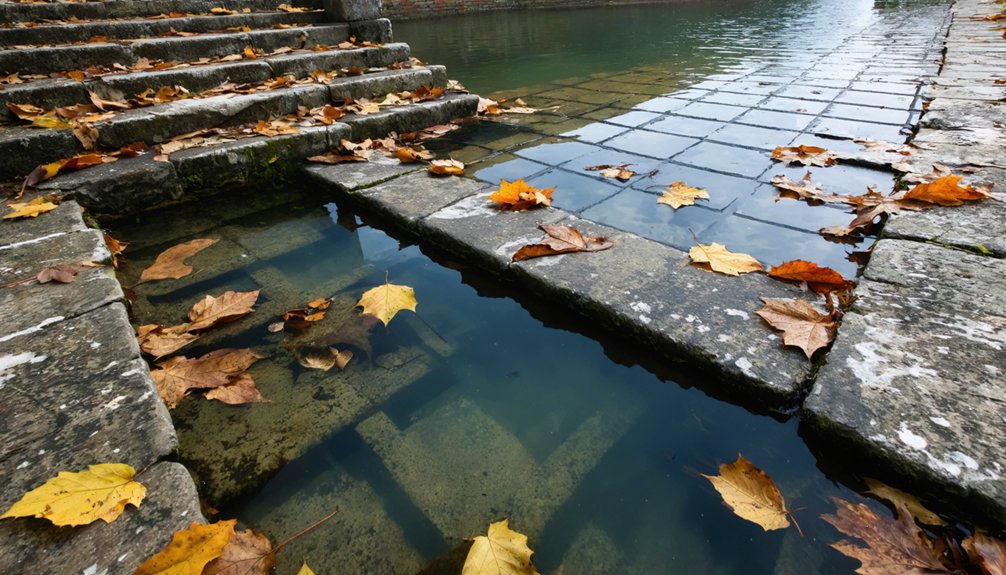
By the 1920s, Boston’s growing thirst for clean water would seal Enfield’s fate forever. You’d witness the state wielding unprecedented power through Chapter 375 of 1926, granting metropolitan water commissioners authority to condemn private property and displace entire communities.
Quabbin construction officially began with the Ware River Diversion in 1926, followed by massive dam works throughout the 1930s.
The Reservoir impact on Enfield was absolute—approximately 2,500 residents faced forced removal as the state exercised eminent domain over homes, farms, and businesses.
You’d see families torn from ancestral lands, their properties demolished or relocated before flooding began. On April 28, 1938, Enfield officially ceased to exist, disincorporated along with three neighboring towns to make way for the 412-billion-gallon reservoir.
Demolition and Displacement
Once the state secured legal authority over Enfield’s territory, systematic demolition crews began the methodical destruction of an entire community. You’d witness inventory teams cataloging every structure before razers dismantled homes, mills, and public buildings.
Workers salvaged machinery from textile factories, selling metal and equipment to nearby towns while leaving select foundations as cost-prohibitive markers.
The demolition impacts devastated 2,500 Swift River Valley residents who faced forced relocation through eminent domain. You’d see families scattered across Belchertown, New Salem, and Ware as churches, schools, and civic organizations dissolved.
State compensation rarely matched property’s sentimental value, destroying farm-based livelihoods and local businesses. Despite displacement, community resilience emerged through descendant reunions and historical associations that preserved Enfield’s memory beyond April 28, 1938’s formal disincorporation.
The Athol & Enfield Railroad
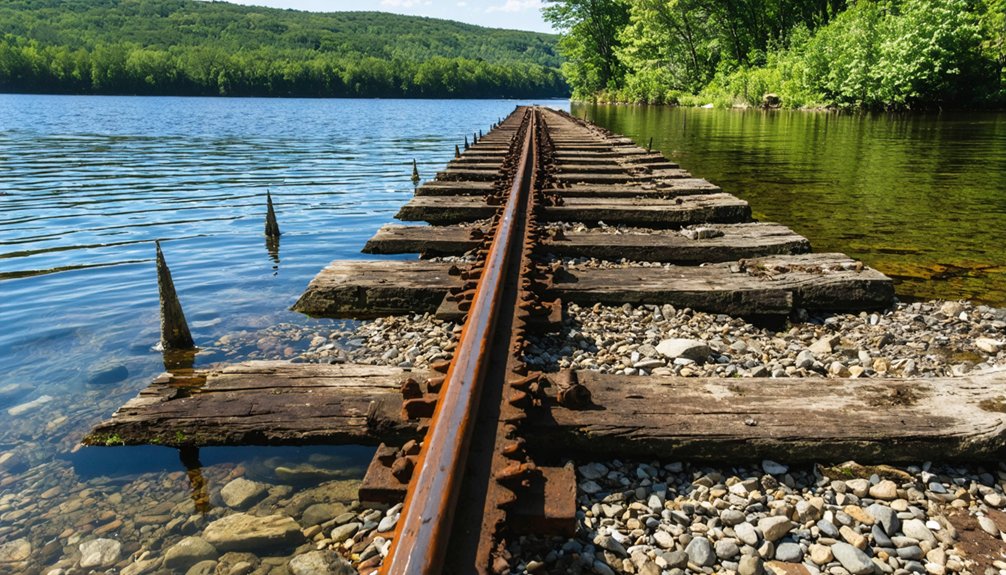
Chartered in 1869, the Athol and Enfield Railroad promised to connect isolated Swift River Valley communities to broader commercial networks.
You’d find this modest line, affectionately nicknamed the “Rabbit Line,” crawling along the valley floor beginning operations in 1871. The railroad significance became evident as it linked Enfield to Palmer and eventually Springfield, transforming the local economy.
You’d discover this charming railway, lovingly called the “Rabbit Line,” slowly winding through the valley and revolutionizing regional commerce.
The railroad’s colorful identity reflected its humble nature:
- Known by various nicknames: Rabbit Run Railroad, Bunny Road, and Soapstone Limited
- Served forgotten Quabbin towns including Dana, Enfield, Greenwich, and Prescott
- Operated freight and passenger service from 1871 until 1935
After joining the Boston & Albany Railroad in 1880, you could travel from these remote valley communities to major urban centers, forever changing rural New England commerce.
The Final Farewell
Melancholy settled over Enfield as the town prepared for its final chapter in 1938.
You’d have witnessed farewell traditions unlike any other as more than 2,000 people gathered for the Final Farewell Ball on April 27th. A funeral-like parade featuring a horse-drawn fire engine draped in black processed through mostly boarded-up buildings to the town hall. The band’s haunting rendition of “Auld Lang Syne” officially marked Enfield’s end, creating a powerful moment of community legacy preservation.
The next day, April 28th, brought formal disincorporation. Enfield’s territory was divided among Belchertown, New Salem, Pelham, and Ware.
Cemetery exhumations relocated all remains before flooding, while salvage operations stripped usable materials from buildings. By 1940, every structure was demolished, leaving nothing but memories beneath the reservoir’s waters.
Underwater Legacy and Remembrance

You’ll find Quabbin Reservoir holds more than water—it preserves the submerged remnants of four lost communities beneath its 39-square-mile surface.
When you visit today, you’re looking at the largest man-made reservoir that was completed in 1946, where tombstones and mausoleums from Enfield’s cemeteries still rest underwater despite the systematic relocation of 7,600 bodies to Quabbin Memorial Park.
The Massachusetts historical societies and local organizations now maintain artifacts and records that serve as the primary connection to these drowned towns, ensuring their stories survive above the waterline.
Quabbin’s Submerged History
Beneath the tranquil waters of Quabbin Reservoir lies a preserved archaeological landscape that spans 39 square miles of submerged history.
You’re looking at America’s most methodically documented underwater ghost town, where four complete communities rest beneath 412 billion gallons of Boston’s drinking water.
Exploring the depths of this underwater site offers a unique glimpse into ghost towns in Massachusetts history, revealing the stories of once-thriving communities now submerged. The remnants of homes, streets, and even local businesses tell a tale of resilience and change, as nature gradually reclaims the land. As divers navigate these waters, they uncover artifacts that help piece together the vibrant life that existed before the reservoir was created.
Late 1990s divers conducting underwater exploration discovered remarkable submerged artifacts that authorities had missed during the extensive pre-flooding clearance:
- A complete mausoleum structure preserved on the reservoir floor
- Multiple tombstones scattered across the submerged landscape
- Foundation remnants from the 14 demolished mills and countless homes
You can’t access these underwater ruins—the reservoir’s strictly protected.
But knowing they’re there connects you to the 2,500 displaced residents whose ancestral homes now rest in perpetual darkness, creating an unintentional time capsule of 1930s rural New England life.
Preserving Lost Communities
While federal authorities can’t permit public diving in Boston’s water supply, archaeologists have developed sophisticated preservation protocols that protect Quabbin’s submerged communities without compromising the reservoir’s primary function.
You’ll find researchers using remote sensing technology—side-scan sonar and multibeam bathymetry—to map Enfield’s buried foundations without physical disturbance.
Community preservation efforts focus on in situ stabilization, where sandbags and geotextile covers protect structural remains from erosion.
When submerged artifacts require recovery, specialists maintain continuous wet storage and apply desalination protocols to prevent deterioration.
They’ve created extensive 3D photogrammetry models and virtual reconstructions that preserve Enfield’s memory for descendants and researchers.
These digital archives guarantee you can explore the lost town’s legacy through publicly accessible exhibits, maintaining historical connections despite the site’s inaccessibility.
Historical Society Artifacts
The Swift River Valley Historical Society‘s carefully curated collections preserve tangible remnants of Enfield’s vanished community, offering visitors direct connections to the town’s pre-reservoir existence.
Through meticulous artifact conservation, these collections document daily life interrupted by forced displacement in 1939.
You’ll discover authentic pieces that residents salvaged before flooding:
- Transportation relics – Dana’s 1927 Ford Model A fire truck and Athol & Enfield “Rabbit Run” railroad artifacts
- Domestic treasures – Kitchenware, textiles, and architectural elements like staircases reused in neighboring towns
- Civic heritage – Church pews, town hall fixtures, and municipal records transferred to safety
Historical documentation extends beyond physical artifacts. Cemetery inventories track reinterred burials, while family papers and photographs reconstruct community bonds severed by state authority.
These collections resist erasure, ensuring Enfield’s memory survives governmental decisions.
Frequently Asked Questions
Can You Still See Any Ruins of Enfield Underwater in Quabbin Reservoir?
You can’t freely explore underwater ruins due to watershed restrictions, but permitted documentary dives have documented submerged foundations and cemetery remains. Underwater exploration remains limited; historic preservation efforts relocated most structures before flooding.
What Happened to the Enfield Residents After They Were Forced to Relocate?
After Enfield relocation, you’d find resident experiences varied dramatically. Some like Marion Andrews Smith rebuilt in nearby Ware, salvaging materials from their original homes, while others scattered across Massachusetts, forever losing their community roots.
Are There Any Ghost Stories or Paranormal Activities Reported at Quabbin Reservoir?
Four towns flooded in 1938 sparked numerous ghost sightings around Quabbin Reservoir. You’ll find paranormal investigations targeting Asa Snow’s legend, Dana apparitions, and EVP attempts at Riverside Cemetery, though evidence remains largely anecdotal.
How Deep Is the Water Over the Original Enfield Town Site?
You’ll find water depths of 100-150 feet covering Enfield’s submerged history at the town center. The exact depth varies seasonally with reservoir operations, but historical records confirm substantial submergence beneath Quabbin’s waters.
Can Visitors Access Any Preserved Enfield Buildings That Were Moved Elsewhere?
You can visit preserved buildings relocated to New Salem before Enfield’s flooding. Bear’s Den exhibits showcase salvaged materials, furniture, and artifacts, preserving the historical significance of displaced communities for those seeking authentic connections.
References
- https://www.harvardmagazine.com/2023/08/quabbin-reservoir-lost-towns-elena-palladino
- https://enfieldhistoricalsociety.org/enfield-history/
- https://en.wikipedia.org/wiki/Enfield
- https://www.ghosttowns.com/states/ma/enfield.html
- https://ournewenglandlegends.com/podcast-417-the-ghost-towns-of-the-quabbin/
- https://freepages.rootsweb.com/~nyterry/genealogy/towns/enfield/enfieldhis.html
- http://explorewmass.blogspot.com/2008/07/postcards-from-lost-town-enfield.html
- https://www.suffieldhistoricalsociety.org/blog/suffield-border-wars
- https://enfieldhistoricalsociety.org/old-town-hall/the-settling-of-enfield/
- https://connecticuthistory.org/surveying-connecticuts-borders/