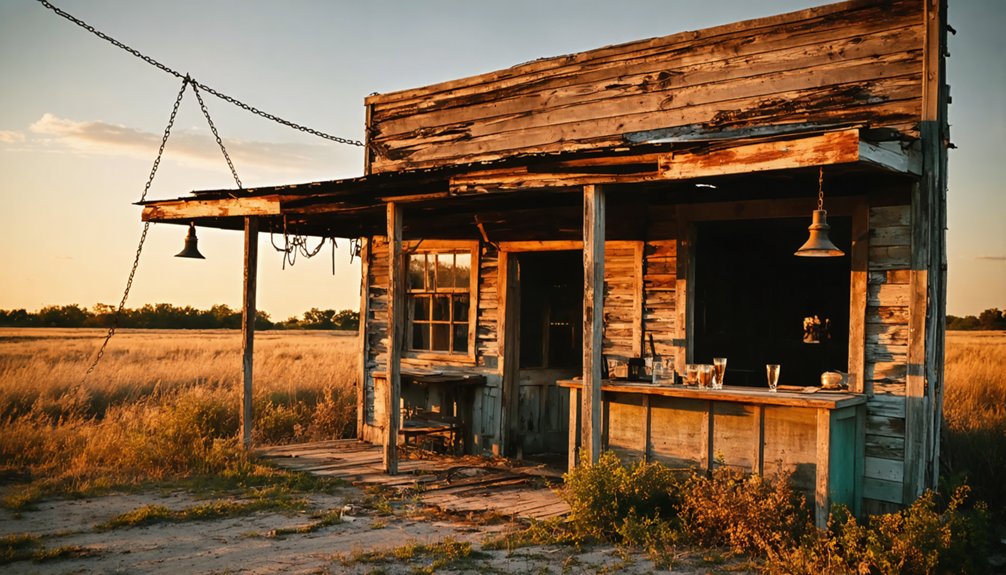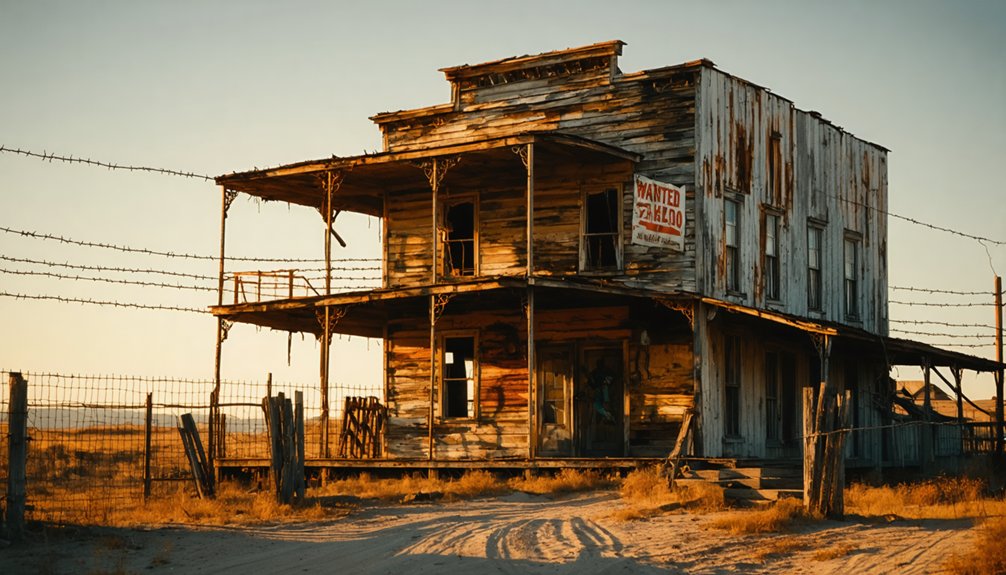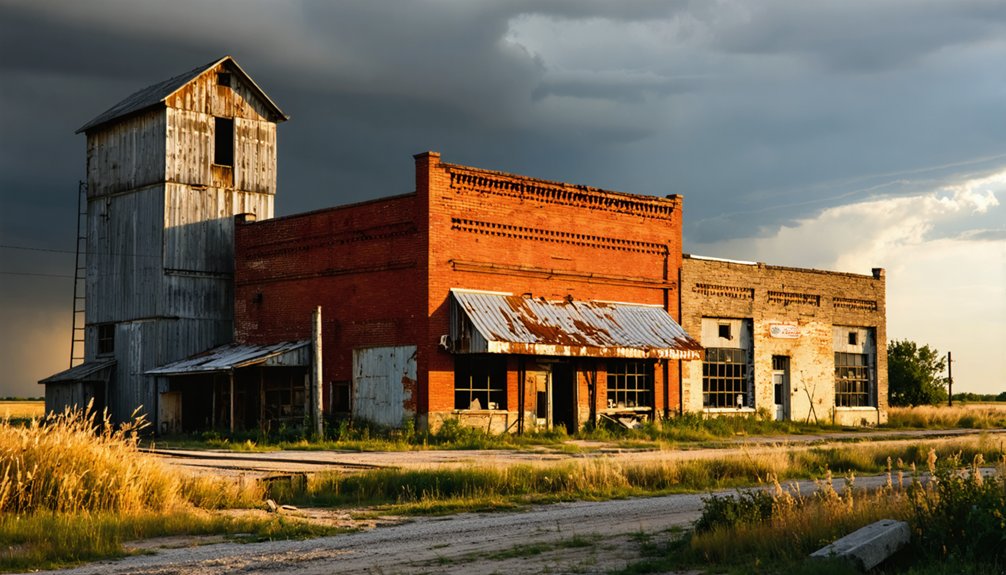
Kansas’s abandoned railroad towns tell the story of boom and bust as rail networks expanded to nearly 10,000 miles by the 1920s before dramatically declining. You’ll find remnants like Quindaro, once a significant Underground Railroad stop, and Ottawa, transformed by rail connections in 1868. Today, only 4,216 miles remain active, with former settlements marked by earthen grades and limestone depots. These ghost towns reveal how transportation shaped—and ultimately transformed—the Kansas landscape.
Key Takeaways
- Kansas’s railroad network peaked at nearly 10,000 miles in the 1920s, leaving numerous abandoned towns when track miles decreased to 4,216.
- Ghost towns like Quindaro, which flourished as a Free State town with 600 residents by 1857, were abandoned after serving their economic purpose.
- Railroad abandonments accelerated post-World War II, with 46 documented instances as companies adapted to changing transportation demands.
- Visible remnants include earthen grades, partially intact rails, and architectural landmarks like depots, bridges, and Harvey Houses.
- Former railroad corridors have been converted to recreational trails, with historical mapping resources available for exploring Kansas’s transportation heritage.
The Rise and Fall of Quindaro: Kansas’s Underground Railroad Haven
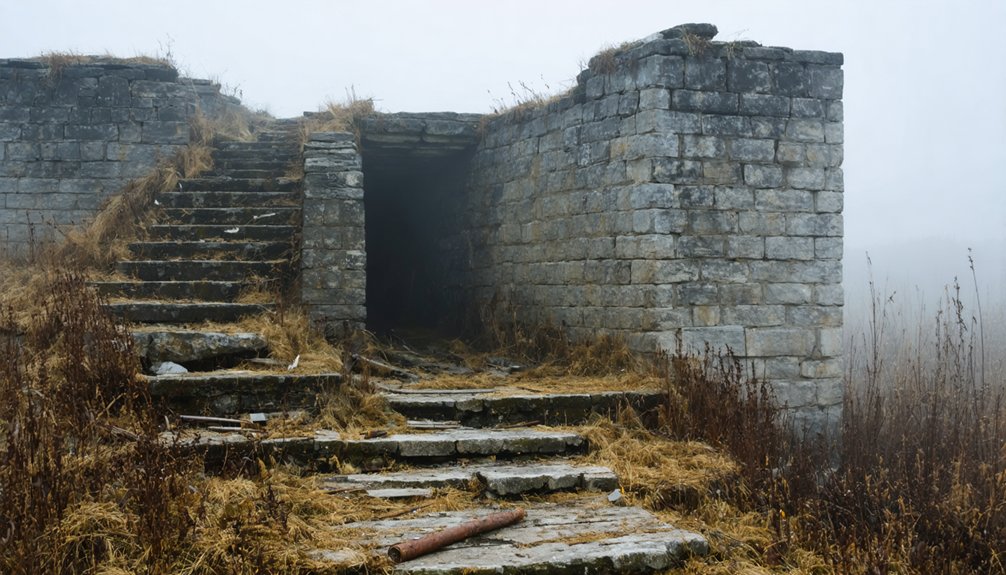
When you explore the forgotten landscapes of Kansas’s territorial past, few stories resonate with the moral complexity and historical significance of Quindaro. Founded in 1857 on Wyandot land, this Free State town arose as a deliberate counter to slavery’s expansion under the Kansas-Nebraska Act.
Amid Kansas’s territorial struggles, Quindaro stands as a forgotten moral beacon against slavery’s dark tide.
Named for Wyandot tribal member Nancy Quindaro Brown Guthrie, this river settlement quickly became essential to the Underground Railroad. Here, abolitionists, Native Americans, and free Blacks united to shelter fugitive slaves from neighboring Missouri.
You’ll find the Quindaro legacy etched into sites like “Uncle Tom’s Cabin” and hidden cisterns that once concealed freedom seekers. The town’s growth was impressively rapid, reaching 600 residents by summer 1857.
Though abandoned by 1862 after Kansas achieved free-state status, Quindaro’s ruins stand as evidence of a remarkable coalition that valued liberty over prejudice—a powerful chapter in America’s struggle for justice. Its strategic location along the Missouri River made it an ideal settlement for those seeking freedom and prosperity in the newly formed territory.
Ottawa’s Golden Age: When Railroads Brought Prosperity
As the Leavenworth, Lawrence, and Galveston Railway reached Ottawa in 1868, this Franklin County settlement experienced a transformative shift from rural outpost to regional commercial center.
The railroad integration catalyzed Ottawa’s prosperity, replacing horse-drawn transportation with swift connections to Lawrence and the expansive Atchison, Topeka & Santa Fe network.
The hallmarks of Ottawa’s railroad golden age included:
- George P. Washburn’s architectural masterpiece—the 1888 limestone depot
- The Santa Fe Railroad’s acquisition bringing over 13,000 miles of commercial connectivity
- Creation of machine shops and roundhouses generating essential employment opportunities
- Establishment of ancillary industries that sustained local economic growth
Though mid-century automotive competition eventually diminished railroad significance, Ottawa preserved its heritage.
The railroad’s construction, completed primarily by Chinese railroad workers, represented one of the earliest major infrastructure projects in post-Civil War Kansas.
Today’s Old Depot Museum stands as a symbol to the era when rail connections determined a town’s commercial fate.
Visitors can explore this rich history at the museum located at 135 West Tecumseh, which houses exhibits showcasing the region’s railroad heritage.
Kansas Rail Network: From 10,000 Miles to Ghost Tracks
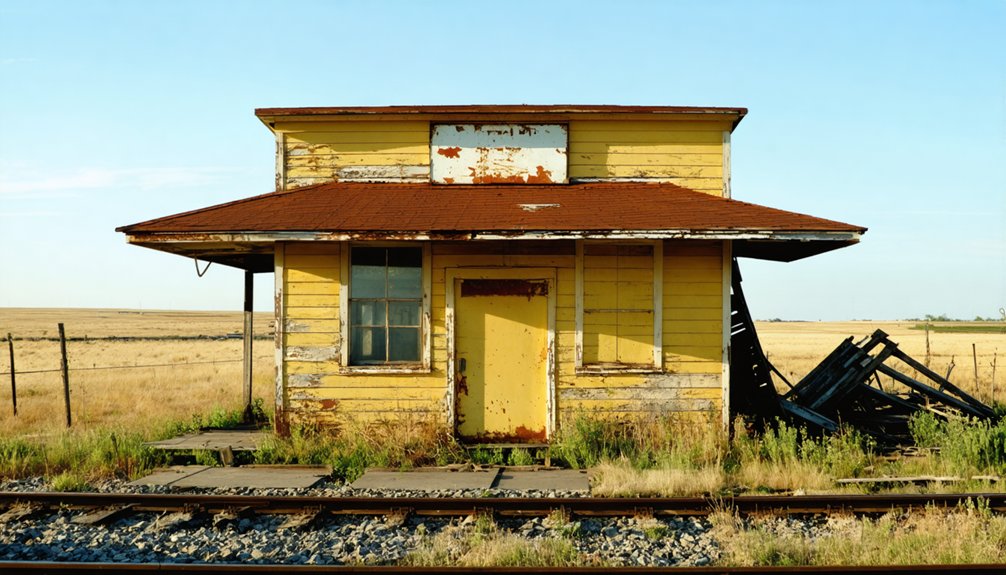
You’d scarcely recognize Kansas’s once-sprawling railroad empire that peaked at nearly 10,000 miles in the 1920s, now reduced to fewer than 5,000 miles of active track.
Railroad tycoons William Barstow Strong and Jay Gould’s fierce competition fueled overbuilding across the state, creating a network that couldn’t sustain itself after World War II.
Today’s ghost tracks and abandoned rights-of-way mark where the Atchison, Topeka & Santa Fe and Missouri Pacific Railroads once connected hundreds of agricultural communities to the nation’s commercial arteries. The earliest foundation of this network can be traced to the Leavenworth, Pawnee & Western, chartered in 1855. The Kansas legislature’s ambitious vision began as early as 1855 when they granted charters to five railroad companies, setting the foundation for the expansion that would follow.
Peak Network Expansion
The vast iron web that once spanned Kansas reached its zenith in 1917, when an impressive 9,367 miles of track stretched across the state’s rolling plains and tallgrass prairies.
This extensive network emerged during the post-Civil War era as railroad connections transformed Kansas from frontier territory to agricultural powerhouse. The Kansas Pacific Railway played a crucial role in this transformation as it facilitated settlement throughout the central Great Plains.
You can appreciate the magnitude of this expansion through these significant developments:
- Twenty-six different railroad companies operated tracks that reached every county in Kansas.
- Population surged from 100,000 to nearly one million by the 1880s as track mileage expanded.
- Major lines like Atchison, Topeka and Santa Fe established vital east-west corridors.
- Kansas City emerged as a magnificent hub, with twelve rail lines converging at its monumental 15-acre station.
This transportation revolution permanently altered the landscape, creating towns where only prairie had existed before. By the late 19th century, Kansas became a crucial shipping point with over three million Texas longhorn cattle transported via the expanding railway system.
Tycoon Railroad Wars
While Kansas railroads collectively created an unprecedented transportation network, fierce competition between powerful railroad tycoons shaped the state’s development in ways still visible today.
You can trace the remnants of Jay Gould’s tactics against William Barstow Strong’s empire in the redundant branch lines that served no purpose except to block competitors. Remarkably, many of these strategic deterrents remained operational until the 1970s.
The high-stakes race for Indian Territory rights pitted James Joy’s Border Tier Railroad against the Katy, with the latter winning through superior strategy.
Meanwhile, Arthur Stilwell’s vision for the Kansas City Southern Railway—financed by Dutch investors—created another essential corridor. Stilwell’s railroad was officially incorporated in 1893 as the Kansas City, Pittsburg and Gulf Railroad before its reorganization in 1900.
When you explore abandoned railroad towns today, you’re witnessing the physical aftermath of these grand commercial chess matches that once determined Kansas’s economic destiny. The state’s rail infrastructure peaked at nearly 10,000 miles of track before economic shifts led to widespread abandonment.
Modern Track Remnants
Standing today amid Kansas’s prairie landscape, you’ll find yourself traversing just 4,216 miles of active railroad—a remarkable decline from the nearly 10,000 miles that once crisscrossed this agricultural heartland.
This dramatic reduction occurred primarily during post-World War II era, with the 1970s-1980s witnessing 46 documented abandonments as rail companies responded to diminishing agricultural shipping demands.
The physical vestiges of this once-mighty network remain visible through:
- Earthen grades scarring rural landscapes
- Partially intact rail sections awaiting track restoration efforts
- Railroad preservation initiatives converting abandoned corridors to recreational trails
- Documented pathways maintained in state geospatial databases
These remnants stand as evidence to Kansas’s transportation heritage, their ghostly presence inviting exploration while historical mapping resources guide adventurers through the freedom of discovering these industrial artifacts.
Leavenworth’s Railroad Legacy: What Remains Today
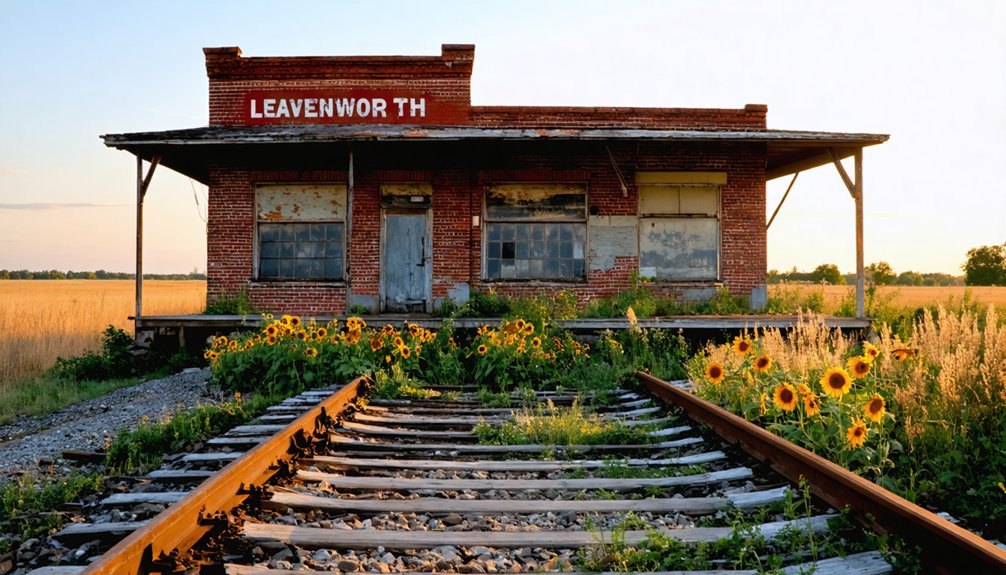
Despite Leavenworth’s ambitious railroad aspirations, you’ll find today only fragments of what might’ve been a thriving rail hub—abandoned rights-of-way where the Kansas Central Railway and other lines once connected the city to a web of commerce.
The Union Depot, converted to new uses, stands as silent testimony to the city’s railroad past, while Fred Harvey‘s connection to Leavenworth predates his famous Santa Fe Railway restaurant empire.
The Terminal Bridge, though modified for modern traffic, remains perhaps the most visible reminder of Leavenworth’s once-promising but ultimately limited role in Kansas railway development.
Vanished Tracks, Enduring Structures
Although time has erased much of Leavenworth’s once-thriving railroad infrastructure, the city’s enduring structural remnants tell a compelling story of ambition, progress, and ultimate limitation.
The Union Depot, with its Romanesque Revival railroad architecture, stands as the crowning achievement of this bygone era, now repurposed as the Riverfront Community Center while preserving its historical significance.
As you explore Leavenworth’s railroad heritage, you’ll discover:
- The Terminal Depot – the sole surviving freight depot from the peak railroad era
- Union Depot – an 1888 masterpiece by architect James McGonigle, restored in 1988 and 2014
- Terminal Bridge landing at Choctaw Street – marking where trains once crossed the Missouri
- Remnants of the five original rail lines that once promised to make Leavenworth a transportation hub
Union Depot’s Second Life
When the last passenger trains departed Leavenworth’s Union Depot in 1963, few could have foreseen the remarkable transformation that would eventually breathe new life into this architectural treasure.
The depot’s journey of adaptive reuse began when V.B. Greenamyre purchased the abandoned station, repurposing it for his business enterprises. By 1984, the structure found its true second calling after the city acquired it and undertook an extensive renovation.
This Romanesque Revival masterpiece—designed by Cobb and Frost and built by James McGonigle in 1888—emerged in 1988 as the Leavenworth Riverfront Community Center.
Now listed on the National Register of Historic Places, the former railroad hub exemplifies how historic preservation and community engagement can intersect.
With its indoor pool and gymnasium, this enduring landmark continues to serve Leavenworth residents while honoring the city’s railroad legacy.
Fred Harvey’s Railroad Connection
Behind Leavenworth’s storied railway heritage stands the remarkable figure of Fred Harvey, whose vision for quality dining forever transformed the passenger experience on America’s railroads.
After arriving in 1865 as a freight agent, Harvey witnessed firsthand the deplorable conditions travelers endured, inspiring his revolutionary railroad hospitality concept.
When visiting Leavenworth today, you’ll discover Harvey’s enduring legacy through:
- Historical markers commemorating the original Harvey House location
- Local museum exhibits showcasing the meticulous standards that defined Harvey Houses
- Community celebrations honoring Leavenworth’s role in launching Harvey’s hospitality empire
- Architectural remnants of the railroad era that Harvey helped define
Though the original Harvey Houses no longer serve passengers, their influence persists in Leavenworth’s commitment to tourism and hospitality, preserving the spirit of quality service that Harvey championed.
Why Kansas Towns Disappeared: Beyond Railroad Abandonment
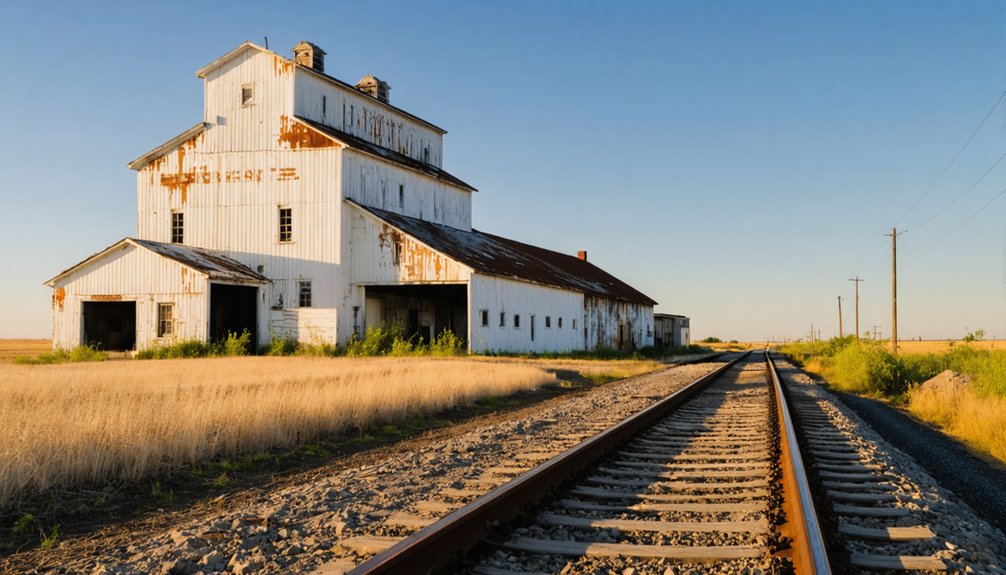
While railroad abandonment often receives primary attention in discussions of Kansas ghost towns, the reality behind these vanishing communities reveals a complex interplay of economic, social, and environmental factors that collectively devastated rural settlements.
In similar fashion, exploring mining history in Alaska unveils a narrative of ambition and hardship, where the quest for gold and resources once fueled thriving towns that are now mere echoes of the past. These once-bustling settlements, driven by the promise of wealth, illustrate how natural resource extraction often shapes the economic landscape and the fate of communities. As miners flocked to these remote areas, they left behind remnants of their endeavors, inviting modern explorers to uncover the stories etched into the land.
You’ll find that agricultural transformation dramatically reduced labor needs—farms that once employed dozens now operate with a single person, triggering economic migration to urban centers. The loss of county seat status stripped towns of administrative importance, while school closures severed community identity and accelerated depopulation.
When schools disappeared, young families followed, creating a negative feedback loop of diminishing services and residents.
Natural disasters further crippled vulnerable communities, with tornadoes and floods destroying infrastructure that cash-strapped towns couldn’t afford to rebuild.
These overlapping challenges, not just changing transportation patterns, sealed the fate of countless Kansas settlements.
The Scott Special’s Unexpected Stop: Kent and Other Lost Depots
The Scott Special’s harrowing emergency stop at Kent, Kansas represents one of the most compelling yet underexamined episodes in American railroad history.
When locomotive 530 suffered a burst cylinder head at this tiny post office town, it threatened to derail the entire record-breaking attempt.
Kent’s significance emerged briefly but powerfully during this July 1905 journey.
The mechanical failures at Kent revealed four critical aspects of early 20th century railroading:
- The fragility of high-speed locomotive technology
- The strategic importance of small depot locations for emergency responses
- The remarkable adaptability of railway crews under pressure
- The eventual obsolescence of towns that once served critical infrastructure roles
You’re witnessing a forgotten moment when a vanishing town briefly participated in transportation history—a freedom-defining journey that would stand unmatched for over three decades.
Preservation Efforts: Saving Kansas’s Railroad Heritage
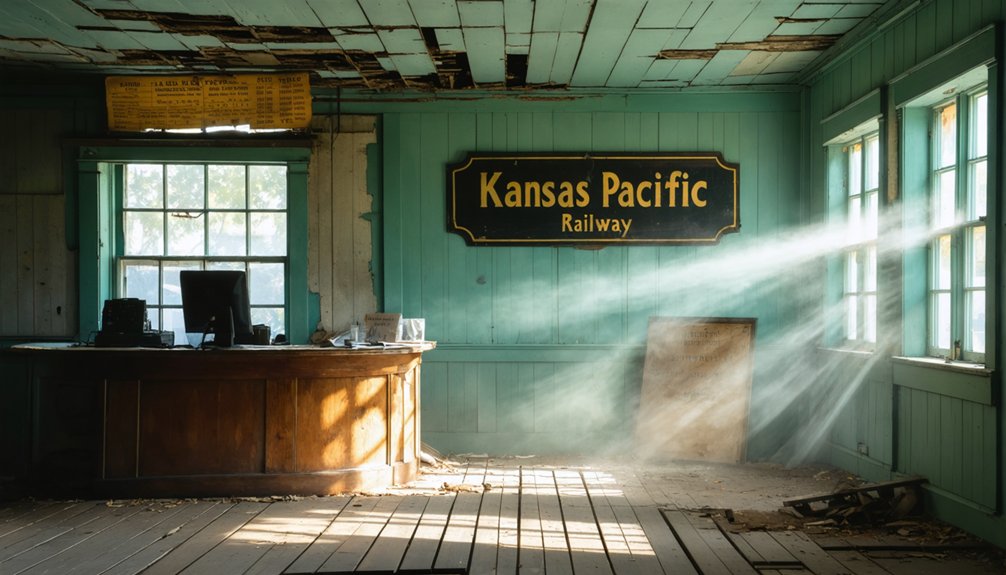
Despite decades of neglect and the relentless march of time, preservation efforts across Kansas have breathed new life into the state’s remarkable railroad heritage. Community engagement has proven vital, with volunteer initiatives like Holyrood’s citizen-led campaign to save their Santa Fe depot in 2014 demonstrating grassroots preservation power.
These restored structures often gain new purposes as museums and meeting spaces. Federal designations have amplified these efforts, with sites like Quindaro Townsite achieving National Historic Landmark status, releasing significant resources for conservation.
Even ghost towns like Nicodemus, designated in 1996, preserve the complex legacy of Black settlement and railroad exclusion. While challenges remain—funding limitations, structural deterioration, and development pressures—multigenerational participation from Boy Scouts to historical societies guarantees Kansas’s railroad story endures for future generations to explore.
The ghost towns of Nebraska’s frontier also tell a story of resilience and adaptation. As remnants of once-thriving communities, they evoke a sense of nostalgia and curiosity, inviting visitors to uncover the tales of those who lived and labored there. Through preservation efforts and tourism, these sites continue to be a vital link to America’s westward expansion and the diverse narratives that shaped the region.
Frequently Asked Questions
How Did Kansas Railroad Towns Adapt During Prohibition?
You’ll discover railroad towns maintained covert speakeasy establishments and operated bootlegging operations, leveraging rail infrastructure for illicit transport while developing alternative economic activities like agriculture and non-alcoholic social gatherings.
What Indigenous Communities Were Displaced by Railroad Development?
You’ll find Potawatomi, Lakota, Cheyenne, Piankashaw, Wea, Kaskaskia, and Peoria communities suffered severe displacement effects through railroad expansion that systematically dismantled their indigenous heritage and traditional economies in Kansas.
Did Any Kansas Railroad Towns Survive by Reinventing Themselves?
Remarkably, just as you investigate this topic, Wamego exemplifies successful reinvention through Oz theming. You’ll find revitalization efforts across Kansas railroad towns leveraged themed tourism, historic preservation, and economic diversification to secure their futures.
Where Can Visitors Explore Abandoned Rail Tunnels Safely?
You’ll find safe rail tunnel exploration at Rock Island Railroad Tunnels in Missouri, which are being converted to rail trails—offering urban exploration opportunities without compromising your safety through official, maintained pathways.
How Did Railroad Towns Handle Racial Segregation Historically?
You’ll find Kansas railroad towns enforced harsh segregation policies through sundown restrictions, economic discrimination, and deliberate bypassing of Black settlements. Community responses ranged from relocation to establishing independent Black townships like Nicodemus.
References
- https://kctoday.6amcity.com/quindaro-town-ruins-kansas-city-ks-underground-railroad
- https://dianastaresinicdeane.wordpress.com/2012/06/12/ghost-trains-on-the-low-plains-a-kansas-railroad-story/
- https://www.american-rails.com/knrs.html
- https://www.trainorders.com/discussion/read.php?11,2075286
- https://en.wikipedia.org/wiki/List_of_ghost_towns_in_Kansas
- https://www.youtube.com/watch?v=UJWJx6Huow8
- https://myfamilytravels.com/small-railroad-towns-in-kansas-that-feel-frozen-in-the-1950s/
- https://abandonedkansas.wordpress.com/2014/12/16/kansas-railroads/
- https://texashistory.unt.edu/ark:/67531/metapth190433/
- https://kclibrary.org/news/2022-03/kc-black-history-do-you-know-town-was-stop-underground-railroad