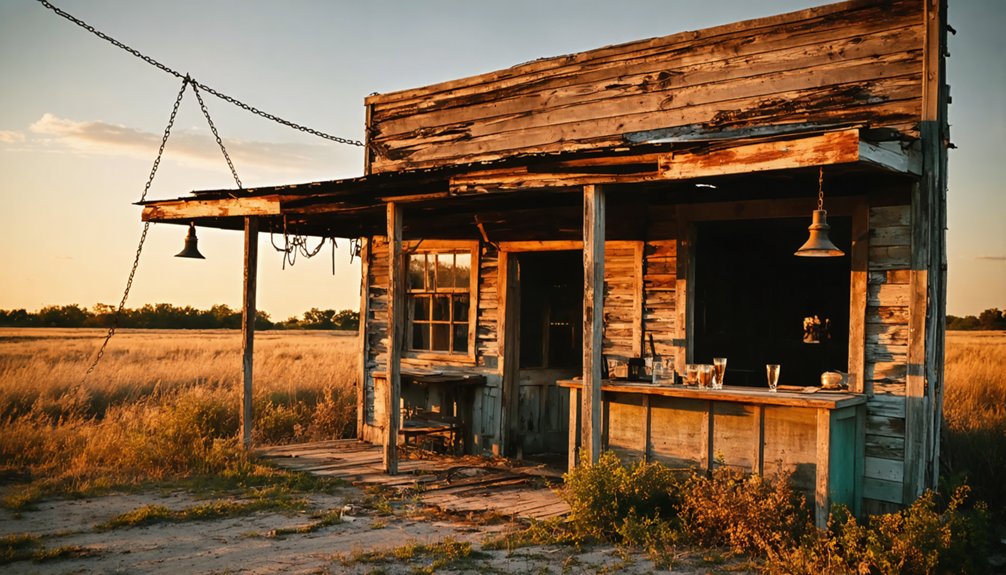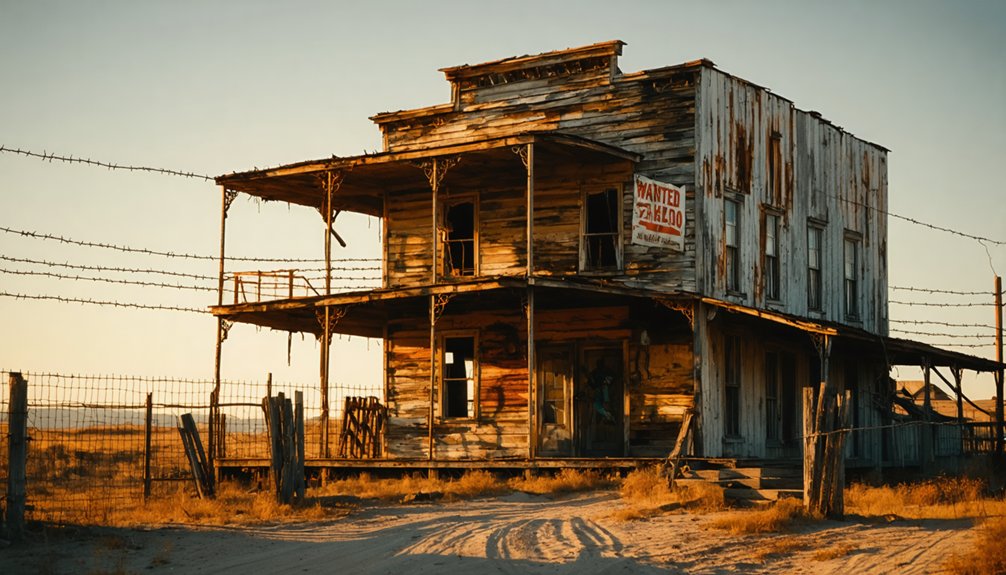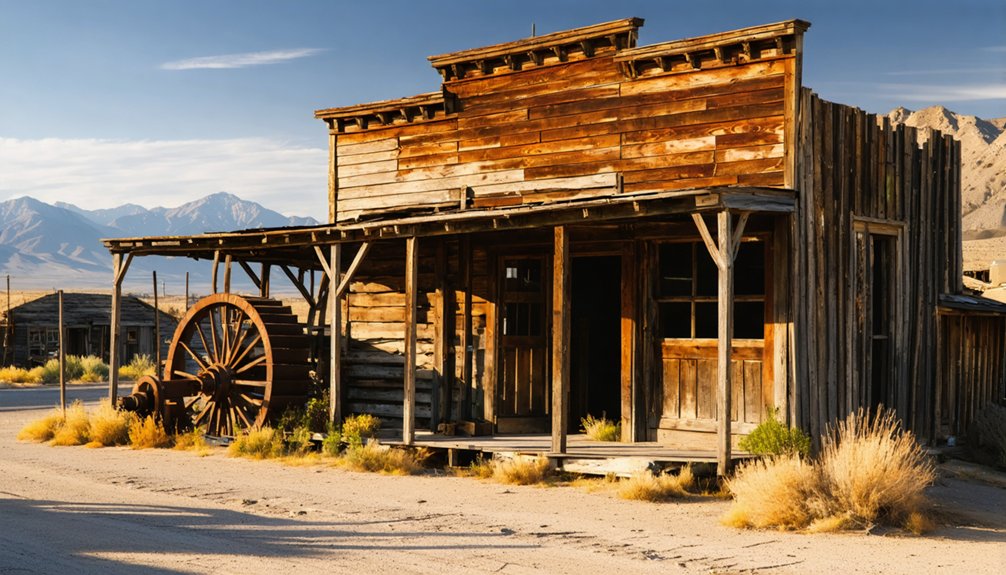
You’ll find California’s Gold Rush ghost towns along Highway 49 and desert routes, where abandoned buildings tell stories of 1800s mining booms. Visit Bodie State Historic Park, preserved in “arrested decay,” or Calico Ghost Town for reconstructed silver mining history. Photograph weathered structures during golden hour (one hour before sunset) for dramatic textures. Bring sturdy boots, water, and respect historical sites by staying on designated trails. These time capsules reveal much more when you know what to look for.
Key Takeaways
- Highway 49’s Gold Rush Trail offers a 300-mile scenic route through numerous ghost towns, ideal for a 2-3 day road trip.
- Bodie State Historic Park preserves over 100 structures in “arrested decay,” providing authentic glimpses into 1880s mining life.
- Visit during golden hours (one hour before sunset) for optimal photography lighting that highlights textures in weathered structures.
- Participate in immersive activities like gold panning at Marshall Gold Discovery Park or historical reenactments at Columbia.
- Pack sturdy boots, water, first aid supplies, and respect preservation rules by staying on designated paths and leaving artifacts untouched.
What Makes a Ghost Town and Where to Find Them in California
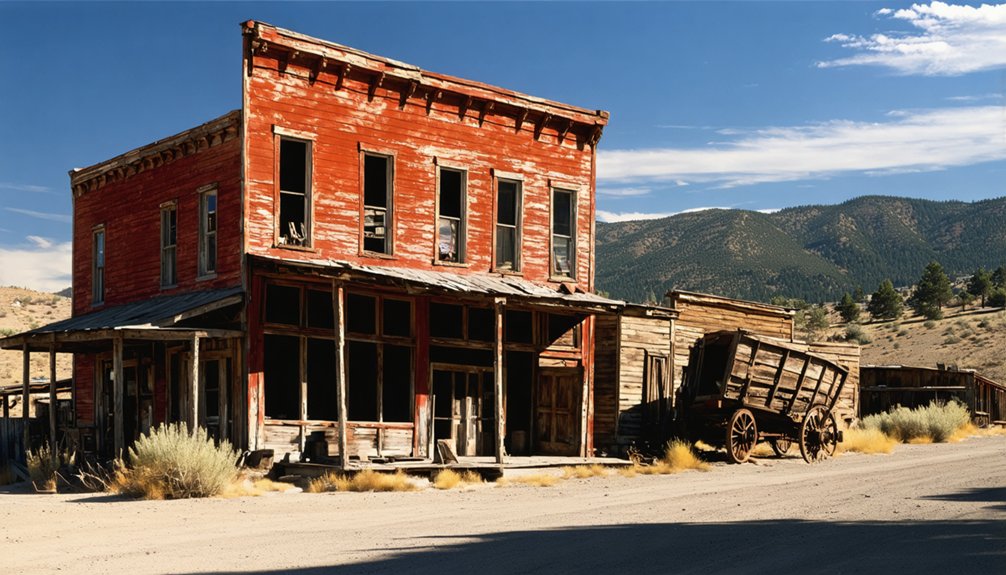
Silence permeates the weathered buildings of California’s ghost towns, standing as poignant reminders of the state’s gold-fueled past. These abandoned settlements emerged when mining activities ceased, leaving behind intact structures but virtually no inhabitants.
You’ll recognize true ghost towns by their abandoned architecture—weathered storefronts, dilapidated saloons, and remnants of mining operations that once thrived with activity.
California’s Gold Rush era (1848-1855) birthed hundreds of these settlements, scattered primarily throughout the Sierra Nevada and northern regions. Notable locations include Bodie, now a State Historic Park with over 100 preserved buildings, and Coloma, birthplace of the California Gold Rush. Bodie exemplifies a ghost town maintained in a state of arrested decay by California preservationists who perform only essential repairs. During its peak in the 1880s, Bodie was home to over 10,000 residents who flocked to the area following the discovery of gold by prospector W.S. Bodey in 1859.
The Gold Rush ignited a constellation of settlements across California’s wilderness—now silent monuments to frontier ambition.
These sites aren’t merely curiosities—they’re protected historical treasures offering unfiltered glimpses into mining history. Visiting these time capsules connects you directly with California’s rugged past, free from modern distractions.
Planning Your Ghost Town Road Trip: Essential Routes and Maps
To venture into California’s historic ghost towns requires more than casual exploration—it demands strategic planning and reliable navigation.
Begin with Highway 49’s Gold Rush Trail, a 300-mile route through Sierra Nevada foothills connecting towns of profound historical significance like Coloma and Angels Camp. For desert enthusiasts, explore the Mojave routes featuring Calico and Randsburg, while adventurous travelers might tackle remote dirt tracks to Cerro Gordo.
Effective ghost town navigation depends on preparation. Download offline maps before departure, as cell service is unreliable in remote areas.
Consider trip duration carefully—Highway 49 deserves 2-3 days, while complete exploration warrants a segmented approach between northern and southern routes. Budget at least three hours to appreciate the rich history of Calico, where approximately 500 mines once operated during its silver boom. State and national park maps provide invaluable guidance, offering context for these preserved windows into California’s gold-fevered past.
Near Placerville, make time to visit Marshall Gold Discovery State Historic Park which features Sutter’s Mill reconstruction, where the California Gold Rush officially began in 1848.
Bodie State Historic Park: The Best Preserved Mining Town in America
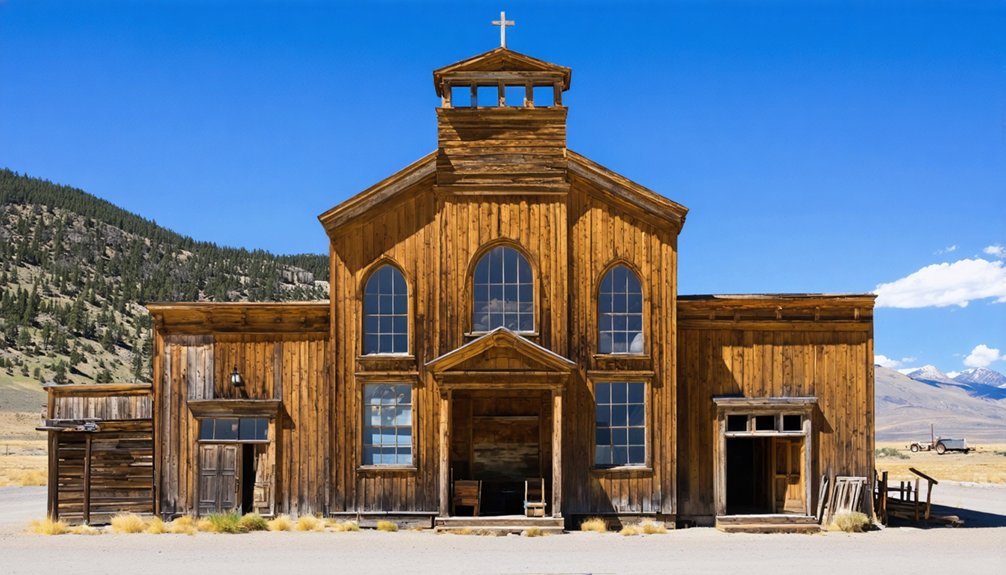
Stepping into Bodie State Historic Park transports visitors back to California’s gold-fevered past, offering the most authentic and thorough ghost town experience in America. Established after W.S. Bodey’s 1859 gold discovery, this boomtown exploded in 1876 when the Standard Company struck a profitable deposit, swelling the population to nearly 10,000 by 1879.
Today, you’ll explore over 100 structures preserved in “arrested decay”—a conservation approach maintaining buildings exactly as residents left them. The park serves as a disambiguation resource for visitors seeking to understand the various historical contexts of the Bodie name. Access becomes especially challenging during winter months when the site is only reachable by ski and snowmobile.
Bodie’s ghost town architecture remains remarkably intact with original furniture and artifacts visible through dust-coated windows. The town’s grid of weathered wooden buildings includes residences, a church, and remnants of 65 saloons that once lined Main Street.
Designated a National Historic Landmark in 1961 and a state park in 1962, Bodie now welcomes 200,000 annual visitors seeking unfiltered glimpses into mining history.
Capturing Perfect Photos in California’s Abandoned Mining Towns
When photographing California’s abandoned mining towns, you’ll find the most dramatic light during the early morning and late afternoon “golden hours,” when the sun bathes weathered structures in warm, directional illumination.
These periods create long shadows that accentuate textures on rustic surfaces and provide natural contrast that enhances architectural details of saloons, stamp mills, and miners’ cabins.
You can also utilize overcast conditions to capture the nuanced details of weathered wood and rusting metal artifacts without the interference of harsh midday shadows. Silver City Ghost Town offers thousands of historical artifacts and displays that make excellent photography subjects throughout the year.
Highway 395 provides convenient access to numerous ghost towns where photographers can discover unique compositions among the remnants of California’s gold mining era.
Light and Shadows
California’s abandoned mining towns present unique photographic challenges and opportunities through their distinctive interplay of light and shadow. The harsh desert environment creates intense midday illumination that bounces off weathered walls, revealing architectural details otherwise hidden. Patience is essential when working in these locations, as bracketing exposures helps manage the extreme lighting contrasts between bright exteriors and dim interiors.
You’ll need to adjust your camera settings frequently as light intensity varies dramatically throughout the day. Watch for long shadows cast through broken doorways and fractured window frames, creating natural geometric patterns across interior floors. These shadow patterns offer powerful compositional elements that change hourly. Like Kolmanskop’s acclaimed photographers, consider using a versatile kit that includes wide-angle and zoom lenses to capture the full range of scenes.
For texture enhancement, position yourself to capture light at oblique angles across peeling wallpaper and weathered surfaces. Early morning provides soft side lighting that adds depth to sand-filled rooms.
For night photography, carefully balance artificial lighting with ambient conditions to prevent overexposure while maintaining shadow detail in these forgotten spaces.
Golden Hour Timing
How expertly do photographers capture California’s ghost towns? The key lies in understanding golden hour timing—that magical window when the sun sits low, creating perfect lighting conditions.
In California’s abandoned mining towns, golden hour typically begins about one hour before sunset, though this varies seasonally. During winter months, prepare for sunset golden hour photography as early as 3:00-4:00 PM, while summer sessions often start around 7:00 PM.
Always arrive 30 minutes early to scout locations and set up equipment.
- The warm, orange glow illuminating weathered wooden structures
- Shadows stretching dramatically across dusty streets
- Sunlight filtering through broken windows of abandoned saloons
- Golden rays highlighting the texture of rusted mining equipment
- The ethereal quality of light wrapping around crumbling stone walls
Calico Ghost Town: Silver Mining Legacy and Modern Tourism Experience

While Calico’s explosive 1880s silver mining boom extracted over $20 million in its first decade and employed 500+ active mines by 1893, the town quickly collapsed after silver prices plummeted from $1.31 to 63 cents per ounce.
You’ll find Walter Knott’s meticulous 1950s restoration preserved five original buildings while authentically reconstructing others based on period photographs, creating California’s officially designated Silver Rush Ghost Town.
Today, you can explore underground exhibits at Maggie’s Mine, witness the Glory Hole’s rich silver extraction site, and experience 1880s life through restored general stores, hotels, and boarding houses in this San Bernardino County park.
Silver Mining Boom
Although California’s gold rush initially captured the imagination of fortune seekers worldwide, the silver mining boom in Calico proved equally transformative for the region. Founded in 1881, this bustling mining center quickly produced $20 million in silver ore over just 12 years, accounting for nearly 80% of San Bernardino County’s silver output.
- You’ll stand where 3,500 residents once pursued fortune in these rugged mountains.
- You’re witnessing the remnants of an economic powerhouse that delivered $86 million in silver.
- You’ll feel the weight of history as silver prices collapsed, devastating dreams overnight.
- You’re exploring the exact spot where Walter Knott’s uncle staked original claims.
- You’re experiencing firsthand how quickly a thriving town can transform into a ghost town.
Old West Attractions
The silver boom’s sudden collapse might’ve spelled permanent doom for Calico, but instead, the abandoned mining town has risen to become one of California’s most celebrated historical attractions.
Walter Knott’s 1950s restoration preserved its old west authenticity, leaving five original structures untouched while rebuilding others to their 1880s appearance. In 2005, it earned official recognition as California’s Silver Rush Ghost Town.
Today, you can explore the underground passages of Maggie Mine, witness optical illusions at the Mystery Shack, or pan for “fool’s gold.”
The Lucy Lane Museum houses artifacts that tell Calico’s storied past, while gunfight shows bring the frontier era to life. Ghost stories abound during October’s haunt events, creating an authentic window into California’s rugged mining heritage that’s accessible year-round from 9 AM to 5 PM.
Desert Recreation Hub
Beyond its historical significance, Calico Ghost Town has evolved into a premier desert recreation hub that draws visitors year-round to San Bernardino County.
Since Walter Knott’s 1950s restoration and subsequent donation to the county in 1966, this California State Historical Landmark (#782) has balanced authentic preservation with recreational development.
- Immerse yourself in mining heritage through the Maggie Mine tour, where you’ll witness the legendary “glory hole” that yielded $65,000 in silver.
- Experience desert wildlife while traversing hiking trails surrounding the former boomtown.
- Ride the Calico Odessa Railroad for panoramic desert vistas once valued by silver prospectors.
- Participate in historical reenactments that transport you to the 1880s mining heyday.
- Explore recreational activities including camping facilities that make Calico a complete desert destination.
Lesser-Known Ghost Towns Worth Discovering Off the Beaten Path
Hidden among California’s Sierra Nevada mountains and desert landscapes lie several remarkable ghost towns that few tourists ever discover.
These hidden treasures include Bennettville, established in the 1870s with high silver mining hopes before its rapid abandonment, and Dog Town, Mono County’s first gold settlement that flourished briefly until fire and depleted resources sealed its fate.
For those seeking historical significance, Lundy offers silver mining ruins that blend naturally with Sierra Nevada terrain near Mono Lake.
Darwin, situated near Death Valley, maintains a curious balance between ghost town status and active community with approximately 40 residents.
Meanwhile, Silver City presents a unique preservation approach – its structures were relocated and maintained in “arrested decay” to showcase authentic 1850s gold rush architecture.
Safety Tips and Ethical Guidelines for Ghost Town Exploration
When you explore California’s gold rush ghost towns, you’ll need reliable survival equipment including sturdy footwear, water, layered clothing, sunscreen, and emergency supplies for areas with limited cell coverage and extreme conditions.
Preserving these historical treasures requires strict adherence to regulations that prohibit removing artifacts, using metal detectors, or disturbing structures maintained in “arrested decay” states.
You must follow posted signage, stay on designated trails, properly dispose of trash, and document your visit through photography rather than vandalism to guarantee these unique historical sites remain intact for future generations.
Essential Survival Equipment
Modern ghost town exploration requires four essential pieces of safety equipment that reflect both historical challenges and contemporary hazards.
When preparing your survival gear, prioritize protection against the same dangers miners faced, while respecting structural integrity concerns that didn’t exist during the Gold Rush era.
- Sturdy boots with ankle support for traversing unstable terrain and potential snake encounters in abandoned structures
- High-quality water filtration system to address contaminated water sources affected by mercury and cyanide residue
- Respirator mask to protect against dust, debris, and potential airborne toxins in degrading buildings
- Detailed first aid kit including antivenin information for remote areas far from medical assistance
- Bright headlamp with backup batteries for safely examining dark interiors without damaging mining essentials
Respecting Historical Sites
Exploring ghost towns with proper equipment only represents half of responsible adventuring; equally important is understanding how to protect these fragile windows into California’s past.
These sites operate under “arrested decay” principles, preserving authentic historical integrity that requires your active participation in conservation.
Remember: taking or disturbing artifacts, rocks, or plants is illegal. Metal detectors are prohibited, and you should never enter unstable structures unless explicitly permitted.
Follow designated pathways and respect “no entry” signs that protect both you and historical assets.
Maintain visitor etiquette by keeping noise minimal, controlling pets, and obtaining permits for professional photography.
Report vandalism immediately. Historical preservation depends on your compliance with these guidelines, ensuring these treasures remain intact for future explorers while maintaining the atmospheric authenticity that makes ghost towns so compelling.
Mining Technology and Architecture: What to Look For During Your Visit
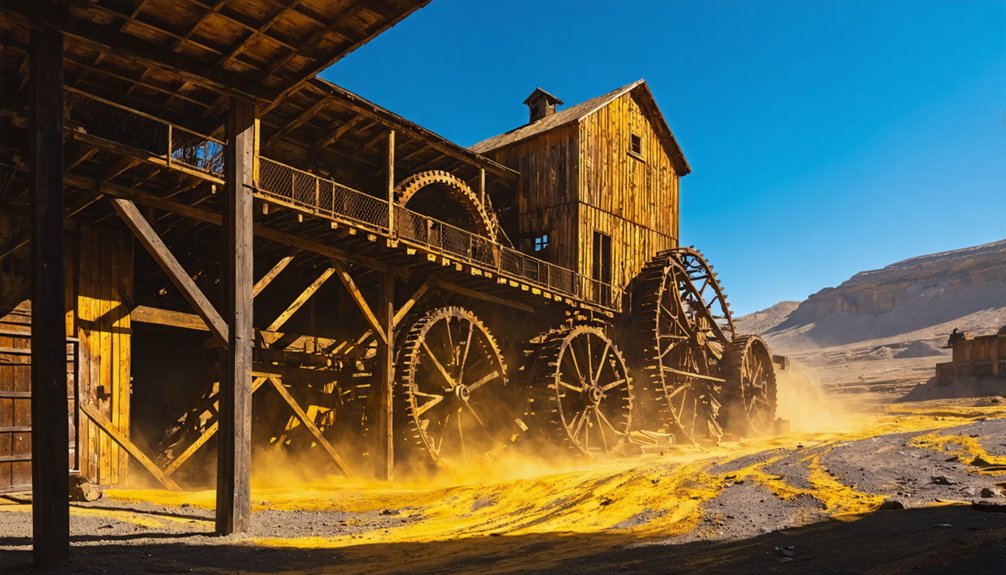
As you traverse the historic pathways of California’s ghost towns, identifying the technological progression of Gold Rush mining operations enhances your appreciation of these preserved sites.
The abandoned towns of California tell stories of ambition and adversity, revealing the dreams of fortune seekers who once roamed these rugged landscapes. As you explore the remnants of their lives, you’ll encounter a blend of architectural styles that reflect the diverse influences of the era. Each structure varies in preservation, offering a glimpse into the past and the resilience of communities forged in hardship.
You’ll witness California’s mining heritage through architectural remnants spanning from simple panning methods to industrial-scale hydraulic operations.
Watch for these distinguishing features:
- Weathered sluice boxes and cradles showcasing miners’ ingenuity in separating precious metal from sediment
- Towering stamp mills where massive hammers once pulverized ore into gold-yielding dust
- Remnants of water delivery systems—flumes, canals, and dam structures—that powered entire mining districts
- Mercury amalgamation equipment illustrating the dangerous yet effective chemical processing methods
- Foundations of steam-powered machinery that revolutionized extraction capabilities through mechanical force
These technological innovations transformed California’s landscape while creating the ghost towns you’re exploring today.
Seasonal Considerations and Weather Preparation for Desert Ghost Towns
While mining technology shaped the physical structures you’ll observe in ghost towns, the harsh desert climate has preserved and weathered these historical sites in distinctive ways.
These environments demand respect and preparation as you navigate seasonal weather patterns.
Spring (March-May) and fall (September-November) offer ideal exploration conditions with moderate temperatures and minimal desert hazards.
Summer brings dangerous heat exceeding 100°F, while winter can deliver snow and ice above 4,000 feet elevation with winds reaching 70 mph.
Pack layers to accommodate temperature swings, sturdy footwear, extra water, and sun protection.
Always check road conditions before departing, as monsoon rains can wash out dirt roads and winter storms may block mountain passes.
Remember that wildlife patterns shift seasonally—snakes emerge in warm months, while tracks appear in winter mud or snow.
Ghost Town Festivals, Events and Living History Experiences
California’s abandoned mining settlements come alive through vibrant festivals, events, and living history experiences that transport visitors back to the Gold Rush era.
Major ghost town festivals include Calico Days with miner triathlons and costume contests, Columbia State Historic Park’s immersive reenactments, and Coloma Gold Rush Live’s three-day historical recreation.
- Feel the adrenaline rush during authentic gunfighter shows performed by volunteer troupes
- Experience the thrill of striking gold in hands-on panning demonstrations
- Marvel at over 100 costumed interpreters bringing 1852 Columbia to life
- Discover your pioneer spirit through butter churning and historical trade shop activities
- Wander through haunted sites on Columbia’s Ghost Stories Tour while local folklore raises goosebumps
Admission ranges from $8-15 for adults, with special activities sometimes requiring additional fees.
Frequently Asked Questions
Are Ghost Towns Legally Accessible at Night for Paranormal Investigations?
No, you can’t legally access ghost towns at night without explicit permission. Nighttime accessibility requires written consent from property owners, and investigation regulations prohibit unauthorized entry regardless of your paranormal interests.
How Did Women and Children Experience Daily Life in Mining Towns?
Can you imagine the resilience? You’d face harsh conditions while balancing family roles: cooking, laundering, and managing scarce resources. Your daily chores included helping with gold panning while caring for children in dangerous mining environments.
What Indigenous Communities Were Displaced During the Gold Rush Period?
You’ll find the Nisenan, Miwok, Maidu, Modoc, Yurok, Wintu, Pomo, and Shasta were among the displaced tribes, suffering catastrophic population decline from 150,000 to below 30,000 through violence and disease.
Can Metal Detectors Be Used at California Ghost Town Sites?
Like a prospector balancing pan and law, you’ll need to navigate metal detecting regulations carefully. You can’t detect in state historic parks, but private ghost towns allow treasure hunting with proper permission and ethical practices.
Which Ghost Towns Have the Most Authentic Saloons Still Serving Drinks?
You’ll find the most authentic historic saloon culture in Virginia City, Tombstone, Columbia, and Calico. Each preserves 19th-century ghost town nightlife while serving modern patrons in their carefully maintained establishments.
References
- https://www.loveexploring.com/gallerylist/67994/americas-eeriest-gold-rush-ghost-towns
- https://www.camp-california.com/california-ghost-towns/
- https://www.visitcalifornia.com/road-trips/ghost-towns/
- https://patch.com/california/banning-beaumont/13-ghost-towns-explore-california
- https://californiahighsierra.com/trips/explore-ghost-towns-of-the-high-sierra/
- https://wanderwisdom.com/road-trips/top-old-west-and-mining-towns-to-visit-in-california
- https://asyaolson.com/the-best-gold-rush-ghost-towns-in-california/
- https://westernmininghistory.com/state/california/
- https://www.tripadvisor.com/ShowTopic-g28926-i29-k14741167-Gold_Rush_Ghost_Towns-California.html
- https://www.pacificadventureclub.com/blog/the-infamous-bad-man-of-bodie-california-ghost-town-a-haunting-history