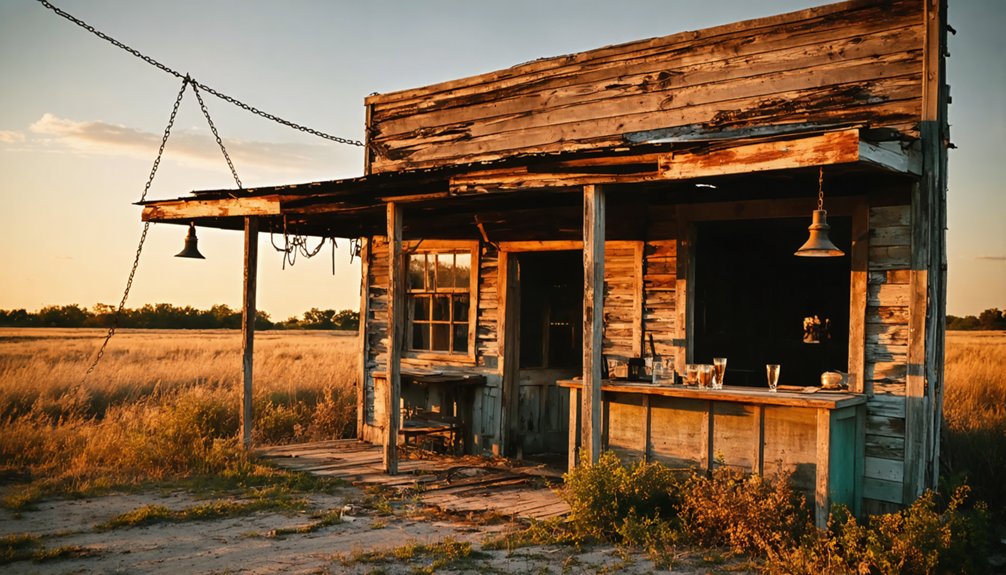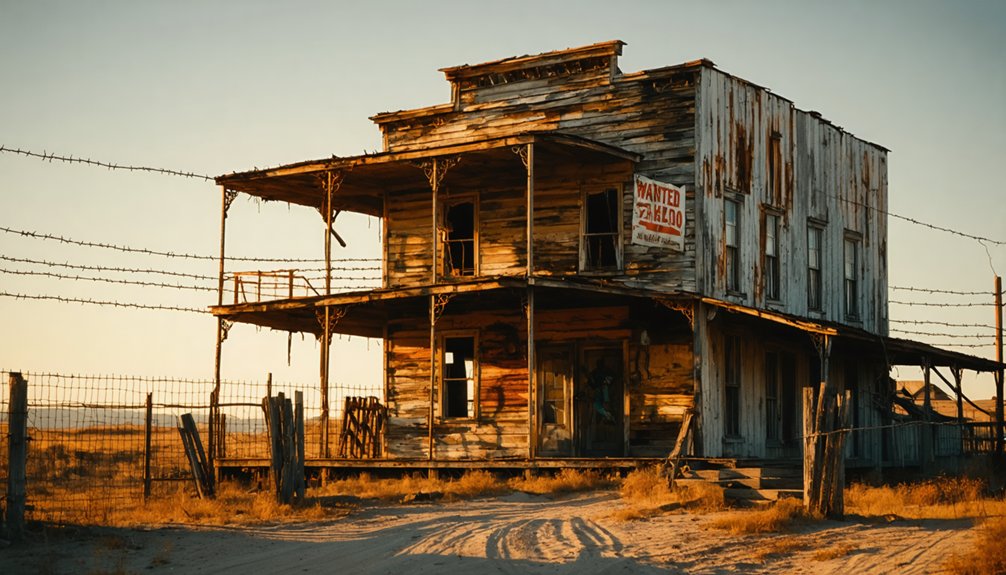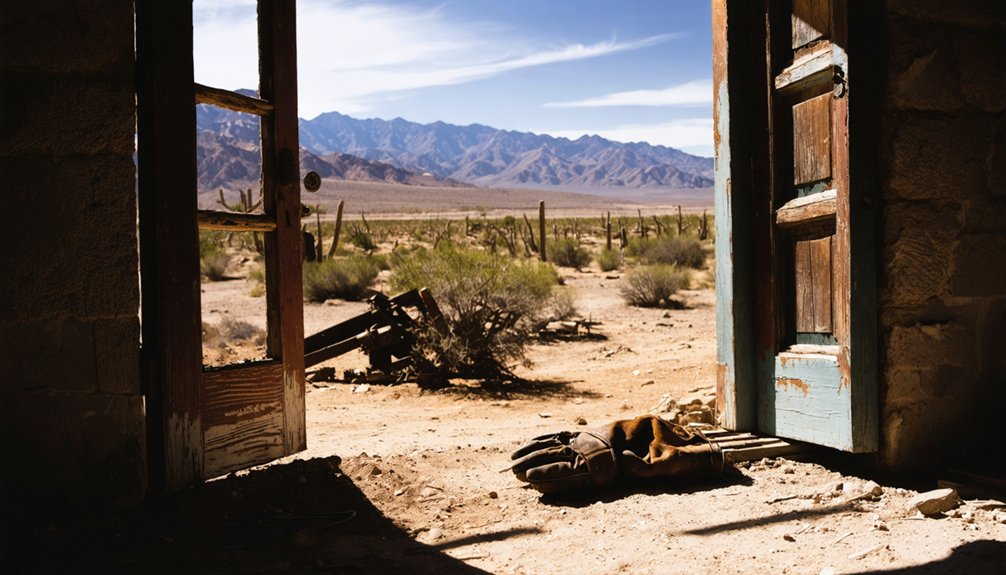
When you explore Texas’s ghost towns, you’ll discover America’s richest collection of abandoned settlements—over 500 scattered across the state. From railroad communities like Eagle Lake to silver mining boomtowns like Shafter, these ruins chronicle the dramatic economic shifts of the 19th and early 20th centuries. You’ll encounter everything from submerged coastal ports destroyed by hurricanes to preserved courthouses with tales etched in their weathered foundations. Each crumbling structure offers a window into Texas’s turbulent past.
Key Takeaways
- Texas houses over 500 ghost towns with notable concentrations in Wilson County and the New Braunfels area.
- Mining ruins like Terlingua and Shafter feature abandoned machinery and dangerous tunnels that illustrate Texas’s industrial past.
- Coastal ghost towns like Indianola showcase settlements destroyed by hurricanes and economic shifts in the 19th century.
- Helena’s preserved courthouse, Terlingua’s artist community, and historic cemeteries offer glimpses into vanished communities.
- Historical commissions and preservation groups work to document and maintain these sites despite funding and legal challenges.
The Ghost Town Capital: Why Texas Leads the Nation
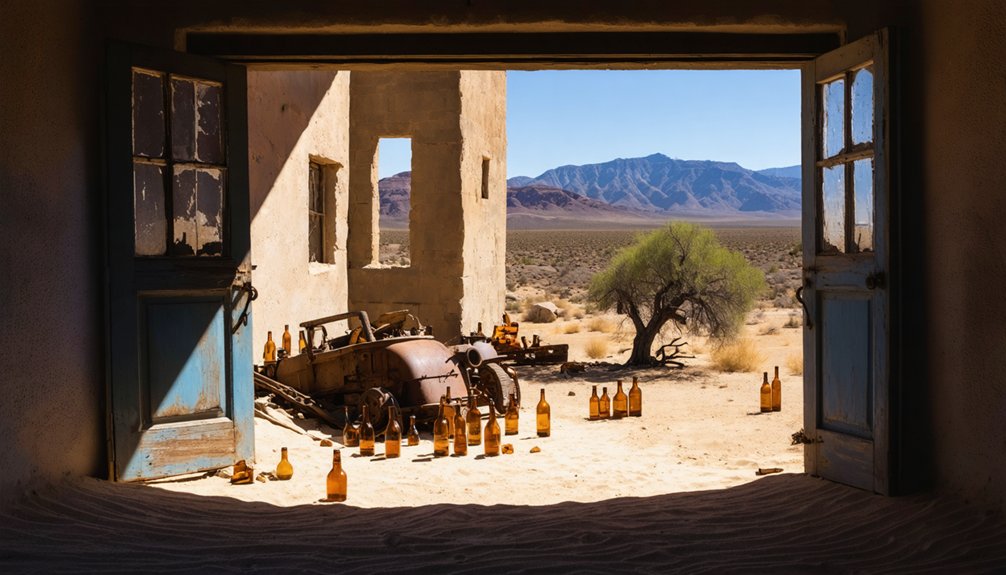
When examining abandoned settlements across the United States, Texas stands unequivocally as the nation’s ghost town capital, hosting approximately 511 deserted communities—significantly outpacing California’s 346 and Kansas’s 308. This abundance reflects the state’s turbulent economic history and population shifts.
Wilson County alone contains 31 ghost towns, while the New Braunfels area features roughly 25 abandoned settlements within a 25-mile radius. These concentrations illustrate the dramatic boom-and-bust cycles that shaped Texas’s development.
The dense clustering of ghost towns in central Texas reveals the fragile nature of frontier prosperity.
Gomez exemplifies this pattern as it was once a thriving settlement with businesses and a cotton gin until the railway favored nearby Brownfield, leading to its complete abandonment.
The cultural significance of these sites extends beyond mere statistics—Texas’s reputation as America’s most haunted state, with over 7,600 reported ghost encounters, has transformed these abandoned places into repositories of ghost town legends.
These forgotten communities serve as physical reminders of Texas’s dynamic past, where fortunes rose and fell with cotton, wheat, mining, and ranching industries. According to a recent study by ActionNetwork.com, Texas dominates nearly every paranormal category with 558 ghost towns scattered across the state.
Abandoned Railroad Towns: When Progress Passed By
Throughout the late 19th century, the iron rails stretching across Texas’s vast landscape acted as lifelines that birthed hundreds of communities virtually overnight.
You’ll find towns like Eagle Lake (1859) and Old Town Spring (1873) established directly from railroad expansion, transforming undeveloped terrain into bustling centers of commerce.
These settlements thrived on industries the railroads enabled—lumber operations, sand and gravel mining, and sugar refineries. The town of Hagerman, originally named Steedman, grew to a population of 250 with numerous businesses after receiving its railroad depot in the early 1900s.
But when highways rose to prominence, the very progress that created these towns ultimately caused their decline. The Southern Pacific abandoned unprofitable agricultural branches, and by 1987, once-promising Belle Plain retained just four families.
Today, you can explore these forgotten places where abandoned depots and ghost tracks reveal a bygone era—some, like Old Town Spring, reinvented as tourist destinations celebrating their railroad heritage. Eagle Lake’s Tower 115, once vital to managing crossings of three major railroads, stood as a sentinel until 1996 when razed.
Mining Settlements: From Boom to Bust
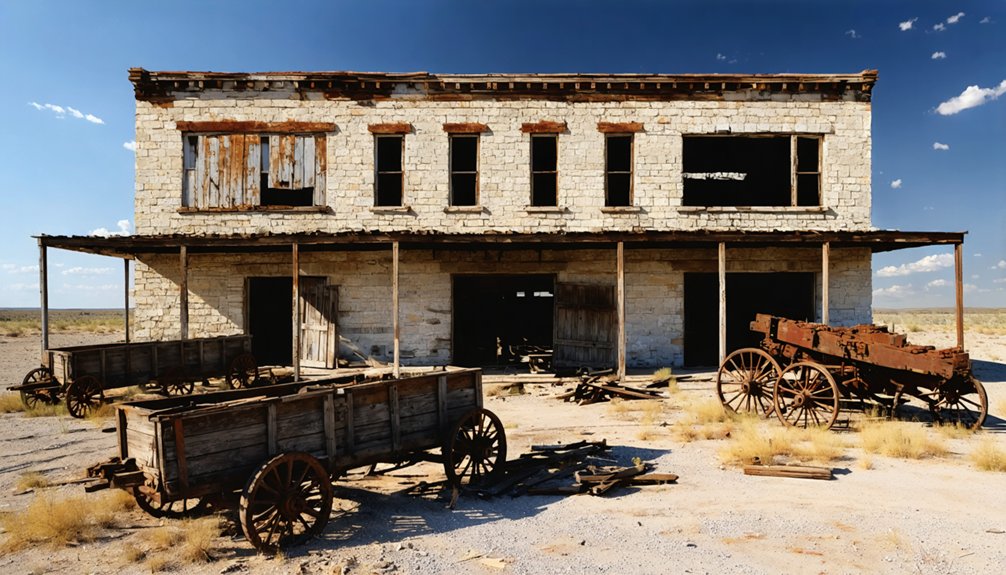
As you explore Texas ghost towns, you’ll encounter the remnants of silver strikes that transformed vacant land into bustling communities during the 1880s, especially in Shafter where the Presidio Mining Company extracted approximately 2 million tons of silver ore.
Underground mining operations posed substantial dangers to workers, contributing to the transient nature of these settlements despite the economic prosperity they temporarily enjoyed.
The abandoned equipment and infrastructure scattered across these former boomtowns—from Terlingua’s quicksilver processing facilities to Thurber’s coal mining apparatus—now stand as silent testimonies to the dramatic rise and fall of Texas mining communities that once supported thousands of residents before market crashes and resource depletion forced their abandonment. Terlingua experienced its peak production during World War I, which significantly contributed to its population growth before the eventual decline of mining operations in the 1930s.
Silver Strike Fever
The silver-laden earth of Texas beckoned fortune seekers in the late 19th century, transforming barren landscapes into bustling communities seemingly overnight.
When prospectors first discovered silver deposits around the Chinati Mountains in the 1870s, you’d witness the rapid establishment of mining settlements like Shafter, where surface ore sparked a silver discovery frenzy.
By the 1880s, operations like the Presidio Mining Company employed hundreds, extracting ore initially valued at $45 per ton, with rich pockets yielding up to $500.
The mining culture thrived as the region produced over 30 million ounces of silver through the 1940s. The introduction of air drills and tramways in 1913 revolutionized ore processing efficiency at the Presidio Mine.
But prosperity couldn’t last.
Depleted ore quality, flooding challenges, and plummeting silver prices during the Great Depression eventually silenced the mines, leaving ghost towns where dreams of wealth once flourished. In its heyday, the boomtown of Shafter reached a peak population of 4,000 residents before dramatically declining to just a handful of families today.
Dangerous Underground Realities
Beneath the promise of prosperity that lured thousands to Texas mining settlements lurked a deadly reality few prospectors fully comprehended.
You’d have faced lethal underground dangers daily in towns like Shafter and Terlingua, where silver and mercury extraction occurred without modern safety protocols.
Mining health deteriorated rapidly as workers endured toxic gas exposure, poor ventilation, and frequent tunnel collapses.
Mercury mines proved particularly devastating, with vapor inhalation causing irreversible poisoning. Without protective equipment, injury and death rates soared throughout the 19th and early 20th centuries.
Terlingua’s mining district, established after the discovery of cinnabar, became notorious for its hazardous working conditions and high fatality rates.
Towns that once flourished during economic booms were quickly abandoned during severe economic declines, leaving behind dangerous infrastructure and forgotten stories of human sacrifice.
Today, these abandoned workings remain perilous—unstable tunnels, concealed shafts, and toxic residues threaten unwary explorers.
The physical ruins you see aboveground merely hint at the treacherous labyrinths below that claimed countless lives during Texas’ mining era.
Abandoned Equipment Tells Stories
Silent sentinels of Texas’s industrial past, abandoned mining equipment scattered throughout ghost towns offers profound insights into boom-and-bust cycles that transformed remote settlements.
When you explore these sites, you’ll witness how technological evolution directly paralleled economic fortunes.
- Transportation Evolution (1880s-1913) – From mule-drawn wagons to tramways at Shafter, abandoned machinery chronicles the struggle against geographic isolation.
- Processing Advancements (1900s) – Mining artifacts like mercury-recovery systems replaced by cyanide processing reflect desperate attempts to maximize extraction efficiency.
- Industrial Scale Shifts (1883-1940) – Equipment remnants at Presidio Mine showcase how operations expanded from 50-ton to 300-ton capacity mills during boom periods.
- Technological Abandonment (1930s) – Specialized equipment like Terlingua’s Scott furnaces, hastily dismantled during market collapses, tells the final chapter of mining communities.
Coastal Ghost Ports: Relics of Maritime Texas
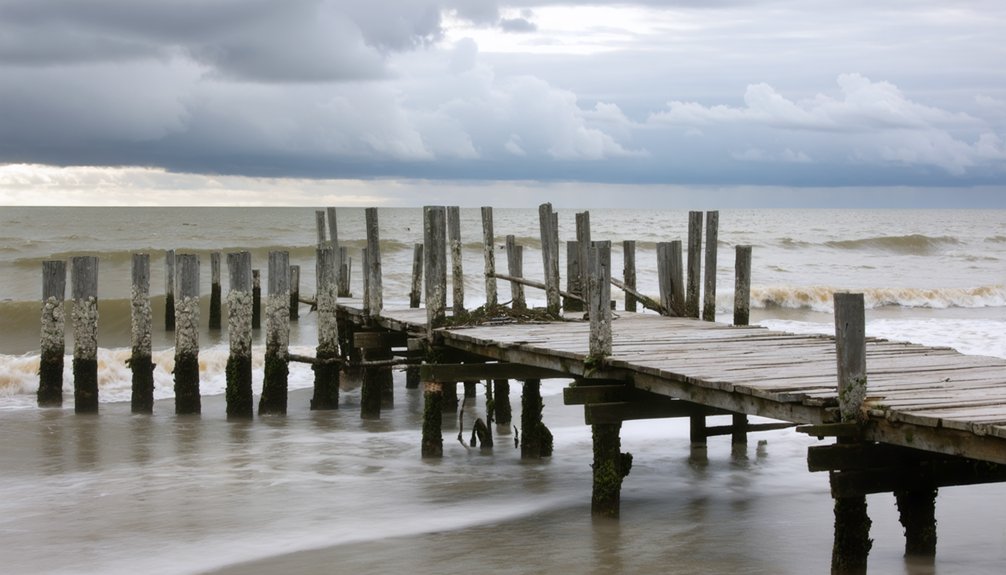
Texas’s maritime past reveals itself through ghost ports where thriving 19th-century coastal economies once flourished before being violently erased from the landscape.
You’ll find Indianola’s foundations now submerged beneath Matagorda Bay, while Linnville’s remains were scattered first by Comanche raiders in 1840 and later by coastal erosion.
These abandoned harbors tell stories of innovation—from the camel corps departing Indianola in 1856 to the concrete-hulled SS Selma whose remnants still break the surface of Galveston Bay.
Vanished Port Economies
Along the windswept shores of the Gulf Coast, several once-thriving maritime communities have vanished into the annals of history, leaving behind only scattered remnants of their former prominence.
These maritime legacies tell tales of economic significance that once fueled Texas’ growth during the 19th century. Indianola, St. Mary’s of Aransas, and Linnville represent vanishing industries that couldn’t withstand nature’s fury or changing transportation networks.
- Indianola served as Texas’ second-largest port until devastating hurricanes in 1875 and 1886 ended its existence.
- St. Mary’s of Aransas flourished shipping cattle and cotton until reef damage halted Morgan Lines service.
- Linnville’s promising future ended abruptly with the 1840 Comanche raid that forced permanent abandonment.
- The loss of railroad connections diverted commerce to inland centers, sealing these coastal settlements’ fate.
Storms Washed Away History
The devastating power of Gulf Coast hurricanes rewrote Texas coastal history, transforming bustling port towns into submerged legends that now exist primarily in historical archives.
Nowhere is this more evident than in Indianola’s tragic demise. Once Texas’ second-largest port with nearly 5,000 residents, this thriving immigration gateway and commercial hub first faced catastrophe in 1875 when a massive hurricane killed hundreds and devastated its infrastructure.
Despite valiant rebuilding efforts, nature struck again in 1886 with an even more destructive storm. The dual hurricane aftermath proved insurmountable, permanently transforming Indianola into a ghost town.
Today, you’ll find only scattered remnants of this lost cultural heritage: the La Salle Monument, a surviving cemetery, and courthouse foundations submerged beneath Matagorda Bay waters—silent testimonies to a once-prosperous port community erased by the Gulf’s fury.
Visiting Today: What Remains to Be Discovered
What remains of these once-thriving communities offers a rare glimpse into Texas’s vanishing frontier history, with each ghost town presenting unique opportunities for modern explorers.
You’ll find architectural remnants ranging from Helena’s two-story courthouse to Shafter’s weathered structures gradually surrendering to desert elements.
- In Helena, visit the preserved courthouse, original post office, and Masonic lodge where ghostly encounters have been reported by visitors exploring after dusk.
- Discover Terlingua’s transformed landscape, where crumbling adobe structures now host a vibrant artist community.
- Explore Medicine Mound’s historic Hicks-Cobb general store and rusty gas pumps that stand as sentinels to a bygone era.
- Wander Toyah’s abandoned streets complete with furnishings inside buildings, including the imposing high school where local legends claim ghost children roam at night.
Tales From the Cemetery: Stories Written in Stone
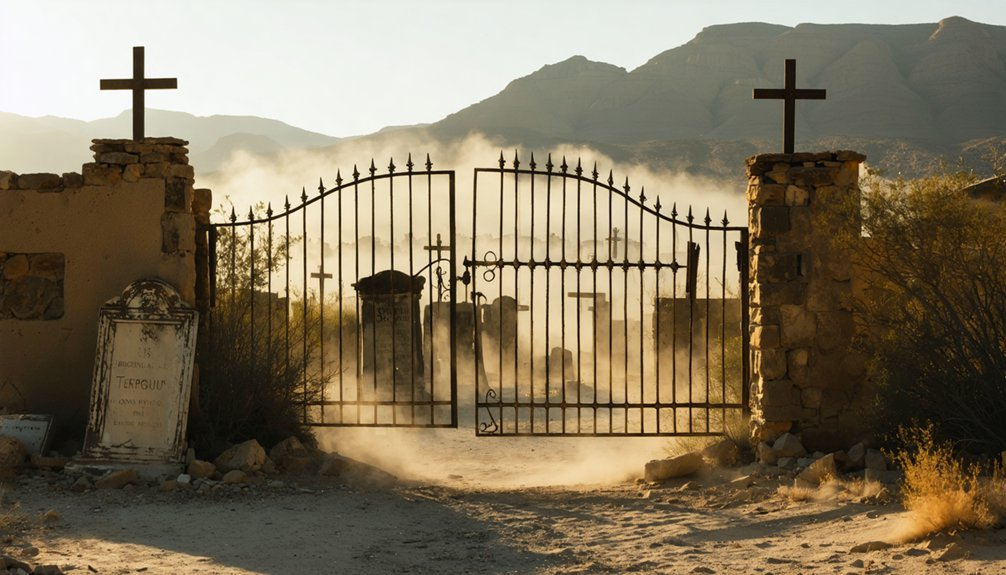
Silent guardians of forgotten communities, Texas ghost town cemeteries offer more than just final resting places—they serve as open-air archives where weathered tombstones and ornate monuments chronicle the lives, deaths, and cultural tapestries of vanished towns.
When you visit Springfield Cemetery at Fort Parker State Park, you’ll find the sole remnant of a once-thriving town destroyed by fires.
At Belcherville, cemetery symbolism reveals social hierarchies through Masonic emblems and isolated family plots.
Grave marker stories—like Anthony Bascilli’s elaborate Hungarian burial in Thurber—preserve cultural practices that would otherwise be lost.
Hand-carved stones, such as John W. Campbell’s in Belcherville, demonstrate local craftsmanship while offering tangible connections to the past.
These stone narrators silently testify to the booms, busts, and human experiences that shaped Texas’s forgotten communities.
Preservation Efforts: Saving Texas’s Vanishing History
As threatened ghost towns fade from Texas’s landscape, preservation efforts have emerged from grassroots movements to state-sanctioned initiatives, creating a complex network of guardians for these vanishing historical treasures.
Artifacts from Texas ghost towns offer a tangible connection to the lives once lived in these now-abandoned places. Each piece tells a story of resilience, hope, and the passage of time, inviting exploration and reflection. By seeking out these remnants, enthusiasts not only preserve history but also breathe new life into the narratives of the past.
You’ll find over 200 county historical commissions working alongside nonprofits like Preservation Texas to secure funding and navigate complex property issues despite significant challenges.
- Community involvement manifests through volunteer-led cemetery maintenance, museum staffing, and fundraising events like ghost tours and Victorian tea parties.
- Funding challenges persist despite creative solutions such as 10K races, grants from the National Park Service, and county support.
- Legal hurdles include unclear property titles, zoning restrictions, and coordination among multiple landowners.
- Heritage tourism provides sustainable revenue when communities organize chili cook-offs and cultural festivals, attracting thousands of visitors annually.
Frequently Asked Questions
Are Ghost Towns Legally Accessible or Considered Trespassing?
While ghost towns fascinate freedom-seekers, they’re legally accessible only with owner permission. Despite apparent abandonment, historical preservation and ghost town regulations classify unauthorized entry as trespassing, regardless of a site’s neglected appearance.
Which Texas Ghost Towns Have Paranormal or Haunting Legends?
You’ll find haunting tales in Terlingua with its candlelit cemetery vigils, Indianola’s hurricane-victim spirits, Jefferson’s Victorian hauntings at The Grove, and Barstow and Toyah where ghostly encounters include robed specters and children’s apparitions.
What Safety Precautions Should Visitors Take When Exploring Ruins?
Wear appropriate safety gear including sturdy boots, gloves and respirators. Bring a first aid kit, notify others of your location, and never explore unstable structures alone. Research site-specific hazards beforehand.
Do Any Ghost Towns Hold Annual Festivals or Gatherings?
Ever crave authentic Texan heritage? You’ll find festival activities like Bankersmith’s Texas Testicle Festival and Route 66 celebrations across ghost towns, with community events showcasing local culture, cuisine, and history year-round.
Can Metal Detectors Be Legally Used at Ghost Town Sites?
You’ll need specific permissions for legal metal detecting in ghost towns. Texas metal detection laws require landowner approval, and historical preservation concerns mandate permits for sites over 100 years old. Don’t remove artifacts without authorization.
References
- https://en.wikipedia.org/wiki/List_of_ghost_towns_in_Texas
- https://texashighways.com/travel-news/four-texas-ghost-towns/
- https://www.hipcamp.com/journal/camping/texas-ghost-towns/
- https://www.county.org/county-magazine-articles/summer-2025/ghost-towns
- https://www.youtube.com/watch?v=Zd8-gKw-5Hc
- https://freepages.history.rootsweb.com/~gtusa/usa/tx.htm
- https://www.texasescapes.com/TOWNS/Texas_ghost_towns.htm
- https://mix931fm.com/texas-ghost-towns-history/
- https://www.desertedtexas.org
- https://www.youtube.com/watch?v=4LftYW04-CU