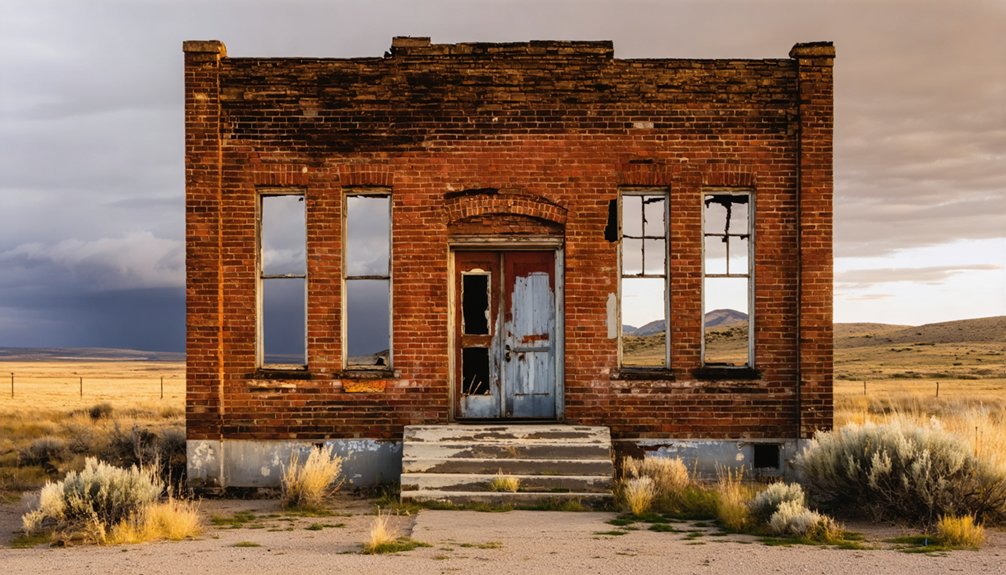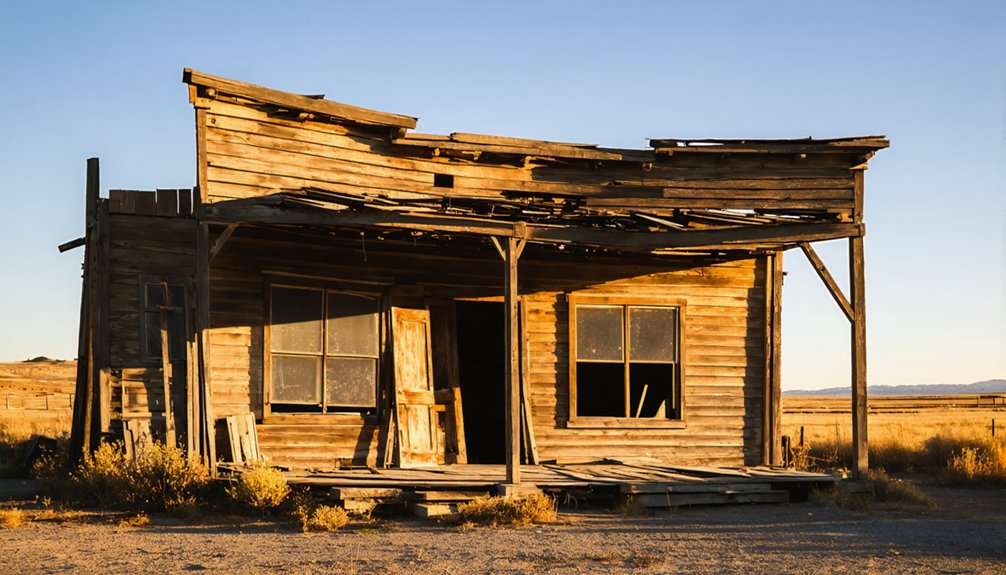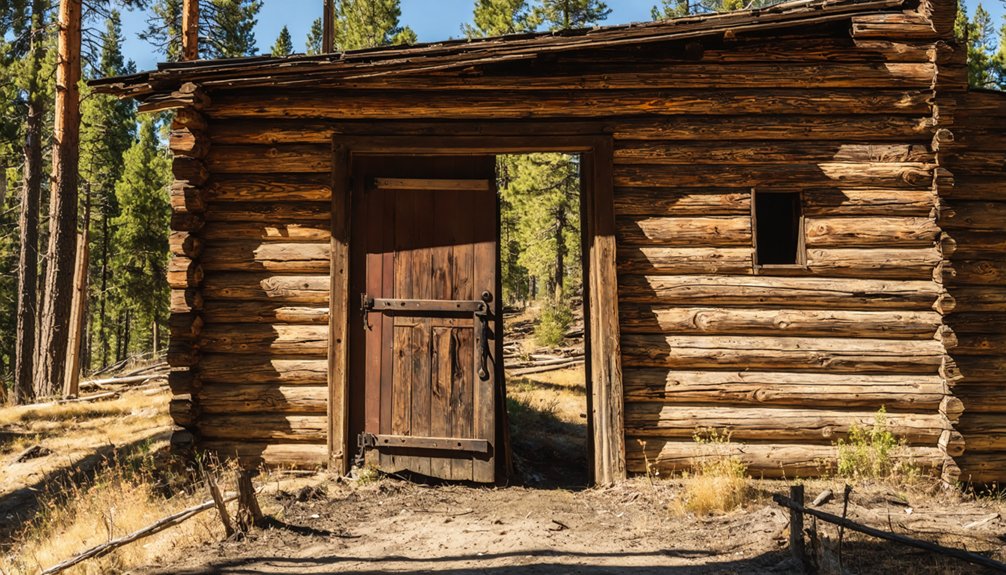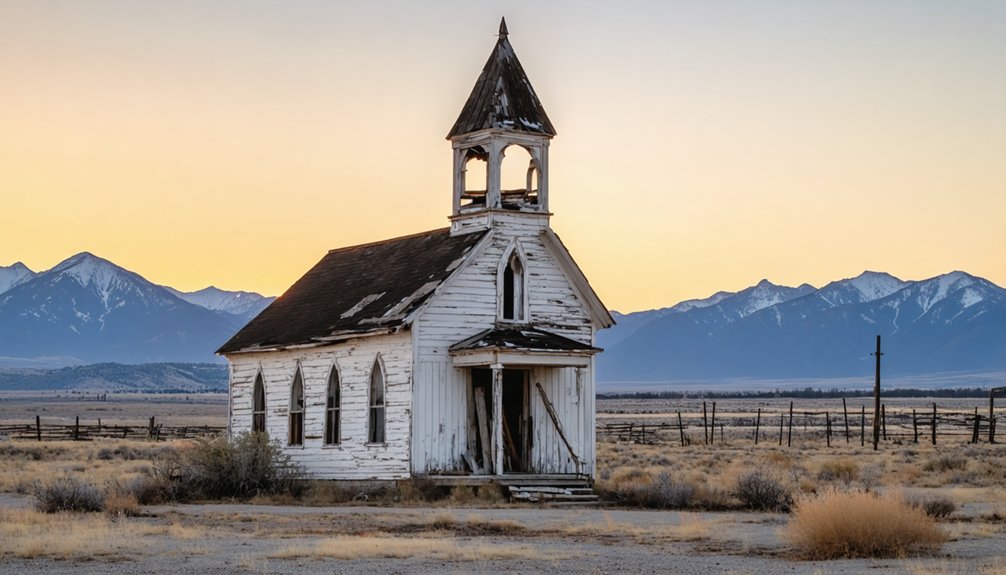
You’ll find Idaho’s most famous ghost towns include Silver City, the state’s largest with over 300 preserved 19th-century structures and $60 million in extracted precious metals. Custer showcases gold rush history from the 1870s with its restored schoolhouse and Empire Saloon, while Bayhorse features the Western US’s best-preserved mill site from its 1880s boom. Chesterfield preserves Mormon pioneer heritage with 27 surviving structures, and Bonanza represents Idaho’s most prosperous silver mining era before its 1904 abandonment. These preserved sites offer deeper insights into Idaho’s frontier legacy.
Key Takeaways
- Silver City is Idaho’s largest ghost town with over 300 preserved 19th-century structures and the haunted Historic Idaho Hotel.
- Custer originated from 1870s gold rush, features restored buildings including schoolhouse and Empire Saloon, now protected by Challis National Forest.
- Bayhorse contains the best-preserved mill site in the Western US and produced ten million dollars in precious metals before 1915.
- Chesterfield preserves 27 structures from an 1881 Mormon pioneer settlement, offering free guided tours from Memorial Day through Labor Day.
- Bonanza and Gilmore were major mining towns that peaked in the early 1900s before abandonment due to fires and mine closures.
Silver City: Idaho’s Largest and Most Haunted Ghost Town
Today, you can experience ghostly encounters at the historic Idaho Hotel, where visitors report spirits from the town’s turbulent past.
The mining conflicts, including underground battles that left miners dead, contribute to Silver City’s haunted reputation.
Nearly a dozen cemeteries remind you of the hard lives these pioneers endured. The town reached its peak prosperity in the 1880s when it housed 2,500 residents before declining into the ghost town it is today.
Silver City produced over $60 million in precious metals before the mines were depleted around 1912.
Custer: A Golden Era Preserved in Stone
You’ll find Custer’s origins rooted in the 1870s mineral rushes that transformed this remote valley into a bustling gold camp of 600 residents by 1896.
The town’s historic stone and wooden structures, including the restored schoolhouse and Empire Saloon, showcase authentic 19th-century frontier architecture that survived decades of abandonment. The Lucky Boy and Black mines supported the town’s economy during its peak years before decline began in 1903.
When the Challis National Forest assumed ownership in 1966 and secured National Register status in 1981, they preserved this 29-acre site as one of Idaho’s most intact mining settlements. Today’s visitors should bring essential supplies including water, snacks, and sunscreen when exploring this remote historic location.
Gold Rush Origins
When prospectors struck gold in Idaho’s Yankee Fork area in 1867, they couldn’t have imagined their discovery would eventually spawn one of the state’s most legendary mining towns.
You’ll find these early gold discoveries began modestly, with small-scale operations persisting for over a decade. The breakthrough came in 1870 when miners found gold on a Yankee Fork tributary near Jordan Creek, prompting the formation of the Yankee Fork Mining District.
William Norton’s significant July 1875 find yielded $20,000 in ore, proving the region’s potential. The discovery of the General Custer Mine in 1876 attracted even more miners to the area, further establishing the region’s reputation as a promising gold source. The town of Custer was officially settled in 1878 alongside the construction of the General Custer Mill, marking the beginning of organized mining operations in the area.
Historic Stone Structures
Although most of Idaho’s mining settlements have vanished without a trace, Custer’s stone structures stand as enduring monuments to the town’s golden era between 1879 and 1910.
You’ll discover the Stone Cabin Ruins north of town, once a one-room structure housing multiple miners during peak operations. Now it’s reduced to scattered native stones, representing the only known stone building in Custer’s townsite.
The General Custer Mill‘s 20-stamp steam-powered facility processed ore through six 500-gallon settling pans after its December 1880 completion.
This mill’s architectural significance enabled Custer’s growth over neighboring Bonanza. The town featured essential community infrastructure including a schoolhouse, jail, saloons, and businesses to serve its growing population.
Today, seven contributing structures within the 29-acre Historic District demonstrate successful historic preservation efforts, earning National Register designation in 1981 as part of the Land of the Yankee Fork Historic Area. Park Rangers provide detailed layouts and historical context to help visitors understand the significance of these preserved structures.
National Forest Preservation
The Challis National Forest‘s acquisition of the Custer area in 1966 marked a turning point for preserving Idaho’s mining heritage.
You’ll find that forest management initially viewed the deteriorating structures as fire hazards, but perspectives shifted toward preservation. The area’s transformation into the Salmon-Challis National Forest enabled thorough conservation efforts that culminated in National Register of Historic Places designation in 1981.
You can explore Custer’s pioneer Forest Service mining camp project, which converted the schoolhouse into a museum and preserved the ore bin, saloon, and log dwellings. The Idaho Department of Parks and Recreation formed a partnership with the Forest Service in 1990 to establish the Land of the Yankee Fork Historic Area.
Preservation challenges continue through partnerships between the South Custer Historical Society, Idaho Heritage Trust, and federal agencies. Their collaborative efforts, including grants received in 2004, 2006, and 2009, guarantee these mining remnants remain accessible for future generations seeking authentic frontier experiences. The White Knob Historical Preservation Committee has focused specifically on preserving historic mining structures in the Alder Creek Mining District through stabilization of railroad trestles and restoration of tramway towers.
Bayhorse: Home to the Best-Preserved Mill Site in the Western US
Nestled in the rugged mountains of central Idaho, Bayhorse stands as one of the state’s most remarkable ghost towns, boasting the best-preserved mill site in the entire Western United States. Founded in 1877, Bayhorse history reveals a thriving mining community that peaked with 300-400 residents during the 1880s-1890s.
You’ll discover how miners employed sophisticated mining techniques, including a multi-level gravity-fed stamp mill that operated continuously, processing ore to sand consistency. The Ramshorn and Beardsley mines produced ten million dollars in precious metals before operations ceased in 1915.
Today, you can explore preserved structures including the stone Wells Fargo building, charcoal kilns, and the famous mill within Land of the Yankee Fork State Park, experiencing authentic Western mining heritage firsthand.
Chesterfield: Mormon Pioneer Heritage in Southeastern Idaho
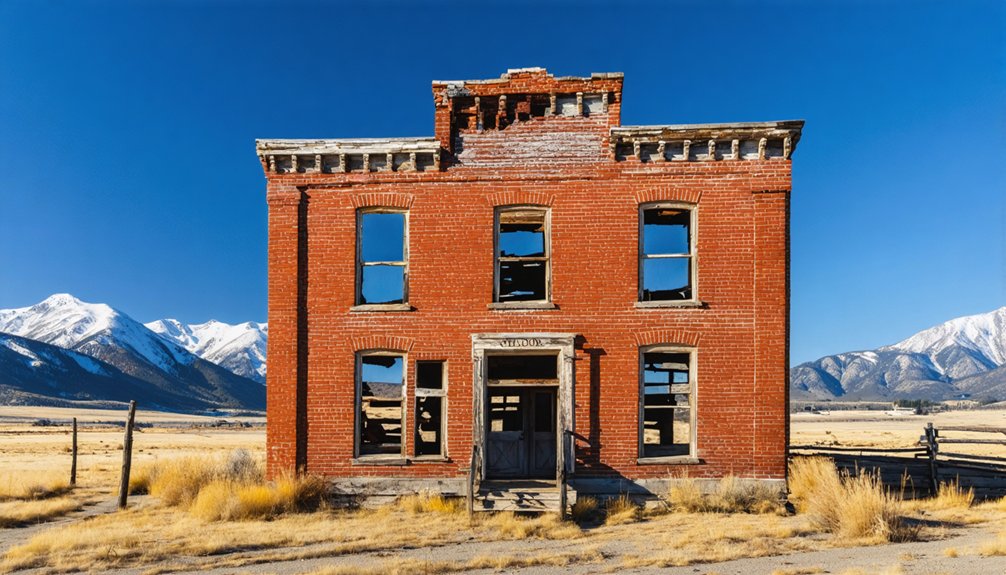
You’ll discover Chesterfield’s unique place among Idaho’s ghost towns as a Mormon pioneer settlement founded in 1881 by Chester Call and families seeking grazing land beyond Salt Lake Valley’s crowded conditions.
As you explore abandoned sites in Idaho’s wilderness, you’ll find remnants of a time when pioneers braved the elements for a chance at a new life. The quiet solitude of these locations tells stories of resilience and adaptation. Each site offers a glimpse into the challenges faced by those who settled in this rugged territory.
The town’s 27 preserved structures, maintained by the Chesterfield Foundation since 1980, showcase authentic pioneer architecture including the reconstructed Meetinghouse, Edward Reese house, and Brook Mercantile building.
Visitors can explore this National Register site during summer months and attend the annual Memorial Day celebration that honors the community’s role in assisting Oregon Trail travelers.
Mormon Settlement History
Following Chester Call and Christian Nelson’s grazing reconnaissance in 1879, Mormon pioneers established Chesterfield in southeastern Idaho’s Portneuf River Valley as part of the church’s systematic colonization of the Intermountain West.
You’ll find this settlement exemplified typical Mormon migration and settlement patterns, with families moving north from Utah to create another religious colony.
Preserved Pioneer Structures
The physical remnants of this Mormon settlement tell a compelling story through 27 surviving structures that span from the 1880s to 1925, creating one of Idaho’s most intact pioneer townscapes.
You’ll discover diverse pioneer architecture including log cabins, frame houses, and brick buildings that showcase the community’s evolution. The Christian Nelson house exemplifies sophisticated construction with its segmentally arched windows and corbeled chimney, while restored cabins like the Ira Call residence demonstrate humble beginnings.
Key community buildings retain their historical significance through careful preservation. You can visit the original LDS meetinghouse, now housing Oregon Trail artifacts, plus the restored amusement hall and tithing granary.
The Chesterfield Foundation‘s dedicated efforts since 1980 guarantee these structures continue documenting Mormon pioneer life for future generations.
Tourist Attraction Features
Nestled in the northeast corner of the Portneuf River Valley at over 5,400 feet elevation, Chesterfield operates as a seasonal tourist destination from Memorial Day through Labor Day, welcoming visitors Monday through Saturday from 10:00 am to 6:00 pm.
You’ll discover free guided Chesterfield tours departing until 4:30 pm, with reservations available at (208) 403-7830. The town’s historical significance comes alive through its museum housed in the original general store, staffed entirely by dedicated volunteers who share stories of Mormon settlement dating to 1881.
You can explore 27 surviving brick buildings constructed between 1884-1904 across 100 acres of National Register property.
The annual Memorial Day Celebration draws visitors seeking authentic pioneer heritage, while on-site camping lets you experience this preserved frontier community overnight along the historic Oregon Trail route.
Gilmore: Mining Legacy Near the Montana Border
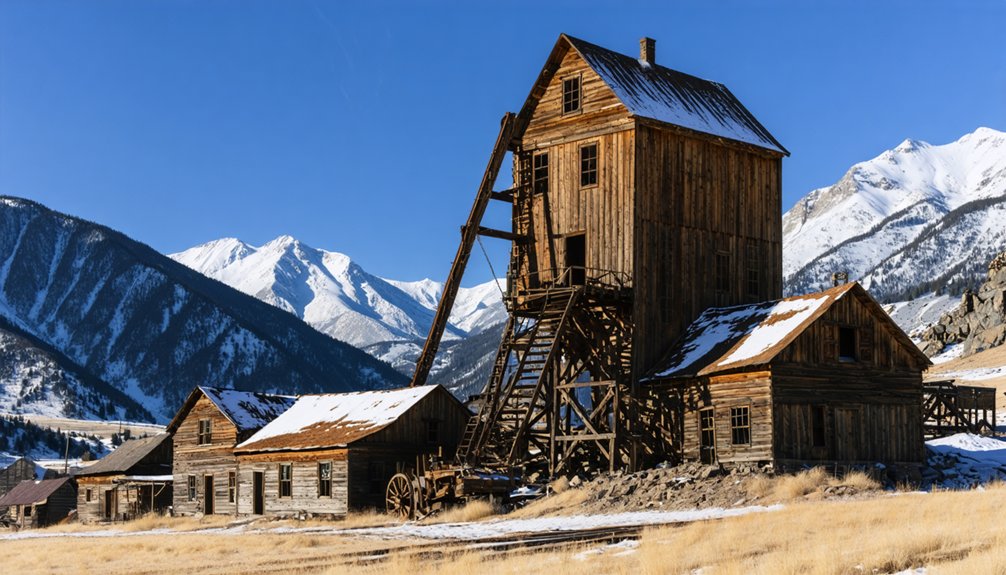
Silver and lead discoveries near Leadore around 1882 sparked the establishment of what would become one of Idaho’s most significant mining settlements.
You’ll find Gilmore History began at Horseshoe Gulch before relocating to lower elevations. Named after Jack T. Gilmer in 1902, the Post Office misspelled it as Gilmore.
Mining Operations flourished when the Gilmore and Pittsburgh Railroad arrived in 1910, transporting ore over the Continental Divide. The town peaked at 600 residents with substantial infrastructure including a large power plant.
Pittsburgh capital funded major developments, including a 6,000-foot tunnel by 1916.
Everything changed when the power plant exploded in 1927, devastating operations. Mining ceased by 1929, and you can now explore approximately 40 remaining buildings located 60 miles south of Salmon.
Bonanza: The Most Prosperous Silver Mining Town
While Gilmore represented the later era of corporate mining ventures, Bonanza epitomized the classic boom-town phenomenon of Idaho’s silver rush.
You’ll find Bonanza history began in 1876 when prospectors discovered the General Custer Mine, transforming wilderness into a thriving settlement by 1878. The town’s rapid growth included saloons, boarding houses, and a toll road to Challis by 1879.
Mining impact drove prosperity through the 1880s as the General Custer, Lucky Boy, Black, and Sunbeam mines produced silver and gold ore.
The Yankee Fork Mining District attracted regional and overseas investors, making Bonanza one of Idaho’s most significant mining centers.
However, devastating grass fires in 1889 and 1897, combined with mine closures by 1904, triggered abandonment.
Today, you’ll discover scattered ruins, two cemeteries, and the restored Yankee Fork Gold Dredge.
Exploring Idaho’s Ghost Town Trails and Preservation Efforts

How can you experience Idaho’s mining heritage firsthand while ensuring these fragile historical sites survive for future generations?
Trail exploration through Custer County’s Bayhorse Ghost Town Trail reveals one of the Western US’s best-preserved boomtown mill sites, featuring stone buildings and charcoal kilns from 1879.
You’ll discover Custer Ghost Town’s guided tours showcasing peak gold rush remnants alongside the historic Yankee Fork Gold Dredge.
Silver City in Owyhee County offers remote southwestern access to over 300 preserved 19th-century structures, while Chesterfield’s intact Mormon settlement preserves pioneer farming history.
Ghost town preservation requires following Leave No Trace principles: carry maps, wear sturdy boots, pack water, avoid touching artifacts, and stick to designated trails to prevent erosion of these irreplaceable historical treasures.
Frequently Asked Questions
Are Visitors Allowed to Stay Overnight in Any of Idaho’s Ghost Towns?
Yes, you can stay overnight through designated lodging like Burgdorf cabins or Silver City’s Idaho Hotel. Ghost town camping follows overnight regulations varying by land ownership—federal lands allow dispersed camping while protected sites prohibit stays.
What Safety Precautions Should Tourists Take When Exploring Abandoned Mining Structures?
You shouldn’t enter abandoned mining structures due to toxic gases, unstable explosives, and collapse risks. Stay outside, maintain distance from openings, watch for wildlife encounters, and follow forest service prohibitions protecting visitors.
Which Ghost Towns Have the Best Accessibility for Elderly Visitors or Wheelchairs?
You’ll find Bonanza and Custer offer the best wheelchair accessibility with paved roads and accessible bathrooms. Placerville provides easier vehicle access via Highway 21’s paved routes, making visitor facilities more manageable for elderly explorers.
Are There Guided Tour Companies That Specialize in Idaho Ghost Town Experiences?
You’ll find Land of the Yankee Fork State Park offers guided tours at Custer Ghost Town, while Bayhorse provides state worker-led experiences. These specialized companies deliver authentic historical insights into Idaho’s mining heritage and abandoned settlements.
What Is the Best Time of Year to Visit Idaho’s Ghost Towns?
Coincidentally, you’ll find best seasons align with your wanderlust—summer through early fall offers ideal access. Weather considerations include avoiding winter closures and spring snowmelt that restricts high-clearance vehicle routes to remote sites.
References
- https://en.wikipedia.org/wiki/List_of_ghost_towns_in_Idaho
- https://www.thegoldminehotel.com/ghost-towns-and-haunted-places-in-idaho
- https://idaho-forged.com/idahos-ghost-towns-eerie-yet-approachable/
- https://visitidaho.org/things-to-do/ghost-towns-mining-history/
- https://idahosmammothcave.com/unique-things-to-do-in-idaho-ghost-town-hunting-in-silver-city/
- https://thesmartrver.com/visit-silver-city-idaho/
- https://westernmininghistory.com/towns/idaho/silver-city/
- https://www.youtube.com/watch?v=rTSZSlxTmbs
- https://www.youtube.com/watch?v=W347SjpcWF0
- https://www.historicsilvercityidaho.com