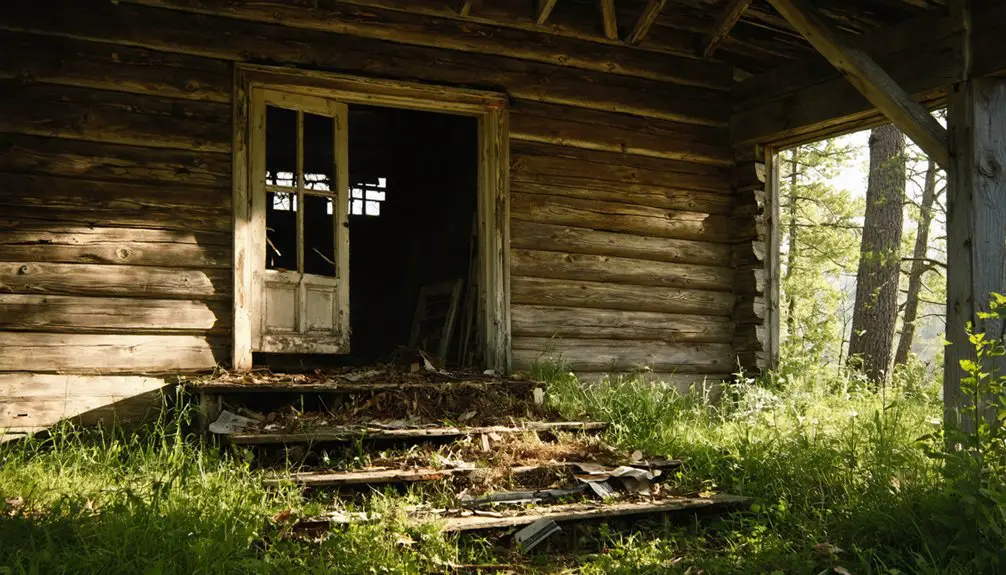
You’ll find Maine’s most haunting ghost towns scattered from Revolutionary War-era Freeman, where sheep farmers once thrived before abandonment in the 1970s, to Flagstaff’s entire community now resting beneath 20,000 acres of lake water since 1950. Industrial remnants mark Riceville’s tannery town ruins in Hancock County, while Fort William Henry’s colonial stones whisper tales of 1696 betrayals. Each settlement reveals distinct chapters of Maine’s forgotten communities and the forces that erased them from maps.
Key Takeaways
- Flagstaff lies submerged beneath Flagstaff Lake after the entire town was flooded for hydroelectric power in 1950.
- Freeman originated from Revolutionary War relief grants but declined from 838 residents to complete abandonment by 1970.
- Riceville was an industrial tannery town that became completely abandoned by 1910 after a devastating fire.
- Fort William Henry was a colonial military outpost from 1692 that fell during siege and reportedly haunts visitors.
- Ligonia Village was a company town for mill workers that evolved into modern South Portland neighborhoods.
Flagstaff: Maine’s Most Famous Submerged Settlement
When you stand on the shores of Flagstaff Lake today, peering into the dark waters that stretch across more than 20,000 acres near Eustis, you’re looking at Maine’s most haunting example of progress’s price. Beneath these waters lies complete Flagstaff history—entire townships sacrificed for hydroelectric power in 1950.
Central Maine Power Company didn’t just buy land; they erased communities. Families who’d farmed this rich Dead River valley since the 1800s watched bulldozers destroy their gristmills, sawmills, and homes. Despite fierce resistance, eminent domain prevailed. Residents held one final Fourth of July celebration in 1949 before the flooding began.
You can still witness submerged remnants when water levels drop—foundation stones, street layouts, scattered debris telling stories of displacement. Clear cutting operations stripped the land bare before the waters rose, removing all traces of the forest that once surrounded these communities. Scuba diving expeditions now offer underwater exploration of these lost communities for those seeking a more immersive encounter with history. Freedom sometimes demands such sacrifices, but at what cost?
Freeman: From Revolutionary War Relief Grant to Abandonment
Few ghost towns can trace their origins to such a specific act of wartime destruction as Freeman, born from the ashes of Portland’s Revolutionary War devastation.
When British Captain Henry Mowat torched Falmouth (Portland) in October 1775, he couldn’t have imagined he’d spawn a frontier settlement 200 miles inland. Massachusetts granted western relief tracts in 1791, compensating survivors for their £50,000 losses.
You’ll find Freeman’s Revolutionary War impact shaped everything—from its 1797 surveying to its 1808 incorporation.
Freeman history peaked at 838 residents by 1840, when massive sheep farms dominated thousands of cleared acres. The Civil War and Industrial Age triggered steady decline: 397 by 1900, 219 by 1930.
At its height, the community supported multiple churches, schools, and even maintained its own train station that connected residents to the broader region. Disincorporation followed in 1937, then final abandonment in the early 1970s, leaving only cemetery stones and crumbling foundations. Today, Freeman Ridge serves as a commuter community for those seeking small-town lifestyles.
Riceville: Industrial Mill Town Remnants in Hancock County
The company-built settlement included workers’ homes, a boarding house, and general store.
After F. Shaw and Brothers failed in the 1880s, Buzzell and Rice continued operations until catastrophe struck.
Fire consumed the entire tannery between December 30-31, 1905, according to the Ellsworth American. The tannery owners had previous insurance claims and chose not to reconstruct the facility.
Without rebuilding, the post office closed in 1906, and by 1910, you’d discover a completely abandoned village—cellar holes marking where dreams once flourished. The settlement was originally established as a small tannery town in the early 1860s in what was then known as Township 39 Middle Division.
Fort William Henry: Colonial Military Outpost Turned Ghost Site
Unlike the industrial ghost towns scattered throughout Maine’s interior, Fort William Henry represents a different kind of abandonment—one forged by colonial warfare and betrayal along the rocky Pemaquid Peninsula.
You’ll discover this haunted history began in 1692 when Massachusetts spent two-thirds of its budget constructing massive stone walls and bastions. The colonial architecture featured 22-foot-high fortifications housing 20 cannon, yet poor mortar quality proved fatal during the 1696 siege.
Captain Pasco Chubb’s treacherous betrayal of Abenaki sagamore Edgeremet under a truce flag sealed the fort’s doom. When water supplies ran low, Chubb negotiated his escape while abandoning his garrison to slaughter. The Abenaki’s fierce retaliation ultimately compromised the fort’s defenses and forced the British surrender.
Captain Chubb’s cowardly betrayal under a flag of truce doomed his own men to a brutal massacre.
Today, you can explore the reconstructed ruins where visitors report glowing lights and cold spots—spirits of Edgeremet and his sons still haunting their betrayers’ crumbling stronghold. The site operates as the Colonial Pemaquid State Historic Site, welcoming visitors daily from 9 a.m. to 5 p.m. to experience this turbulent chapter of Maine’s past.
Ligonia Village: South Portland’s Forgotten Industrial Community
While most ghost towns vanish into Maine’s wilderness, Ligonia Village hides in plain sight within South Portland’s modern neighborhoods, its industrial heritage masked by contemporary starter homes and suburban tranquility.
You’ll discover this forgotten community emerged in the 1860s as a company town for Portland Rolling Mills workers. Irish families transformed raw land into a self-contained industrial neighborhood, complete with shops and community facilities.
Henry Bodge’s 1866 land purchase sparked development along Main Street, creating Maine’s quintessential mill town.
Today, you can explore remnants scattered throughout South Portland’s residential streets. Though the mills vanished decades ago, Ligonia’s bones remain visible to those seeking its story. The neighborhood maintains its walkable character with sidewalks along Broadway, preserving the pedestrian-friendly layout that once connected mill workers to their daily lives.
The area represents successful community revival—where industrial workers once labored, families now enjoy affordable housing while unknowingly preserving this industrial heritage through adaptive neighborhood evolution. As South Portland expanded over the decades, Ligonia Village was gradually absorbed into the larger city, losing its distinct identity in the process.
Frequently Asked Questions
Can Visitors Legally Access and Explore These Maine Ghost Town Sites?
Why wouldn’t you explore these accessible ruins? You’ll find minimal legal restrictions at these sites. Follow basic access guidelines: stick to designated trails, respect historic remnants, and visit during daylight hours for safe, unrestricted exploration.
Are There Any Safety Hazards When Visiting Abandoned Buildings and Ruins?
Yes, you’ll face serious risks including structural collapse, toxic mold exposure, and sharp debris. Take safety precautions by evaluating building integrity first, wearing protective gear, and maintaining clear exit routes during exploration.
What Specific Artifacts or Items Can Still Be Found at These Locations?
You’ll discover historical relics like household pottery fragments, rusted tools, and foundation stones at these sites. While Maine’s ghost towns lack traditional mining equipment, you can find old farming implements and remnants of daily life scattered throughout the ruins.
Do Any of These Ghost Towns Have Reported Paranormal Activity or Hauntings?
You’ll discover haunted legends throughout these locations – Skowhegan’s Strand Theater echoes with 90-year-old spirits, while Bucksport’s witch-cursed tombstone displays supernatural leg prints. Ghost sightings plague cemetery-overtaken Ligonia Village, creating spine-chilling adventures.
Which Ghost Towns Offer the Best Photography Opportunities for Urban Explorers?
You’ll find Kezar Falls Woolen Mill offers exceptional abandoned structures with dramatic industrial decay, while Perkins Township delivers stunning scenic landscapes where historic foundations blend seamlessly with Kennebec River views and wildlife compositions.
References
- http://strangemaine.blogspot.com/2012/02/ghost-towns-of-maine.html
- https://www.mooseriverlookout.com/post/ghost-towns-in-maine-9-fascinating-places-that-rose-fell
- https://en.wikipedia.org/wiki/List_of_ghost_towns_in_Maine
- https://92moose.fm/maines-spookiest-ghost-story-is-the-very-first-in-history/
- https://b985.fm/6-maine-ghost-towns-you-never-knew-existed/
- https://downeast.com/history/maine-ghost-stories/
- https://wcyy.com/6-maine-ghost-towns-you-never-knew-existed/
- https://wcyy.com/maine-underwater-ghost-town-flagstaff-lake/
- https://darkdowneast.com/flagstafflake/
- https://wjbq.com/ghost-town-legendary-sacrifice-flagstaff-maine/