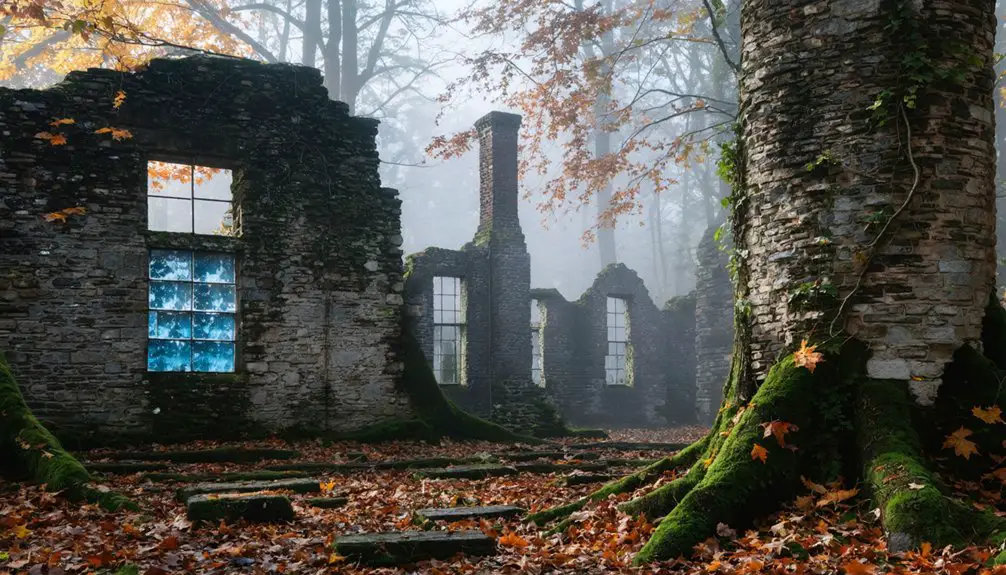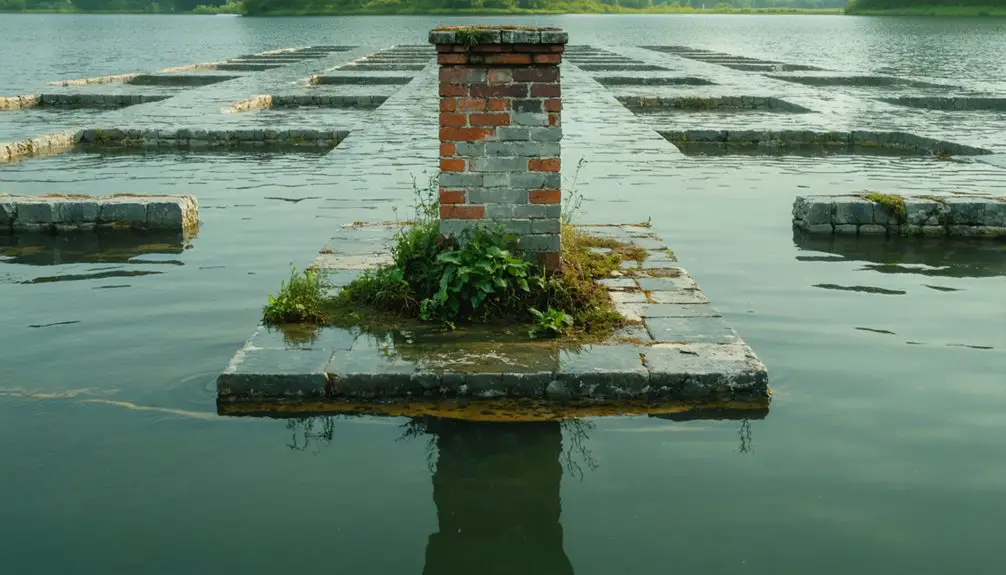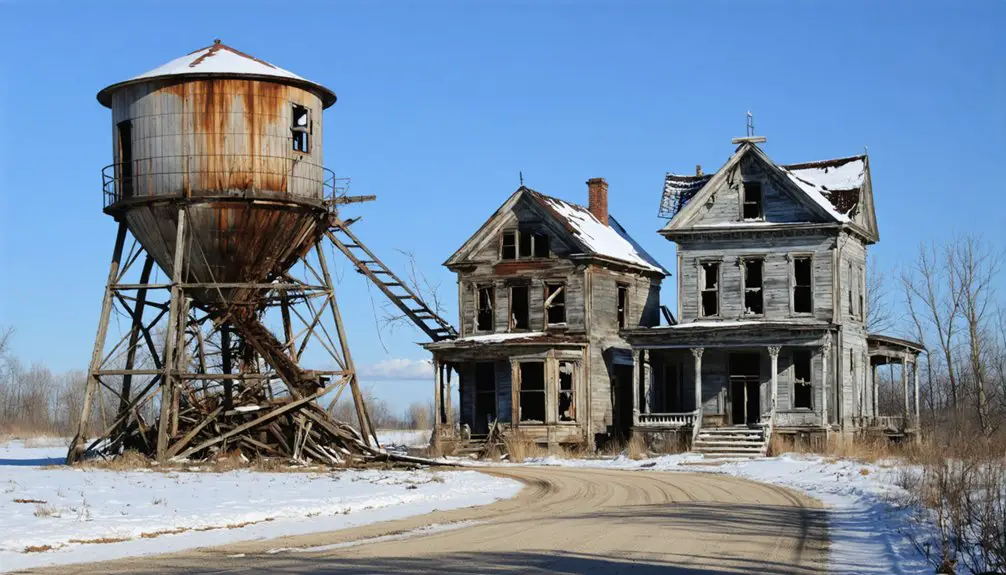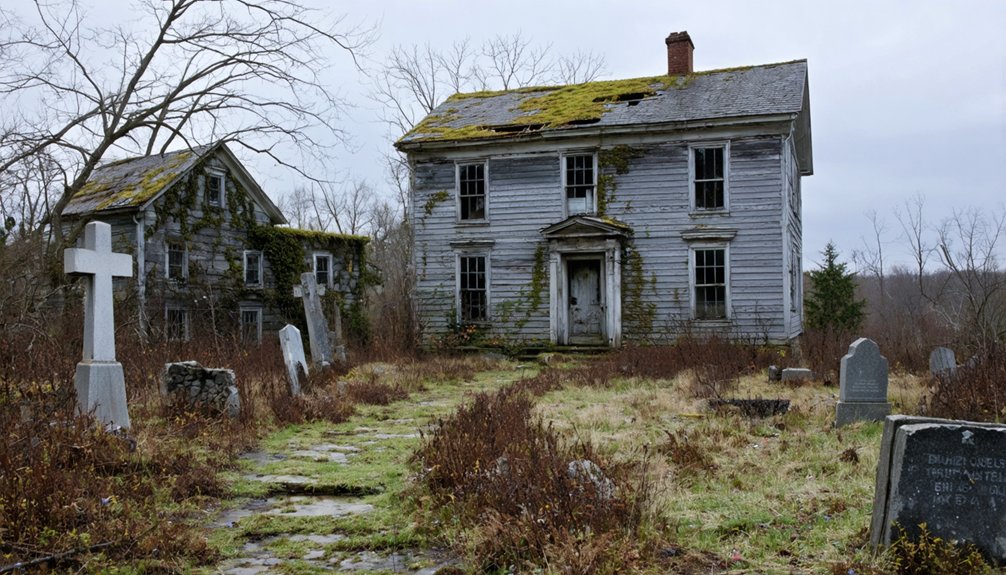
You’ll discover Massachusetts’s most famous ghost towns include Dogtown on Cape Ann, abandoned after the Revolutionary War and later overrun by feral dogs, and four Swift River Valley communities—Dana, Enfield, Greenwich, and Prescott—deliberately flooded in 1938 for Boston’s Quabbin Reservoir. Over 2,000 residents were forcibly relocated through eminent domain, with entire cemeteries exhumed before the towns vanished beneath the waters. These haunting remnants reveal compelling stories of displacement and sacrifice.
Key Takeaways
- Dogtown was established in 1693 as Commons Settlement, declining after the Revolutionary War into a refuge for vagrants and criminals.
- Four Swift River Valley towns (Dana, Enfield, Prescott, Greenwich) were deliberately flooded in 1938 to create the Quabbin Reservoir.
- Over 2,000 residents were forcibly relocated through eminent domain, with 7,500 bodies exhumed from cemeteries before flooding began.
- Dogtown folklore includes Thomazine “Tammy” Younger, the “Queen of the Witches,” who allegedly bewitched oxen for tolls near Alewife Brook.
- These ghost towns represent both natural decline and government displacement, leaving behind foundations, cellar holes, and historical markers.
Dogtown: From Pirate Haven to Feral Dog Territory
The rocky highlands near Gloucester became home to a peculiar settlement in 1693, when families sought refuge from coastal pirates and Native American raids.
You’ll find this inland haven, originally called Commons Settlement, once sheltered around 100 families who harvested wood and raised livestock on its poor soil.
The community thrived until post-Revolutionary War migrations left abandoned homes behind. These empty dwellings eventually attracted vagrants and criminals, transforming the once-peaceful settlement into a haven for unsavory characters.
Among the outcasts were women like Thomazine “Tammy” Younger, known as the Queen of the Witches, who allegedly bewitched local oxen for tolls while living near Alewife Brook.
The Swift River Valley Tragedy: Four Towns Lost to Progress
You’ll find Massachusetts’ most devastating ghost town story in the Swift River Valley, where the state government deliberately destroyed four entire communities to create the Quabbin Reservoir.
Dana, Enfield, Prescott, and Greenwich ceased to exist on April 27, 1938, when the Swift River Act forced over 2,000 residents from their homes through eminent domain. The Farewell Ball that final evening drew over 2,000 attendees who gathered to mark the end of their communities with a parade and solemn moments of silence.
The massive reservoir project required the exhumation of 7,500 bodies from local cemeteries before the valley was flooded to serve Boston’s water needs.
Quabbin Reservoir Construction Impact
When Massachusetts officials confirmed the Quabbin Reservoir project in 1922, they set in motion one of the state’s most dramatic examples of progress demanding sacrifice.
You’ll find that reservoir construction began in earnest after 1927 legislation authorized flooding the Swift River Valley. The state seized over 75,000 acres from eight communities, displacing more than 2,000 residents who faced forced relocation by 1938.
Construction crews completed Goodnough Dike and Winsor Dam by April 1935, then spent seven years filling the massive reservoir. The massive undertaking required removing 1,100 structures from the valley, including homes, businesses, and entire community centers.
The economic impacts devastated surrounding communities, stripping away their tax base and leaving towns struggling to fund essential services. Author Elena Palladino documented this history in “Lost Towns of the Swift River Valley,” including details about a farewell ball held in 1938 to mark the towns’ official disincorporation.
Today, these towns receive payments in lieu of taxes, but they’re still grappling with the long-term consequences of losing their economic foundation to Massachusetts’ water needs.
Four Communities Completely Submerged
Although four towns met their fate beneath the rising waters, each carried centuries of New England history into the depths of Quabbin Reservoir.
You’ll discover that Greenwich heritage stretches back as the oldest European settlement in Swift River Valley, incorporated in 1754 with a peak population of 1,000.
Meanwhile, Prescott history began with incorporation in 1822, remaining a rural farming community of around 500 residents through the late 1800s.
Dana and Enfield joined these communities when all four were disincorporated at midnight on April 27, 1938. The Swift River Valley Historical Society now preserves the memory of these lost communities through donated family heirlooms and artifacts spanning from 1750 to 1938.
The reservoir’s creation displaced over 2,000 people who had called these communities home for generations.
Greenwich now lies completely submerged, while most of Prescott remains above water as Prescott Peninsula in New Salem, preserving fragments of what freedom-loving settlers once built.
Mass Resident Displacement 1928
After Massachusetts legislators passed the Swift River Act in 1927, approximately 2,500 residents faced forced displacement from their ancestral homes in Swift River Valley.
You’d witness families forced to abandon lifelong farms, mills, and businesses as state agents wielded eminent domain powers for Boston’s water supply needs.
The Massachusetts displacements unfolded through a bureaucratic process where homeowners submitted declaration forms offering sale prices while Metropolitan District Water Supply Commission agents conducted appraisals.
Some residents negotiated voluntarily, but others faced inevitable eviction when agreements couldn’t be reached.
This systematic removal process stripped communities of their freedom and heritage.
The Historical significance extends beyond mere statistics—entire generations lost their roots as 650 homes disappeared and roads closed by summer 1939, erasing centuries of established community life forever. Four complete towns including Dana and Enfield were permanently submerged beneath the reservoir waters, while Prescott was disincorporated and Greenwich was partially flooded. The displacement also required the relocation of over 7,500 deceased from more than thirty cemeteries to the newly established Quabbin Park Cemetery.
Enfield: A Community Sacrificed for Boston’s Water Supply
You’ll find Enfield’s story begins in 1816 when portions of Greenwich and Belchertown formed this Swift River Valley community named after early settler Robert Field.
The town thrived at the junction of the Swift River’s east and west branches until April 28, 1938, when Massachusetts disincorporated Enfield to make way for the Quabbin Reservoir project.
You’re witnessing how Boston’s need for water supply displaced over 2,000 residents from the Swift River Valley, forcing them to abandon their homes before flooding began in August 1939.
Swift River Valley Settlement
Settlement Challenges defined the 1740s as colonists established their first communities.
Greenwich emerged as Quabbin Parish in 1754, becoming the valley’s oldest European town.
Quabbin Reservoir Construction Impact
The Massachusetts Legislature’s 1927 decision to flood the Swift River Valley sealed Enfield’s fate, transforming this 111-year-old community into a sacrifice for Boston’s growing water needs.
You’ll discover that quabbin history reveals how the state acquired properties through negotiation or eminent domain, forcing entire families from their ancestral homes.
Construction began in 1930 with massive reservoir engineering projects—the Winsor Dam and Goodnough Dike—that would forever change the landscape.
Community Displacement and Relocation
When Massachusetts officials delivered their final notices in 1938, over 2,000 residents faced an unprecedented forced exodus from their ancestral homes in the Swift River Valley.
You’d witness displacement narratives that revealed the human cost of progress, as families like Marion Andrews Smith’s refused to abandon generations of memories without resistance. Smith held out until eminent domain seizure forced her departure, salvaging what she could from her 1896 Victorian home—floors, hardware, trim, and the grand staircase—to rebuild in Ware.
The relocation challenges weren’t just logistical; they were deeply personal. Some residents, like Olivia Herbert, moved entire houses to distant states like Vermont.
Greenwich: The Original Settlement That Vanished Beneath the Waves
Granted in 1737 as part of Narragansett Township Number Four, Greenwich holds the distinction of being the first European settlement in the Swift River Valley and the oldest of four towns that would eventually disappear beneath the Quabbin Reservoir’s waters.
You’ll find that Greenwich history began with Scottish and Irish settlers who established the Plantation of Quabbin, later renamed after the Duke John Campbell. The town incorporated on April 20, 1754, developing into a thriving agricultural community with 77 farms by 1890.
Its residents built the valley’s first church in 1749 and established lasting religious traditions. The Quabbin legacy ultimately claimed this pioneer settlement in 1938, ending 184 years of continuous habitation when the reservoir’s waters forever submerged Greenwich’s fertile plains.
Prescott: Where Residents Boated to Taverns and Children Waded to School
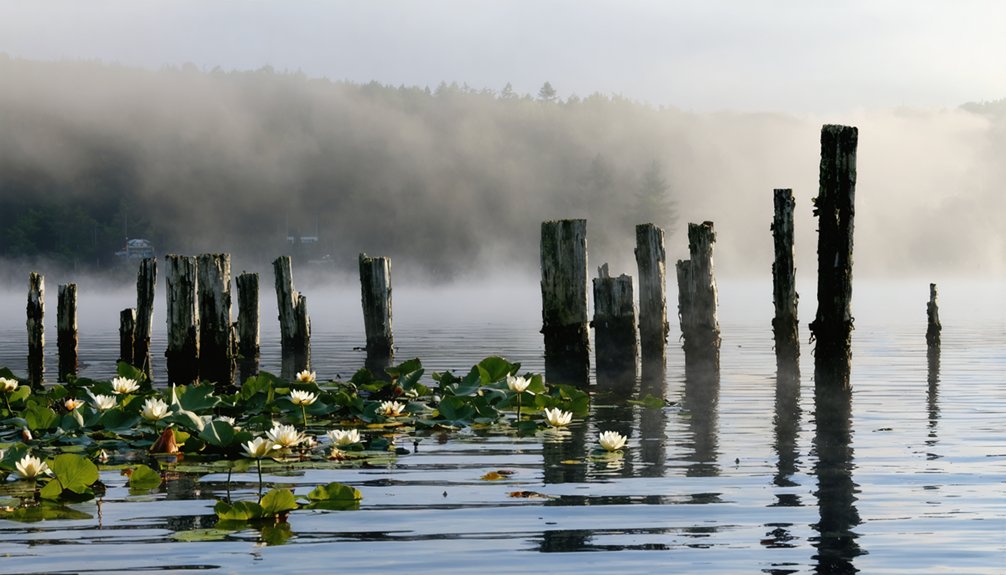
Named after Colonel William Prescott of Bunker Hill fame, Prescott incorporated in 1822 from portions of Pelham and New Salem, establishing itself on land that would prove both blessing and curse.
You’ll find Prescott history deeply intertwined with water—residents embraced a unique boating lifestyle, rowing across waterways to reach taverns for evening entertainment. Children didn’t walk to school; they waded through streams as part of their daily routine.
The town peaked at 300 residents by 1900, but you’d witness its dramatic end in 1938 when Massachusetts disincorporated Prescott for the Quabbin Reservoir project.
Flooding began in August 1939, submerging this Swift River Valley community. Today, you can explore Prescott Peninsula’s restricted wildlife sanctuary, where ruins and old foundations tell stories of a town that literally vanished beneath the waves.
Dana: Worcester County’s Submerged Legacy
While Prescott’s residents embraced their watery lifestyle by choice, Dana’s relationship with water became one of forced sacrifice when Massachusetts condemned this Worcester County town for the greater good.
You’ll discover that Dana, incorporated in 1801 and named for statesman Francis Dana, thrived until the 1930s when Boston’s water needs sealed its fate.
The state displaced 2,500 residents through eminent domain, compensating landowners just $108 per acre.
Despite legal appeals to the Massachusetts Supreme Judicial Court, officials razed all buildings by 1940.
Dana’s legacy endures at Dana Common, where you can walk among stone foundations and granite steps.
This 68-acre site’s historical significance earned National Register recognition, commemorating those who sacrificed their homes for progress.
Whitewash Village: Cape Cod’s Hurricane-Devastated Fishing Community

Unlike Dana’s forced displacement by government mandate, Whitewash Village met its demise through nature’s relentless assault on Cape Cod’s shifting coastline.
You’ll find this lost settlement’s story began in 1711 on Monomoy Island, where 200 residents built a thriving fishing community around Powder Hole harbor.
The village’s Fishing Heritage flourished through the 19th century, with cod, mackerel, and lobster supporting families who shipped their catch to Boston and New York.
However, you’d witness economic decline as salt works failed and fish populations dwindled from overfishing.
Around 1860, a devastating hurricane sealed the community’s fate, filling the harbor with sand and making it impassable.
By 1876, residents had abandoned their homes entirely.
Today, only Whitewash Legends and Monomoy Point Light remain as reminders to this vanished maritime community.
The Human Cost of Ghost Towns: Stories of Displacement and Loss
Behind every abandoned foundation and overgrown cellar hole lies a human story of forced departure and shattered communities. When you examine Dogtown’s decline, you’ll find vulnerable populations—freed Black Americans, suspected witches, and outcasts—clinging to depleted land until the 1830s.
Cornelious Finson, the last resident, died seven days after removal from his cellar hole in 1839.
The Quabbin displacement demonstrates government power over individual rights. You’d witness 2,500 residents forced from Dana, Enfield, Greenwich, and Prescott in the 1930s for Boston’s water supply.
Their community resilience couldn’t overcome eminent domain. Historical memory persists through relocated graves and stone markers honoring those who sacrificed everything.
These ghost towns reveal how economic interests and urban growth repeatedly triumph over rural communities’ fundamental right to remain.
Frequently Asked Questions
Can You Visit the Ruins of These Massachusetts Ghost Towns Today?
You can explore these ghost town ruins today through public trails and boat access. Historical preservation efforts maintain Dogtown’s cellar holes, Norton Furnace remnants, and Long Point’s foundations for visitor exploration.
What Happened to the Cemeteries When the Towns Were Abandoned or Flooded?
You won’t find flooded cemeteries from abandoned Massachusetts towns. Cemetery preservation remained priority due to historical significance. Most sites like Salem’s Burying Point stayed maintained as cultural landmarks rather than ghost town ruins.
Explorers and photographers often seek out abandoned places in Massachusetts to capture the haunting beauty of forgotten structures. From derelict factories to empty mansions steeped in history, these locations tell a story of a bygone era. Each site holds a unique charm, drawing curiosity while reflecting the passage of time and the slow reclaiming of nature.
Are There Any Paranormal Activities Reported at These Ghost Town Locations?
You’ll find haunted legends and ghost sightings primarily at Dogtown, where witch Tammy Younger and mysterious crows reportedly appear. The submerged Quabbin towns fuel local ghost lore, while other locations lack documented paranormal activities.
How Much Compensation Did Residents Receive When Forced to Relocate?
You’d receive varying relocation compensation depending on your situation – some ghost town residents got nothing, while others received modest payments. Unfortunately, most resident experiences involved forced displacement with minimal financial support or legal protections.
What Artifacts Have Been Recovered From the Submerged Quabbin Reservoir Towns?
You’ll find few Quabbin artifacts recovered underwater – mainly tombstones and a mausoleum discovered during 1990s dives. Their historical significance remains preserved through Swift River Valley Historical Society’s exhibits and archived photographs instead.
References
- https://historyofmassachusetts.org/ghost-towns-massachusetts/
- https://bostonuncovered.com/ghost-towns-massachusetts/
- https://en.wikipedia.org/wiki/List_of_ghost_towns_in_Massachusetts
- https://travelnoire.com/abandoned-town-in-northern-massachusetts
- https://985thesportshub.com/listicle/the-12-most-haunted-places-in-massachusetts/
- https://wnaw.com/ma-ghost-towns-hiking/
- https://www.tripadvisor.com/Attractions-g28942-Activities-c47-t14-Massachusetts.html
- https://www.onlyinyourstate.com/experiences/massachusetts/ghost-town-dogtown-ma
- https://historyofmassachusetts.org/the-witches-of-dogtown/
- https://www.bostonhiddengems.com/blog/dogtown-ma