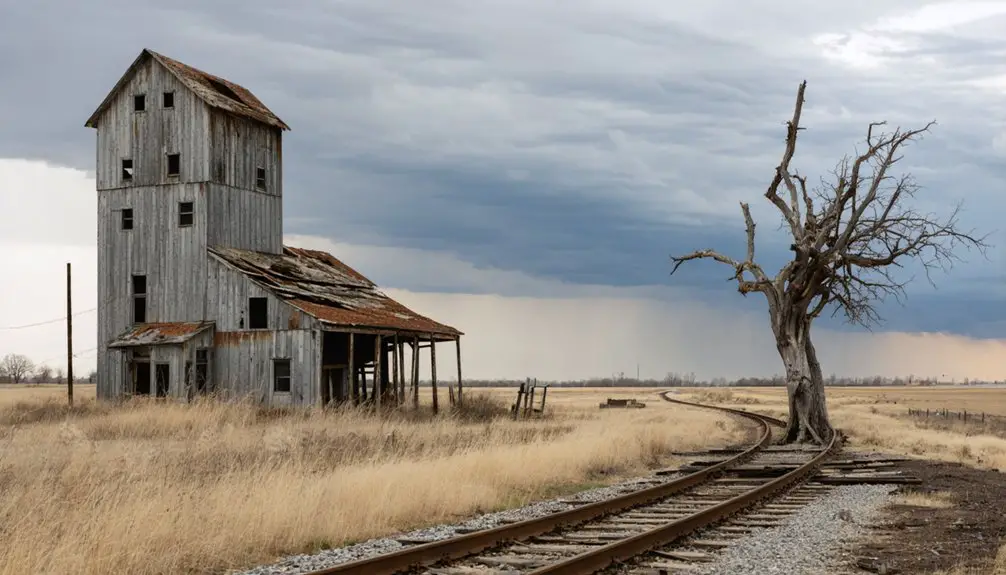
You’ll discover that Minnesota’s most famous ghost towns include Forestville in Fillmore County, which thrived with 150 residents in the 1860s before railroad bypasses led to abandonment, and Elcor near Gilbert, housing nearly 1,000 mining families until the Corsica mine’s 1954 closure forced mass eviction. Other notable sites include Nininger, Ignatius Donnelly’s failed Mississippi River metropolis, and Tazaska, William Russell’s unrealized Lake Minnetonka capital dream. These preserved sites offer fascinating glimpses into Minnesota’s boom-and-bust heritage.
Key Takeaways
- Forestville (1852) reached 150 residents before railroad bypassing led to abandonment; now preserved as living museum by Minnesota Historical Society.
- Nininger was founded in 1856 as planned Mississippi River metropolis with 1,000 residents before 1857 economic panic caused widespread abandonment.
- Elcor housed nearly 1,000 diverse immigrant families by 1920 until Corsica mine closure in 1954 forced complete resident eviction.
- Tazaska was William Russell’s failed 1844 attempt to create a capital on Lake Minnetonka, halted by economic panic.
- Economic factors like the Panic of 1857, mining industry decline, and railroad route changes drove most Minnesota ghost town abandonments.
Forestville: The Town That Time Forgot in Fillmore County
In the summer of 1853, Robert Foster walked from Decorah, Iowa, to stake land claims along Minnesota’s Root River, setting in motion the creation of what would become one of southern Minnesota’s most significant settlements.
You’ll find Forestville history began when first settlers arrived in 1852 after treaties with Dakota people. By the 1860s, you’d have witnessed 150 residents bustling through general stores, sawmills, and hotels.
When railroads bypassed the town in 1868, you’d have watched families abandon their homes for railway towns.
The Meighen family eventually owned everything, operating it as a company town until 1910. Farmers often purchased goods on credit, leading to high-interest loans that increased the Meighens’ control over the community.
The original store owners stocked goods worth $700, which was equivalent to $20,000 today, making it a substantial investment for frontier merchants.
Today’s historical preservation efforts by Minnesota Historical Society let you explore this authentic time capsule at Historic Forestville.
Elcor: Iron Range Mining Community Lost to Progress
While southern Minnesota’s Forestville fell victim to changing transportation patterns, the state’s northern reaches witnessed a different kind of boom and bust cycle on the Iron Range.
You’ll find Elcor’s story near Gilbert in St. Louis County, where mining heritage shaped everything from 1897 onward.
Originally called Elba, this company town housed nearly 1,000 residents by 1920. You’d have found two churches, schools, stores, and diverse immigrants including Croatian, Finnish, and Italian families.
The community resilience was remarkable—workers owned homes while companies controlled land.
When the Corsica mine closed in 1954, residents faced eviction for land reclamation.
By 1956, you’d find nothing but foundations and scattered artifacts. Modern visitors researching this lost community may encounter technical difficulties when accessing historical databases and digital archives about Elcor’s history. Like many Iron Range communities, Elcor was established in the early 1900s as a mining town that thrived until the mining industry declined in the 1950s.
Today, the Minorca mine covers where this thriving community once stood.
Tazaska: The Lake Minnetonka Dream That Vanished
Unlike the Iron Range’s industrial boom towns, Minnesota’s ghost town history includes ambitious lakeside communities that never materialized beyond paper platting.
You’ll find Tazaska’s story buried beneath Orono’s modern lakefront properties, where William Russell envisioned territorial greatness in 1844.
Russell positioned his proposed capital on Lake Minnetonka‘s northwest Crystal Bay shores, platting the settlement in 1855 on an isthmus between Forest Lake and North Arm.
You’d discover this sacred Dakota ground promised prosperity through its strategic waterway location.
However, Tazaska’s legacy crumbled during 1857’s economic panic.
You won’t locate remnants of post offices, schools, or significant infrastructure because sufficient settlers never arrived.
These abandoned dreams vanished completely, leaving only territorial records as evidence of Russell’s failed vision for Minnesota’s political center. Like other Lake Minnetonka settlements including St. Albans and Island City, the community failed to develop into a viable town despite its ambitious planning. Meanwhile, successful towns like Excelsior emerged from the vision of George Bertram who arrived in 1852 seeking prime development land.
Island City: William Russell’s Failed Lakeside Vision
Although William Russell’s territorial capital dreams had crumbled with Tazaska, he wasn’t finished with Minnesota’s lakefront development schemes.
You’ll find Island City represented his renewed attempt at harnessing lakeside allure for profit. Russell established this resort community in the mid-19th century, promoting it as an upscale vacation destination with hotels, docks, and boating facilities designed to rival emerging Midwest getaways. Like many ambitious developments of the era, Island City eventually declined as residents relocated to more established communities, following the pattern of settlements such as Maine Prairie Corners that saw their populations move to Kimball. The community’s fate reflected the broader challenges of early Minnesota settlement, where harsh weather and geographic isolation made sustaining remote developments particularly difficult.
Nininger: Grand Ambitions Near the Twin Cities
You’ll find Nininger’s story begins with Ignatius Donnelly and John Nininger’s ambitious 1856 plan to create Minnesota’s next great metropolis along the Mississippi River, seventeen miles south of St. Paul.
Their utopian vision attracted 1,000 residents through aggressive marketing campaigns that promised a thriving capital city, complete with 3,800 subdivided lots and grand metropolitan aspirations. The community flourished briefly, even hosting Minnesota’s first baseball club meeting in August 1857.
The 1857 financial panic triggered by the Ohio Life and Trust Company bankruptcy devastated the settlement, leading to widespread foreclosures and the abandonment of Donnelly’s dreams.
Today, you can visit the site in Dakota County where only a historical marker stands among farm fields, marking what remains of one of Minnesota’s most notorious speculative failures.
Failed Dreams and Visions
When Ignatius Donnelly and John Nininger formed their partnership in the early 1850s, they envisioned creating nothing less than a great metropolis along the Mississippi River that would rival the Twin Cities.
You’d find their failed aspirations rooted in pure speculation rather than organic industry. They purchased 474 acres in Dakota County, subdividing it into 3,800 lots with dreams of establishing Minnesota’s future capital.
Their visionary failures became apparent when reality struck hard. The Panic of 1857 devastated their finances, forcing residents to flee to established cities like St. Paul and Minneapolis.
Peace in Kansas diverted emigration away from Minnesota, while conflicts with Native Americans deterred potential settlers. Railroad promises never materialized, leaving Nininger isolated and doomed to abandonment.
Modern Day Remnants
Today, you’ll find little evidence of Donnelly and Nininger’s grand metropolitan dreams when you visit the former townsite in Dakota County.
The 474-acre subdivision that once housed 1,000 residents has undergone complete agricultural transformation, with corn stalks and tractor engines replacing bustling streets and ambitious settlers.
You can locate the site roughly four miles northwest of Hastings along the Mississippi River, where a solitary historical marker stands as your primary reminder of this vanished metropolis.
The steady hum of farm machinery dominates where Nininger history once unfolded with such promise.
Ashton: Minnesota’s Mysterious Vanished Settlement
You’ll find Ashton among Minnesota’s most enigmatic ghost towns, where lost historical records create significant gaps in our understanding of this vanished settlement.
The townsite once occupied sections 11 and 12 of Pleasant Hill Township in Winona County before disappearing entirely from the landscape.
When you examine statewide inventories of abandoned communities, Ashton appears alphabetically among Minnesota’s ghost towns, yet its mysterious fate remains largely undocumented compared to better-preserved historical sites.
Lost Historical Records
The scarcity creates a puzzle for historians and ghost town enthusiasts:
- No surviving post office records or business directories
- Absent from extensive Hennepin and Blue Earth County inventories
- Missing population data and economic activity documentation
- Lacks detailed accounts of daily life or community leaders
- Omitted from thorough ghost town surveys with verified facts
This mystery stems from complete erasure without the preservation efforts that saved other abandoned settlements’ stories.
Statewide Inventory Gaps
While extensive surveys have documented Minnesota’s most well-known ghost towns, significant gaps remain in statewide inventories that leave settlements like Ashton shrouded in mystery.
You’ll find Ashton listed alphabetically among hundreds of abandoned sites, yet it lacks specific county designation or geographic coordinates. These inventory inconsistencies reflect broader documentation challenges across Minnesota’s rural landscape.
Unlike preserved sites such as Forestville, Ashton appears only in incomplete rosters without detailed mapping or historical context.
You won’t discover it in popular enumerations of six or eleven famous ghost towns, nor in specialized guides covering mining or military settlements.
The settlement exemplifies Minnesota’s paper towns—grand visions that vanished amid 19th-century economic shifts, leaving behind sparse records that confound modern researchers seeking thorough territorial histories.
Alphabetical Ghost Town
Hidden within sections 11 and 12 of Pleasant Hill Township in Winona County lies Ashton, a completely vanished settlement that exemplifies Minnesota’s forgotten paper towns.
You’ll find no trace of abandoned infrastructure today—this mid-1850s planned community has been entirely reclaimed by swampland and overgrowth.
Ashton’s story reveals how environmental challenges doomed frontier settlements:
- Hillside farming practices caused devastating soil erosion
- Agricultural failure drove residents away by the 1860s
- Lack of railroad access sealed the town’s fate
- Environmental degradation transformed fertile land into marsh
- Complete abandonment left no structures for ghostly legends
You can explore this ghost town site through Winona County’s historical trails, where swampy terrain now marks where families once attempted to build their American dreams on unsuitable land.
The Rise and Fall of Mining Company Towns
When Peter Mitchell explored the rugged terrain around present-day Babbitt in 1870, he discovered what he described as “an iron mountain 12 miles long and 1/2 mile wide,” setting in motion a chain of events that would transform Minnesota’s wilderness into a network of bustling mining company towns.
Company town dynamics shaped every aspect of workers’ lives, from housing to commerce. You’d find three distinct residential patterns: unplatted squatters’ locations, company locations, and model locations.
Company towns controlled every facet of daily life, from where workers slept to where they spent their wages.
Mining community evolution accelerated as corporations like U.S. Steel built complete settlements around their operations. Workers lived in company-controlled homes, shopped at company stores, and often received payment in scrip.
Towns like Marble peaked at 887 residents in 1910, while Silver Bay emerged in the 1950s. When high-grade ore depleted, entire communities vanished, leaving behind Minnesota’s haunting mining ghost towns.
Railroad Bypasses That Sealed Towns’ Fates

You’ll find that railroad bypasses devastated Minnesota settlements more decisively than any other single factor in the late 1800s.
When the Southern Minnesota Railroad routed north through Wykoff and Spring Valley in 1868, it sealed Forestville’s fate—the town’s population plummeted from over 150 residents in 1860 to just 68 by 1870.
Transportation route changes didn’t just reduce commerce; they shifted entire regional economies away from established communities, leaving once-thriving towns to wither as trade flowed along new rail corridors.
Forestville’s Railroad Decline
Key factors in Forestville’s demise:
- Loss of competitive shipping rates for agricultural products
- Merchant exodus to railroad towns with better market access
- Declining stagecoach traffic reducing transient customers
- Increased credit defaults leading to land consolidation
- Weakening civic institutions as population dwindled
Transportation Route Changes
While Forestville’s decline illustrates how losing railroad access devastated established communities, dozens of other Minnesota settlements met similar fates when rail lines bypassed them entirely.
You’ll find Vicksburg in southwestern Minnesota exemplifies this transportation impact—it flourished briefly before the railroad’s late 19th-century bypass strangled its growth.
Pomme de Terre, one of Minnesota’s earliest settlements, couldn’t survive when rails favored other locations.
Old Wadena thrived as a river trading post until railroad bypass eliminated its essential role.
In Kittson County, Pelan’s citizens abandoned their 1887 homestead community when the 1907 railroad passed miles away.
Helvetia’s ghost town evolution accelerated when the 1886 rail bypass created a competing community just one mile south.
Economic Panics and Their Impact on Early Settlements
Throughout Minnesota’s early development, a series of devastating economic panics repeatedly shattered the dreams of hopeful settlers and transformed thriving communities into abandoned ghost towns.
You’ll discover how these financial catastrophes disrupted settlement cycles and tested Minnesota’s economic resilience. The Panic of 1857 drove land prices to unsustainable levels before values plummeted, reducing immigration to just 2,157 newcomers from 1858-1860.
The 1873 crisis devastated labor unions and created widespread unemployment. The 1893 panic halted mining operations and caused 15,242 business failures. The Great Depression proved most destructive, with unemployment reaching 33% nationally and nearly 20% of Minnesota workers jobless by 1930.
- Agricultural prices fell 40% after 1870, crushing farming communities
- Farmer gross income dropped 65% between 1918-1932
- Stock market lost $74 billion by 1932
- Bank closures wiped out settlers’ life savings
- Reduced railroad investment isolated remote settlements
Preserving the Memory of Minnesota’s Lost Communities

Despite the complete abandonment of Minnesota’s ghost towns, dedicated preservation efforts guarantee these lost communities remain accessible to future generations.
You’ll find Forestville’s cultural significance preserved through the Minnesota Historical Society‘s restoration of 1890s structures, including Meighen General Store and family residence. Thomas Meighen’s 1936 donation created this living museum where you can explore stocked general stores and period buildings.
Historical markers document community legacies across multiple sites. You’ll discover Nininger’s town history through dedicated markers, while Goodhue County Historical Society installs signs at ghost town locations.
Archaeological documentation preserves Upper Post Flats through controlled excavations and interpretive panels. The Minnesota Valley National Wildlife Refuge protects Carver Rapids since 1976, emphasizing both ecological and cultural stories for future exploration.
Frequently Asked Questions
Are There Any Remaining Artifacts or Structures Visitors Can See Today?
You’ll discover absolutely stunning architectural remnants throughout these sites! Forestville’s preserved 1852 buildings showcase remarkable historical significance, while Elcor’s industrial foundations and Wasioja’s seminary ruins offer tangible connections to Minnesota’s past.
How Many Total Ghost Towns Exist Throughout Minnesota?
You’ll find over 100 ghost towns scattered across Minnesota, though exact ghost town statistics remain elusive due to incomplete records. Their historical significance reflects mining booms, logging operations, and economic shifts that shaped the state’s development.
Among these, visitors can explore the best ghost towns in Minnesota, each offering a glimpse into the past with crumbling structures and haunting tales. Many of these sites are accessible for hiking and photography, making them popular among history buffs and adventurers alike. As you wander through their remnants, you can imagine the once-thriving communities that existed before they were abandoned.
In addition to exploring these historic sites, there are often local events themed around ghost towns in Minnesota events that celebrate the unique stories of these abandoned places. Community gatherings, guided tours, and seasonal festivals provide a chance for visitors to engage deeper with the history and folklore. These events are perfect for both locals and tourists looking to connect with the past in a vibrant and immersive way.
Can You Visit These Ghost Town Sites Safely and Legally?
You can safely visit Minnesota’s ghost town sites legally through state parks and public lands. Follow marked trails, respect safety regulations, and obtain required permits. Most sites offer maintained access with minimal restrictions for exploration.
What Happened to the Residents When These Towns Were Abandoned?
Ironically, you’ll find residents didn’t vanish—they migrated following predictable economic decline patterns. Families relocated to railroad towns, reservation lands, or mining areas, adapting to survive Minnesota’s shifting economic landscape rather than disappearing mysteriously.
Are There Any Ghost Towns in Minnesota That Were Successfully Revived?
You won’t find many successful revivals among Minnesota’s ghost towns. Most town transformations involve partial preservation like Forestville’s living history site or Whalan’s trail stop, rather than full residential and commercial restoration.
References
- https://en.wikipedia.org/wiki/List_of_ghost_towns_in_Minnesota
- https://www.carvercountyhistoricalsociety.org/ghost_towns.php
- https://www.minnesotahistory.org/post/a-complete-guide-to-the-ghost-towns-of-hennepin-county
- https://quickcountry.com/minnesotas-abandoned-ghost-towns/
- https://kroc.com/9-strange-ghost-towns-within-100-miles-of-rochester-minnesota/
- https://www.youtube.com/watch?v=btvFiKT3Quw
- https://www.youtube.com/watch?v=5bCG6B2rzZY
- https://www.mngoodage.com/voices/mn-history/2019/07/a-ghost-town-turned-history-site/
- https://www.cbsnews.com/minnesota/news/forestville-southern-minnesota-ghost-town-still-attracting-summer-visitors/
- https://www.mnhs.org/forestville/learn/site