You’ll discover Missouri’s most famous ghost towns along the abandoned Route 66 corridor, where Arlington’s historic resort buildings stand empty since 2008, and Times Beach became a Superfund site after dioxin contamination forced 2,000 residents to evacuate in 1985. Avilla’s storefronts recall its highway heyday, while Halltown’s antique shops occupy former gas stations. Hamburg disappeared entirely when the government seized it for wartime production during WWII. These abandoned communities reveal fascinating stories of America’s industrial transformation.
Key Takeaways
- Arlington flourished as a railroad resort and Route 66 destination before declining after Interstate 44 construction in 1965.
- Times Beach was completely evacuated in 1985 due to severe dioxin contamination and is now Route 66 State Park.
- Halltown transformed from a thriving Route 66 stop into Missouri’s “antique capital” along the famous Ghost Town Stretch.
- Hamburg was razed by the federal government during World War II to establish Weldon Spring Ordnance Works.
- Burfordville evolved from a bustling mill town to just 87 residents, preserving Missouri’s oldest covered bridge from 1868.
Arlington: A True Vintage Route 66 Ghost Town
Arlington stands as one of Missouri’s most authentic Route 66 ghost towns, where you’ll discover the remnants of a community that thrived for nearly a century before Interstate 44 sealed its fate.
Established in 1867 by Thomas Harrison near Little Piney River, the town initially flourished as a railroad resort destination. When Route 66 arrived in 1926, Arlington boomed with thriving businesses like Stony Dell Resort, John’s Modern Cabins, and Vernell’s Motel.
The Highway’s Route 66 Legacy brought prosperity until the 1950s, when road widening bypassed the town completely. Interstate 44’s 1965 construction delivered the final blow, closing the post office and devastating local businesses. The last business finally closed its doors in 2008, marking the complete end of commercial activity in Arlington.
Today, Historic Preservation efforts can’t reverse decades of decay, but you’ll find compelling ghost town views along the dead-end remnant of original Route 66. Several historic buildings, including the old Arlington Hotel, remain as landmarks that preserve pieces of the town’s storied past.
Times Beach: From Thriving Community to Superfund Site
You’ll find Times Beach‘s transformation from a modest Route 66 community to America’s most notorious environmental disaster began in the 1970s when a waste hauler unknowingly spread dioxin-contaminated oil on the town’s roads.
The 1982 discovery of contamination levels 300 times above safe limits, combined with devastating floods, forced the complete evacuation of over 2,000 residents by 1985. The government implemented a $32 million buyout to relocate all residents from what became the largest civilian exposure to dioxin in U.S. history. The town originally started in 1925 as a seasonal resort promoted through a St. Louis Times newspaper subscription offer.
Today, you can visit the site as Route 66 State Park, where the former town lies buried beneath what locals call the “town mound.”
Dioxin Contamination Crisis
When Russell Bliss began spraying what he believed was waste oil on Times Beach‘s unpaved roads in 1972, neither he nor the town’s residents knew they were releasing one of America’s most devastating environmental disasters.
The mixture unknowingly contained dioxin from NEPACCO’s Agent Orange production, creating widespread dioxin exposure throughout the community.
You’d witness the environmental impact immediately at a horse arena in 1971, where animals began dying after spraying.
By 1979, the CDC launched investigations following horse owners’ complaints.
When the Meramec River flooded in December 1982, it spread contamination throughout Times Beach, reaching levels 300 times the CDC’s safe limit.
The EPA discovered dioxin concentrations between 100-300 parts per billion, making this the largest civilian dioxin exposure in U.S. history. The entire town was evacuated in 1985 due to the severe health risks posed by the contamination.
The cleanup involved a temporary incinerator that treated over 265,000 tons of contaminated materials by 1996.
Route 66 Park
The environmental catastrophe that devastated Times Beach marked the end of a community with deep roots along America’s most famous highway.
You’ll find that Missouri transformed this contaminated site into Route 66 State Park, opening September 11, 1999, on 409 acres where the town once stood.
The state’s commitment to Historic Preservation guarantees visitors can explore the highway’s legacy through interpretive displays and the restored Bridgehead Inn, now serving as the park’s visitors center.
You can walk trails where families once lived, launch boats on the Meramec River, and experience the Route 66 corridor that shaped this community’s destiny. The cleanup effort included processing over 265,000 tons of dioxin-contaminated material through an on-site incinerator at a cost of $200 million.
The contamination originated from oil mixed with chemical waste that was sprayed on the town’s roads, creating one of America’s most notorious environmental disasters.
The EPA declared the site safe in 2001, allowing you to safely explore this remarkable transformation from ghost town to memorial park.
Avilla: The Capitol 66 Ghost Town Experience
Along Missouri’s historic Route 66 corridor in Jasper County, Avilla stands as one of the state’s most haunting examples of American highway decline.
You’ll discover a town founded in 1856 that survived Civil War guerrilla attacks, only to face modern economic devastation. The railway’s bypass stunted early growth, while Interstate 44’s construction in the 1960s delivered the final blow to Route 66-dependent businesses.
Walking Avilla’s empty streets, you’ll witness abandoned storefronts from its highway heyday, when Bernie’s Bar & Grill served travelers. The town shares its name with multiple geographical locations across the United States, making it part of a broader pattern of American settlement naming.
Today’s crumbling facades and boarded windows tell the story of a once-thriving stop that time forgot.
Historical preservation efforts can’t compete with reports of ghostly encounters, including the legendary “Avilla Phantom Bushwhacker”—a headless Confederate specter tied to the infamous “Death Tree” where a guerrilla’s skull once hung as warning. Visitors often share paranormal experiences through online platforms, contributing to the collective understanding of this haunted location.
Halltown: Where Yesterday Meets Today
You’ll find Halltown clinging to the old Route 66 path, where antique shops now occupy the historic buildings that once housed thriving businesses during the highway’s heyday.
The town’s population peaked at 168 residents in 1946 before Interstate 44’s bypass in the early 1960s triggered a steady decline that sent young people away for opportunities elsewhere.
This quiet community represents a key stop along southwest Missouri’s “Ghost Town Stretch,” where collectors and Route 66 enthusiasts can step between two worlds on streets that blend a frozen past with an uncertain present.
Antique Shops and Signage
Weathered storefronts and vintage signage tell Halltown’s remarkable transformation from bustling Route 66 stopover to Missouri’s self-proclaimed “Antique Capital of the World.”
George Hall’s first store in 1876 sparked the settlement that would bear his name, but it wasn’t until Route 66’s arrival in the 1920s that Halltown truly flourished. By 1925, nine service stations and three general stores served travelers along the famous highway.
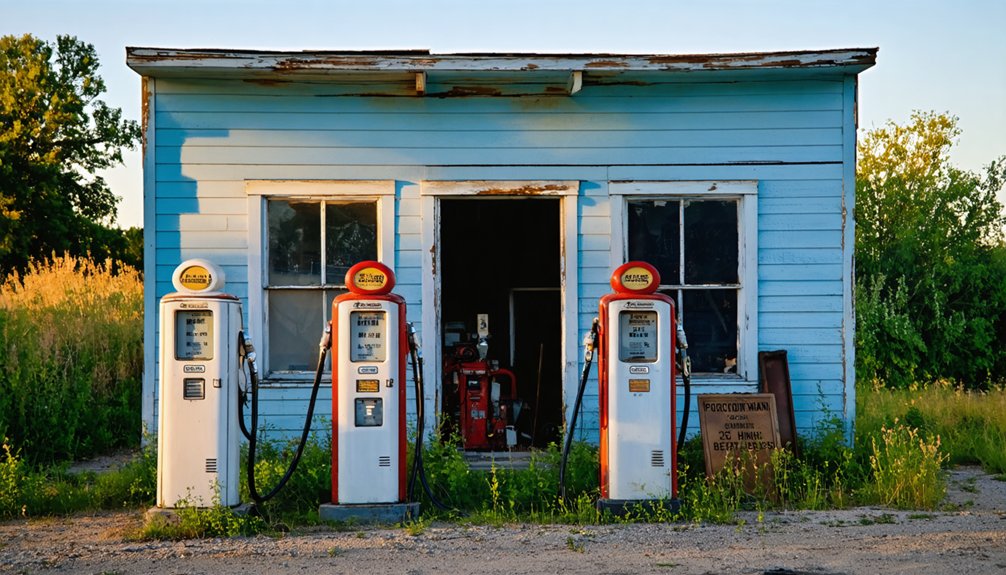
When I-44 bypassed the town in the early 1960s, enterprising locals repurposed those same commercial buildings into antique shops. Today, you’ll discover faded antique signage marking former gas stations and general stores now filled with vintage decor.
The slogan “Where Yesterday Meets Today” perfectly captures how these preserved storefronts bridge past and present for Route 66 enthusiasts.
Post-War Population Decline
When Interstate 44 replaced Route 66 in the early 1960s, Halltown’s transformation from “Little Chicago” to quiet village became inevitable.
You’ll find that population migration accelerated as young residents departed for educational opportunities and employment elsewhere.
The 1961 realignment between Spencer and Paris Springs signaled the beginning of economic shifts that’d devastate local commerce.
Southwest Missouri Ghost Stretch
Among Southwest Missouri’s forgotten stretches of old Route 66, Halltown stands as perhaps the most poignant example of how America’s Mother Road could transform a community twice—first lifting it to prosperity, then abandoning it to near-obscurity.
When I-44 bypassed Halltown’s business district in the early 1960s, it joined neighboring towns like Plano, Spencer, and Avilla in Missouri’s infamous “Ghost Stretch.”
You’ll find this Route 66 heritage preserved in repurposed antique shops that now occupy buildings from Halltown’s 1920s boom. The urban decay tells a familiar story—nine service stations reduced to memories, three general stores shuttered.
Here’s what makes Halltown unique today:
- Antique Capital transformation – Old buildings house collectors’ treasures
- Route 66 enthusiast destination – Draws nostalgic travelers seeking authentic history
- Frozen-in-time atmosphere – Streets evoke stepping between past and present
Hamburg: Lost to War Production Efforts
During World War II‘s urgent production demands, the federal government seized the town of Hamburg in St. Charles County, Missouri. Between 1940 and 1941, you’ll find this represents one of America’s most dramatic examples of wartime displacement.
The government razed Hamburg completely to establish the Weldon Spring Ordnance Works for explosive production. Residents faced forced relocation as federal authorities terminated their community entirely.
Hamburg history reveals how three towns—Hamburg, Howell, and Toonerville—vanished simultaneously for the war effort. The site later hosted uranium processing operations, creating radioactive contamination around Hamburg Quarry.
Today, you can explore these historical remnants via the eight-mile Hamburg Trail connecting to Katy Trail. The area now serves conservation purposes while preserving this sobering reminder of government overreach during wartime.
Burfordville: Industrial History Along the Mill Trail
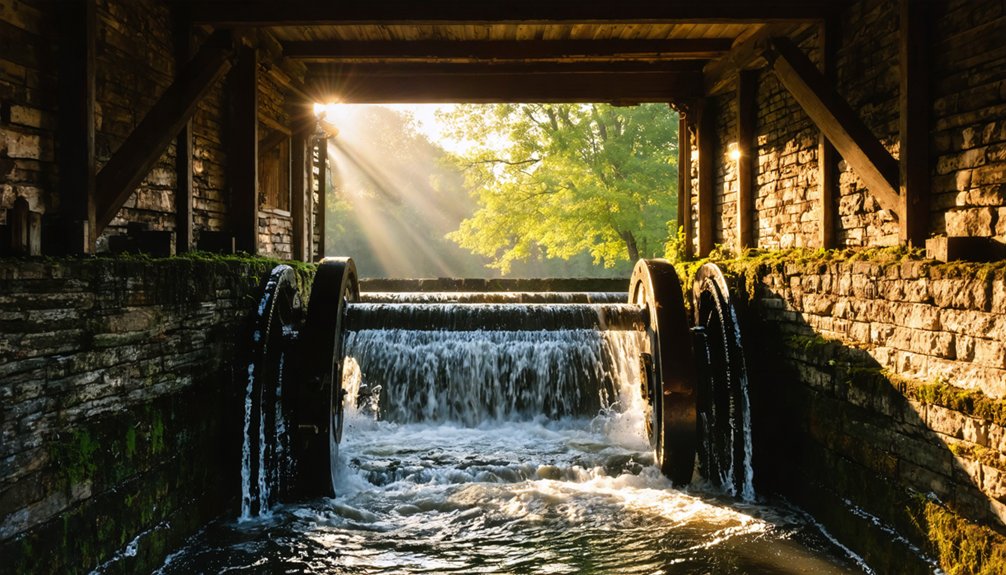
Unlike many Missouri settlements that emerged during American expansion, Burfordville traces its origins to 1797 when George Frederick Bollinger, a Swiss-German immigrant, discovered this promising site along the Whitewater River under Spanish territorial control.
You’ll find that Bollinger Mill became the community’s cornerstone, operating before the Civil War and preserving Missouri’s early industrial heritage through multiple reconstructions throughout the 1800s.
The historic Covered Bridge, begun in 1858 but delayed by war, stands as Missouri’s oldest surviving covered bridge since its 1868 completion.
Key Historical Features:
- Bollinger Mill – Pre-Civil War gristmill donated to Missouri State Parks in 1967
- Covered Bridge – 1868 construction, restored after 1986 flood damage
- Population Evolution – From bustling mill town to current 87 residents
Both landmarks earned National Register recognition.
Hidden Gems Along Missouri’s Abandoned Highway Corridors
While mill towns like Burfordville declined due to industrial changes, Missouri’s ghost towns along abandoned highway corridors tell a different story of twentieth-century progress literally passing communities by.
When Route 66 opened in 1926, towns like Halltown, Spencer, and Avilla thrived along the Springfield-to-Carthage corridor. You’ll discover hidden treasures in these forgotten routes that once bustled with cross-country travelers.
The 1961 Interstate-44 realignment devastated these communities. Spencer’s restored buildings now serve tourists, while Plano survives with just two pre-Route 66 structures.
Arlington sits abandoned by the river, and Times Beach exists only as a visitor center. You can explore these forgotten routes where dozen towns became ghost towns, their remnants highlighting how highway realignments erased entire communities within decades.
Preservation Efforts and Modern-Day Ghost Town Tourism
Across Missouri, preservation efforts have transformed several ghost towns from forgotten ruins into carefully maintained historical sites that attract thousands of visitors annually.
Missouri’s forgotten ghost towns now stand as vibrant historical destinations, welcoming thousands through dedicated preservation efforts.
You’ll find dedicated volunteers restoring buildings at Quindora Townsite near Kansas City, where this Underground Railroad stop once housed 600 residents. The State Historic Preservation Office, operating under the National Historic Preservation Act of 1966, coordinates these preservation initiatives statewide through their “Our Sense of Place” plan.
Ghost town tourism thrives through these coordinated efforts:
- Arrow Rock and Ste. Genevieve earned National Trust Distinctive Destination recognition, drawing heritage tourists.
- Certified Local Governments secure federal grants for educational programs and property rehabilitation.
- Missouri Preservation advocacy programs host annual conferences highlighting endangered sites through Places in Peril nominations.
You can explore these preserved communities that showcase Missouri’s rich cultural heritage.
Frequently Asked Questions
Are There Any Other Ghost Towns in Missouri Besides These Six?
You’ll find additional ghost towns beyond those six, including lesser known sites like Almartha, Bacon, Calvey, and Chaonia. Missouri’s vast rural landscape contains dozens more abandoned settlements from various historical periods.
As you explore Missouri’s abandoned towns, you’ll come across intriguing stories of the past and fascinating architecture lost to time. Each site holds remnants of its former community, inviting you to imagine the lives once lived there. From crumbling facades to overgrown roads, these forgotten places offer a unique glimpse into the state’s rich history.
What Safety Precautions Should Visitors Take When Exploring These Abandoned Areas?
You’ll need proper safety gear including masks and protective clothing when entering abandoned structures. Maintain wildlife awareness since animals often inhabit vacant buildings. Always check for structural damage and toxic contamination before exploring.
Can You Legally Metal Detect or Collect Artifacts in Missouri Ghost Towns?
Metal detecting’s absolutely forbidden in Missouri’s ghost towns on public land due to strict artifact preservation laws. You’ll face felony charges for removing historical items. Private ghost towns require landowner permission, but metal detecting regulations still apply.
Which Ghost Towns Offer the Best Photography Opportunities for Urban Explorers?
You’ll find exceptional urban exploration photography opportunities at Far West’s atmospheric foundations, Pink Hill’s colorful contrast ruins, Jordan’s intimate decay details, and Plano’s limestone structures. These photography tips maximize your creative documentation potential.
Are There Guided Tours Available for Missouri’s Most Famous Ghost Towns?
You’ll find guided tour options scarce as tumbleweeds—Missouri’s famous ghost towns like Arlington and Phenix lack commercial tours due to their historical significance as self-guided exploration sites on private or restricted lands.
References
- https://en.wikipedia.org/wiki/List_of_ghost_towns_in_Missouri
- https://www.legendsofamerica.com/mo-ghosttowns/
- https://www.visitmo.com/articles/missouris-most-haunted-places
- https://www.geotab.com/ghost-towns/
- https://www.youtube.com/playlist?list=PL4jqwLUrhjNScUWj03mXzSKyBNMNqZHGw
- https://www.youtube.com/watch?v=ApiGf0lxnSo
- https://www.ghosttowns.com/states/mo/mo.html
- https://abandonedmo.com
- https://www.onlyinyourstate.com/state-pride/missouri/vacant-ghost-town-arlington-rural-mo
- https://www.legendsofamerica.com/arlington-road-missouri/